The Ultimate Guide to Software Development Pricing Models in 2026
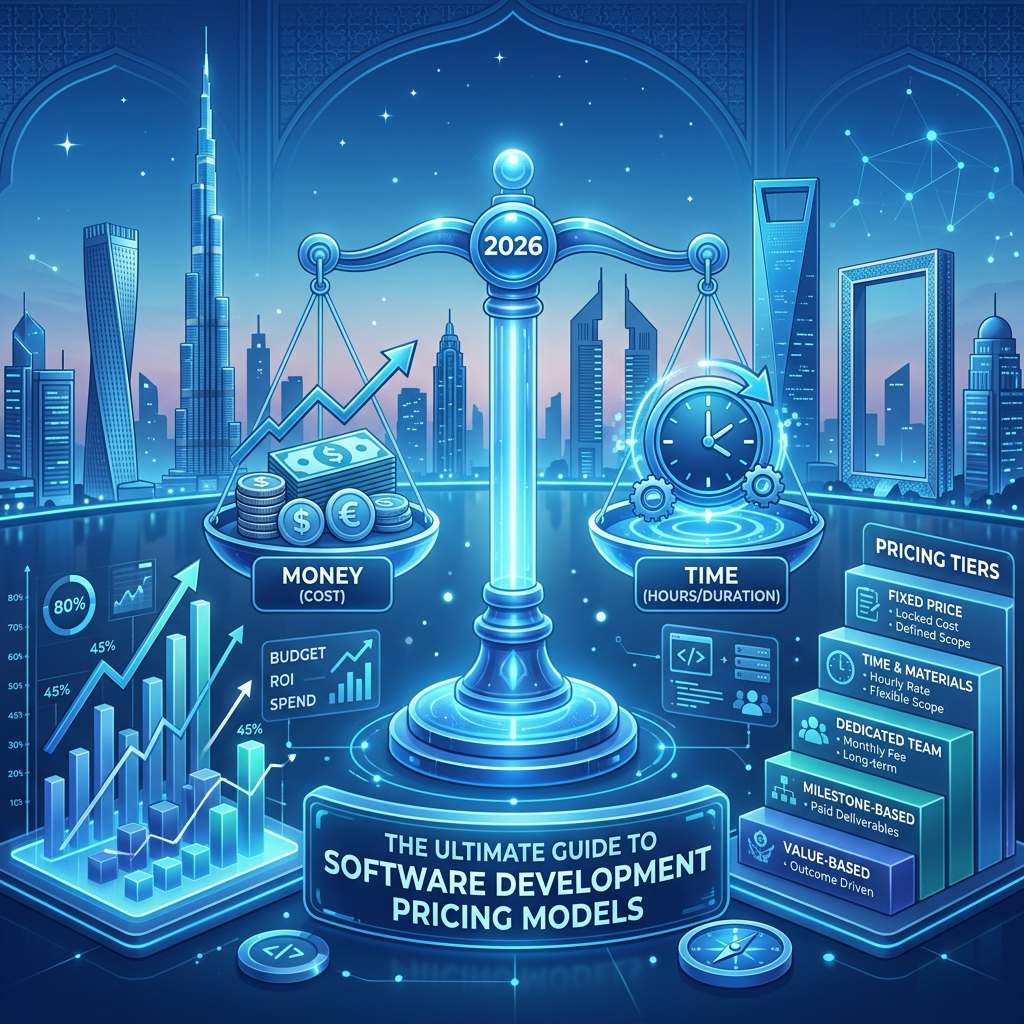
Choosing the right pricing model for your custom software development project is arguably as critical as choosing the right tech stack. In 2026, software projects have become increasingly complex, integrating AI, large-scale data pipelines, and multi-platform support. A rigid pricing model on a highly dynamic project is a recipe for scope creep, budget overruns, and strained vendor relationships. Conversely, too much flexibility without proper oversight can lead to runaway budgets.
This exhaustive guide breaks down the dominant pricing models in the software industry today: Fixed Price, Time & Materials (T&M), the Dedicated Team model, and hybrid approaches. We will explore exactly when to use each, their financial pros and cons, and how to navigate the risks associated with custom software builds in Dubai and globally.
The Engagement Lifecycle: Predictability vs. Time
Before diving into the exact pricing structures, it is essential to understand how project predictability changes over time. The further you are into a project, the clearer the scope becomes. This is why many agencies push for a paid discovery phase before committing to a fixed price.
(Low Predictability)"] --> B["Discovery Phase
(Medium Predictability)"] B --> C["Design & Prototyping
(High Predictability)"] C --> D["Development & MVP
(Very High Predictability)"] D --> E["Scale & Maintenance
(Continuous Evolution)"] style A fill:#f8fafc,stroke:#cbd5e1,stroke-width:2px style B fill:#f1f5f9,stroke:#94a3b8,stroke-width:2px style C fill:#e0f2fe,stroke:#38bdf8,stroke-width:2px style D fill:#bae6fd,stroke:#0ea5e9,stroke-width:2px style E fill:#dcfce7,stroke:#22c55e,stroke-width:2px
Deep Dive: The Core Pricing Models
1. Fixed Price Model (Fixed Bid)
The Fixed Price model guarantees a specific scope of work, delivered by a specific date, for an exact amount of money. This model requires an exhaustive Discovery Phase where every single feature, screen, API endpoint, and business rule is documented in a Software Requirements Specification (SRS).
How it works: The agency estimates the effort required based on the SRS, adds a risk buffer (typically 15% to 30%), and provides a final number. Payments are usually tied to specific milestones (e.g., 20% upfront, 30% upon design approval, 30% upon beta release, 20% on final launch).
- Best For: Small, highly predictable projects (like a simple marketing app, a landing page, or a proof-of-concept MVP) where the requirements are crystal clear and unlikely to change.
- Pros: Strict budget control, clear deliverables, predictable timeline. The financial risk lies mostly with the development agency.
- Cons: Extremely inflexible. Any changes, new ideas, or pivots mid-project require tedious Change Requests (CRs), renegotiation, and extra costs. It also incentivizes the agency to cut corners to protect their margins if they underestimated the effort.
2. Time & Materials (T&M)
Under T&M, you pay for the actual hours worked by the development team, plus any material costs (like third-party licenses or cloud infrastructure). It operates seamlessly with Agile methodologies, allowing the scope to evolve based on market feedback or shifting business priorities.
How it works: You receive an estimated range (e.g., 400-500 hours) but you are billed at a blended hourly rate (or individual role rates) on a weekly or monthly basis. You review timesheets and progress reports regularly.
- Best For: Medium to large projects, complex software, startups finding product-market fit, and projects where the full scope cannot be detailed upfront.
- Pros: High flexibility. You can pivot instantly, drop unnecessary features, or add new ones without renegotiating a contract. You only pay for the work actually done.
- Cons: The final budget is variable and not guaranteed. It requires a high level of trust, transparency, and ongoing communication with your development partner to ensure efficiency.
3. Dedicated Team Model (Team Augmentation)
The Dedicated Team model involves hiring an outsourced team of developers, QA engineers, designers, and project managers who work exclusively on your projects. They act as a seamless extension of your in-house staff.
How it works: You pay a flat monthly fee per team member (e.g., AED 15,000/month for a Senior Frontend Developer). The agency handles HR, payroll, benefits, hardware, and office space.
- Best For: Long-term projects, enterprise software, continuous product development, and companies looking to scale their engineering capacity quickly without dealing with local HR and recruitment overhead.
- Pros: Complete control over the team's workload and daily priorities. Deep integration into your company culture and domain knowledge retention. Flexibility to scale the team size up or down with standard notice periods.
- Cons: Requires you to have strong internal technical or product leadership (like a CTO or Product Owner) to guide the team on a daily basis and ensure productivity.
How to Choose the Right Model: A Decision Framework
Selecting the right model doesn't have to be guesswork. Follow this flowchart to determine the best approach for your specific scenario:
100% defined and documented?"} Q1 -- "Yes, completely clear" --> Q2{"Is the project
expected to take
less than 3 months?"} Q1 -- "No, they will evolve" --> Q3{"Do you have an
internal technical leader
(CTO/Product Manager)?"} Q2 -- "Yes" --> Model1[/"Fixed Price Model"/] Q2 -- "No, it's a long-term build" --> Q3 Q3 -- "No, I need the agency
to manage the project" --> Model2[/"Time & Materials (T&M)"/] Q3 -- "Yes, I want to manage
the developers directly" --> Model3[/"Dedicated Team Model"/] style Start fill:#f3f4f6,stroke:#6b7280 style Q1 fill:#e0e7ff,stroke:#6366f1 style Q2 fill:#e0e7ff,stroke:#6366f1 style Q3 fill:#e0e7ff,stroke:#6366f1 style Model1 fill:#dcfce7,stroke:#22c55e,stroke-width:2px style Model2 fill:#fef08a,stroke:#eab308,stroke-width:2px style Model3 fill:#bfdbfe,stroke:#3b82f6,stroke-width:2px
Comparing Cash Flow & Burn Rates
How you pay is just as important as what you pay. Understanding the cash flow implications of each model is critical for startups and established enterprises alike.
Bar: Fixed Price (Milestone bursts) | Line 1: T&M (Variable based on hours) | Line 2: Dedicated Team (Flat predictable rate)
Detailed Comparison Matrix
Here is a side-by-side technical and operational comparison of how these three models stack up across critical project factors in 2026:
| Project Factor | Fixed Price | Time & Materials | Dedicated Team |
|---|---|---|---|
| Scope Flexibility | Extremely Low. Requires Change Requests and contract renegotiation. | Very High. Scope can be reprioritized every sprint. | Complete Flexibility. You direct the team's daily tasks. |
| Budget Predictability | Guaranteed (assuming no scope changes). | Variable. Can increase if requirements expand. | Highly Predictable. Fixed monthly burn rate per developer. |
| Risk Distribution | Agency bears the risk of underestimation. | Client bears the risk of prolonged timelines. | Shared. Client manages productivity, agency provides talent. |
| Client Involvement Needed | Low. Heavy involvement upfront, minimal during development. | High. Continuous feedback, sprint planning, and reviews required. | Very High. Daily management, standups, and direct technical leadership. |
| Speed to Kickoff | Slow. Requires exhaustive documentation and estimation phases. | Fast. Can start coding within days after general alignment. | Medium. Requires time to interview and assemble the right talent. |
| Ideal Project Length | 1 to 3 Months | 3 to 9 Months | 9+ Months (Long-term continuous development) |
The Hybrid Approach: Fixed Budget, Agile Scope
What happens when a startup has a strict, unchangeable budget (e.g., $50,000 from a seed round) but knows their requirements will evolve? The modern solution in 2026 is the Fixed Budget, Agile Scope model.
In this scenario, the budget is capped at $50,000. The agency and the client agree to work in Agile sprints using a T&M model until the budget is exhausted. The client ruthlessly prioritizes the backlog every week to ensure the most critical features are built first. If the budget runs out, lower-priority features are dropped, but a functional, tested product is guaranteed to be delivered within the financial constraints.
Conclusion
There is no universally "best" pricing model—only the best model for your specific stage, budget, and internal capabilities. If you demand absolute certainty over cost and are willing to freeze your requirements, Fixed Price offers peace of mind. If you are building a complex product that must adapt to market realities, Time & Materials offers the necessary agility. And if you are scaling a tech company and need to expand your engineering bandwidth rapidly, the Dedicated Team model provides unparalleled control and cultural integration.
At Triostack, we consult with you during the initial discovery phase to recommend the engagement model that protects your budget while maximizing the quality of the final software product.
Triostack Editorial Team
Technology Evangelist & Writer
Triostack Editorial Team is an experienced writer and technologist, exploring the intersections of AI, cloud architecture, and modern application development. Passionate about turning complex technical concepts into accessible insights.