AI Agents in 2026: How Businesses Are Automating Workflows End-to-End
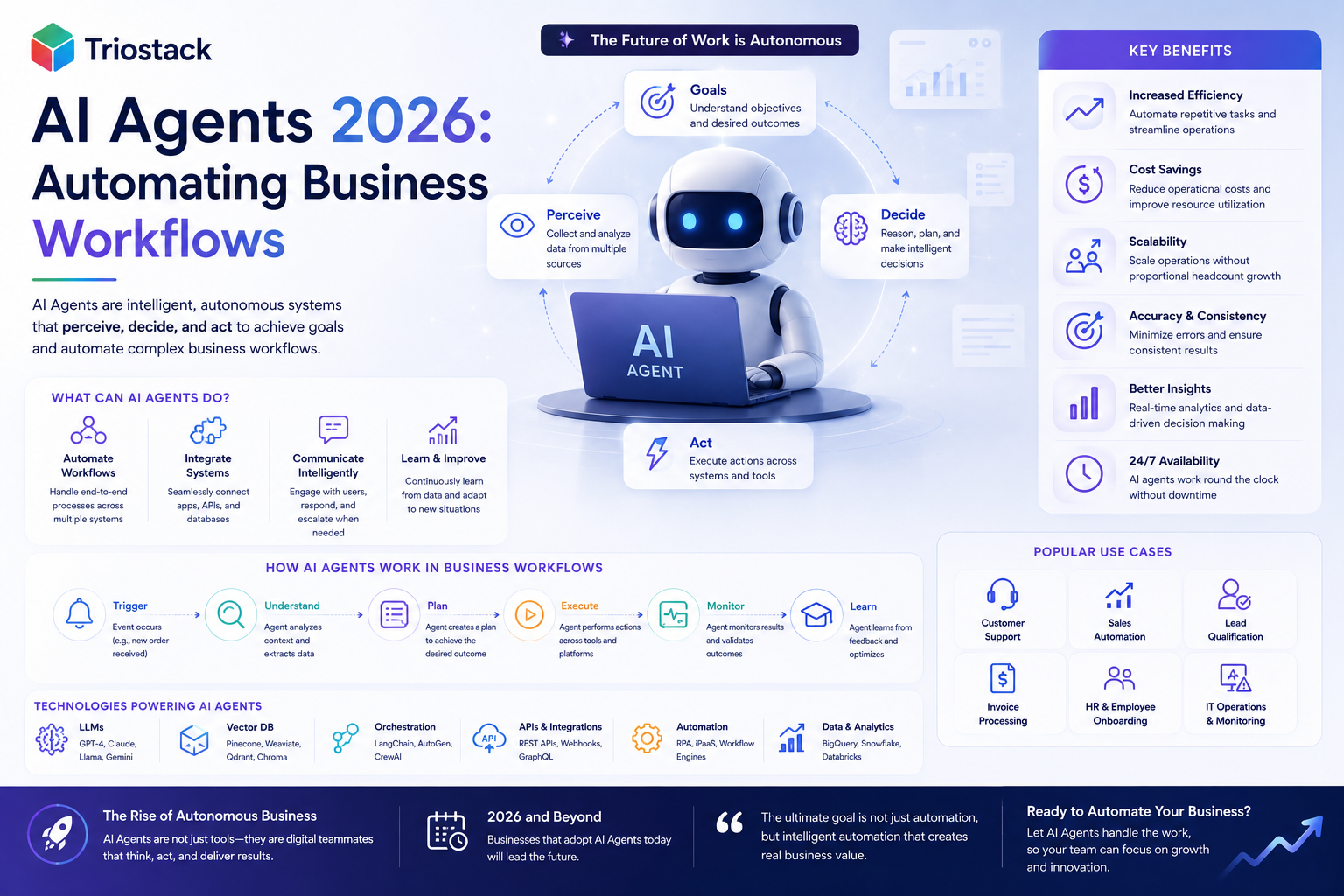
Chatbots answered questions. AI agents get work done. That distinction defines the shift happening across business software in 2026 — instead of a single request-response interaction, AI agents plan, use tools, and carry out multi-step tasks on a person's behalf, checking in only when a decision genuinely needs human judgment.
What Makes AI Agents Different From Traditional Automation
Traditional automation follows a fixed, pre-programmed sequence of steps and breaks when the input doesn't match what was expected. AI agents reason about the task, adapt their approach when something unexpected happens, and can call different tools or APIs depending on the situation — closer to how a capable employee would handle a variable task than how a rigid script would.
Where AI Agents Are Delivering Real Business Value
Customer Support
Agents can look up order history, issue refunds within policy limits, and escalate only the cases that genuinely need a human, cutting resolution time for routine requests dramatically.
Sales & CRM Operations
Agents can enrich lead data, draft personalized outreach, update CRM records, and schedule follow-ups automatically, freeing sales teams to focus on conversations rather than data entry.
Internal Operations & IT
Provisioning access, resetting credentials, and routing internal tickets to the right team are exactly the kind of multi-step, rules-based work agents can now handle with minimal supervision.
Data Analysis & Reporting
Agents can pull data from multiple systems, reconcile it, and produce a first-draft report or dashboard update, cutting the manual assembly work analysts previously did by hand.
How to Design a Reliable AI Agent Workflow
- Give the agent a narrow, well-defined scope of tools and permissions rather than open-ended access to every system.
- Build in explicit checkpoints where the agent must pause for human approval on high-impact actions.
- Log every decision and tool call so failures can be audited and root-caused.
- Start with a single workflow, measure accuracy and time saved, and expand only after it's proven reliable.
Risks and Guardrails to Consider
The biggest risk with AI agents isn't a dramatic failure — it's quiet, confident mistakes that go unnoticed because the agent completed the task without obviously breaking anything. Guardrails like permission scoping, approval checkpoints for irreversible actions, and regular audits of agent decisions are what separate a genuinely useful deployment from a liability.
Conclusion
AI agents represent a real shift in how work gets done, but they reward teams that deploy them deliberately: narrow scope first, clear guardrails, and expansion based on measured results rather than hype. Businesses that treat agent design with the same rigor as any other production system will get the most durable value from it.
Frequently Asked Questions
Are AI agents the same as chatbots?
No — chatbots typically respond to a single query, while AI agents can plan and execute multi-step tasks across tools and systems with limited human input.
What is the safest way to start deploying AI agents in a business?
Start with a single, well-scoped workflow that has clear approval checkpoints for high-impact actions, then expand once it's proven reliable in production.
Do AI agents replace the need for human oversight?
No — reliable agent deployments still include human checkpoints for irreversible or high-impact decisions, along with regular audits of agent behavior.

Triostack Editorial Team
Technology Evangelist & Writer
Triostack Editorial Team is an experienced writer and technologist, exploring the intersections of AI, cloud architecture, and modern application development. Passionate about turning complex technical concepts into accessible insights.