Electric Vehicle Software Development - A Comprehensive Guide
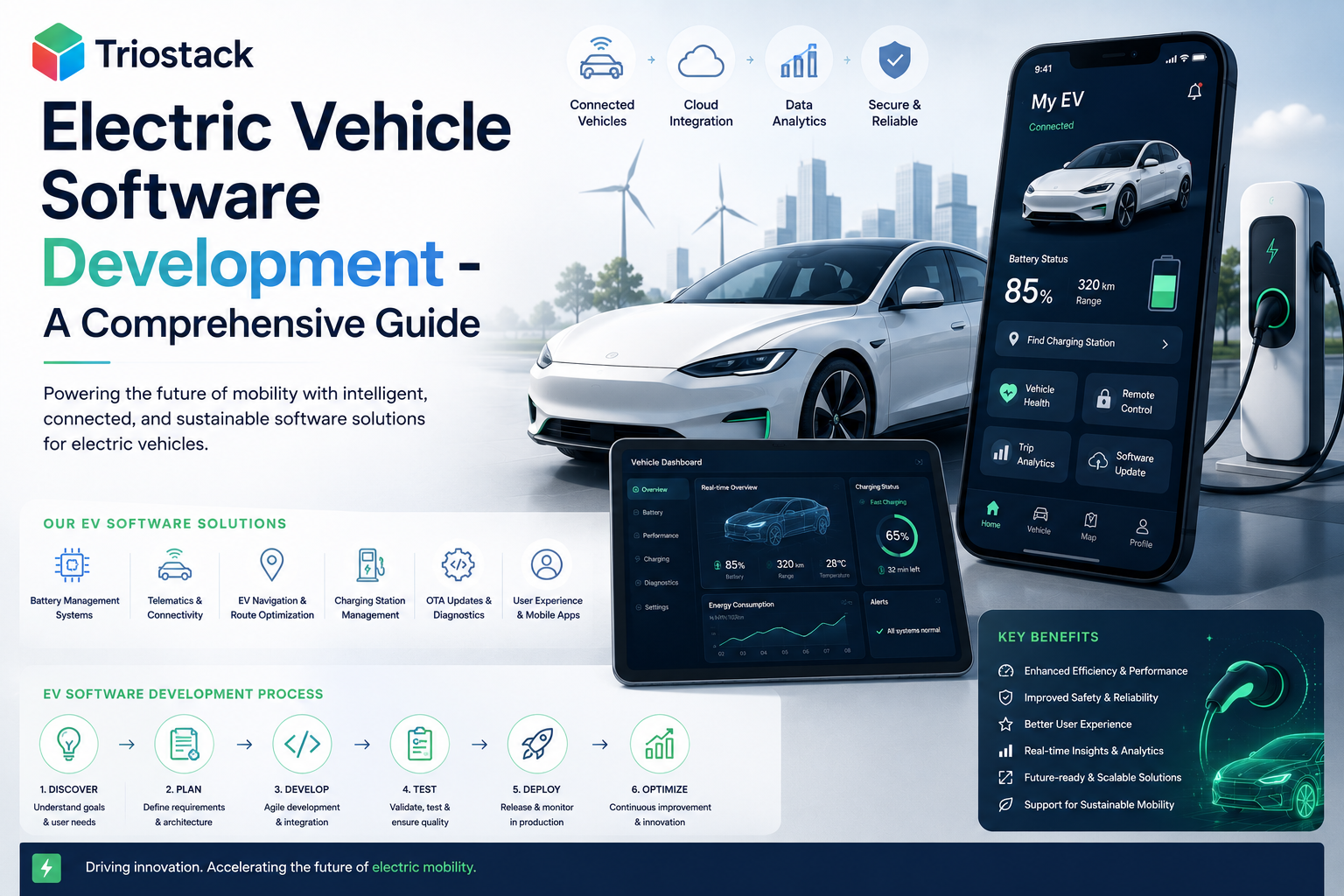
Modern electric vehicles are as much software products as they are machines. Range, safety, charging convenience, and the in-car experience are all determined as much by code as by hardware — which is why automakers and mobility startups alike are investing heavily in EV software capability.
Why Software Is the New Differentiator in EVs
With battery chemistry converging across manufacturers, the experience layer — how efficiently the vehicle manages energy, how intuitive the infotainment system is, and how safely it handles assisted driving — is what actually separates competing EVs in the eyes of consumers.
Core Software Layers in a Modern EV
Battery Management System
The Battery Management System (BMS) monitors cell voltage, temperature, and state of charge in real time, directly affecting range, safety, and battery lifespan. Small software inefficiencies here translate directly into lost range for the driver.
Infotainment & Connectivity
Modern infotainment systems handle navigation, media, over-the-air updates, and increasingly, voice assistants and app ecosystems — all while needing to stay responsive and secure against remote attacks.
ADAS
Advanced Driver Assistance Systems rely on sensor fusion from cameras, radar, and lidar, processed in real time to support features like adaptive cruise control, lane keeping, and automated parking. Safety-critical code here goes through far stricter validation than typical consumer software.
Fleet & Charging Management
For commercial EV operators, software that manages charging schedules, route planning around charging infrastructure, and fleet health monitoring is what makes electrification operationally viable at scale.
Key Challenges in EV Software Development
- Coordinating software teams across battery, powertrain, infotainment, and safety systems that must all work together flawlessly.
- Meeting automotive safety standards such as ISO 26262 for safety-critical components.
- Managing secure over-the-air updates without bricking vehicles or introducing new vulnerabilities.
- Handling the sheer volume of sensor and telemetry data in real time.
Best Practices for Building Reliable EV Software
Successful EV software programs invest early in simulation and hardware-in-the-loop testing, adopt strict version control and rollback strategies for over-the-air updates, and treat cybersecurity as a first-class requirement rather than an afterthought. Cross-functional collaboration between hardware and software teams from the earliest design stages consistently produces more reliable vehicles.
Conclusion
As EVs mature, the manufacturers and mobility companies that win will be the ones treating software as a core product discipline — not a supporting function bolted onto the hardware. Investing in the right architecture, safety processes, and update infrastructure pays off across the entire vehicle lifecycle.
Frequently Asked Questions
What is the most safety-critical software layer in an EV?
The Battery Management System and ADAS are typically the most safety-critical, since failures can directly affect vehicle safety and battery integrity.
Why do EVs need over-the-air software updates?
OTA updates let manufacturers fix bugs, improve range efficiency, and add features without requiring a physical service visit, similar to smartphone updates.
Do EV software teams need automotive-specific expertise?
Yes — safety-critical automotive software follows different standards and validation processes than typical consumer software, so automotive domain experience is important.

Triostack Editorial Team
Technology Evangelist & Writer
Triostack Editorial Team is an experienced writer and technologist, exploring the intersections of AI, cloud architecture, and modern application development. Passionate about turning complex technical concepts into accessible insights.