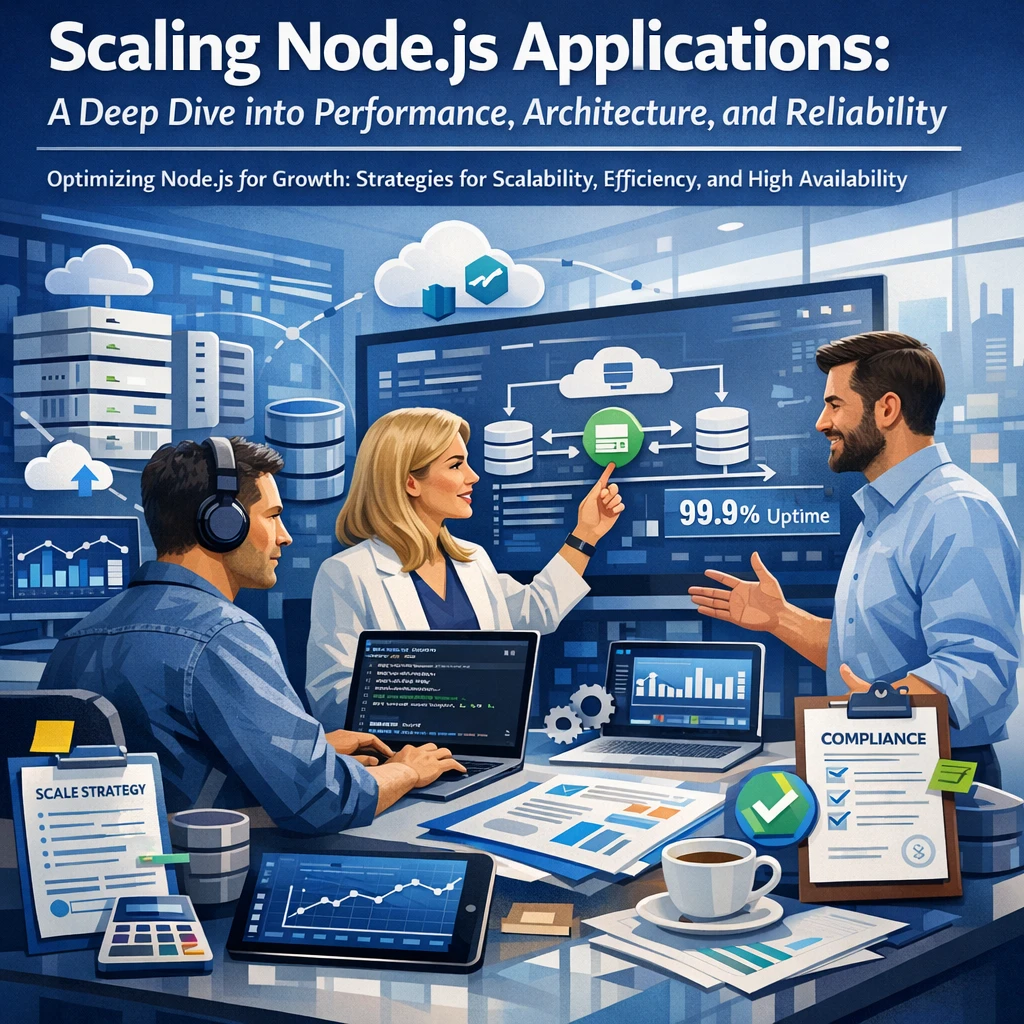
Scaling Node.js Applications: A Deep Dive into Performance, Architecture, and Reliability
Introduction
Node.js redefined how we build scalable, high-concurrency services. Its single-threaded nature, combined with a non-blocking event loop, lets applications handle thousands of connections with relatively modest hardware. But as real-world traffic, data gravity, and feature complexity grow, scaling Node.js becomes less about chasing the latest framework and more about architecting resilient systems, choosing the right tooling, and continuously tuning for performance and reliability.
This guide dives deep into scaling Node.js in production. You’ll find actionable patterns for vertical and horizontal scaling, container orchestration, microservices, caching strategies, observability, and operational best practices. Whether you run a monolithic REST API, a real-time messaging service, or a data-intensive microservice mesh, the strategies discussed here are applicable and actionable in modern cloud environments.
Understanding Node.js at Scale: Core Concepts
To scale Node.js effectively, you must understand the core constraints and leverages inherent to the platform:
- Event-driven, non-blocking I/O: Node.js excels with I/O-bound workloads, but CPU-intensive tasks can block the event loop and degrade latency. Offload CPU work to workers, child processes, or separate services when needed.
- Single-threaded by default: A single Node.js process can only utilize one CPU core. Scaling requires multiple processes or distributed systems rather than chasing a faster single thread.
- Asynchronous programming discipline: Proper async patterns (promises, async/await, streams) are essential to avoid subtle blocking and to maximize throughput.
- Backpressure and streaming: For large payloads (files, data pipelines), streaming and backpressure control are critical for stability under load.
With these concepts in mind, you can design systems that scale both horizontally (more machines) and vertically (more capable machines) while maintaining predictable latency and reliability.
Section 1: Architectural Patterns for Scaling Node.js
There are several architectural patterns that influence how you scale Node.js in the wild. Each pattern has trade-offs in complexity, cost, and latency. Below are the most impactful patterns in current production systems.
Horizontal Scaling with Stateless App Tiering
The most common and robust scaling approach is horizontal scaling: run many stateless Node.js processes behind a load balancer. Statelessness means each request can be served by any instance, which simplifies autoscaling and failure recovery.
Key takeaways: - Use a shared, centralized cache layer (e.g., Redis) to reduce database load and preserve per-request latency. - Ensure all app instances are stateless and share nothing about user session state unless you centralize session data in a store. - Enable auto-scaling policies in your orchestrator to react to traffic spikes and reduce costs during idle periods.
Vertical Scaling and CPU Utilization
Vertical scaling involves moving to machines with more CPU cores, memory, or faster disks. It works well for small teams or initial growth, but it has diminishing returns and a finite ceiling. In practice, vertical scaling is a precursor to horizontal scaling rather than a replacement.
- Monitor CPU saturation, event loop delays, and memory pressure to decide when to scale up or out.
- Be mindful of Node.js process fragmentation, V8 heap growth, and garbage collection pauses which can affect latency.
When vertical scaling reaches a ceiling, you should combine it with horizontal scaling and service segmentation to continue delivering performance without single points of failure.
Microservices, Services Mesh, and Domain Separation
As systems grow, teams often split a monolith into microservices. This reduces blast radius, improves deployment agility, and enables language- or framework-specific optimizations. A service mesh (e.g., Istio, Linkerd) provides strong observability, traffic control, and resilience across services.
Guidance for microservices adoption:
- Start with a well-defined domain-driven design and bounded contexts to avoid service sprawl.
- Keep data ownership clear; prefer per-service databases or carefully managed shared databases with clear boundaries.
- Instrument inter-service communication with robust retries, circuit breakers, and timeouts to prevent cascading failures.
Event-Driven Architecture and Message Queues
Decoupled, asynchronous communication is a powerful lever for scaling. Message queues and event streams smooth traffic spikes, enable backpressure, and support durable workloads. Common stacks include Redis Streams, Kafka, RabbitMQ, or cloud-native event buses.
Design patterns to consider:
- Event sourcing for auditability and replayability.
- Consumer groups to scale parallel processing of events.
- Idempotent handlers to tolerate retries without duplicating work.
Section 2: Node.js Core Scaling Techniques
Beyond architecture, the runtime and process model matter. Node.js provides several mechanisms to leverage multi-core CPUs and improve resilience under load. The following techniques are foundational and widely adopted in production systems.
Clustering and Multi-Process Architectures
The cluster module and process managers allow you to run multiple Node.js worker processes that share server ports and balance incoming connections across cores. This approach improves utilization and provides process-level isolation.
Practical tips:
- Use cluster.with");
- Handle worker crashes with restart policies and health checks.
- Be careful with shared state; use an external store for session data and caches.
PM2, Forever, and Process Management
PM2 is a popular process manager that provides clustering, zero-downtime reloads, and built-in monitoring. It’s excellent for on-prem or small-scale deployments and pairs well with containerized environments when appropriate.
When you move to Kubernetes or other orchestrators, PM2 remains useful inside containers for simple management, but you often rely on the orchestrator’s own deployment, scaling, and health-check features.
Connection Pooling and Database Scaling
Scaling Node.js often requires scaling the data layer in tandem. Connection pools help manage database connections safely across many app processes. Strategies include:
- Limit max connections per process to prevent overwhelming the database.
- Use a central connection pool per service or per application tier to minimize contention.
- Prefer read replicas and caching for read-heavy workloads to reduce database pressure.
Section 3: Containers, Orchestration, and Infrastructure as Code
Modern scaling is inseparable from how you deploy. Containers, orchestration, and infrastructure as code enable repeatable, auditable, and scalable environments.
Containers and Docker
Containerizing Node.js apps standardizes runtime environments, reduces “works on my machine” issues, and simplifies scaling with replication controllers. A minimal, well-structured Dockerfile typically includes a small base image, a non-root user, a non-blocking startup, and a lightweight runtime.
Kubernetes, Helm, and Autoscaling
Kubernetes provides robust orchestration for Node.js services across many nodes. Key concepts include Deployments, Services, Horizontal Pod Autoscalers (HPA), and ConfigMaps/Secrets. Use Helm charts to manage complex deployments and to standardize releases across environments.
- HPA monitors CPU/mine load and scales the number of pods based on target metrics.
- Probes (liveness/readiness) ensure traffic only reaches healthy pods.
- Rolling updates minimize downtime during deployments.
Managed Services vs Self-Managed Clusters
Cloud providers offer fully managed options (EKS, GKE, AKS) and serverless container options (Fargate, Cloud Run). Each option shifts operational responsibilities and pricing but can dramatically simplify scaling and reliability when used correctly.
Section 4: Caching, Databases, and Edge Strategies
Cache strategies and edge routing are foundational to scaling performance. Properly positioned caches reduce latency and DB load while edge strategies accelerate the user experience for global audiences.
Caching Tactics
- In-memory caches (e.g., Redis, Memcached) for hot data and session storage.
- HTTP caches and CDN for static or semi-static content to remove load from app servers.
- Cache invalidation policies and time-to-live (TTL) to ensure fresh data without excessive cache churn.
Database Scaling Techniques
Relational databases and distributed data stores often become bottlenecks as load grows. Common techniques include:
- Read replicas to offload read traffic from the primary database.
- Sharding to distribute write load and data volume across multiple nodes.
- Connection pooling to manage bursty traffic without exhausting database resources.
- Query optimization and proper indexing to reduce latency and resource usage.
Section 5: Observability, Reliability, and Security
Scale without visibility is a risk. Instrumentation, tracing, metrics, logs, and security controls must progress in lockstep with growth.
Observability Stack
A robust observability stack includes:
- Application metrics: latency, throughput, error rates, saturation indicators.
- Distributed tracing to follow requests across services.
- Structured logs with correlation IDs to debug issues quickly.
- Centralized log aggregation and alerting to reduce MTTR.
Security Considerations
Security should be woven into scaling decisions. Considerations include:
- Secure inter-service communication (mTLS, secrets management).
- Rate limiting, API gateway security, and proper authentication/authorization.
- Regular vulnerability scanning and dependency management as part of CI/CD.
Section 6: Tooling, Pricing, and Practical Trade-offs
Choosing the right tooling stack is critical for sustainment. The following table summarizes common tools for scaling Node.js, their typical use cases, core features, pros/cons, and pricing considerations. This will help you align operational practices with business goals.
| Tool | Typical Use Case | Core Features | Pros | Cons | Pricing |
|---|---|---|---|---|---|
| PM2 | Single host or small fleets needing simple clustering | Process management, clustering, zero-downtime reloads, monitoring | Easy setup, fast time-to-value, good for on-prem | Limited cross-host orchestration; not a full orchestrator | OSS: Free; PM2 Plus: subscription |
| Kubernetes | Large-scale, multi-host deployments with autoscaling | Deployments, pods, services, HPA, configmaps, secrets | Highly scalable, ecosystem, robust fault tolerance | Steep learning curve, operational overhead | Cloud-provider pricing for clusters + node costs |
| Docker + Cloud Managed Orchestrator (EKS/GKE/AKS) | Managed container orchestration with cloud-native tooling | Managed control plane, autoscaling, integration with cloud services | Reduced ops burden, faster time-to-scale | Vendor lock-in risk; ongoing cloud costs | Cluster control-plane pricing; compute/resource charges |
| AWS Fargate / Cloud Run (Serverless Containers) | Event-driven or bursty workloads with minimal ops | Serverless containers, autoscaling, pay-per-use | No server management, easy to scale | Cold starts, vendor constraints, less control over environment | Pay-per-use for compute + memory |
| Nginx / HAProxy | Reverse proxy and load balancing in front of app servers | HTTP load balancing, health checks, TLS termination | Proven, fast, broad ecosystem | Not a runtime orchestrator; needs integration with app infra | Open-source (free); Nginx Plus (paid) |
Actionable takeaway: start with a simple, proven architecture (stateless app tier behind a load balancer), add caching, and progressively introduce containerization and orchestration as demand grows. Use the table above to map your current scale state to a target architecture and to identify gaps in observability and reliability.
Implementation Playbooks: A Step-by-Step Path to Scale
Playbook A: Start with a Monolith, Prepare for Growth
If you’re starting from a monolith but expect growth, begin with a stateless design and a robust caching layer. Build a robust CI/CD pipeline, add observability, and create a small, predictable autoscaling policy in your run-time environment.
- Refactor to stateless sessions; store sessions in Redis or a dedicated session store.
- Introduce a caching layer with TTL-based invalidation for frequently accessed data.
- Containerize the app and run behind a load balancer with health checks.
- Set up basic instrumentation and dashboards for latency, throughput, and errors.
Playbook B: Move to Microservices with Controlled Decomposition
When you reach a critical mass of features and teams, decompose into services with explicit boundaries. Use an API gateway and a service mesh for resilience and observability.
- Define bounded contexts and service ownership; automate deployments per service.
- Use asynchronous communication where possible to decouple services and absorb bursts.
- Instrument cross-service traces and establish a standardized error handling policy.
Playbook C: Optimize for Global Scale
Global applications require edge caching, near-region data access, and robust data replication strategies. Combine CDN caching, Redis caching near the edge, and read replicas to minimize latency for users worldwide.
- Place primary read/write endpoints behind a global DNS-based routing mechanism.
- Use regional caches and read replicas to minimize cross-region latency.
- Implement circuit-breakers and failover strategies to handle regional outages gracefully.
Frequently Asked Questions
1) How does Node.js clustering actually improve performance, and when should I use it?
Clustering allows you to run multiple Node.js worker processes that share a port, effectively utilizing multi-core CPUs. Each worker runs its own event loop and handles a subset of incoming connections. The master process coordinates and restarts workers if they fail. Use clustering when you want to improve peak concurrency on a single host or when you want to maximize CPU utilization on a machine. Important caveats: shared in-memory data is not shared across workers, so you must use an external store (e.g., Redis) for session data and shared caches. For more complex scaling needs, combine clustering with container orchestration to scale across multiple hosts.
2) When is it better to use Kubernetes or a serverless container approach (Fargate/Cloud Run) than a traditional VM setup?
Kubernetes provides powerful orchestration for multi-node, highly available deployments with fine-grained control over deployments, networking, and autoscaling. It is ideal when you require long-running services, complex service meshes, and precise resource governance across many microservices. Serverless containers (Fargate, Cloud Run) remove most of the operational burden: you pay for what you use, and scaling is automatic. They shine when workloads are irregular or unpredictable and you want to minimize ops work. The downside is potential cold-start latency and some vendor lock-in. The best approach is often a hybrid: core services on Kubernetes for control and governance, with edge runtimes or less critical functions on serverless containers.
3) How do I manage data consistency and transactions across microservices?
Distributed transactions across microservices are complex. Favor eventual consistency where possible and use patterns like Saga to manage long-running transactions with compensating actions. For data access, prefer per-service databases to minimize cross-service contention, and implement robust APIs with consistent versioning. Where cross-service reads are necessary, rely on read replicas and caching while maintaining a single source of truth per domain boundary.
4) What are practical metrics and dashboards to monitor at scale?
Key metrics include:
- Latency distribution (p50, p95, p99) and tail latency.
- Error rate by endpoint and service; alert on spikes beyond baseline.
- Throughput (requests per second) and CPU/memory utilization per service.
- Queue depths, cache hit/miss rates, and DB connection pool saturation.
- Deployment health: rollout progress, dropped requests during deploys, and restart rates.
Combine metrics with traces to diagnose performance regressions across services and rely on structured logs with correlation IDs to streamline incident response.
Conclusion
Scaling Node.js is a holistic discipline that blends architectural choices, runtime strategies, containerization, data management, and operational excellence. A resilient system scales by design, not by luck: statelessness, clear boundaries, robust caching, and intelligent orchestration enable you to absorb traffic bursts, evolve features rapidly, and maintain consistent user experiences under load. Start with a simple, solid baseline, and progressively layer on complexity in a controlled, observable manner. The patterns, diagrams, and playbooks in this guide are not a checklist to be followed blindly; they’re a toolkit you can tailor to your organization’s scale, budgets, and goals.

Triostack Team
Technology Evangelist & Writer
Triostack Team is an experienced writer and technologist, exploring the intersections of AI, cloud architecture, and modern application development. Passionate about turning complex technical concepts into accessible insights.