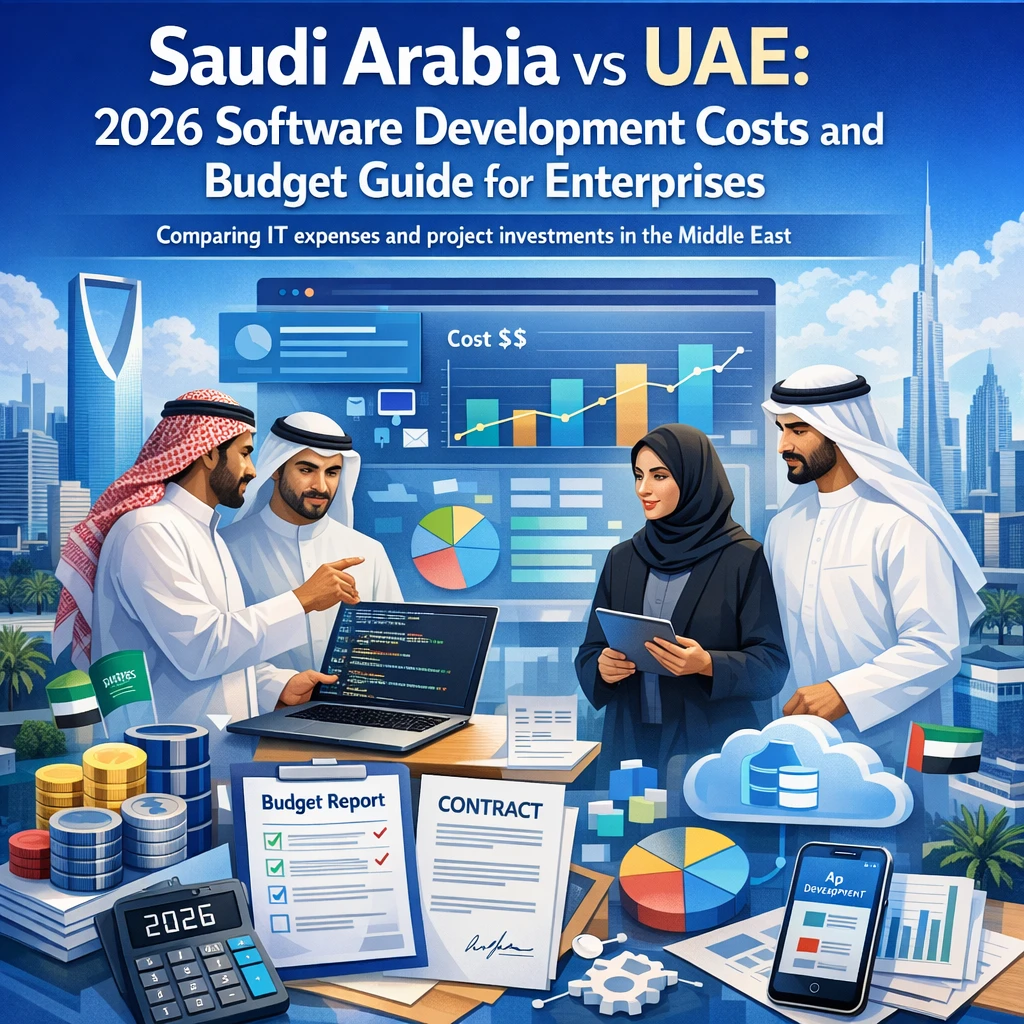
Saudi Arabia vs UAE: 2026 Software Development Costs and Budget Guide for Enterprises
Introduction
As enterprises accelerate digital initiatives across the Middle East, two regional powerhouses—Saudi Arabia and the United Arab Emirates—stand out for markedly different cost structures, talent ecosystems, and policy environments. In 2026, the question isn’t merely what software development costs in these markets are, but how to budget for a reliable, high-velocity delivery stream that aligns with strategic objectives, risk tolerance, and long-term total cost of ownership. This in-depth analysis provides a practical, numbers-driven framework to compare Saudi Arabia (KSA) and the UAE, surface hidden costs, and deliver actionable budgeting playbooks for CIOs, CFOs, and program sponsors.
Market Context: UAE and KSA in 2026
The UAE and Saudi Arabia have continued to invest heavily in digital transformation, yet they diverge in structural factors that shape software development budgets. The UAE’s market tends to command premiums driven by a high cost of living, a veteran multinational talent base, and premium service ecosystems in Dubai and Abu Dhabi. Saudi Arabia, by contrast, is executing aggressive localization and Saudization programs, large-scale mega-projects, and a rapidly expanding tech workforce that increasingly absorbs expatriate talent while prioritizing local employment. Both markets share 5% VAT, evolving corporate tax regimes, and a push toward cloud-first strategies that shift cost from capex-heavy data centers to opex-based cloud consumption.
Key macro trends to watch in 2026 include: a continued emphasis on local data sovereignty and regulatory compliance, government-backed accelerators for AI and modernization (with distinct regulatory sandboxes in each country), and a shift from pure cost-per-hour considerations to holistic cost of ownership (TCO) that includes talent development, time-to-value, and long-term productivity gains from modernization initiatives.
Cost Drivers in 2026: Beyond Hourly Rates
When budgeting for software development, a few mass-market myths must be debunked. A lower hourly rate does not automatically translate into lower total cost if it compromises reliability, ramp-up speed, or security. In both KSA and UAE, the following components drive TCO:
- Talent mix and salaries: Senior engineers and domain experts command premium in both markets, but Saudi Arabia’s Saudization agenda subtly reshapes the profile of local hires and total compensation required to attract expatriates for specialized roles.
- Benefits, visa, and compliance: Employment visas, health insurance, end-of-service benefits, and localization compliance add non-trivial costs to in-house and managed teams.
- Workplace and occupancy: Physical office space is less essential with robust remote-work policies, but some roles still require co-located collaboration, driving overhead in high-cost markets like Dubai.
- Tax and regulatory burden: VAT is 5% in both markets; corporate tax changes (KSA’s evolving CT regime and UAE’s evolving CT framework) influence after-tax profitability and internal rate of return for software projects.
- Infrastructure, tooling, and security: Cloud, DevOps tooling, security audits, and compliance requirements (data localization, privacy, and sector-specific regulations) add recurring costs that scale with the size of the program.
- Delivery model and risk: Nearshore, onshore, and offshore models each bring different risk profiles related to language, time zones, and governance, which impact speed, defect rates, and rework costs.
To translate these into actionable budgets, enterprises should move from a pure “hourly rate” lens to a comprehensive estimation that includes team composition, delivery cadence, and risk reserves. The next sections lay out precise budgeting frameworks, supported by data, scenarios, and tools you can use to build a robust 2026 plan.
Cost Components: What Really Drives the 2026 Budget
Below is a practical breakdown of cost components, with typical ranges you can apply to your planning spreadsheets. The ranges reflect market realities in the UAE and KSA as of 2026, and assume a mix of local hires, expatriates, and outsourced partners within a governed delivery model.
- Personnel costs: The lion’s share of software costs comes from salaries and benefits. UAE rates are typically higher for senior talent, while KSA shows a strong push toward local talent expansion that adjusts compensation bands. Expect junior developers in the UAE to be in the range of USD 60–95 per hour, mid-level USD 90–140, and seniors USD 120–180. In KSA, junior USD 40–85, mid USD 70–120, and senior USD 100–170. Monthly per-developer costs vary similarly and can be influenced by local benefits, housing allowances, and visa packages.
- Benefits and retention: Health insurance, annual leave, education allowances for dependents, and end-of-service benefits—especially in GCC markets—add 10–25% on top of base salaries in many cases.
- Infrastructure and cloud: Cloud infrastructure (compute, storage, network) and developer tooling (CI/CD, security, monitoring) scale with project complexity. Cloud costs are often the second-largest recurring line item after personnel for modern software programs.
- Security, compliance, and audits: In industries like finance, healthcare, or government services, you’ll incur additional costs for security architectures, penetration testing, and ongoing compliance checks. This is non-trivial for regulated programs and can be a budget multiplier in both markets.
- Regulatory and taxation: VAT at 5% on most software services is common; corporate tax considerations in KSA (and evolving structures in the UAE) can affect post-tax profitability and reinvestment capacity.
- Project governance and escalation buffers: A disciplined governance model with a product owner, solution architect, QA lead, and risk manager reduces rework and expedites alignment, but adds headcount cost and governance overhead.
In practice, this means a project budget in the UAE is likely to carry a higher baseline for personnel and housing allowances, whereas Saudi projects may see greater emphasis on local talent pipelines and Saudization-related benefits. The remainder of this article provides concrete budgeting patterns, scenarios, and decision frameworks to help you allocate funds efficiently in 2026.
Scenario-based Budgeting: Concrete Pathways for 2026
Use these scenarios to guide your planning, depending on your strategic goals, risk appetite, and time-to-market requirements.
Scenario A — Rapid MVP in UAE with a Dedicated Team
Objective: Build a minimum viable product for a digital platform targeting UAE-based customers, with a quick first release within 4–6 months, and plan for future regional expansion.
- Team composition: 1–2 senior engineers, 2–3 mid-level developers, 1 QA lead, 1 product owner, 1 UX designer, 1 DevOps engineer.
- Engagement model: Dedicated team with onshore UAE delivery center or nearshore collaboration, plus a small offshore support crew for non-urgent tasks.
- Estimated cost (rough bands):> USD 110–180 per hour blend; monthly per dev USD 10k–22k; total team monthly cost USD 60k–120k depending on rate mix and overtime.
- Risks and mitigations: High cost of living premiums and visa constraints—mitigate with blended offshore capacity and a strong automation/CI discipline to reduce cycle times.
Scenario B — Localized Saudization-first Delivery in KSA
Objective: Build core digital capabilities inside Saudi Arabia to align with Saudization goals and data localization policies, with a 6–9 month initial delivery window.
- Team composition: 2–3 senior engineers (local hires preferentially), 2–4 mid-level developers, 1 QA lead, 1 PO, 1 UI/UX designer.
- Engagement model: Hybrid model with on-site KSA presence for critical components; offshore support for standard tasks; emphasis on local career progression and knowledge transfer.
- Estimated cost: USD 40–85 per hour for juniors, USD 70–120 for mids, USD 100–170 for seniors; monthly per dev USD 8k–18k; total monthly for a mid-heavy team USD 40k–100k.
- Risks and mitigations: Market volatility in expatriate incentives; mitigate with local growth programs and partner ecosystems; ensure robust transfer plans to local teams.
Comparative Toolkit: Tools, Platforms, and Pricing Models
Beyond raw rate arithmetic, choosing the right delivery toolkit and pricing model can dramatically impact budgets and outcomes. The table below provides a compact guide to common engagement models, their typical cost implications, and their suitability for UAE vs KSA projects.
| Engagement Model | Region Suitability | Typical Rate Range (USD/hr) | Avg Monthly Cost per Dev (USD) | Pros | Cons |
|---|---|---|---|---|---|
| Dedicated Team (In-house/Onshore) | UAE or KSA | UAE: 60–180; KSA: 40–170 | UAE: 10k–22k; KSA: 8.5k–18.5k | High alignment, predictable velocity, scalable governance | Higher fixed cost, management overhead |
| Staff Augmentation (Local + Offshore) | UAE/KSA with offshore support | Hybrid: 25–90 | 6k–14k per dev (offshore portion) | Cost control, flexibility, faster ramp-up | Coordination risk, time-zone gaps |
| Managed Services / Outcome-Based | UAE or KSA, heavy vendor involvement | Varies (project-based) | Depends on scope; often blended | Accelerated time-to-value, shared risk | Less control over day-to-day delivery |
| Offshore (Low-Cost Center) | India/EAP, etc. with nearshore options | 25–60 | 6k–12k (remote team) | Substantial cost savings, 24/7 coverage possible | Communication, latency, IP risk |
To translate these models into real-world budgets, map your project’s risk tolerance, data sensitivity, and location strategy to a concrete cost envelope. For many GCC enterprises, a blended approach—local Saudization-first delivery in KSA for sensitive modules, paired with offshore or nearshore partners for non-core features—yields a strong balance of control, cost, and speed.
Tools and Platforms: What You Should Budget For in 2026
Tooling, platforms, and services form a non-trivial portion of the ongoing run-rate. In 2026, expect to budget for:
- Cloud platforms: AWS, Microsoft Azure, or Google Cloud with related data-transfer costs, storage, and function execution charges. Consider data residency requirements in the KSA and UAE and whether a multi-region architecture is warranted.
- DevOps and CI/CD: Jenkins, GitLab, GitHub Actions, or Azure DevOps; containerization (Docker, Kubernetes) and orchestration costs; PaaS/SaaS tooling for security and governance.
- Security and compliance tooling: SAST/DAST, SOC 2-like controls, identity and access management (IAM), and data loss prevention (DLP) solutions tuned to GCC regulatory expectations.
- Productivity and collaboration: Jira, Confluence, Figma, Miro, and Slack/m Chat tools; language and localization support for Arabic UI/UX where applicable.
ROI in these areas is often realized through faster time-to-market, reduced defect rates, and improved security posture—especially important for financial services, government, and healthcare projects common in both markets.
Case Studies: Practical Lessons from Real Projects
While every organization has unique constraints, several recurring patterns emerge from GCC software initiatives. Here are two representative use cases that highlight budgeting decisions and outcomes.
Case Study 1 — Digital Platform Modernization for a UAE-based Retail Group
Challenge: Modernize a monolithic core platform to a microservices architecture with a focus on omnichannel customer experiences. Budget pressure came from premium talent costs and the need for rapid release cycles.
- Approach: A dedicated UAE-based team supplemented by offshore QA and automation. Emphasis on automated regression suites to reduce regression risk across frequent releases.
- Budget outcome: Higher upfront cost due to UAE premiums, but faster time-to-market enabled by stable governance and on-demand capacity.
- Key lesson: Invest in CI/CD and automated testing early to control long-run costs and maintain velocity amid premium market conditions.
Case Study 2 — Saudization-led Platform for a Saudi Government Contractor
Challenge: Build a regulated platform with strict data governance, localization requirements, and local hiring mandates.
- Approach: Saudi-based delivery with strong local partner ecosystem, capped reliance on offshore teams for sensitive modules, and strong knowledge transfer to local staff.
- Budget outcome: Moderate costs with favorable retention of critical knowledge in-country; long-term TCO benefited from reduced attrition and stronger compliance posture.
- Key lesson: Align vendor incentives with local capacity development; plan for a staged handover to internal teams to maximize long-term value.
ROI, TCO, and Total Value Creation
Budgeting for software development is not just about the initial expenditure; it’s about how the investment translates into business outcomes. The ROI equation in 2026 GCC scenarios typically includes:
- Time-to-market acceleration and revenue impact from faster go-to-market cycles
- Defect reduction and quality improvements that lower post-release support costs
- Improved security/compliance posture that reduces risk exposure and potential fines
- Talent development and localization benefits that reduce long-term recruitment costs
- Flexibility and scalability of cloud-native architectures that enable cost optimization over time
Frequently Asked Questions
1) How do salary and rate differences between UAE and KSA typically affect project budgeting?
In general, UAE rates tend to carry an overall premium due to higher living costs and a mature, multinational talent pool. KSA, with its localization push, often offers more favorable local hiring terms and cost efficiencies from Saudization-related incentives. For planning, expect the UAE to contribute higher hourly rates and monthly costs for senior roles, while KSA may exhibit a wider variance depending on local versus expatriate mix. The practical takeaway is to budget for a premium in the UAE for top-tier specialists, while leveraging local talent and blended offshore talent in KSA where appropriate to optimize long-run cost efficiency.
2) What are the most important budgeting levers for 2026 in GCC markets?
The most impactful levers are: (1) team composition and rate mix (senior vs mid vs junior), (2) engagement model (dedicated vs staff augmentation vs managed services), (3) data localization and regulatory compliance costs, and (4) cloud and tooling costs tied to your architecture and security posture. Prioritizing governance, automated testing, and modular delivery can dramatically reduce rework and accelerate ROI, even in premium markets like the UAE.
3) How should I choose between UAE and KSA delivery for a multi-region product?
Adopt a hybrid strategy: use KSA for localization-driven components and compliance-heavy modules, complemented by UAE-based teams for high-velocity customer-facing features, architecture, and platform-level decisions where regional market expertise matters. Nearshore or offshore partners can fill non-core skill gaps, provided you implement strong IP protection, robust communication cadences, and clear escalation paths.
4) Are VAT and corporate tax important in software project budgeting?
VAT at 5% applies to most software services in both markets, directly increasing cost of services. Corporate tax considerations should influence after-tax profitability and reinvestment planning, particularly in KSA where CT regimes apply to profits. In budget terms, you should build a modest contingency for tax-related adjustments and ensure your pricing models reflect after-tax profitability goals.
Conclusion: A Practical Path Forward for 2026
Budgeting software development in 2026 for Saudi Arabia and the UAE requires more than chasing the lowest hourly rate. Enterprises must embrace a holistic approach that accounts for talent composition, regulatory complexity, and the strategic value of the delivery model. The UAE offers premium speed and a highly mature ecosystem, which is invaluable for market-ready products and complex digital platforms. Saudi Arabia offers strong localization dynamics and a growing, resilient talent pipeline that can deliver compelling long-run cost efficiencies when paired with a thoughtful transfer-to-localization plan. By combining the right delivery model with disciplined governance, robust tooling, and a clear ROI framework, executives can chart a budget that unlocks speed to market while preserving long-term value and compliance across both GCC markets.
Actionable Takeaways
- Start with a TCO model that includes people, tooling, cloud, security, and compliance costs. Do not rely on hourly rates alone.
- For 2026, consider a hybrid delivery approach: Saudization-balanced local delivery in KSA for core capabilities, complemented by UAE-based premium delivery for rapid, customer-facing features and architecture leadership.
- Invest early in automated testing, CI/CD, and modular architecture to reduce rework and exploit faster release cadences—especially important in a premium UAE market.
- Plan for regulatory changes by engaging with local partners who understand data localization and compliance requirements in each market.
Final Thoughts
Enterprises aiming to maximize value from GCC software programs in 2026 should map region-specific realities to a flexible, governance-forward budgeting approach. While the UAE offers speed-to-value and a mature ecosystem, Saudi Arabia provides localization advantages and a rapidly expanding talent pool that can yield compelling long-term cost efficiency when coupled with structured local capacity-building. With the right mix of teams, tools, and governance, your budgets can deliver not only cost control but measurable business outcomes across the Middle East’s most dynamic software markets.

Triostack Team
Technology Evangelist & Writer
Triostack Team is an experienced writer and technologist, exploring the intersections of AI, cloud architecture, and modern application development. Passionate about turning complex technical concepts into accessible insights.