Offshore Software Development vs In-House Teams in the UK: Which Model Delivers Better ROI?
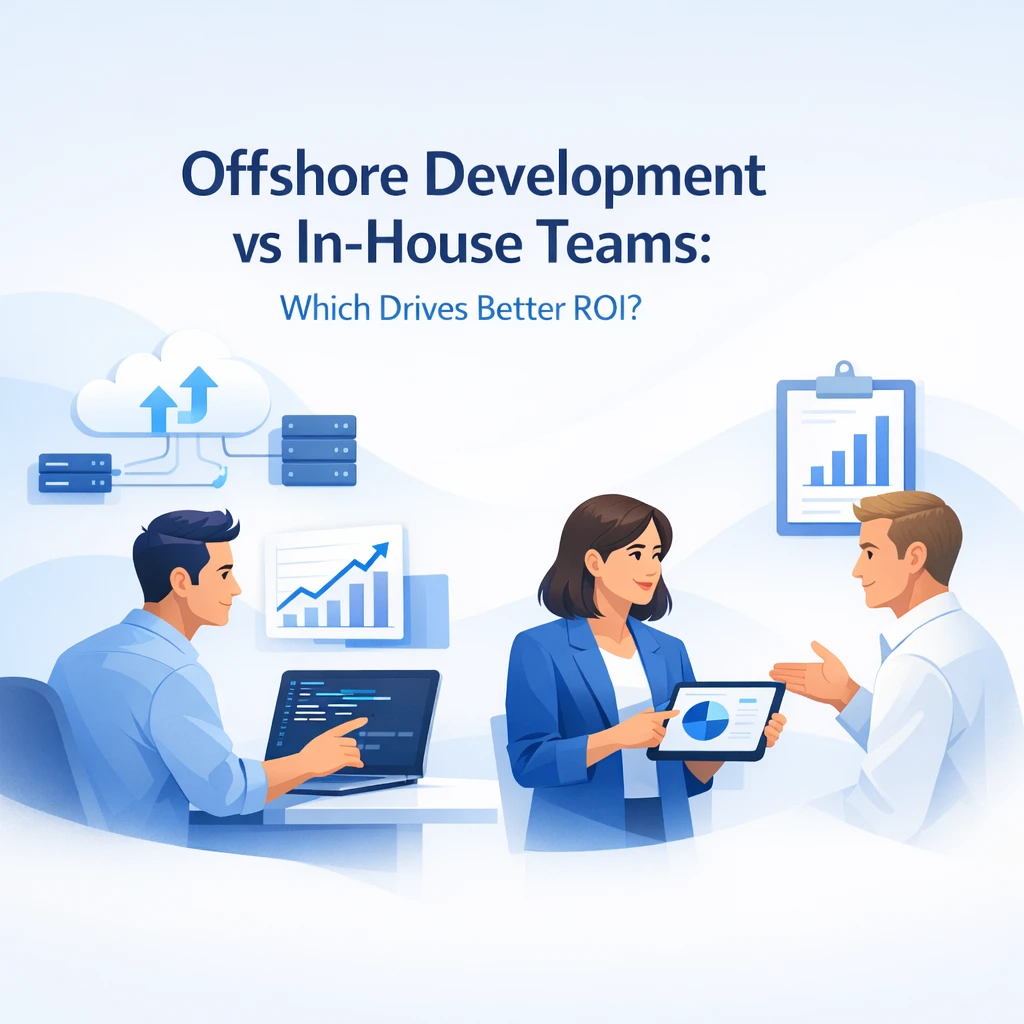
A practical guide for SMBs, SMEs, and startups planning software projects between USD $5,000 and $200,000. Learn how to compare ROI, assess risk, and choose a scalable partner like Triostack Technologies for global delivery.
Introduction
For growing businesses, software development decisions often hinge on cost, speed, risk, and long-term viability. The choice between offshore development and keeping work in-house is not merely a cost comparison; it’s a strategy that affects product velocity, talent access, security posture, and customer outcomes.
This article unpacks the ROI considerations of offshore software development versus in-house teams, with practical guidance for UK-based organizations engaging vendors in the UAE, GCC, Europe, the US, or beyond. We’ll ground the discussion in real-world scenarios, provide actionable frameworks, and illustrate how a trusted global partner—like Triostack Technologies—can help you design, build, deploy, and maintain scalable software products.
What is the Topic?
Offshore software development refers to engaging external teams (often in different time zones) to design, build, and maintain software products. In-house teams are your direct employees, located on your premises or within your corporate offices, working under your governance. The core ROI question is: which model delivers faster value, higher quality, lower total cost of ownership (TCO), and better alignment with business goals over time?
In practice, most UK-based organizations operate in a hybrid reality: core product ownership remains in-house, while execution—especially for non-core modules or specialized capabilities (e.g., AI features, cloud migrations, or mobile apps)—is offshored or nearshored to trusted partners.
Why it Matters in 2026
The business landscape in 2026 is characterized by faster time-to-market expectations, global talent competition, and heightened emphasis on security, compliance, and user experience. For many UK-based startups and SMEs, offshore development offers access to broader talent pools, flexible scaling, and cost advantages that can preserve runway and speed up delivery—without sacrificing quality when managed well.
Current Industry Challenges
- Talent scarcity in high-demand tech hubs; rising salaries in in-house markets.
- Time-to-market pressures requiring parallel development streams and optimized delivery pipelines.
- Security, IP protection, and regulatory compliance across jurisdictions.
- Managing distributed teams, aligning product vision, and ensuring consistent quality.
A thoughtful mix of offshore or nearshore development with strong governance can address these challenges while maintaining strategic control, especially for non-core components and rapid feature experiments.
How the Technology Works
The decision to offshore is not about sacrificing control; it’s about distributing capability across specialized centers while implementing robust governance, security, and alignment mechanisms. The architecture typically emphasizes modular design, clear API boundaries, and well-defined interfaces that enable independent teams to contribute without friction.
A modern approach to offshore development often leverages:
- Component-based architectures (microservices or modular monoliths)
- API-first design with well-documented contracts
- DevOps practices and CI/CD pipelines across teams
- Cloud-native hosting, scalable databases, and observability
- Security-by-design, including data protection and access controls
Architecture Overview
A typical offshore-in-house collaboration uses a layered architecture with clear ownership boundaries. In practice, you might see:
- Core product team in-house (PM, UI/UX, product owner responsibilities)
- Offshore delivery teams handling features, integrations, and QA
- External consultants or security experts for specialized tasks
Below is a high-level architecture example that supports remote delivery while preserving governance.
Step-by-Step Workflow
- Discovery and scoping: Align business goals, define MVP, and set success metrics.
- Team formation and contracts: Choose a delivery model (dedicated teams, fixed-price, or time-and-materials).
- Architecture and design: Establish platform choices, data models, and security baselines.
- Implementation sprints: Parallel development, with integrated QA and UX validation.
- Quality assurance and security review: Automated tests, performance checks, and compliance reviews.
- Deployment and go-to-market: Release planning, staging, production rollout, and monitoring.
- Maintenance and evolution: Ongoing support, feature updates, and refactoring as needed.
Build vs Buy: A Practical Comparison
When deciding between offshore build and in-house development, weigh governance, speed, cost, and risk. The table below highlights common considerations.
| Aspect | In-House | Offshore / External Partner | What to Consider |
|---|---|---|---|
| Cost Pressure | Higher fixed payroll; benefits; office costs | Lower hourly rates; pay-for-delivery models possible | Balance ongoing costs vs. project-based budgeting |
| Time to Value | Longer hiring cycles; ramp-up time | Faster access to specialists; scalable teams | Define MVP and governance to keep velocity high |
| Quality & Security | Control is high; internal processes can be mature | Depends on vendor maturity; requires rigorous SLAs | Security-by-design and audit trails are essential |
| Scaling | Challenging to scale quickly; hiring frictions exist | Flexible scaling with dedicated teams | Structured outsourcing contracts help scale reliably |
| IP & Governance | Direct control; IP ownership clearer | Contractual protections; NDAs; IP terms critical | Clear ownership and exit clauses are non-negotiable |
In many UK markets, a hybrid approach often emerges: core product leadership stays in-house while execution, testing, and feature enrichment are supported by offshore or nearshore partners under strong governance.
Estimated Development Cost (RFC): SMBs and Startups
The following ranges reflect common engagements for mid-size software projects. Real-world costs depend on scope, tech stack, data complexity, regulatory requirements, and team composition.
| Deliverable | Estimated Range (USD) | Notes |
|---|---|---|
| Business Website | 5,000 – 15,000 | Informational or CMS-driven site with basic features |
| Customer Portal | 10,000 – 40,000 | User authentication, profiles, data visualization |
| CRM | 15,000 – 100,000 | Sales/marketing automation, integrations |
| ERP | 40,000 – 200,000 | Cross-department processes, data migration |
| AI Chatbot | 5,000 – 25,000 | Conversational design and basic NLP |
| AI Automation | 15,000 – 80,000 | Workflow automation and integration with systems |
| SaaS MVP | 20,000 – 80,000 | Minimal viable product with core features |
| Enterprise Web App | 30,000 – 200,000 | Large-scale systems with compliance requirements |
Pricing depends on factors such as feature complexity, integration needs, data migration, security/compliance, cloud hosting, and ongoing maintenance. When planning, map a tiered roadmap with a secure MVP, followed by incremental releases that deliver measurable business value.
Recommended Technology Stack
Choosing a resilient stack improves ROI by reducing rework, enabling faster delivery, and simplifying maintenance. The following are common, proven components for offshore-plus-in-house models:
- Frontend: React, Vue, or Angular for rich UX
- Backend: Node.js, Python, Java, or .NET with API-first design
- Databases: PostgreSQL, MySQL, or cloud-native options (Aurora, CosmosDB)
- Cloud: AWS, Azure, or Google Cloud, with a focus on managed services
- AI/ML: PyTorch or TensorFlow with MLOps tooling
- Mobile: React Native or Flutter for cross-platform needs
- CI/CD: GitHub Actions, GitLab CI, Azure DevOps
- Security: OWASP-ASVS, secrets management, SSO, encryption
Business Use Cases
ROI improvements come from aligning the right delivery model with business goals. Consider these typical use cases:
- Speed-to-market: Startups needing a scalable MVP with flexible funding models.
- Feature-rich platforms: SMEs expanding into new markets with GDPR-ready data handling.
- Legacy modernization: Enterprises migrating to cloud-native architectures with improved observability.
- Product-led growth: SaaS providers iterating rapidly on core product features while maintaining cost discipline.
Industry Applications
Across sectors, offshore collaboration can enable targeted capabilities while keeping strategic ownership in-house:
- Logistics: real-time tracking dashboards, route optimization, and carrier integrations.
- Healthcare: compliant patient portals, scheduling, and telemedicine features.
- Retail: omnichannel checkout, loyalty programs, and inventory sync.
- Finance & Insurance: secure data processing, reporting, and risk analytics.
Benefits of Offshore Delivery When Executed Well
- Cost efficiency with access to a broader talent pool
- Faster scaling of development teams during peak cycles
- Focus on core business while specialized execution accelerates non-core features
- Improved time-to-market and iterative value delivery
- Access to global best practices and cross-cultural perspectives
Challenges and How to Address Them
- Communication gaps: invest in structured communication rituals and collaboration tools.
- IP and data security: enforce NDAs, ROFR, and robust data protection strategies.
- Quality governance: define SLAs, QA benchmarks, and continuous integration standards.
- Cultural and time-zone differences: plan overlap hours and synchronous/asynchronous workflows.
Common Mistakes to Avoid
- Rushing vendor selection without a clear RACI and risk register.
- Underestimating the importance of data security and regulatory alignment.
- Treating offshore teams as interchangeable; lack of domain knowledge transfer.
- Neglecting long-term support and roadmap alignment beyond initial release.
Best Practices for Offshore Partnerships
- Define a clear product vision with measurable outcomes for each sprint.
- Establish robust governance: a product board, monthly risk reviews, and documented decision rights.
- Invest in security, compliance, and data governance from Day 1.
- Prefer dedicated teams with stable membership and knowledge transfer protocols.
- Maintain strong communication channels: weekly demos, sprint reviews, and documented decisions.
Future Trends: What’s Shaping Offshore Delivery in 2026 and Beyond
- AI-enabled development and large language models accelerating coding, test generation, and UI design.
- Greater emphasis on platform engineering, observability, and site reliability for complex systems.
- Hybrid delivery models with optimized timezone overlap and asynchronous collaboration.
- Federated security models and zero-trust architectures becoming standard in vendor engagements.
How Triostack Delivers Projects Globally
Triostack Technologies offers end-to-end software development services with global delivery capabilities. We help UK-based organizations access scalable teams, implement secure processes, and maintain product quality across dispersed locations. Our approach blends structured governance, transparent communication, and a focus on business outcomes.
Key capabilities include:
- Custom Software, Web Development, and Mobile Apps
- AI Development, Machine Learning, and Data-driven features
- CRM, ERP, and SaaS product development
- Cloud Migration, DevOps, and CI/CD automation
- UI/UX design, API Development, and Integration services
- Dedicated Teams, QA, and Maintenance
- Technical Consulting for architecture and strategy
Remote Delivery: How Triostack Delivers from India
Triostack partners with UK businesses to deliver high-quality software from India, combining global scale with rigorous governance. Our remote delivery model emphasizes agility, transparency, and outcomes.
Agile and Planning Practices
Core components of our model include:
- Agile framework aligned to your sprint cadence
- Sprint Planning with clear goals, acceptance criteria, and prioritized backlog
- Weekly demos and transparent progress updates
- Communication via Slack, Teams, Zoom, and Google Meet
- Issue tracking in Jira, project management in ClickUp
- Source control and CI/CD pipelines in GitHub or GitLab
- Cloud-based staging environments and automated QA pipelines
- Documentation, security, and NDA/IP protection protocols
- Dedicated Project Managers and long-term support
UAE businesses often outsource development to India due to cost efficiency, a large talent pool, faster hiring, scalable teams, high-quality engineering, and strong communication practices. Triostack aligns with these advantages while maintaining strict governance and security.
This model supports time-zone overlap for daily touchpoints, while enabling you to draw on wider talent pools, maintain cost discipline, and scale quickly when requirements change.
Security, NDA, IP Ownership
We ensure robust NDAs, clear IP ownership terms, and industry-standard security practices across all projects to protect your assets and data.
Case Studies (Realistic Illustrations)
Below are representative, anonymized examples that illustrate how offshore delivery can enable tangible outcomes in different contexts.
Dubai-based Logistics Company — Offshore-Delivery to Accelerate a Transport Management Platform
Challenge: A regional logistics provider needed a scalable transport management platform to support multi-carrier integrations and real-time tracking. In-house capacity was limited, and the business wanted faster time-to-market.
Approach: Triostack assembled a dedicated offshore team alongside a lean in-house product owner. We focused on API-first design, microservice-based architecture, and cloud-native deployment. Regular demos and risk reviews were held to ensure alignment with business goals.
Outcome: The platform supported multiple carriers, improved order processing visibility, and enabled feature releases in quarterly increments. The client reported higher customer satisfaction due to reliable delivery estimates and proactive status updates.
UAE Healthcare Clinic — Patient Portal and Admin Console
Challenge: A healthcare clinic required a HIPAA/GDPR-compliant patient portal for appointment scheduling, telehealth, and secure messaging, plus an internal admin dashboard.
Approach: Triostack delivered a compliant MVP using secure authentication, role-based access, and audit trails. The offshore team provided iterative enhancements and integration with the clinic’s existing EHR system.
Outcome: Improved patient engagement and streamlined administrative workflows, with a clear path to broader telemedicine capabilities.
Saudi Retail Business — eCommerce Platform Enhancement
Challenge: A retail brand sought to modernize its eCommerce experience with a responsive front end, scalable back end, and a unified CRM integration.
Approach: Offshore teams implemented a componentized frontend, secure checkout, and CRM integrations. The project followed a staged rollout with continuous feedback loops from a dedicated product owner.
Outcome: A more resilient platform with faster feature delivery, enabling promotions and improved analytics.
UK SaaS Company — SaaS MVP and Iterative Enhancements
Challenge: A UK-based SaaS startup needed a lean MVP with a clear go-to-market plan and iterative enhancements based on user feedback.
Approach: Triostack provided a dedicated offshore squad to accelerate MVP delivery, with close collaboration to ensure product-market fit and scalable architecture.
Outcome: Faster time-to-market, validated product-market fit, and a scalable platform architecture for future growth.
Pricing Factors and Cost Drivers
Understanding what drives cost helps SMBs and startups plan effectively. The following factors commonly influence offshore development budgets:
- Project scope and feature complexity
- Quality requirements, testing, and security/compliance needs
- Data migration and integration with existing systems
- Team composition and location (dedicated vs. milestone-based)
- Vendor governance, project management, and IP protection
- Duration and rate structures (fixed-price vs time-and-materials)
In practice, many UK clients find that offshore engagement with clear governance yields a lower TCO than keeping everything in-house, especially during early growth stages or when core product ownership is retained internally for strategic control.
Development Timeline: What to Expect
The timeline depends on scope, but a typical lifecycle might look like this:
| Phase | Duration (weeks) | Key Deliverables |
|---|---|---|
| Discovery & Planning | 2–4 | Requirements, MVP scope, architecture blueprint |
| Design & Prototyping | 2–5 | UI/UX, API contracts, data model |
| Build & QA | 6–20 | Feature development, automated tests, security checks |
| Platform Readiness | 2–4 | Staging, performance, security audits |
| Go-live & Support | Ongoing | Production rollout, monitoring, maintenance |
This is a generic guide. Actual timelines are tailored to your product complexity and the preferred engagement model.
Future Trends in Offshore Software Development
As markets evolve, the ROI calculus shifts with new capabilities and practices:
- Hybrid workforce models with improved overlap and asynchronous workflows
- Platform engineering to reduce toil and stabilize product velocity
- Enhanced data protection by design and stronger cross-border compliance
- AI-assisted software engineering to accelerate coding and testing
Frequently Asked Questions
- Is offshore development right for my UK-based business?
- It depends on your product strategy, risk tolerance, and governance. Offshore delivery can unlock faster scaling and cost advantages when paired with strong product ownership and security controls.
- How do I protect IP when working with offshore teams?
- Use robust NDAs, clear IP ownership terms, access controls, and code ownership agreements. Maintain documentation of all design decisions and source control access.
- What governance structure works best with offshore partners?
- A joint product board, weekly demos, sprint reviews, SLAs, and transparent reporting help maintain alignment and predictability.
- How do I ensure quality across distributed teams?
- Invest in automated testing, code reviews, architectural governance, and continuous integration/continuous delivery pipelines.
- What is Triostack’s approach to security and compliance?
- We embed security-by-design, conduct regular security reviews, and align with your regulatory requirements (e.g., GDPR, HIPAA where applicable).
Conclusion
Offshore software development offers compelling ROI for UK businesses seeking speed, scale, and cost efficiency, provided governance, security, and product ownership are managed rigorously. In many cases, a blended approach—core product management in-house with offshore execution for selected capabilities—delivers the optimal balance of control and velocity.
Triostack Technologies stands ready to help you design a roadmap that aligns with your strategic goals, whether you’re building a new SaaS platform, modernizing an ERP, or expanding an eCommerce ecosystem. Our global delivery model, combined with a disciplined approach to architecture, security, and QA, helps you optimize ROI across the entire software lifecycle.
If you’re planning a similar software project, Triostack can help you design, build, deploy and maintain a scalable solution.
Note: This article is educational in nature and reflects industry best practices and Triostack’s approach to global software delivery. Details may vary by project and region.
Triostack Team
Technology Evangelist & Writer
Triostack Team is an experienced writer and technologist, exploring the intersections of AI, cloud architecture, and modern application development. Passionate about turning complex technical concepts into accessible insights.