Offshore Software Development vs In-House Teams in Dubai: Which Model Scales Faster and Costs Less?
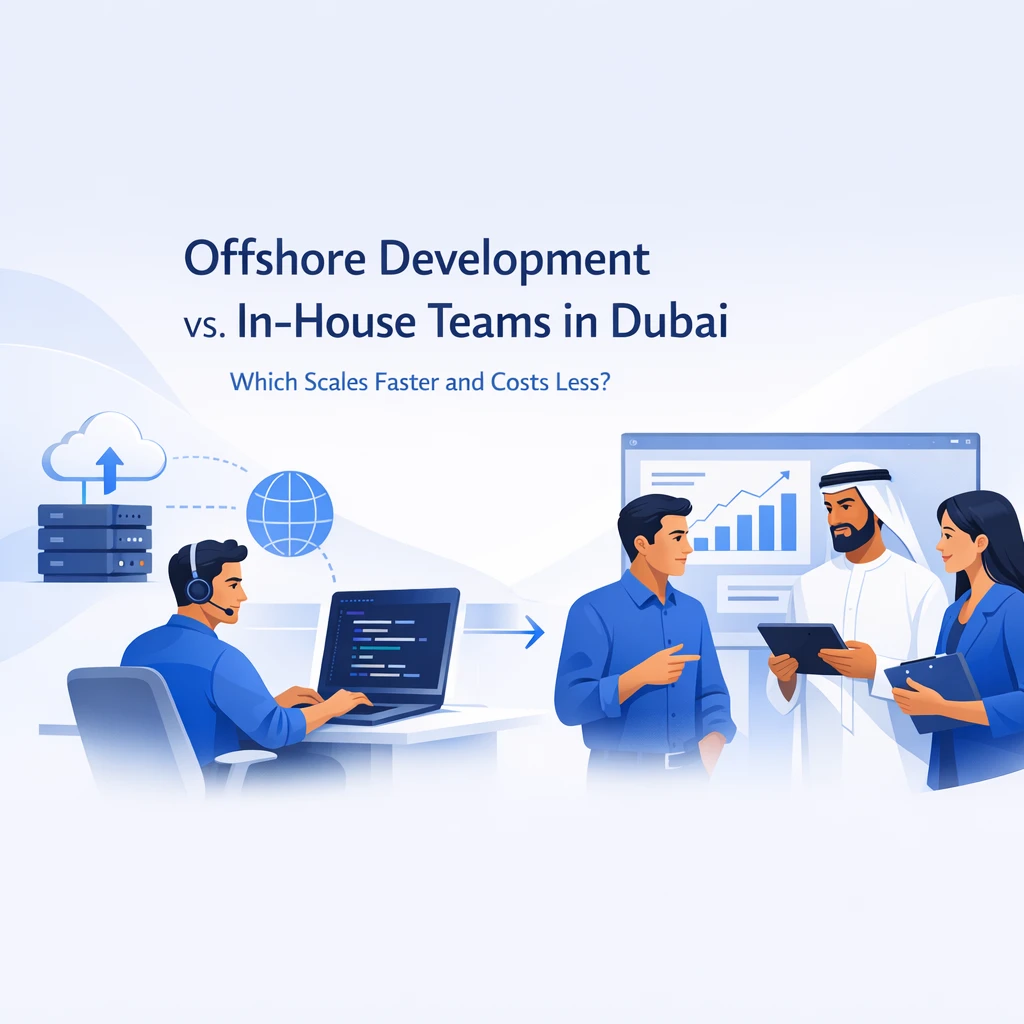
For SMBs, SMEs, startups, and growth-focused enterprises in Dubai and across the Gulf region, choosing how to build software is a strategic decision with long-term implications for speed, cost, and competitive advantage. This guide compares offshore software development with in-house teams, highlights practical decision criteria, and shows how a global software partner like Triostack Technologies can help you scale responsibly and efficiently.
Introduction
In an era where digital products are essential to customer experience, the way you source software development matters as much as the product you build. Dubai and the broader Middle East are experiencing a dynamic mix of regulatory evolution, talent migration, and rapid digital transformation across industries such as logistics, healthcare, retail, and fintech. The core question remains: should you rely on offshore teams, or consolidate development under an in-house unit? The answer is nuanced and often project-specific. This article lays out the trade-offs, provides a decision framework, and shares real-world guidance to help executives, founders, CTOs, and product leaders decide what scales fastest and costs least, while preserving quality and security.
What is the Topic?
The topic contrasts two common software delivery models:
- Offshore Software Development — engaging remote teams (often in engineering hubs like India) to design, develop, test, and maintain software on behalf of the client, with a distributed project team that sits outside the client’s time zone.
- In-House Teams — building and maintaining a local or regional internal software team integrated with the client’s leadership, product, and IT operations.
Both models pursue the same outcomes: faster time-to-market, higher quality software, and a product that meets customer needs. The differences lie in cost structure, talent availability, process maturity, and governance. In this article, we explore how these factors play out in Dubai and globally, with concrete workflows, architectures, and practical steps you can apply today.
Triostack Technologies operates as a global software partner with a focus on Custom Software, Web & Mobile Development, AI & ML, CRM, ERP, SaaS, Cloud Migration, DevOps, UI/UX, API Development, Dedicated Teams, QA, and Maintenance. This article references how Triostack approaches offshore delivery from its hubs, including remote collaboration, governance, and IP protection—without sounding promotional, but with proven, practical guidance.
Why it Matters in 2026
Across the UAE, KSA, Qatar, Oman, Kuwait, Bahrain, and beyond, organizations are navigating:
- Talent scarcity and rising wage inflation in specialized engineering roles
- Demand for faster product iterations to capture market opportunities
- Stricter data security, privacy, and regulatory compliance
- Currency and economic volatility influencing total cost of ownership
- Demand for scalable architectures that support growth, localization, and multi-cloud strategies
Choosing an outsourcing or hybrid model is not a bolt-on decision; it shapes long-term governance, risk, and the ability to respond to market shifts. A well-structured offshore engagement can unlock access to a large talent pool, provide cost flexibility, and speed up delivery, while a well-run in-house team can deliver deep domain knowledge and faster decision cycles in some contexts. The goal is to pick a model that aligns with your product strategy, risk tolerance, and growth trajectory.
Current Industry Challenges
- Talent supply and cost: The region faces a competitive market for software engineers, data scientists, and cloud specialists. Offshore partners can augment or flex your capacity while avoiding long hiring cycles.
- Speed to market: Startups and scale-ups must validate ideas quickly; offshore teams often enable rapid ramp-up and parallel work streams.
- Security and IP: Data protection and IP ownership require robust contracts, NDAs, and governance regardless of delivery location.
- Localization and compliance: Regulation, language, and cultural alignment matter for customer-facing products, especially in healthcare, fintech, and logistics.
- Quality at scale: Ensuring consistent QA, automated testing, and DevOps maturity across distributed teams is essential for reliability.
Triostack leverages globally distributed teams with strong QA, security, and governance processes to manage complexity and risk while delivering predictable outcomes for projects within the USD 5,000 to 200,000 range.
How the Technology Works: A Quick Primer
Both offshore and in-house approaches rely on modern software engineering practices and tooling. Core concepts include:
- Modular architectures (microservices, modular monoliths) to enable scale and reuse
- Continuous integration and continuous deployment (CI/CD) to shorten feedback loops
- Cloud-native design with security-by-design and compliance baked in
- Agile project management, with clear sprint cadences and transparent progress reporting
- Robust documentation, versioning, and IP protection provisions
Triostack combines these practices with a pragmatic approach to vendor management, ensuring alignment between business goals and engineering execution.
Architecture Overview
Regardless of delivery location, successful software architectures share common ground: scalability, resilience, and maintainability. The following diagram illustrates a typical setup used in offshore–in-house collaborations.
In this model, the client retains product ownership and product management while the offshore team handles design, development, and testing. The architecture emphasizes cloud-native components, containerization, and automated testing to enable rapid scaling and secure operation across geographies.
Step-by-Step Workflow
The following workflow captures a pragmatic approach for offshore or hybrid teams, with emphasis on governance, visibility, and risk management.
- Discovery & Alignment: Stakeholder interviews, business goals, user personas, and success metrics.
- Architecture & Planning: High-level architecture, technology stack decisions, and security posture.
- Team Setup & Onboarding: Roles defined, access controls, tooling, and communication norms.
- Sprint Planning & Prioritization: Roadmaps translated into 2–4 week sprints with clear acceptance criteria.
- Development & QA: Parallel streams, automated testing, and continuous feedback loops.
- UAT & Deployment: User acceptance testing, compliance checks, and staged deployments.
- Product Stabilization & Support: Monitoring, incident response, and ongoing enhancements.
In offshore engagements, timing, communication cadence, and documentation quality are the practical levers—everything hinges on how well teams synchronize across time zones and cultures. Triostack’s remote delivery model emphasizes structured sprint rituals, clear documentation, and transparent dashboards to keep everyone aligned.
Business Use Cases
Below are representative scenarios where offshore or hybrid teams can unlock value while maintaining governance and security.
- Dubai logistics company: A specialized tracking portal and customer portal to improve transparency and routing optimization. Offshore teams accelerate feature delivery while ensuring robust security and auditability.
- UAE healthcare clinic: A patient engagement platform with secure EHR integration, appointment scheduling, and telehealth modules—requiring HIPAA-like compliance and strong data protection controls.
- Saudi retail business: An omnichannel e-commerce and CRM integration with store POS back-end, enabling regional localization and fast deployments across markets.
- Australian startup: A fintech SaaS MVP with modular microservices, rapid iteration, and cloud-native scalability to support international expansion.
- UK SaaS company: A customer analytics platform with AI-assisted insights, deployed across multiple regions with strict data governance.
Industry Applications
Across sectors active in the region, a well-structured outsourcing or hybrid model can support:
- Logistics and supply chain optimization
- Healthcare portals and patient engagement
- Retail brand e-commerce and loyalty programs
- Financial services front-end apps and CRM/ERP integrations
- AI-enabled customer support and automation
Benefits
- Faster scaling: Access to large engineering pools and flexible staffing models.
- Cost controls: Variable cost structures that help manage cash flow and capex/opex trade-offs.
- Quality through process maturity: Mature CI/CD, automated testing, and QA practices often become more visible in offshore partnerships with strong governance.
- Focus on core business: Your team concentrates on strategy while delivery experts execute engineering work.
- Global talent access: Talent with domain expertise that may be scarce locally can be accessed through trusted partners.
Challenges
- Communication gaps: Timezone differences and cultural nuances require deliberate communication planning.
- Security controls: Data protection, NDA enforcement, and IP ownership require robust contracting.
- Quality risk management: Ensuring consistent quality across distributed teams requires metrics and governance.
- Change management: Aligning stakeholders and product owners across geographies can slow decisions without robust processes.
Common Mistakes
- Underestimating the importance of clear product ownership and backlog governance.
- Neglecting security and data governance in the earliest design decisions.
- Over-reliance on a single offshore vendor without alignment on roadmaps.
- Insufficient emphasis on UI/UX and end-user feedback during MVP stages.
Best Practices
- Establish a clear RACI and decision-rights framework up front.
- Invest in comprehensive documentation, architecture diagrams, and API contracts.
- Define security requirements early and integrate with CI/CD and cloud controls.
- Set up regular cadence for demos, feedback sessions, and risk reviews.
- Prefer modular architectures to enable flexibility and easier replacements if needed.
Build vs Buy: Decision Framework
Choosing between offshore build, in-house development, or a hybrid approach depends on multiple factors. The table below summarizes typical considerations.
| Criteria | Offshore/Outsourcing | In-House |
|---|---|---|
| Cost structure | Lower upfront but ongoing management costs; rate cards per hour or per story point | Higher fixed costs due to salaries, benefits, and facilities |
| Time-to-hire | Faster access to engineers; scalable staffing | Longer recruiting cycles; onboarding delays |
| Scalability | Easy to ramp up or down with contracts | Limited by internal headcount and budgets |
| Control & IP | Clear contracts, IP clauses, but less day-to-day control | Maximum control and alignment with product vision |
| Quality & governance | Requires strong vendor management and SLAs | Direct governance but requires mature internal processes |
| Communication | Timezone and cultural considerations; needs robust rituals | Direct communication; faster decisions for some teams |
Estimated Development Timeline (Typical SMB Projects)
| Phase | Typical Duration (weeks) | Key Activities | Notes |
|---|---|---|---|
| Discovery & Planning | 1–3 | Stakeholders, requirements, backlog, high-level architecture | Critical for scope control |
| Design & Architecture | 2–4 | Architecture diagrams, API contracts, security posture | Define MVP scope carefully |
| Development (Sprints) | 6–14 | Feature delivery, testing, demos | More sprints for complex domains |
| QA & UAT | 2–4 | Automation, security, performance tests | Client sign-off essential |
| Deployment & Handover | 1–2 | Production rollout, documentation | Staged deployment recommended |
| Post-launch Support | Ongoing | Monitoring, incident response, enhancements | KPIs tracked in production |
Recommended Technology Stack
For SMBs and startups aiming for scalable, cloud-native solutions, a pragmatic stack includes:
- Frontend: React, Vue, or Angular with TypeScript for maintainability
- Backend: Node.js, Spring Boot, or .NET for robust performance
- Database: PostgreSQL, MySQL, or MongoDB depending on data needs
- Cloud & DevOps: AWS or Azure with CI/CD (GitHub Actions, GitLab CI), IaC (Terraform)
- AI/ML: Python-based pipelines, ML services, and model deployment strategies
- Security: OAuth2/OIDC, SSO, TLS, encryption at rest and in transit
- Observability: Prometheus, Grafana, centralized logging
Future Trends
- AI-assisted software engineering to accelerate prototyping and automation, balanced with governance
- Platform-based product architectures enabling rapid localization and verticalization
- Increased emphasis on security-by-design, zero-trust models, and regulatory alignment
- Rising importance of edge computing and hybrid cloud strategies for regional performance
Remote Delivery from India: How Triostack Delivers Projects Globally
Many clients in the UAE, GCC, Europe, North America, and beyond engage with Triostack’s engineers in India to unlock scale, cost efficiency, and quality. Our remote delivery model emphasizes structured governance, robust security, and transparent collaboration.
Agile, Sprint Cadence, and Demos
- Agile methodology with weekly demos and sprint planning
- Weekly updates via Slack, Teams, or Zoom
- Clear backlog in Jira or ClickUp with visible progress for clients
Tooling & Collaboration
- Version control: GitHub or GitLab
- CI/CD: Azure DevOps, GitHub Actions, or GitLab CI
- Issue tracking: Jira or ClickUp
- Cloud staging for pre-production testing
Security, IP Ownership, and Compliance
- NDAs and IP ownership agreements
- Secure coding standards and regular security reviews
- Data handling aligned with client policies and regional regulations
Time Zone & Language
- Timezone overlap with client teams to maximize real-time collaboration
- English communication as the primary collaboration language
- Dedicated project managers ensuring continuity across sprints
Why UAE businesses outsource development to India often makes sense: cost efficiency, access to a large talent pool, faster hiring, flexible team scaling, high-quality engineering, and strong communication practices that support reliable offshore delivery.
Case Studies (Illustrative, Anonymized)
Dubai Logistics Company — Cloud-enabled Tracking Portal
Challenge: A logistics provider needed a scalable portal to track shipments, optimize routes, and provide customers real-time visibility. Approach: Triostack assembled a distributed team to design a modular portal with microservices and a secure API layer. Outcome: Faster feature delivery and improved operational transparency across multi-region shipments through an API-driven ecosystem.
UAE Healthcare Clinic — Patient Engagement Platform
Challenge: A healthcare clinic required a patient portal with appointment scheduling, telehealth, and secure EHR integrations. Approach: A hybrid model with offshore development and on-site product ownership, focusing on security and regulatory alignment. Outcome: A more connected patient journey and a scalable backend that supported telemedicine growth.
Saudi Retail Business — Omnichannel CRM & E-commerce
Challenge: Local and cross-border sales required a unified CRM with e-commerce integration and localization. Approach: A phased delivery plan with a strong emphasis on UI/UX and performance. Outcome: Streamlined customer data and improved conversion across channels.
Cost Considerations for SMBs
Understanding typical pricing helps plan budgets and scope. The ranges below reflect common market expectations for small-to-mid-sized projects. Actual prices vary by domain complexity, regulatory requirements, tech stack, and team composition.
| Project Type | Typical Range (USD) | Notes | Key Influencers |
|---|---|---|---|
| Business Website | 5k–15k | Informational or marketing sites with lightweight CMS | Design complexity, content scale |
| Customer Portal | 10k–40k | Authenticated portal with basic integrations | Security, integrations, UX |
| CRM | 15k–100k | Lead, contact, opportunity management with workflows | Customizations, integrations, data migration |
| ERP | 40k–200k | Core business processes, multi-module, localization | Process mapping, data migration, compliance |
| AI Chatbot | 5k–25k | Conversational interface with NLU | Scope, training data, integrations |
| AI Automation | 15k–80k | Robotic process automation and ML-enabled workflows | Data quality, governance |
| SaaS MVP | 20k–80k | Minimum viable product with core features | Market fit, modularity |
| Enterprise Web App | 30k–200k | Large-scale web applications with integrations | Security, scalability, compliance |
Pricing is driven by scope, complexity, security requirements, data migration needs, and the number of integrations. An offshore partner may reduce per-hour rates while requiring governance investments; an in-house team may incur higher fixed costs but offer tighter, faster decision-making for domain-specific challenges.
Future Trends
Beyond immediate project economics, successful delivery relies on architectural foresight and governance. Expect continued emphasis on:
- Mature AI/ML integration for product features and automation
- Localized data practices and regional compliance patterns
- Hybrid cloud architectures and edge computing for latency-sensitive apps
- Tooling standardization to enable smoother cross-border collaboration
How Triostack Delivers Projects Globally
Triostack Technologies operates with a global delivery mindset, combining experienced engineers with robust project governance. Our approach focuses on clarity, quality, and continuity across geographies:
- Comprehensive discovery and scoping to prevent scope creep
- Sprint-based delivery with weekly demos and transparent backlog tracking
- Security-first design, NDA protection, and explicit IP ownership terms
- Dedicated project managers and engineering leads to ensure accountability
Why Businesses Choose Triostack
Triostack’s experience spans Custom Software, Web & Mobile Development, AI & ML, CRM, ERP, SaaS, Cloud Migration, DevOps, UI/UX, API Development, Dedicated Teams, QA, and Maintenance. We emphasize not just coding, but delivery governance, security, and long-term partnerships. Clients benefit from:
- Access to experienced, scalable engineering teams with global delivery experience
- Flexible engagement models (dedicated teams, time-and-materials, or fixed-price within scope)
- Transparent project management, robust QA, and reliable post-launch support
- Assurance of IP ownership and data security with industry-standard practices
Remote Delivery in Practice: Why UAE Businesses Outsource to India
Outsourcing development to India is a strategic choice for many UAE-based companies seeking to scale efficiently. The key drivers include:
- Cost Efficiency: Competitive hourly rates without sacrificing engineering quality
- Large Talent Pool: Deep expertise across web, mobile, AI, data science, and cloud
- Faster Hiring: Well-established pipelines and graduate cohorts ensure quick ramp-up
- Flexible Team Scaling: The ability to scale teams up or down based on demand
- High Quality Engineering: Strong engineering culture and rigorous QA practices
- Strong Communication: English as a commonly used business language in delivery centers
Crucially, Triostack maintains a tight governance regime: detailed scope, documented architecture, and regular, observable progress through tools like Jira, ClickUp, GitHub, and CI/CD dashboards. Timezone overlap is optimized through planned collaboration windows, while security and IP protections are embedded in contracts and SDLC practices.
Additional Diagrams
Frequently Asked Questions
- Is offshore development suitable for highly regulated industries?
- Yes, with proper governance. In industries like healthcare and finance, you’ll want strong data protection, audit trails, and compliant development practices, which can be implemented with offshore teams under robust contracts.
- How do I protect my IP with offshore partners?
- Use NDAs, explicit IP ownership terms, code escrow where appropriate, and secure development practices. Align all IP terms in the contract and ensure access controls are enforced in the SDLC tooling.
- What is the typical time-to-delivery for an MVP?
- For a well-scoped MVP, a 8–14 week window is common, depending on domain complexity, integrations, and regulatory requirements. Offshore teams can provide rapid ramp-up, but it’s essential to lock down scope early.
- How do I choose between offshore and in-house?
- Assess strategic priorities: cost sensitivity, speed to market, domain expertise, regulatory posture, and long-term product roadmap. A hybrid model—core team in-house with offshore augmentation—often yields balance.
Conclusion
There is no one-size-fits-all answer to Offshore vs In-House in Dubai and beyond. For many SMBs and startups, offshore delivery offers compelling advantages in scale, cost flexibility, and speed to market, especially when paired with disciplined governance and robust security. For others, in-house teams deliver deep domain knowledge and faster strategic decision-making in tightly regulated or highly specialized contexts. The best path often combines both approaches into a coherent, governance-driven strategy tailored to your product, market, and risk appetite.
Triostack Technologies aims to be a trusted partner for organizations pursuing scalable, high-quality software delivery. Whether you’re building a CRM, ERP integration, a SaaS MVP, or AI-powered applications, Triostack can help you design, build, deploy, and maintain a product that scales with your business—with a focus on practicality, transparency, and outcomes.
Call to Action
Businesses planning similar software solutions often benefit from experienced software development partners like Triostack Technologies. If you're planning a project in the USD 5k–200k range and want to explore scalable delivery options, consider a discovery session to map a practical, low-risk roadmap.
Explore Triostack’s Custom Software & Web Development services or contact us to discuss your goals.
Triostack Team
Technology Evangelist & Writer
Triostack Team is an experienced writer and technologist, exploring the intersections of AI, cloud architecture, and modern application development. Passionate about turning complex technical concepts into accessible insights.