Offshore Software Development in India for GCC Companies: Vendor Selection, Cost Savings, and Delivery Best Practices
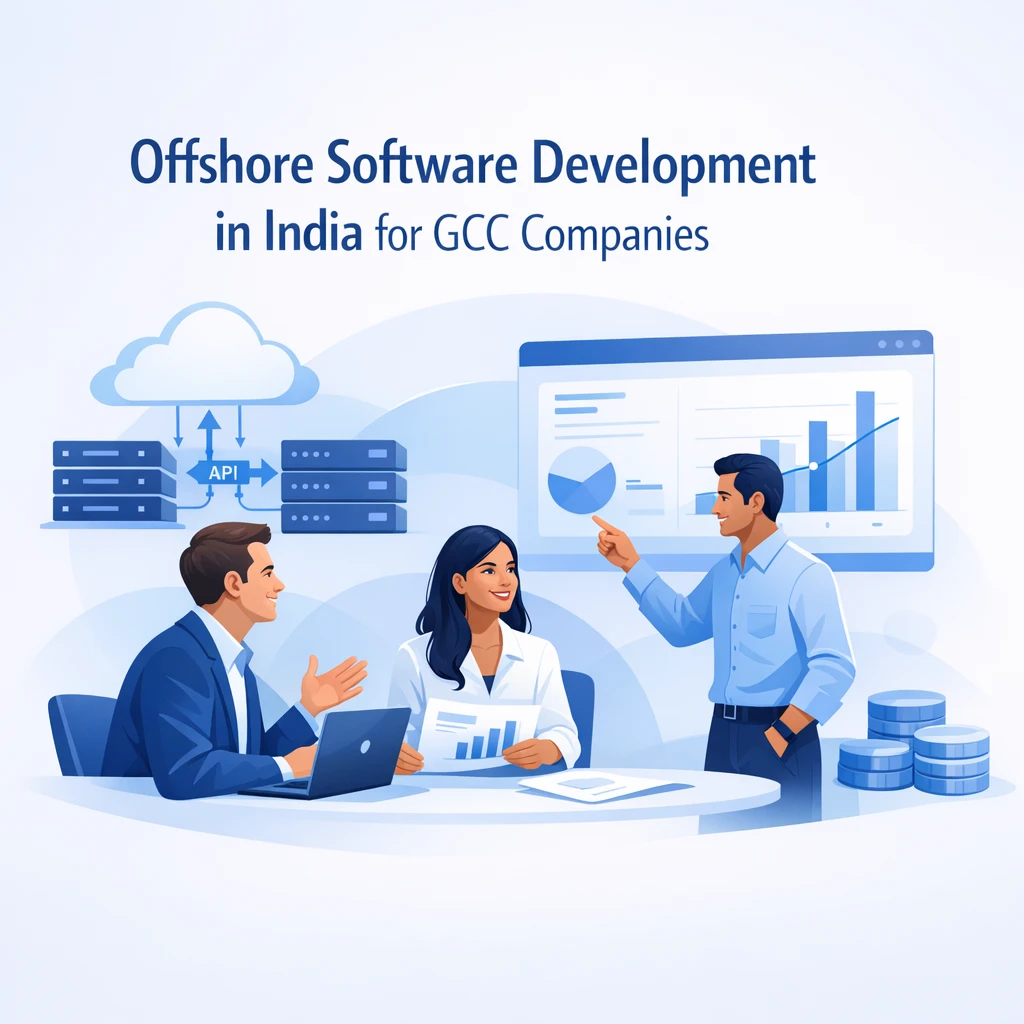
Global GCC enterprises seeking digital capabilities often consider offshore software development partners in India. The purpose of this guide is to educate decision-makers—CEOs, CTOs, product leaders, and transformation leads—on how to evaluate vendors, forecast cost savings, and manage delivery for projects typically ranging from USD 5,000 to 200,000. Triostack engages with clients across Dubai, UAE, Saudi Arabia, Qatar, Oman, Kuwait, Bahrain, and beyond, delivering software with a focus on quality, security, and long-term value.
\n\nWhat is Offshore Software Development?
\nOffshore software development is a model where a client contracts a software development partner located in a different country to design, build, test, and deploy software solutions. For GCC companies, India is a long-standing hub because of a large talent pool, competitive rates, and mature processes. The arrangement can involve dedicated teams, cap-ex projects, or product development outsourcing based on the client’s objectives and risk tolerance.
\n\nVendor Selection: How GCC Companies Pick a Partner
\nVendor selection is more than a single transaction. It is a strategic decision that impacts product quality, risk, and speed to market. A practical approach includes a two-tier evaluation: (1) capability and governance assessment, and (2) a structured pilot or MVP to prove fit. At Triostack, we advocate a decision framework that combines technical rigor with business outcomes.
\n- \n
- Capability assessment: architecture maturity, stack alignment, code quality, security posture, and QA discipline. \n
- Delivery governance: PM maturity, sprint rituals, reporting cadence, and risk management. \n
- Security and compliance: data protection, IP ownership, NDA strength, and regulatory awareness for GCC markets. \n
- Reference checks: client references, case studies, and the ability to demonstrate proven outcomes in similar domains. \n
- Pilot / MVP: a compact project to validate collaboration, tooling, and quality gates before larger commitments. \n
When you evaluate a partner, ask for: (i) a sample architecture diagram; (ii) a transparent staffing plan with roles and experience; (iii) a documented QA strategy; (iv) evidence of security controls enforced across the SDLC; and (v) a clear plan for knowledge transfer and long-term maintenance. Triostack emphasizes architecture-first delivery, governance, and measurable outcomes to ensure a low-risk, high-value engagement.
\n\nWhy it Matters in 2026
\nGlobal tech delivery has evolved. The COVID-era acceleration of remote work is now a standard operating model. For GCC firms aiming to accelerate time-to-market and preserve capital, outsourcing development to India offers:
\n- \n
- Access to a vast, multi-disciplinary talent pool with experience across fintech, healthcare, logistics, and retail. \n
- Cost efficiency without compromising quality, due to favorable overall cost baselines and high productivity. \n
- Scalable engagement models that adjust to project scope, from MVPs to full-scale enterprise platforms. \n
- Robust security frameworks and IP protection aligned with international standards. \n
Current Industry Challenges
\nOutsourcing can deliver value, but it requires careful navigation of common obstacles:
\n- \n
- Vendor due diligence: evaluating capabilities beyond marketing collateral, including code quality, testing rigor, and client references. \n
- Scope drift and misalignment: startups and SMBs often underestimate the complexity of integration with existing systems. \n
- Security and compliance: data protection, privacy laws, and regulatory requirements across GCC markets. \n
- Communication and collaboration: time-zone differences and cultural nuances can affect speed and clarity. \n
- Quality assurance: ensuring that the offshore team delivers at or above the client’s quality bar, including performance, security, and maintainability. \n
How the Technology Works
\nOffshore development uses established software engineering practices across a range of engagement models. The core building blocks include product discovery, agile delivery, continuous integration and deployment, and ongoing maintenance. A typical engagement involves daily standups, weekly demos, backlog grooming, and periodic architecture reviews. Modern tooling—Jira, ClickUp, GitHub or GitLab, Azure DevOps, Slack or Teams, Zoom or Google Meet—enables tight collaboration across continents while maintaining governance and IP protection.
\n\nArchitecture Overview
\nAn effective offshore project architecture balances modular design with robust governance. A common pattern looks like:
\n\nStep-by-Step Workflow
\nBelow is a practical, end-to-end workflow you can adapt. The steps assume a typical project in the USD 5k–200k range, with a dedicated Triostack team or hybrid model.
\n- \n
- Discovery & Scope Definition:
align business goals, success metrics, and constraints; define MVP scope and critical risk items. \n - Vendor Evaluation & Due Diligence:
assess technical capabilities, security posture, and reference checks; request a small pilot if feasible. \n - Engagement Model Selection:
choose between dedicated teams, managed services, or project-based engagement. \n - Contracting & IP Protection:
clarify ownership, NDAs, data handling, and exit terms. \n - Architecture & Tech Stack Agreement:
validate architecture decisions, data flows, and integration points. \n - Plan & Sprint Cadence:
define sprint length, milestones, and acceptance criteria; set up CI/CD pipelines. \n - Design & Prototyping:
wireframes, UI/UX concepts, and proof-of-concept components as needed. \n - Development & Continuous Feedback:
short sprints with automated testing and code reviews; weekly demos. \n - QA, Security, and Compliance:
functional, performance, and security testing; vulnerability scanning; compliance checks. \n - Staging, UAT, and Production:
deploy to staging, run user acceptance testing, and promote to production with proper change management. \n - Maintenance & Support:
post-release monitoring, incident response, and feature enhancements. \n
Business Use Cases
\nVarious GCC market segments benefit from offshore development. Here are representative use cases that Triostack has supported with measurable outcomes:
\n\nCase Study: Dubai-based Logistics Company
\nChallenge: A mid-size logistics provider needed a real-time tracking portal and an API layer to integrate with partner carriers. They required rapid delivery within a tight regulatory window for data protection and scalability.
\nApproach: Triostack assembled a dedicated team in India to deliver a modular platform with microservices, API-first design, and a unified data model. The project included a secure staging environment, automated tests, and a CI/CD pipeline with automated security checks.
\nOutcome: A scalable web portal and robust APIs reduced manual coordination time by 40% and delivered two major feature releases per quarter. The work adhered to UAE data protection guidelines and achieved ISO-like QA rigor.
\n\nCase Study: UAE Healthcare Clinic
\nChallenge: A regional clinic needed a patient portal, appointment scheduling, and integration with an electronic health records (EHR) system. Security and privacy were top priorities.
\nApproach: A phased delivery with a HIPAA-like security posture for patient data, role-based access control, and audit trails. Triostack hosted the solution in a cloud environment with encrypted data at rest and in transit, plus regular security testing.
\nOutcome: Improved patient engagement, 24/7 online appointment access, and smoother data flow to the EHR. The project also established a foundation for telemedicine features in subsequent phases.
\n\nCase Study: Saudi Retail Business
\nChallenge: The retailer required a storefront modernization, CRM integration, and a loyalty program with cross-channel support.
\nApproach: A phased migration to a microservices-based architecture, with a CRM integration layer and a cloud-native deployment model. The team used a blended offshore-onshore model to balance time zones and maintain quick feedback loops.
\nOutcome: Faster Go-to-Market for promotions and a 15–20% uplift in customer retention for key campaigns, supported by analytics dashboards and shopper insights.
\n\nCase Study: Australian Startup
\nChallenge: An early-stage product needed a scalable backend, mobile apps, and an analytics layer for growth experimentation.
\nApproach: Triostack delivered a full-stack product with a modular monolith evolving into microservices, while implementing product analytics and a light ML capability to drive recommendations.
\nOutcome: A viable MVP path with rapid iteration cycles, enabling the startup to raise a round after demonstrating product-market fit in international markets.
\n\nCase Study: UK SaaS Company
\nChallenge: The UK-based SaaS business sought to accelerate development without sacrificing reliability or security in a multi-tenant environment.
\nApproach: A joint offshore-onshore delivery model, with security-by-design principles and automated testing; deployment to a resilient cloud platform with robust monitoring.
\nOutcome: A multi-tenant SaaS platform with improved uptime, faster feature delivery, and a scalable roadmap for future integrations.
\n\nIndustry Applications
\nWhile the examples above highlight logistics, healthcare, retail, and SaaS, offshore software development in India is widely applicable across GCC industries:
\n- \n
- Financial services and fintech platforms requiring secure, compliant software delivery. \n
- Healthcare technology with strong data governance requirements. \n
- Logistics and supply chain platforms needing real-time visibility and integration. \n
- Retail and e-commerce ecosystems with omnichannel capabilities. \n
- Manufacturing and industrial IoT for remote monitoring and analytics. \n
Benefits
\n- \n
- Cost efficiency: Competitive hourly rates and lower T&M costs without compromising quality. \n
- Access to global talent: A broad pool of engineers with experience in modern stacks and industry verticals. \n
- Faster delivery: Scalable teams that can ramp up quickly for MVPs and product iterations. \n
- Quality and governance: Mature QA practices, automated testing, and clear IP protection. \n
- Operational resilience: Ability to run a distributed product team with robust security and backups. \n
Challenges
\n- \n
- Coordination complexity: Aligning time zones and establishing clear rituals is essential. \n
- Scope and change management: Projects can drift without disciplined backlog control. \n
- Security and compliance: Data protection across regions with varying regulations. \n
- Vendor risk: Over-reliance on a single supplier can be risky; diversification is sometimes prudent. \n
Common Mistakes
\n- \n
- Jumping to development before a solid product discovery phase. \n
- Underinvesting in architecture and security from day one. \n
- Ambiguity in acceptance criteria and performance metrics. \n
- Inadequate knowledge transfer and documentation for long-term maintenance. \n
Best Practices
\nTo maximize success, consider the following best practices when engaging with offshore partners in India:
\n- \n
- Start with a pilot or MVP to validate alignment before larger commitments. \n
- Establish a clear engagement model with defined SLAs, KPIs, and IP ownership terms. \n
- Invest in architecture governance, including modular design and API-first integration. \n
- Adopt robust QA and security practices, including automated testing and vulnerability scanning. \n
- Foster transparent communication: regular demos, written decisions, and shared documentation. \n
- Plan for knowledge transfer and long-term support, including maintenance SLAs and on-call coverage. \n
Build vs Buy Comparison
\nFor many SMBs, the decision to build in-house versus outsource to an offshore partner hinges on control, cost, risk, and speed to market. The table below highlights typical considerations.
\n\n| Aspect | In-House / Onshore | Offshore with Triostack (India) |
|---|---|---|
| Cost | Higher salary bands; office+infrastructure | Lower rates; scalable staffing |
| Time to hire | Longer due to local market dynamics | Faster access to skilled engineers |
| Control | High; direct oversight | Structured governance with PMs |
| Quality risk | Depends on team | Established QA, automated testing |
| IP protection | Standard protections | NDAs, data handling, security |
| Scalability | Limited by local hires | Elastic teams and ramping |
Estimated Development Cost
\nBelow are realistic price ranges for typical SMB software initiatives. Note that actual prices depend on scope, complexity, regulatory requirements, and the need for integration with legacy systems.
\n\n| Project Type | Typical Range (USD) |
|---|---|
| Business Website | 5,000 – 15,000 |
| Customer Portal | 10,000 – 40,000 |
| CRM | 15,000 – 100,000 |
| ERP | 40,000 – 200,000 |
| AI Chatbot | 5,000 – 25,000 |
| AI Automation | 15,000 – 80,000 |
| SaaS MVP | 20,000 – 80,000 |
| Enterprise Web App | 30,000 – 200,000 |
Recommended Technology Stack
\nChoosing the right technology stack is a balance of team strengths, project needs, and long-term maintainability. The stacks below reflect modern, scalable choices suitable for SMBs and growing companies.
\n\n| Layer | Recommended Technologies |
|---|---|
| Frontend | React or Vue; TypeScript; CSS-in-JS |
| Backend | Node.js, Python (FastAPI / Django), Java/Spring Boot |
| Mobile | React Native or Flutter |
| Data & AI | PostgreSQL, MongoDB, Python ML stack; frameworks like TensorFlow/PyTorch |
| Cloud & DevOps | AWS/GCP/Azure; Docker + Kubernetes; CI/CD pipelines |
| Security | OWASP, SAST/DAST, IAM, encryption in transit & at rest |
| QA & Testing | Jest/Playwright; Selenium; performance testing tools |
| Analytics & BI | Looker/Power BI or Metabase; data pipelines |
Future Trends
\nThe offshore development landscape is evolving rapidly. Several megatrends shape decision-making for 2026 and beyond:
\n- \n
- AI-assisted software engineering: AI copilots to speed up coding, testing, and debugging; but human oversight remains essential. \n
- Product-led outsourcing: teams aligned around measurable outcomes rather than feature dumps. \n
- Security-by-default: zero-trust architectures, integrated threat modeling, and secure-by-design practices integrated in sprints. \n
- Platform ecosystems: API-first design enabling rapid integration with ERP/CRM and industry-tailored apps. \n
- Automation across the lifecycle: automated deployment, testing, and monitoring to improve reliability and speed. \n
How Triostack Delivers Projects Globally
\nTriostack has delivered software projects for clients around the world, including GCC markets, from a distributed delivery model anchored in India. The approach emphasizes governance, transparency, and predictable outcomes:
\n- \n
- Dedicated teams or managed services: flexible engagement models tuned to project scope and risk tolerance. \n
- Robust security & compliance: NDAs, data handling policies, and IP ownership clarity. \n
- Time zone overlap and communication: overlapping hours with UAE and GCC markets to enable daily touchpoints. \n
- Quality-centered development: automated testing, code reviews, and architecture governance. \n
- Long-term partnerships: ongoing support, maintenance, and roadmap alignment with customer goals. \n
Why Businesses Choose Triostack
\nTriostack emphasizes pragmatic software engineering that scales. The company offers a full spectrum of services—from Custom Software and Web Development to AI Development, CRM, ERP, SaaS, Cloud Migration, DevOps, UI/UX, API Development, Dedicated Teams, QA, and Maintenance. By combining industry knowledge with disciplined execution, Triostack helps GCC, Middle East, North American, and European customers execute multi-sprint delivery calendars with minimal friction. The firm’s approach prioritizes architecture first, governance second, and rapid value delivery third.
\n\nConclusion
\nOffshore software development in India offers GCC companies a practical path to accelerate digital transformation, control costs, and access high-caliber engineering. The decision to work with a partner should emphasize vendor discipline, governance, and the ability to deliver a repeatable, maintainable product. Triostack’s experience with remote delivery, modern tech stacks, and structured engagement models provides a framework for success, not a guarantee of dependency. When approached with clear goals, phased milestones, and a robust risk plan, offshore development can be a catalyst for long-term growth.
\n\nFrequently Asked Questions
\n- \n
- What is offshore software development? \n
- Outsourcing software development to a third-party provider located in a different country to design, build, test, and maintain software solutions. \n
- Why India? \n
- India offers a large, diverse talent pool, mature processes, and cost efficiencies, along with a well-established outsourcing ecosystem that supports complex projects. \n
- How do I evaluate an offshore partner? \n
- Assess technical capabilities, architectural approach, security posture, client references, and a clear pilot or MVP plan. Look for governance, communication rituals, and IP protections. \n
- How long does a typical project take? \n
- Timeline varies by scope. A small MVP may run 8–12 weeks, while a full-featured enterprise web app can span 6–12 months or more; Triostack favors iterative releases with weekly demos. \n
REMOTE DELIVERY: How Triostack Executes Projects from India
\nDelivering quality software remotely requires disciplined processes, robust tooling, and exceptional communication. Triostack’s remote delivery model centers on:
\n- \n
- Agile governance: sprint planning, backlog refinement, and clear acceptance criteria. \n
- Dedicated project managers: single point of contact for the client, ensuring alignment and transparency. \n
- Regular updates: weekly demos via Slack/Teams/Zoom and shared documentation in a central portal. \n
- Collaboration tools: Jira/ClickUp for task management; GitHub/GitLab for source control; CI/CD pipelines; cloud staging environments. \n
- Security & IP protection: strict NDA, access controls, encrypted data handling, and secure development practices. \n
- Time zone overlap: coordinating with GCC teams to enable daily check-ins when necessary; most sessions occur during overlapping hours to support quick decisions. \n
- English communication: professional, proactive, and clear technical writing and presentation materials. \n
- Dedicated PMs and long-term support: ongoing maintenance and feature updates after go-live, with agreed SLAs. \n
Why UAE businesses outsource development to India remains compelling: predictable cost efficiency, access to a large talent pool, faster hiring, flexible scaling, high-quality engineering, and strong communication. By combining these factors with a mature outsourcing ecosystem and a culture of client success, Triostack helps clients build scalable digital products that survive the test of time.
\n
Triostack Team
Technology Evangelist & Writer
Triostack Team is an experienced writer and technologist, exploring the intersections of AI, cloud architecture, and modern application development. Passionate about turning complex technical concepts into accessible insights.