Offshore Software Development for UK and GCC Companies: How to Reduce Costs Without Sacrificing Quality
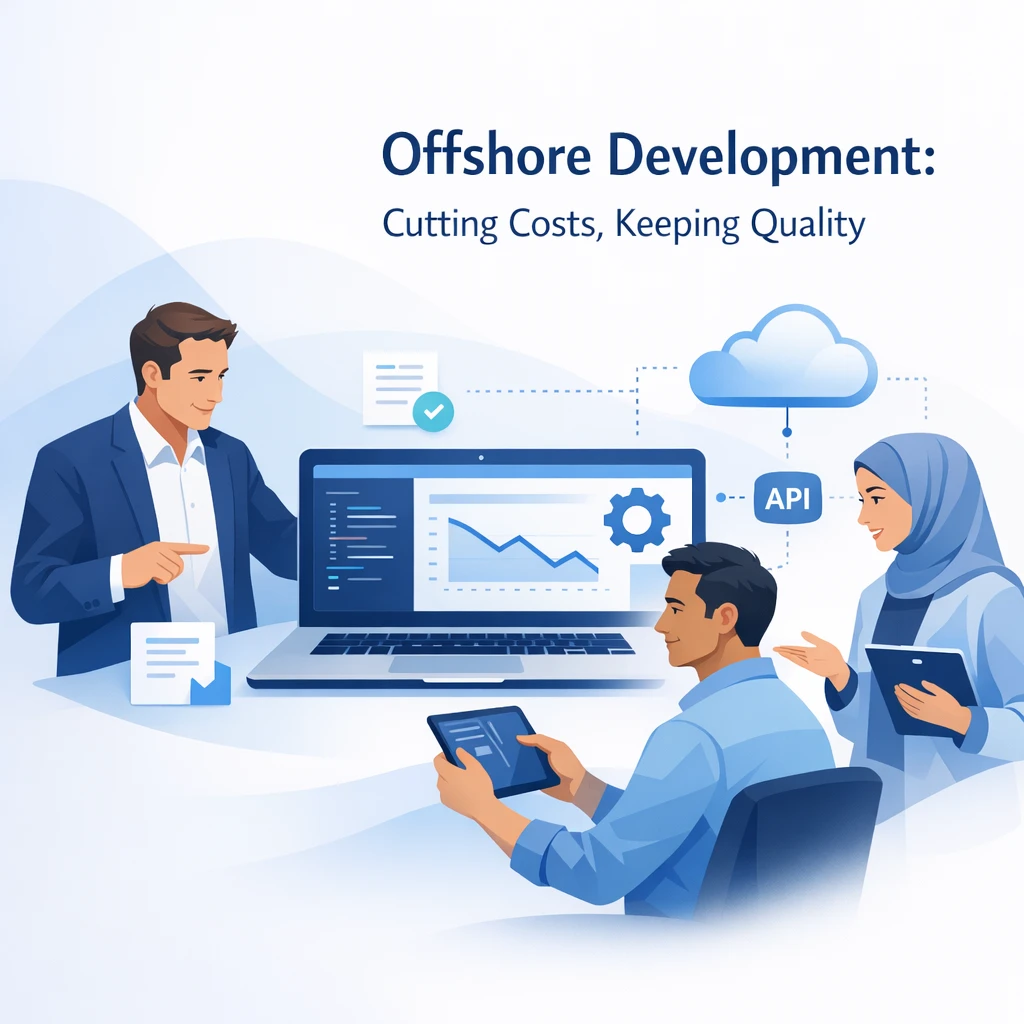
Exploring practical, implementable ways to access high-quality software development from global teams while keeping budgets in check. This article blends industry insight with real-world guidance to help SMBs, startups, and established enterprises plan, execute, and scale offshore software initiatives.
Introduction
For many UK and GCC organizations, offshore software development is a strategic option to accelerate digital transformation, access a broader talent pool, and align project budgets with business outcomes. The goal is not to choose between cost and quality but to design a delivery model that optimizes both. This article provides a practical, practitioner-focused guide to offshore software development that preserves quality while reducing total cost of ownership. The guidance is applicable to SMBs, SMEs, startup founders, CEOs, CTOs, product managers, and digital transformation leaders planning projects in the USD 5,000 to USD 200,000 range.
Throughout, we’ll weave examples based on common scenarios in the Dubai, UAE, Saudi Arabia, Qatar, Oman, Kuwait, Bahrain markets, and extend to the United States, Canada, UK, Europe, Australia, and Singapore. Triostack Technologies is positioned as a trusted, global software development partner that blends deep engineering capability with practical delivery discipline.
What is Offshore Software Development?
Offshore software development refers to the practice of contracting software design, development, QA, and related services to teams located in distant time zones or jurisdictions. The objective is to access cost-effective talent while maintaining alignment with business goals, governance, and quality expectations. In practice, offshore engagements usually involve:
- Dedicated or managed teams with clearly defined roles
- Agile or hybrid delivery models to maintain iterative progress
- Structured governance, security, and IP protection measures
- Transparent pricing with predictable milestones
Triostack emphasizes a collaborative approach, combining local leadership in the UK/GCC with an established delivery presence in India to create a global yet cohesive software factory. This model enables early risk mitigation, faster hiring cycles, and scalable teams that align with project scope and budget constraints.
Why it Matters in 2026
The business environment in 2026 remains characterized by rapid technology adoption, evolving regulatory requirements, and rising expectations for software quality and security. Several trends amplify the case for offshore partnerships:
- Talent scarcity beyond Tier-1 markets creates pressure on timelines and cost.
- Digital transformation urgency requires rapid experimentation and scalable delivery.
- Global compliance and data sovereignty demand mature security and governance frameworks.
- Cloud-native architectures and AI demand specialized skills that can be sourced globally.
For UK and GCC organizations, offshore delivery can bridge talent gaps while enabling continuous improvement through disciplined DevOps, testing, and QA practices. The key is designing processes that maintain alignment with local regulatory expectations, customer needs, and company standards.
Current Industry Challenges
Organizations pursuing offshore software development encounter a range of challenges. Recognizing and addressing these early can save time and reduce risk:
- Time zone and communication gaps can slow feedback loops if not managed with synchronous ceremonies and clear handoffs.
- Security and IP protection require robust NDAs, access controls, and data governance policies.
- Regulatory alignment with GDPR-like standards, data residency rules, and industry-specific compliance.
- Vendor evaluation and governance complexity across borders.
- Quality assurance at distance hinges on mature testing, documentation, and continuous integration.
Triostack addresses these through structured engagement models, transparent reporting, and pragmatic risk management tailored to UK and GCC expectations.
How the Technology Works
Offshore delivery succeeds when people, process, and technology converge. A typical arrangement involves:
- Clear engagement model such as dedicated teams, staff augmentation, or project-based engagement.
- Structured agile ceremonies including sprint planning, daily standups, sprint reviews, and retrospectives.
- Robust DevSecOps practices with CI/CD pipelines, automated testing, and secure code repositories.
- Transparent governance with monthly steering, risk registers, and KPI dashboards.
Triostack leverages a combination of offshore engineering talent with local program leadership to ensure alignment with UK and GCC business stakeholders, regulatory requirements, and customers' expectations for quality and security.
Architecture Overview
While every project is unique, most offshore engagements share a common architectural pattern. The diagram below depicts a typical modern software stack:
Key components often include:
- Frontend: Web and mobile interfaces using modern frameworks
- Backend: Microservices or modular monoliths with APIs
- Data: SQL and NoSQL stores with data governance
- Cloud: Public or hybrid cloud with scalable resources
- DevOps: CI/CD, automated tests, security scanning
For regulated industries in the UAE, Saudi Arabia, and beyond, data residency and access controls are embedded into the architecture, ensuring compliance and auditable traceability.
Step-by-Step Workflow
Here is a practical delivery flow that many Triostack customers find effective when working with offshore teams:
- Discovery and scope: Align on business goals, user personas, and success metrics. Produce a high-level architecture and a prioritized backlog.
- SOW and governance: Define scope, milestones, IP ownership, NDA, and data security requirements. Establish the steering committee and reporting cadence.
- Team formation: Assemble a dedicated team with clear roles (PM, tech lead, engineers, QA, UI/UX, DevOps).
- Kick-off and planning: Conduct a collaborative kickoff, set sprint length, and establish cadences for demos and reviews.
- Iterative development: Execute sprints with daily standups, story point tracking, and continuous integration.
- Quality assurance: Integrate automated tests, code reviews, security testing, and performance testing.
- Staging and release: Deploy to cloud staging for user acceptance testing and stakeholder sign-off before production.
- Maintenance and evolution: Post-launch support, feature refinements, and scaled capability expansions.
Business Use Cases
Offshore development is well-suited for a wide range of business scenarios. Here are representative use cases with practical outcomes:
- Customer Portal for a mid-market organization and its partners, providing secure access, order tracking, and support workflows.
- CRM and Sales Automation to unify leads, opportunities, and customer data across channels with integrated analytics.
- ERP modernization including financials, procurement, and inventory with modular deployment and incremental rollout.
- AI-assisted automation for routine processes, such as ticket routing, invoice processing, or chat-based customer support.
Across these use cases, offshore delivery excels when stakeholders define measurable goals, maintain clear contracts, and enforce consistent QA and security standards.
Industry Applications
Verticals common to UK and GCC markets include logistics, healthcare, retail, manufacturing, and financial services. Offshore teams can contribute across layers, from core systems to customer-facing apps:
- Logistics and supply chain: real-time tracking, route optimization, and fleet management systems.
- Healthcare: patient portals, appointment scheduling, secure data exchange, and telehealth features.
- Retail and e-commerce: omnichannel platforms, loyalty programs, and inventory visibility.
- Financial services: secure portals, analytics pipelines, and regulatory reporting tooling.
Triostack emphasizes industry-aware practices, with security, compliance, and UI/UX design tailored to domain requirements.
Benefits of Offshore Software Development for UK and GCC Companies
- Cost efficiency through competitive market rates while maintaining high engineering standards.
- Access to a larger talent pool with expertise in modern technologies and practices.
- Faster time to market via parallel work streams and round-the-clock progress with time-zone handoffs.
- Scalability to ramp up or down based on project needs without long hiring cycles.
- Focus on core business by outsourcing execution while retaining strategic control.
Challenges and How to Mitigate Them
- Quality assurance requires a mature testing strategy, automated pipelines, and early QA involvement.
- Security and IP demand robust NDAs, access controls, encryption, and code ownership agreements.
- Communication improves with overlapping hours, structured demos, and concise documentation.
Working with an experienced partner like Triostack helps address these challenges through a combination of governance rituals, tooling, and codified best practices.
Common Mistakes and How to Avoid Them
- Rushing scoping leads to scope creep and late change orders. Invest in a robust discovery phase.
- Ignoring security early in design leads to expensive fixes later.
- Underestimating QA and performance testing; allocate dedicated time and resources for non-functional requirements.
- Over-reliance on tools without human oversight; combine automation with experienced engineering judgment.
Best Practices for Successful Offshore Delivery
- Define an explicit build vs buy strategy and evaluate core differentiators for your product.
- Establish a shared product backlog with transparent prioritization and acceptance criteria.
- Governance and IP ensure clear ownership, licensing, and exit options.
- Security by design embed encryption, authentication, and audit trails from day one.
- Proof of quality require demonstrable artifacts at each milestone: shippable features, test results, and documentation.
Build vs Buy: A Quick Comparison
In offshore engagements, deciding between building in-house or buying an off-the-shelf solution is common. Consider these factors:
| Factor | Build (Offshore) | Buy (Offshore or Local) |
|---|---|---|
| Time-to-value | Longer upfront, but tailored | Faster to deploy but may require adaptations |
| Cost predictability | Transparent milestone-based pricing | License or subscription models with ongoing fees |
| Customization | High customization to fit exact processes | Limited customization unless expensive extensions |
| Control and IP | Full control over code and IP | IP ownership may vary by vendor |
Estimated Development Cost (SMB Perspective)
Pricing for offshore development varies by engagement type, location, and scope. Below are typical ranges that SMBs and startups might expect for common software projects. These ranges are indicative and depend on requirements, team composition, and duration.
| Project Type | Typical Range (USD) |
|---|---|
| Business Website | 5,000 – 15,000 |
| Customer Portal | 10,000 – 40,000 |
| CRM | 15,000 – 100,000 |
| ERP | 40,000 – 200,000 |
| AI Chatbot | 5,000 – 25,000 |
| AI Automation | 15,000 – 80,000 |
| SaaS MVP | 20,000 – 80,000 |
| Enterprise Web App | 30,000 – 200,000 |
Pricing factors include: scope, complexity, data migration needs, compliance requirements, UX maturity, integration needs, cloud adoption, security standards, and ongoing support.
Recommended Technology Stack
While a project’s exact stack depends on the domain, Triostack typically aligns technology choices with business goals, performance, and security needs. Common combinations include:
- Frontend: React, Angular, or Vue with TypeScript for maintainability.
- Backend: Node.js, Java Spring Boot, or .NET for scalable APIs.
- Mobile: React Native or Flutter for cross-platform reach.
- AI & ML: Python with TensorFlow or PyTorch, hosted model services.
- CRM/ERP: Custom integrations or industry-standard platforms with custom modules.
- Cloud & DevOps: AWS, Azure, or Google Cloud; CI/CD via GitHub Actions or Azure DevOps.
- QA & UI/UX: Automated testing suites, manual QA, and user-centered design practices.
Triostack emphasizes secure, scalable architectures, modular design, and clear data governance aligned to regional requirements in the UAE and GCC, as well as GDPR-like standards in Western markets.
Future Trends in Offshore Software Development
Key trends shaping offshore delivery include:
- AI-enabled development with copilots, automated code fixes, and intelligent testing.
- Platformization of services to accelerate integrations and productization.
- Security-first design integrating privacy, threat modeling, and continuous compliance checks.
- Geo-agnostic collaboration with resilient communication pipelines and time-zone-aware planning.
For regional players, screening for local compliance and data residency remains essential, even as offshore teams bring global best practices to the table.
How Triostack Delivers Projects Globally
Triostack supports clients across the globe by combining a mature offshore delivery capability with local leadership and client-side collaboration. The model emphasizes:
- Remote delivery from India with English-speaking teams, clear time-zone overlap, and structured communication channels.
- Agile governance with dedicated project managers, weekly demos, and transparent roadmaps.
- Security and compliance including NDA, data handling policies, and role-based access control.
- Long-term support and ongoing optimization after launch.
Operationally, Triostack uses a combination of tools to support remote work and collaboration, including Slack, Teams, Zoom, Google Meet, Jira, ClickUp, GitHub, GitLab, and Azure DevOps. Cloud staging environments and robust QA practices ensure quality before production releases.
REMOTE DELIVERY: How Triostack Executes from India
The remote delivery model is designed to minimize friction and maximize collaboration with UK and GCC teams. It includes:
- Agile with sprint planning, backlog grooming, and sprint reviews that include client stakeholders.
- Weekly demos that provide visibility into progress and early risk identification.
- Communication channels via Slack, Teams, Zoom, and Google Meet for real-time updates.
- Project management and code collaboration using Jira, ClickUp, GitHub, and GitLab, complemented by versioned documentation in Confluence or Notion.
- CI/CD and cloud staging with automated tests, security scans, and staged deployments before production.
- Security and IP ownership protected through NDAs, role-based access, encrypted repositories, and formal IP agreements.
- Time-zone overlap strategically scheduled to align with client hours for critical reviews and decisions.
- Dedicated project managers who act as the single point of contact for clients, ensuring continuity and accountability.
Why UAE businesses outsource development to India is driven by a combination of cost efficiency, a large talent pool, faster hiring, flexible scaling, high-quality engineering, and strong communication capabilities. Triostack also emphasizes robust governance and documentation to ensure clear ownership and predictable outcomes.
Case Studies (Realistic Scenarios, Anonymized)
Below are anonymized, plausible scenarios that illustrate how offshore development can address concrete business needs without relying on fabricated company names or statistics.
Case 1: Dubai-based logistics company modernizes field operations
Challenge: Disconnected field data, delayed parcel status updates, and suboptimal route planning that increased last-mile costs. Goal: Build an integrated logistics app with real-time tracking and driver workflow automation.
Approach: Triostack assembled a dedicated team in India to design and develop a modular logistics platform with a mobile app for drivers, a backend for route optimization, and an admin console for dispatchers. The project followed an Agile cadence with weekly demos to the Dubai-based stakeholders.
Technology: React for frontend, Node.js microservices, PostgreSQL, Redis, and a cloud-hosted Kubernetes cluster. Integrations included an API with the courier partner network and a routing engine using open-source algorithms.
Outcome: Improved visibility across the delivery network, faster issue resolution, and a framework that allowed the client to add predictive analytics for delivery windows. The engagement demonstrated how offshore teams can deliver a mission-critical utility with strong governance and iterative refinement.
Case 2: UAE healthcare clinic launches patient portal
Challenge: A patient portal with secure registration, appointment scheduling, and patient data access that complied with local privacy expectations. Goal: Build a compliant, user-friendly portal and integrate with existing practice management systems.
Approach: Triostack deployed a dedicated team to design a HIPAA-like security posture tailored to regional requirements, built a patient portal, and created integrations with the clinic’s management software.
Technology: Angular frontend, .NET Core backend, OAuth2, JWT, PostgreSQL, and encrypted data storage. DevOps practices included automated security testing and regular penetration testing cycles.
Outcome: A secure, accessible patient portal that improved appointment adherence and patient engagement while maintaining rigorous data protection standards.
Case 3: Saudi retail business implements omnichannel CRM
Challenge: Fragmented customer data, inconsistent marketing messaging, and inefficiencies in loyalty programs. Goal: A unified CRM with omnichannel engagement and analytics dashboards.
Approach: A cross-functional offshore team collaborated with local stakeholders to design a data model, implement integrations with POS systems, and deliver a marketing automation layer.
Technology: React frontend, Node.js backend, GraphQL APIs, MongoDB for customer data, and cloud analytics components. Security and data governance were embedded from the outset.
Outcome: A unified view of customers and streamlined marketing workflows that enabled more consistent customer experiences and data-driven decision making.
Case 4: Australian startup builds a SaaS MVP for a regional market
Challenge: A minimal viable product to validate a new SaaS concept with limited budget and a tight timeline. Goal: Deliver core features with a scalable architecture suitable for growth.
Approach: Triostack provided a compact offshore squad focused on rapid delivery, with emphasis on UX, scalable backend, and an automated testing regime. Weekly client reviews ensured alignment with product-market fit.
Technology: Vue.js frontend, Node.js PaaS backend, PostgreSQL, and containerized deployment in a cloud environment with a simple CI/CD pipeline.
Outcome: A viable product within budget that allowed the client to start user testing and iterate quickly based on feedback.
How to Start with Triostack
If you are planning a similar software project, Triostack can help you design, build, deploy and maintain a scalable solution. Start with a structured discovery phase to clarify goals, risk, and success metrics. We emphasize governance, security, and measurable outcomes from day one.
Tip: Initiate a conversation with a concise brief that outlines business objectives, target users, and any regulatory constraints. A well-scoped discovery phase reduces risk and speeds up delivery.
Frequently Asked Questions
What factors influence offshore development costs?
Project scope, complexity, required integrations, data migration, security and compliance needs, performance requirements, and the chosen technology stack all influence cost. Structured discovery helps establish a predictable price range.
How does Triostack handle IP and security?
We use robust NDAs, role-based access control, encrypted repositories, secure development environments, and formal IP ownership agreements. Security is integrated from day one through threat modeling and continuous security testing.
What is the typical lifecycle for an offshore engagement?
Discovery, SOW and governance, team formation, planning, iterative development, QA, staging, production, and ongoing maintenance. Governance rituals and transparent reporting are maintained throughout.
Conclusion
Offshore software development, when executed with disciplined governance, strong security practices, and clear alignment to business outcomes, can deliver substantial cost savings without compromising quality. UK and GCC organizations can leverage offshore delivery to scale faster, access global talent, and stay competitive in a dynamic digital economy. Triostack works with clients to design the right blend of offshore capabilities, ensuring clear ownership, transparent collaboration, and continuous improvement.
As you evaluate options, consider not just price but a holistic view of capability, governance, and long-term value. A thoughtful offshore strategy—combined with Triostack’s experience in Custom Software, Web and Mobile Development, AI, CRM, ERP, SaaS, Cloud Migration, DevOps, UI/UX, API Development, Dedicated Teams, QA, Maintenance, and Technical Consulting—can help you deliver resilient software that scales with your business.
Triostack Team
Technology Evangelist & Writer
Triostack Team is an experienced writer and technologist, exploring the intersections of AI, cloud architecture, and modern application development. Passionate about turning complex technical concepts into accessible insights.