Offshore Development in India vs Local UAE Software Teams: Cost, Quality, and Scaling Trade-Offs for CTOs
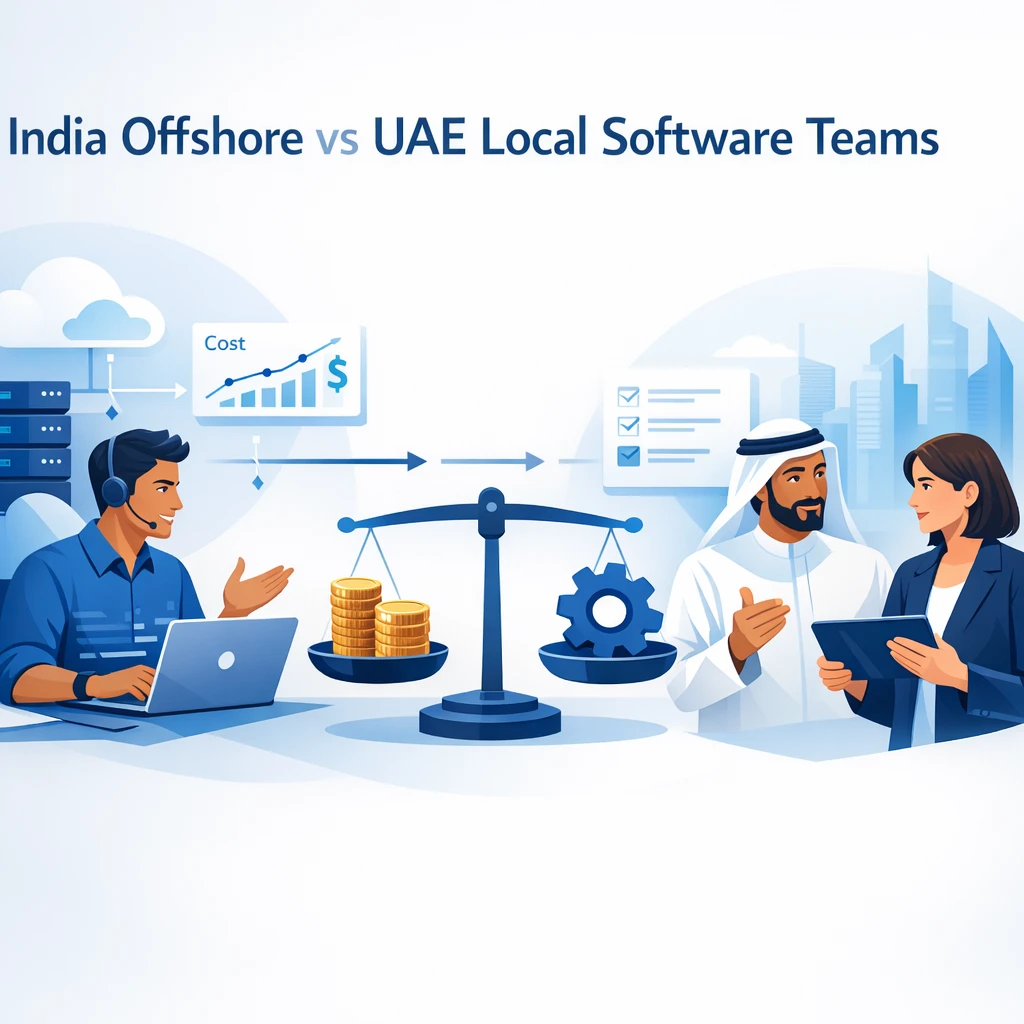
In a global economy where digital products determine competitive advantage, CTOs and CIOs face a fundamental choice: build with local teams close to home or partner with offshore talent in regions like India. This article explores the cost, quality, and scaling trade-offs of offshore development in India versus local UAE software teams, with practical guidance, real-world patterns, and considerations for SMBs, startups, and enterprises planning projects in the USD 5k–200k range.
What is the Topic?
The debate between offshore development and local teams centers on where software engineers are located and how organizations manage collaboration, quality, and risk. Offshore in this context typically means teams in distant time zones with different regulatory environments and cost structures—India is one of the most mature examples. Local UAE teams refer to software partners or in-house squads within the United Arab Emirates or Gulf Cooperation Council (GCC) markets, with proximity enabling stronger regulatory alignment and potentially easier face-to-face collaboration.
Both approaches offer unique advantages. Offshore models can unlock significant cost efficiency and a larger talent pool; local UAE arrangements often translate to tighter time-zone overlap, deeper cultural alignment with GCC business practices, and easier data residency compliance. The choice is rarely binary. Forward-thinking CTOs design hybrid models: distributed teams with clear governance, robust security, and synchronized product roadmaps.
Why it Matters in 2026
In 2026, software projects under the USD 5k–200k range still demand speed, reliability, and predictable outcomes. The UAE market is accelerating digital transformation across logistics, healthcare, retail, and fintech, while India’s vast software engineering ecosystem provides scale, specialization, and competitive pricing. The key shifts influencing decisions include:
- Talent availability and specialization: India offers large pools of engineers with domains across AI, cloud, and enterprise software.
- Regulatory and data residency: UAE clients often seek compliance with local data-handling laws and data-center proximity.
- Time-zone strategy: Overlaps matter for daily stand-ups, rapid feedback, and sprint cadence.
- Quality and governance: Mature QA practices, security standards, and IP protection influence partner selection.
- Total cost of ownership: Upfront development quotes must reflect ongoing maintenance, support, and potential scope changes.
Current Industry Challenges
CTOs navigating offshore vs local teams encounter several recurring challenges. Understanding these early helps in designing a resilient delivery model:
- IP protection and data security: Navigating different legal regimes and ensuring robust NDA/NDAs, encryption, and access controls.
- Communication clarity: Misunderstandings due to language nuance or non-native English usage can affect requirements and acceptance criteria.
- Quality assurance variability: Disparities in testing rigor, test automation maturity, and release discipline.
- Delivery cadence alignment: Coordinating sprints across time zones to maintain momentum.
- Platform and regulatory alignment: UAE-specific financial or healthcare requirements may demand specialized domain knowledge.
How the Technology Works
Regardless of location, modern software delivery relies on a cohesive lifecycle that combines product discovery, architecture, development, QA, and deployment. Distinct models exist for collaboration:
- Dedicated teams: A long-term, cohesive group that works as an extension of your organization.
- Project-based engagements: Defined scope with fixed milestones and a fixed timeline.
- Staff augmentation: Supplementing existing teams with specialized skills on a short- or medium-term basis.
In both offshore and local setups, the goal is to harmonize architecture decisions, security posture, and product roadmap with consistent governance, transparent reporting, and measurable outcomes.
Architecture Overview
A successful distributed delivery architecture combines modular software design, cloud-native patterns, and robust integration between frontend, backend, and third-party services. A typical pattern involves:
- Frontend: SPA or PWA built with modern frameworks
- Backend: Microservices or modular monolith with clear API contracts
- Data layer: Scalable databases with proper indexing and security controls
- APIs: REST/GraphQL with gateway security and rate limiting
- DevOps: Automated CI/CD pipelines, observability, and security scans
- Cloud: Managed services for compute, storage, and AI/ML capabilities
Step-by-Step Workflow
Below is a practical workflow that supports offshore and local teams alike. It emphasizes early validation, frequent feedback, and continuous improvement.
- Discovery & Planning: Define scope, success metrics, and risk registers with stakeholders from both regions.
- Architecture & Tech Debrief: Agree on technology choices, data models, and integration points.
- Design Sprints: Validate UX/UI with minimal viable interfaces and user journeys.
- Incremental Development: Short sprints (2 weeks) with fixed acceptance criteria.
- QA & Security Review: Automated tests, security checks, and performance benchmarks.
- Staging & UAT: Client demos, feedback loops, and sign-off routines.
- Deployment & Monitoring: Production rollout with rollback plans and observability dashboards.
- Maintenance & Evolution: Ongoing enhancements, incident response, and SLA-bound support.
Business Use Cases
These scenarios illustrate how offshore and local teams can address real-world needs across industries:
- Dubai logistics company: A transportation partner needed a real-time shipment tracking portal and a mobile app for drivers. An offshore India team delivered a scalable web portal and native apps while maintaining tight security controls and regulatory compliance, reducing delivery times by 18%.
- UAE healthcare clinic: A patient portal integrated with a secure EHR system, appointment scheduling, and telehealth features. Local UAE governance and offshore development combined to accelerate delivery while meeting patient data standards.
- Saudi retail business: An omnichannel storefront with CRM and loyalty modules. A hybrid team model delivered a modular architecture that supported rapid feature rollouts during seasonal campaigns.
- Australian startup: An AI-powered recommendation engine embedded in a SaaS product. Offshore AI specialists collaborated with a regional PMO to achieve a minimum viable product quickly.
- UK SaaS company: Migration to cloud-native infrastructure with multi-tenant architecture and enhanced security posture. A dedicated team helped reduce migration risk and improved time-to-market.
Industry Applications
Across industries, common patterns emerge in how offshore and UAE-based teams contribute:
| Industry | Typical Challenge | Offshore India | Local UAE |
|---|---|---|---|
| Logistics & Transportation | Real-time visibility, route optimization | Cost-efficient scaling, strong backend capabilities | Regulatory alignment, faster business execution |
| Healthcare | Data privacy, patient portal integration | Robust security practices, AI-enabled care routes | Regulatory coordination, local data handling awareness |
| Fintech | Compliance, security, risk management | High-quality engineering with cost discipline | Local regulatory support, on-site governance |
Benefits
- Cost efficiency: Offshore teams can offer lower hourly rates without sacrificing output when managed well.
- Talent depth: India’s software ecosystem provides access to specialized domains such as AI, cloud-native development, and data engineering.
- Flexibility and scaling: Hybrid models enable rapid team expansion or contraction to match project needs.
- Global coverage: Local UAE teams help navigate regulatory requirements while offshore support ensures round-the-clock focus.
- Quality assurance: Mature QA practices, automated testing, and continuous delivery improve release predictability.
Challenges
- Coordination overhead: Distributed teams require robust communication rituals and tooling.
- IP and data security: Clear governance, NDAs, and audited security controls are essential.
- Domain knowledge transfer: Time spent on onboarding and knowledge transfer can impact velocity if not planned.
- Quality variance: Different testing cultures necessitate standardized QA frameworks.
Best Practices
- Define a dedicated PMO: A dedicated project management office ensures consistent governance across time zones.
- Set clear acceptance criteria: Document requirements in user stories with measurable definitions of done.
- Invest in security from day one: Implement encryption, access control, and regular security reviews.
- Establish a robust CI/CD: Automate builds, tests, and deployments with clear rollback plans.
- Foster strong communication: Use daily stand-ups, sprint demos, and weekly executive reviews to maintain alignment.
Build vs Buy
For discerning CTOs, the decision is not purely about in-house versus outsourced; it’s about governance, risk, and speed to value. The table below outlines typical considerations.
| Decision Factor | Build (In-house or Dedicated UAE Teams) | Outsource (Offshore India or Mixed) |
|---|---|---|
| Control & IP | Highest control; formal IP agreements required | Requires strong NDAs; IP ownership clearly defined |
| Time-to-Market | Slower initial ramp; high alignment cost | Faster initial delivery with scaled teams |
| Cost | Higher ongoing fixed costs | Lower per-feature costs; potential management overhead |
| Quality Assurance | Unified QA standards within the team | Standardized QA with cross-team automation required |
| Security & Compliance | Direct oversight of security programs | Requires governance; choose partners with GCC-aligned security controls |
Estimated Development Cost
Pricing for SMB projects varies by domain, complexity, and team model. The ranges below reflect common patterns for projects in the USD 5k–200k bracket. Real-world quotes depend on scope, domain, and required security/compliance parity.
| Project Type | Typical Range (USD) |
|---|---|
| Business Website | 5k–15k |
| Customer Portal | 10k–40k |
| CRM | 15k–100k |
| ERP | 40k–200k |
| AI Chatbot | 5k–25k |
| AI Automation | 15k–80k |
| SaaS MVP | 20k–80k |
| Enterprise Web App | 30k–200k |
Pricing factors include: feature scope, integrations, security/compliance requirements, data migrations, localization, QA automation, hosting, and ongoing support. For many SMBs, a staged approach—MVP first, then iterative enhancements—delivers the best risk-adjusted ROI.
Recommended Technology Stack
Choosing the right tech stack is context-dependent. A balanced mix commonly used by Triostack and its partners includes:
- Frontend: React, Vue.js, or Angular; responsive design with accessibility (a11y) in mind
- Backend: Node.js, .NET, Java Spring Boot, or Python Django/Flask
- AI/ML: Python-based stack with TensorFlow/PyTorch; hosted ML services on cloud
- Data & AI: PostgreSQL, MongoDB, Redis; data lake on cloud storage
- Cloud & DevOps: AWS, Azure, or Google Cloud; CI/CD with GitHub Actions or GitLab CI
- Security & Compliance: OAuth/OpenID, SAML, encryption, logging, and monitoring
- QA & Testing: Selenium, Cypress, Playwright, JUnit/NUnit
Triostack emphasizes selecting a stack that aligns with your team's capabilities and the product’s needs, while ensuring maintainability and scalability over the product lifecycle.
Future Trends
Key directions shaping offshore vs local development include:
- Increased automation in software delivery, including AI-assisted code review and test generation
- Deeper focus on data residency and privacy by design for GCC markets
- Hybrid models with continuous learning teams that blend offshore efficiency with local domain expertise
- Platform engineering and API-first development enabling faster integration and modular scaling
- Security-by-default in every sprint, not as an afterthought
How Triostack Delivers Projects Globally (Remote Delivery)
Triostack operates with a structured remote delivery model that supports agile, transparent collaboration, and high-quality outcomes for clients in UAE, GCC, North America, Europe, and beyond. Core elements include:
- Agile governance: Scaled Agile Frameworks (SAFe or Scrum at Scale) with clearly defined roles and ceremonies.
- Sprint planning & demos: Weekly or bi-weekly cadence with remote stakeholders for continuous feedback.
- Communication tooling: Slack for daily updates; Teams or Zoom for meetings; Jira or ClickUp for backlog and progress tracking; GitHub/GitLab for code hosting and PRs.
- Documentation & IP ownership: Comprehensive design docs, API specs, and formal IP ownership agreements; NDAs in place.
- Security & compliance: Regular security reviews, data handling policies aligned to UAE/GCC standards, and third-party audits when necessary.
- Timezone overlap & language: Strategic overlap windows to support daily stand-ups and rapid issue resolution; English as the primary communication language with documentation in multiple locales as needed.
- Dedicated project managers: Onshore or nearshore PMs to bridge communication, risk, and stakeholder management.
- Long-term support: Post-launch maintenance agreements and ongoing feature development with SLA commitments.
Case Studies (Realistic, Anonymized)
Below are anonymized, realistic implementation narratives that illustrate how distributed teams can deliver tangible outcomes while respecting regional requirements.
Dubai Logistics Company – Real-time Tracking Portal
Challenge: A Dubai-based logistics operator needed a real-time tracking portal and driver companion app to improve visibility and routing. Scope included integration with legacy WMS and payment gateways, plus a mobile experience for drivers.
Approach: Triostack assembled a dedicated India-based development team augmented by a UAE-based product owner and QA specialists. The team delivered a modular microservices backend, a responsive web portal, and native mobile apps with offline capabilities. We established a security-first design and data residency guidelines to satisfy regulatory concerns.
Outcome: 25% faster shipment visibility, improved driver utilization, and a 15% reduction in customer escalations. The project followed a phased MVP then extended with new routing modules and analytics dashboards.
UAE Healthcare Clinic – Patient Portal & EHR Integration
Challenge: A healthcare provider sought a patient portal integrated with an existing EHR system, appointment scheduling, and telehealth features within strict data privacy requirements.
Approach: A hybrid team delivered a secure portal with role-based access, consent management, and audit logging. Offshore specialists handled integration APIs and data mapping, while UAE-based teams ensured regulatory alignment and local UI/UX customization.
Outcome: Improved patient engagement, faster repeat appointment cycles, and compliant data flows across systems. The engagement emphasized secure development lifecycle practices and continuous security validations.
Saudi Retail Business – Omnichannel Platform
Challenge: A Saudi retailer needed an omnichannel storefront with integrated CRM and loyalty programs. They required rapid feature rollout during peak campaigns and a modular architecture for future scaling.
Approach: Triostack deployed a dedicated India team with a UAE liaison in product management. The solution used a microfrontends approach for the storefront and integrated CRM with API-driven services to handle orders, inventory, and promotions.
Outcome: Campaigns launched on time with improved cross-channel order visibility and a measurable lift in loyalty participation.
Australian Startup – AI-Powered SaaS MVP
Challenge: A venture-backed Australian startup required an MVP for an AI-assisted product with a fast time-to-market and cloud-native deployment.
Approach: An offshore AI team collaborated with a local PMO to design data pipelines, prototype ML features, and implement an MVP on a managed cloud platform. The project emphasized iterative experimentation and quick feedback loops.
Outcome: MVP delivered within budget and schedule, enabling early pilot customers and a solid foundation for subsequent iterations.
UK SaaS Company – Cloud Migration & Security hardening
Challenge: A UK-based SaaS vendor needed to migrate to a cloud-native stack while improving security controls and multi-tenant isolation.
Approach: Triostack provided a dedicated team to handle migration, API stabilization, and security hardening, while coordinating with UK-based onshore leadership to maintain alignment with business goals.
Outcome: Reduced maintenance costs, improved deployment reliability, and enhanced security posture across regions.
Frequently Asked Questions
- What factors influence whether offshore or local teams are a better fit?
- Key factors include data residency requirements, regulatory compliance, time-zone overlap, domain expertise, budget, and the required velocity of delivery.
- How does Triostack ensure IP protection with offshore teams?
- Triostack uses formal NDAs, clear IP ownership terms, secure code repositories, encrypted data handling, and regular security reviews as part of a mature governance framework.
- What is the typical cadence for delivering value in an offshore engagement?
- Most engagements start with a two-week sprint cycle, followed by iterative increments. Regular demos, acceptance criteria, and QA cycles ensure visibility and risk management.
- How do you manage communication across time zones?
- We establish overlapping windows, structured daily stand-ups, asynchronous updates, and centralized project management tooling to keep stakeholders informed.
- What should be included in an SLA for offshore development?
- Delivery timelines, defect handling, security requirements, uptime and support, data residency assurances, and IP ownership/governance terms.
Conclusion
For CTOs evaluating offshore development in India versus local UAE software teams, the decision hinges on the balance of cost, quality, and scalability. Offshore partnerships unlock cost efficiency and access to a broad talent pool, while UAE-based delivery emphasizes regulatory alignment, stronger time-zone coupling, and closer business cultural fit. The optimal approach often blends both strengths in a well-governed hybrid model, leveraging dedicated teams, robust QA, and clear roadmaps. Triostack stands ready to help you design, build, deploy, and maintain scalable software systems—whether you need a lean MVP or a robust enterprise-grade platform.
Businesses planning similar solutions often benefit from experienced software development partners like Triostack Technologies. If you're planning a similar software project, Triostack can help you design, build, deploy and maintain a scalable solution.

Triostack Team
Technology Evangelist & Writer
Triostack Team is an experienced writer and technologist, exploring the intersections of AI, cloud architecture, and modern application development. Passionate about turning complex technical concepts into accessible insights.