MVP Development Cost in the United States: How Founders Can Launch Faster Without Overbuilding
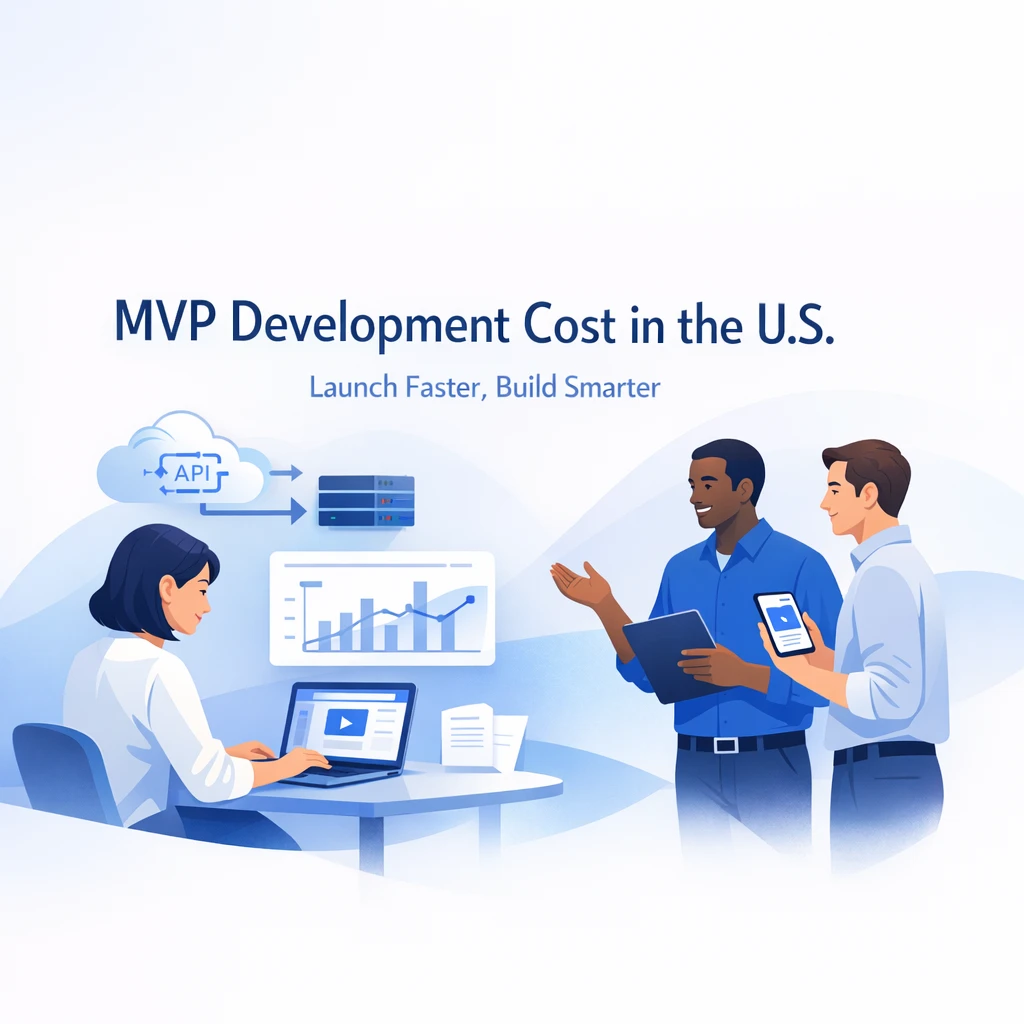
Building a Minimum Viable Product (MVP) is a critical first step for startups and SMBs aiming to validate ideas, attract early adopters, and secure funding. In the United States, where competition is fierce and the pace of adoption is fast, founders often grapple with how to balance speed, quality, and cost. This guide provides a practical framework to estimate MVP costs, avoid overbuilding, and partner with a reliable software development partner to launch faster while maintaining architectural integrity and a path to scale.
While the emphasis here is on the U.S. market, the principles apply globally. The insights also reflect real-world patterns seen in Dubai, UAE, Saudi Arabia, Qatar, Oman, Kuwait, Bahrain, the United Kingdom, Europe, Australia, Singapore, Canada, and beyond—where companies increasingly expect international capabilities, remote delivery, and a proven approach to MVPs.
What is the Topic?
An MVP is a lean version of a product that delivers core value to early users, with a growth plan to add features based on feedback. The cost of building an MVP depends on scope, architecture, team composition, location of the development partner, and the rigor of quality assurance. The central question founders ask is: How can I launch quickly in the U.S. without overbuilding or ballooning the budget?
This article walks through cost drivers, practical budgeting ranges for common MVP components, and a approach for a scalable, secure, and maintainable MVP. It also highlights how Triostack Technologies—along with other seasoned software partners—can help you design, build, deploy, and maintain a high-quality MVP while keeping the total cost predictable.
Why it Matters in 2026
Demand for rapid software delivery continues to accelerate. Founders must balance speed to market with the risk of rework and technical debt. In 2026, market realities include:
- Increased access to global talent and flexible engagement models that enable cost-effective development without compromising quality.
- Rising expectations for cloud-native architectures, data privacy, and scalable APIs.
- Greater emphasis on product-market fit validated through real user feedback rather than lengthy up-front planning.
- Regulatory considerations across industries—healthcare, finance, logistics—affecting how MVPs handle data and compliance from day one.
For founders, the key takeaway is to design for learning: build the smallest possible thing that delivers measurable value, then iterate quickly based on usage data and outcomes. This approach minimizes wasted spend and accelerates progress toward product-market fit.
Current Industry Challenges
Several challenges commonly impact MVP success in the U.S. and globally:
- and feature inflation as stakeholders push for “nice-to-have” capabilities early.
- Quality risk with rushed deployments, security gaps, or flaky integrations.
- Unclear success criteria for the MVP leading to ambiguous feedback and hard decision-making.
- Resource allocation that overcommits to upfront design rather than a lean, iterative process.
- Vendor misalignment where outsourced teams don’t share your product vision or regional constraints.
Addressing these risks requires disciplined scoping, modular architecture, and a reliable partner who can operate effectively in a remote-first environment while maintaining strong communication and governance.
How the Technology Works
An MVP typically emphasizes a few core layers: a user-facing frontend, a resilient backend (APIs, services), a data store, and deployment pipelines. Depending on the product, you may also include AI components, integrations with external systems (CRM, ERP, payment gateways), and a basic analytics layer. The MVP should be cloud-native or cloud-agnostic so you can scale without a heavy re-architecture later.
Key technical principles include:
- Modular architecture with well-defined boundaries (microservices or modular monoliths as appropriate).
- API-first design to enable rapid integrations and future expansion.
- Security-by-design with access controls, encryption, and audit trails from day one.
- Observability through logging, metrics, and tracing to quickly identify and fix issues.
- Continuous delivery with automated testing and deployment pipelines.
In practice, MVP teams often start with a monorepo or a small set of services, then wire in additional capabilities as user signals become clearer. This incremental approach reduces risk and accelerates time to value.
Architecture Overview
Below is a pragmatic, scalable MVP architecture suitable for many product categories—from SaaS and marketplaces to healthcare and logistics tools. It assumes a cloud-native, API-driven approach with modular boundaries and a managed services layer for non-core tasks.
This diagram emphasizes a clean separation of concerns, with a secure entry point (API Gateway), core services, and extensibility for integrations. For MVPs, starting with two to three focused services and a shared data model helps keep costs predictable while enabling future growth. Triostack works with clients to tailor architectures—ranging from monolithic-but-well-structured backends to microservices—based on product needs and the anticipated scale.
Step-by-Step Workflow
A pragmatic MVP workflow blends discovery, fast prototyping, and rigorous validation. Here is a practical sequence that many teams implement successfully:
- Discovery & Goals: Define the problem, target users, and measurable success criteria. Establish a lightweight product requirements document and a validated learning plan.
- UX Strategy & Wireframes: Create user journeys and low-fidelity wireframes to test flows before coding. Prioritize the core value proposition.
- Tech Scoping: Decide on stack, data model, and API contracts. Choose a minimal yet scalable architecture tailored to the MVP’s risk profile.
- Iterative Build: Develop with short sprints, focusing on the MVP’s must-have features first. Use a feature flag strategy for safe incremental releases.
- Quality & Security: Integrate automated tests, security scanning, and privacy controls into CI/CD from day one.
- Launch & Learn: Release to a controlled cohort, collect usage data, and measure against predefined KPIs (e.g., activation rate, retention, conversion).
- Pivot or Scale: Decide whether to pivot, add features, or scale the architecture based on real user feedback and data.
Triostack’s approach emphasizes delivery cadence and visibility—weekly demos, clear sprint goals, and a shared backlog that keeps stakeholders aligned without overcommitting resources.
Business Use Cases
Below are representative MVP scenarios where founders often seek cost-effective, fast-to-market outcomes. Each scenario includes typical scope, outcomes, and the kind of team that achieves them well.
1) Dubai Logistics Company: Real-Time Shipment Tracking
Challenge: A logistics firm needs a lightweight portal for customers to track shipments, view ETAs, and receive alerts. They want a backend to sync data with existing ERP systems.
Approach: Build a web portal with authentication, real-time tracking, and notifications. Use API adapters to integrate with on-prem ERP data and a cloud data store for analytics. MVP features included user login, shipment search, status timeline, and alert rules.
2) UAE Healthcare Clinic: Appointment Scheduling & Patient Portal
Challenge: A clinic requires a patient-facing portal to book appointments, see records, and securely message clinicians, with strict privacy controls.
Approach: Implement a patient portal with SSO, role-based access, secure messaging, and appointment calendars. Use HIPAA-like controls where applicable, with audit logs and data encryption at rest.
3) Saudi Retail Startup: Mobile Loyalty & Ordering
Challenge: A retailer wants a mobile app for loyalty, product discovery, and order placement in a fast-moving market.
Approach: Start with a mobile app and a lightweight backend for loyalty rules, product catalog, and order flow. Include push notifications and a basic analytics dashboard to guide merchandising decisions.
4) Australian Startup: B2B SaaS Onboarding
Challenge: A B2B SaaS company needs an onboarding flow for new customers with guided tours and a usage analytics surface.
Approach: Focus on an onboarding wizard, product tours, and an event-tracking layer that feeds a dashboard used by customer success teams.
5) UK SaaS Company: CRM Lite
Challenge: A European SMB requires a lightweight CRM to manage leads and opportunities with a simple integration to popular email platforms.
Approach: Build core CRM entities, an integration with a widely-used email service, and a robust search capability.
Industry Applications
MVP cost considerations vary by domain. Here are typical industries where rapid MVPs unlock early feedback and revenue signals:
- Logistics and supply chain
- Healthcare and life sciences (with appropriate privacy controls)
- Retail and e-commerce platforms
- Financial services and fintech-leaning applications
- Professional services and B2B platforms
Across these domains, the MVP aims to validate a single value hypothesis—whether a specific feature set can meaningfully improve a business process or customer outcome—before investing in broader capabilities.
Benefits
- Faster time to market with a lean, testable product that yields early feedback.
- Controlled spend by prioritizing must-have features over “nice-to-have” components.
- Lower risk through incremental delivery and ongoing validation against real users.
- Foundation for scale with a modular architecture designed for future enhancements.
- Improved stakeholder alignment via transparent roadmaps, demos, and measurable outcomes.
Challenges
- Balancing speed with quality, especially for regulatory-sensitive domains.
- Ensuring that the MVP remains extensible and not a “one-off” build that becomes tech debt.
- Maintaining product focus when stakeholders have divergent opinions.
- Managing distributed teams and ensuring clear communication across time zones.
Common Mistakes
- Over-scoping the MVP with features that don’t directly prove the core hypothesis.
- Under-investing in security, privacy, and governance from day one.
- Skipping design documentation in favor of ad-hoc development, leading to rework later.
- Choosing a stack based on popularity rather than fit for the MVP’s requirements.
- Failing to plan for data migration and analytics from the start.
Best Practices
- Define a single value hypothesis and measure success with 2–3 KPIs for the MVP.
- Adopt an API-first and modular architecture to keep future expansion cost-effective.
- Use agile ceremonies (short sprints, weekly demos, and a living backlog) to maintain momentum.
- Integrate security and privacy by design, including data encryption and access controls.
- Choose a flexible partner who can operate in your preferred time zones and offer transparent governance.
Build vs Buy: A Quick Reference
| Option | Typical Scope | Pros | Cons |
|---|---|---|---|
| Build (in-house or with a dedicated partner) | Custom MVP with full control | Tailored to exact needs, future-proof | Longer time-to-value, higher upfront cost |
| Buy (out-of-the-box solution with customizations) | Pre-built platform with essential features | Faster time-to-market, lower initial cost | Limited flexibility, ongoing licensing costs |
For most U.S.-based MVPs, a build-with-surgical outsourcing approach—where you buy a limited, well-scoped scaffold and customize it—often delivers the best balance of speed, cost, and control. Triostack frequently helps clients implement a hybrid MVP: core features built in a lean way, with integration adapters and a plan for feature-driven expansion.
Estimated Development Cost
Understanding cost ranges helps founders plan effectively. Below are typical ranges for common MVP components in the United States, reflecting market realities in 2026. Prices assume a mix of nearshore and offshore talent with a clear scope and a dedicated project cadence.
| Component | Typical Range (USD) | Notes |
|---|---|---|
| Business Website | 5,000 – 15,000 | Landing pages, CMS, content strategy |
| Customer Portal | 10,000 – 40,000 | Authentication, dashboards, data views |
| CRM | 15,000 – 100,000 | Lead management, opportunities, reports |
| ERP | 40,000 – 200,000 | Core processes, integrations, multi-entity support |
| AI Chatbot | 5,000 – 25,000 | Rule-based to moderate ML capabilities |
| AI Automation | 15,000 – 80,000 | Process automation, RPA-lite, data workflows |
| SaaS MVP | 20,000 – 80,000 | Multi-tenant, onboarding, analytics |
| Enterprise Web App | 30,000 – 200,000 | Compliance, security, integrations |
Pricing factors include: scope clarity, feature complexity, data migration needs, integrations with third-party systems, regulatory requirements, security and compliance posture, time-to-market pressure, and the chosen technology stack. A well-scoped MVP with a clear data model and API contracts often lands on the lower end of these ranges, while adding AI features or complex ERP integrations pushes costs upward. Triostack helps clients map cost to outcomes, ensuring every dollar aligns with learning goals.
Recommended Technology Stack
For a balanced MVP that scales, a pragmatic stack typically includes:
- Frontend: React or Vue.js for web, with React Native or Flutter for mobile where appropriate.
- Backend: Node.js or .NET Core for service-oriented backends; Java or Go for higher-throughput scenarios.
- APIs: RESTful or GraphQL APIs with clear versioning and schema governance.
- Database: PostgreSQL for relational data; a NoSQL option (e.g., MongoDB) for flexible schemas as needed.
- Cloud & DevOps: AWS or Azure with CI/CD pipelines (GitHub Actions, Azure DevOps); containerization with Docker and orchestration via Kubernetes or a serverless approach for certain components.
- Security & Compliance: IAM, encryption at rest and in transit, regular security scans, and a privacy-by-design approach.
- Analytics & Observability: Centralized logging, metrics, tracing, and a lightweight data analytics layer.
- AI/ML: If required, lightweight ML services or hosted AI APIs with careful data governance.
Triostack brings practical guidance on selecting a stack that balances velocity and long-term maintainability, drawing on global delivery experiences and industry best practices.
Future Trends
Looking ahead, MVPs will increasingly leverage:
- Low-code/no-code elements for rapid prototyping alongside traditional development.
- AI-assisted coding and testing to accelerate validation loops.
- Edge computing for latency-sensitive MVPs in logistics and IoT domains.
- Stronger emphasis on security, privacy, and compliance by design, particularly in healthcare and fintech.
- Deeper platform partnerships with API-driven ecosystems to accelerate integrations.
How Triostack Delivers Projects Globally
Triostack Technologies operates with a global delivery model that blends domain expertise, technical excellence, and agile governance. We help you design, build, deploy, and maintain scalable software products while maintaining a strong focus on ROI and risk management. Our capabilities include:
- Custom Software, Web Development, and Mobile Apps
- AI Development and Machine Learning
- CRM, ERP, and SaaS Platform Development
- Cloud Migration, DevOps, and CI/CD
- UI/UX Design, API Development
- Dedicated Teams, QA, and Maintenance
- Technical Consulting and Architecture Services
We pair deep technical expertise with practical product thinking, ensuring that MVPs are built for growth and resilience. Triostack’s approach emphasizes transparent governance, measurable milestones, and clear ownership of IP and documentation.
Remote Delivery: How Triostack Works from India
Delivering software remotely from India has become a trusted model for many clients in the UAE, GCC, Europe, North America, and beyond. Key elements of Triostack’s remote delivery excellence include:
- Agile framework: Structured sprints, backlog grooming, and sprint planning to maintain alignment and momentum.
- Weekly demos: Regular updates that keep stakeholders informed and reduce rework.
- Communication channels: Slack, Teams, Zoom, Google Meet for real-time collaboration and updates.
- Project management: Jira, ClickUp for task tracking and visibility across teams.
- Version control & CI/CD: GitHub, GitLab, Azure DevOps with automated pipelines and cloud staging environments.
- Security & IP: NDA agreements, strict data handling policies, and clear IP ownership terms.
- Timezone overlap: Flexible overlapping hours to support real-time collaboration with clients in UAE, UK, Europe, and North America.
- English communication: Clear, structured communication and thorough documentation for long-term support.
- Dedicated project managers: Single point of contact to ensure accountability and continuity.
- Long-term support: Post-launch maintenance, updates, and scale-ready roadmaps.
Why do UAE businesses outsource development to India? The reasons include cost efficiency, a large talent pool, faster hiring, high-quality engineering, and strong communication. When paired with robust project management and security practices, this model enables faster MVP delivery without compromising quality or governance. Triostack’s remote delivery model is designed to respect local business practices and regulatory expectations while leveraging global efficiency.
Case Studies
Below are concise, realistic implementations that illustrate how organizations achieve MVP goals through thoughtful scoping, disciplined delivery, and strategic partnerships. Note that these are descriptive examples based on typical engagements and do not disclose confidential data.
Case Study 1: Dubai-based Logistics Company
Situation: A regional logistics operator needed an MVP for real-time shipment tracking and customer-facing dashboards. They required middleware to sync with their existing ERP.
Solution: Triostack delivered a lightweight portal with user authentication, shipment search, real-time status updates, and alert rules. API adapters connected to the ERP, and a small analytics layer provided operational insights. After MVP validation with early customers, the team iterated on alert configurations and expanded the data model for more complex workflows.
Case Study 2: UAE Healthcare Clinic
Situation: A private clinic sought a patient portal with appointment scheduling, secure messaging, and a view of basic medical records, all under strict privacy controls.
Solution: Implemented a HIPAA-like compliance posture with encryption, access controls, audit logs, and role-based views. The MVP included patient registration, appointment management, and a secure messaging channel. Triostack guided regulatory considerations and delivered a path to scale into additional modules (lab results, telehealth, and integrated billing).
Case Study 3: Saudi Retail Startup
Situation: A retailer required a mobile app for loyalty, product discovery, and ordering in a competitive market with a need for quick iteration.
Solution: A mobile app in React Native with a lightweight backend powered by a modular microservice layer. The MVP focused on loyalty rules, product catalog, and order placement, accompanied by a basic analytics dashboard to guide merchandising decisions.
Case Study 4: UK SaaS Company
Situation: A UK-based SaaS firm wanted a CRM-lite to manage leads and opportunities, plus integration with an email platform.
Solution: Built core CRM entities, implemented a two-way integration with the selected email service, and delivered robust search and reporting capabilities. The MVP enabled the company to validate sales workflows and adjust product-market fit quickly.
Future Trends
As markets evolve, MVP development in the United States and globally is likely to emphasize:
- More modular, API-driven platforms to enable faster integrations and future extension.
- Greater use of automated testing and AI-assisted development tools to speed delivery.
- Security-by-design practices that address evolving regulatory requirements across sectors.
- Hybrid delivery models combining nearshore, offshore, and local resources to optimize cost and speed.
Frequently Asked Questions
- What is the typical timeline for an MVP in the United States?
- Most MVPs are delivered in 8–16 weeks, depending on scope, integration requirements, and the complexity of the core value proposition. A highly scoped MVP with two to three must-have features can be ready within 8–12 weeks.
- How do you prevent overbuilding during MVP development?
- Start with a crisp value hypothesis, implement strict backlog prioritization, use feature flags, and validate with real users before expanding scope. Regular stakeholder reviews and weekly demos help maintain focus.
- What is the role of security in an MVP?
- Security-by-design ensures identity, access management, data encryption, secure APIs, and audit trails from day one. This reduces rework and speeds up scaling when you expand to enterprise customers.
- How can a partner help with remote delivery from India?
- An experienced partner brings governance models, time-zone aware scheduling, robust communication channels, and mature QA and security practices to ensure a seamless collaboration with clients in the UAE, UK, North America, and beyond.
Conclusion
Launching an MVP in the United States doesn’t require overbuilding or uncertain budgets. By defining a precise value hypothesis, maintaining a lean but scalable architecture, and partnering with a capable software team that can operate globally, founders can accelerate learning, attract early customers, and position their product for rapid iteration and growth. The key is to balance speed with discipline—build only what you must to learn, measure outcomes, and evolve based on real-world feedback.
Triostack Technologies stands ready to support founders and SMBs with custom software, web development, mobile apps, AI development, CRM, ERP, SaaS, cloud migration, DevOps, UI/UX, API development, dedicated teams, QA, and maintenance. If you’re planning a similar software project, Triostack can help you design, build, deploy and maintain a scalable solution.
Frequently Asked Questions (Additional)
- What are realistic cost ranges for an MVP in the U.S. market?
- What is the best way to scope an MVP to avoid overbuilding?
- How can I ensure a smooth remote delivery with an offshore partner?
Triostack Team
Technology Evangelist & Writer
Triostack Team is an experienced writer and technologist, exploring the intersections of AI, cloud architecture, and modern application development. Passionate about turning complex technical concepts into accessible insights.