MVP Development Cost for US Startups: How Founders Can Validate Faster and Raise with Less Capital
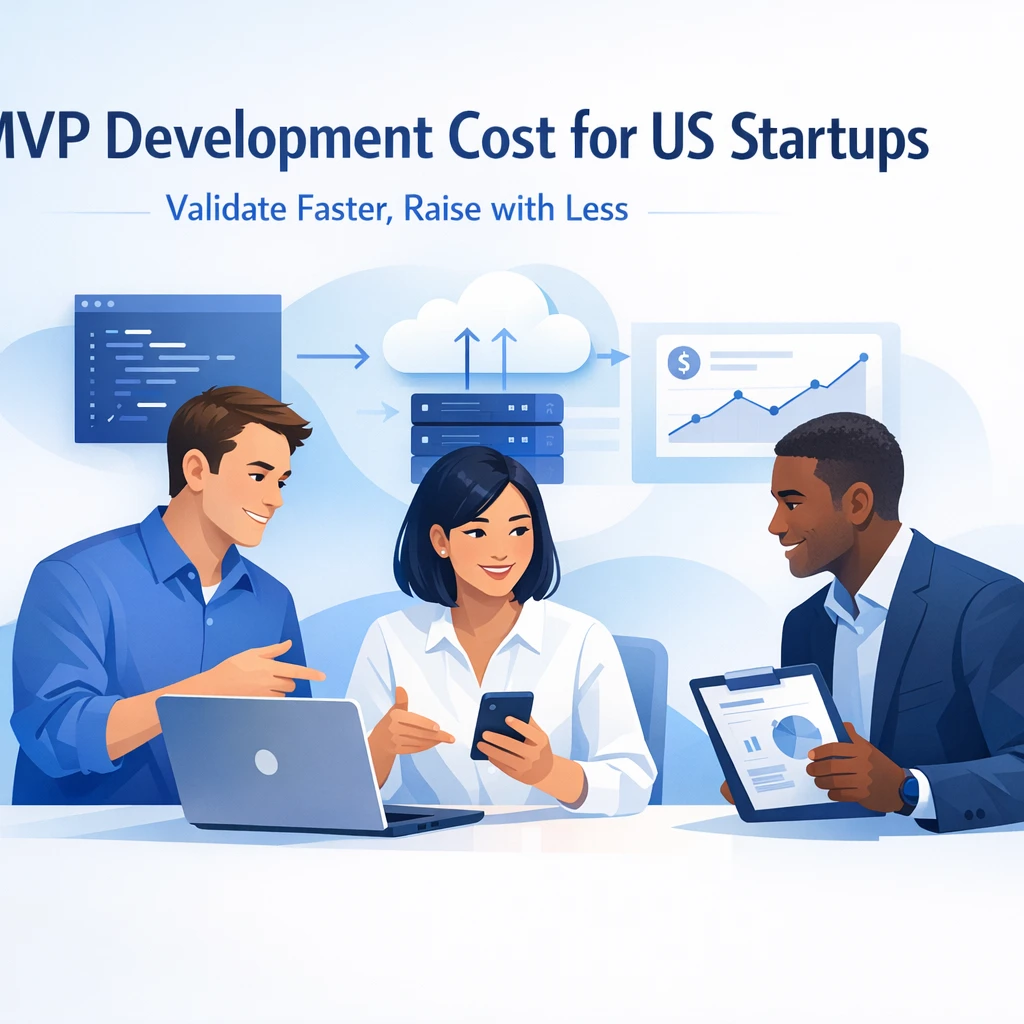
In the fast-moving world of tech startups, building an MVP is not just about code — it’s about learning quickly, testing assumptions, and guiding investors with proof of traction. For founders in the US and global teams serving US markets, understanding the cost dynamics of MVP development can be the difference between a well-funded raise and a stalled idea. This guide provides practical, battle-tested insights to help you validate faster, reduce wasted spend, and position your venture for stronger fundraising conversations — with Triostack Technologies as a global software partner when you need to scale.
Introduction
For US startups and global teams targeting the US market, MVP development is a strategic lever for validation, fundraising, and growth. The cost of building an MVP is not just a spreadsheet line item—it directly shapes how quickly you learn, how convincingly you can demonstrate traction to investors, and how far runway you retain for product iterations. This article offers practical frameworks, real-world examples, and a balanced view of how Triostack Technologies approaches MVP development for a broad range of industries and regions, including the UAE, Europe, and North America.
What is the Topic?
Minimum Viable Product (MVP) is the smallest set of features that delivers the core value proposition to early users and validates critical business hypotheses. An MVP is more than a prototype: it’s a working product you can release to real customers, measure, and iterate on. For founders, MVP development cost matters because it affects your time-to-learning, the volume of experiments you can fund, and your ability to tell a credible fundraising story with evidence rather than assumptions.
Why it Matters in 2026
Economic conditions, competition, and investor expectations continue to evolve. The most successful startups in 2026 combine lean product development with modern architectures that support rapid iteration, data-driven decision-making, and secure multi-tenant platforms. A lean MVP that is extensible, secure, and well-documented can reduce post-launch risk and accelerate investor confidence. In this context, cost is not the only driver—it’s about cost efficiency paired with strategic flexibility.
Current Industry Challenges
- Talent scarcity and rising costs: Hiring senior engineers in traditional markets is expensive; many teams benefit from nearshore or offshore partners to stretch budgets without sacrificing quality.
- Speed vs. quality: Rushing a release can create brittle code; delaying release can stall learning and fundraising momentum.
- Security, compliance, and data privacy: Early-stage products especially in healthcare, fintech, and enterprise sectors must consider regulatory requirements even at MVP scale.
- Remote collaboration: Distributed teams across time zones require solid governance, tooling, and rituals to maintain alignment.
How the Technology Works
An MVP typically blends lean UX, a scalable backend, and a data strategy that supports rapid experimentation. A strong MVP is built on an API-first, modular stack, with feature toggles to manage rollouts and CI/CD to shorten feedback loops. The objective is to deliver measurable value early, learn from real users, and evolve the product in a controlled way.
Architecture Overview
For MVPs, Triostack emphasizes API-first design, secure multi-tenant readiness when needed, and the ability to scale components independently. A practical MVP architecture includes the following layers:
- User Interfaces: Web (Next.js/React) and mobile (React Native or Flutter)
- API Layer: Node.js/Express or Python FastAPI, supporting REST and GraphQL
- Business Logic: Modular services with clear service boundaries
- Data Layer: PostgreSQL for transactions; Redis for caching; optional NoSQL for specialized use cases
- Infrastructure: Cloud provider with infrastructure as code (Terraform), CI/CD, monitoring
- Security & Compliance: IAM, encryption, auditing, and secure data handling
Step-by-Step Workflow
Executing an MVP for a US market startup demands a structured workflow that minimizes waste while preserving speed. The workflow below reflects practical steps used by global software teams who deliver remotely yet stay tightly aligned with US product owners. Additionally, the workflow emphasizes governance practices that support fundraising narratives with traceable metrics.
Key workflow practices
- Discovery validates the problem statement, user personas, success metrics, and potential risk areas within 2–3 weeks.
- Design emphasizes simplicity and modular architecture enabling future feature additions.
- Weekly demos ensure stakeholder alignment and rapid course correction.
- Quality gates (QA, security, accessibility) are integrated into every sprint.
Sprint Cadence and Collaboration
A typical MVP sprint cadence is 1–2 weeks. Triostack uses Jira or ClickUp for planning, Slack for asynchronous updates, and Zoom or Teams for live reviews. A dedicated project manager ensures timezone overlap with the client team to maximize collaboration and reduce feedback latency.
Business Use Cases
Below are representative MVP scenarios common to US and global markets that align with Triostack’s capabilities:
- Customer Portal: A lean portal for tracking orders, quotes, and support tickets with secure authentication and RBAC.
- CRM-lite: Lead capture, contact management, activities, and integration with marketing tools.
- AI-assisted Concierge: A chatbot that handles common inquiries and routes complex requests to humans, enabling faster support.
- Analytics Dashboard: Minimal analytics console with dashboards and KPIs for product teams.
- Partner API: Developer-friendly API with quick onboarding for third-party integrations.
Industry Applications
These industries often realize rapid value from MVPs with limited scope but strong impact:
- Logistics and supply chain: Tracking, routing, and carrier integrations
- Healthcare clinics: Appointment management and patient engagement with privacy by design
- Retail and e-commerce: Inventory, orders, and customer experiences
- Fintech and payments: Lightweight payment flows and risk scoring
- Education: Learning management features and content delivery
Benefits
- Faster validation cycles: Short iterations reveal what matters to customers and investors.
- Cost discipline: Clear scoping keeps runway intact for fundraising.
- Quality from day one: Early investments in architecture and testing lead to reliability and trust.
- Strategic flexibility: Modular stacks support feature expansion or pivots.
- Investor storytelling: Measurable outcomes and traction metrics strengthen fundraising pitches.
Challenges
- Defining a minimal feature set that still delivers value
- Balancing speed with security and compliance
- Selecting an outsourcing model with transparent governance
- Maintaining product quality while scaling the team
Common Mistakes
- Over-scoping the MVP with too many features
- Underinvesting in discovery and user research
- Lack of transparent governance when outsourcing
- Inconsistent engineering standards across distributed teams
Best Practices
- Start with a clear hypothesis and success metrics
- Adopt API-first, modular architecture from day one
- Use feature flags and experiment-driven design
- Establish weekly demos and maintain thorough documentation
- Security and privacy by design from the start
Build vs Buy
Choosing between in-house development and outsourcing hinges on goals, constraints, and risk tolerance. The table below contrasts key factors for clarity:
| Factor | In-House Build | Outsourced MVP with Triostack |
|---|---|---|
| Time-to-Value | Longer due to hiring and ramp-up | Faster with dedicated teams and defined Sprints |
| Cost Predictability | Variable with turnover and learning curves | Transparent pricing and predictable monthly costs |
| Quality & Security | Depends on internal experience | Structured QA, security practices, regulatory alignment |
| Talent Access | Limited by local market | Global talent pool, scalable resources |
| Maintenance | Internal team sustains it | Ongoing support included |
Estimated Development Cost
Understanding approximate budgeting helps founders plan fundraising milestones and communicate a credible plan to investors. Costs vary by feature complexity, regulatory needs, and technology choices. The ranges below reflect common MVP scopes for SMBs and startups delivering software as a service (SaaS) or platform features in US markets, with offshore or nearshore collaboration as a lever for cost efficiency.
| MVP Type | Estimated Range (USD) | Notes |
|---|---|---|
| Business Website | 5,000–15,000 | Basic marketing site with content management and contact forms |
| Customer Portal | 10,000–40,000 | Auth, dashboards, tickets, or orders |
| CRM | 15,000–100,000 | Lead management, pipeline, integrations |
| ERP | 40,000–200,000 | Core modules plus integrations |
| AI Chatbot | 5,000–25,000 | Rule-based to conversational AI with integration |
| AI Automation | 15,000–80,000 | Workflow automation with integrations |
| SaaS MVP | 20,000–80,000 | Core product offering with multi-tenant architecture |
| Enterprise Web App | 30,000–200,000 | More complex features and compliance |
Pricing Factors That Move the Needle
- Scope clarity and feature prioritization
- Choice of tech stack and hosting model
- Security, compliance, and data governance requirements
- User experience and accessibility standards
- Geographic delivery model and time zone overlap
Recommended Technology Stack
Choosing the right stack is essential to achieving a lean MVP that can scale. Below is a pragmatic baseline Triostack often deploys for US startups seeking faster validation with robust scalability.
- Frontend: React / Next.js for server-side rendering and SEO-friendly performance
- Mobile: React Native or Flutter for cross-platform delivery
- Backend: Node.js (Express / Fastify) or Python (FastAPI) for lightweight, scalable services
- APIs: REST and/or GraphQL with a clear API-first approach
- Database: PostgreSQL for transactional data; Redis for caching
- AI/ML: Python-based pipelines; hosted inference in cloud for experiments
- Cloud & Infra: AWS or Azure; Terraform for IaC; containers with Docker; orchestration with Kubernetes or serverless patterns
- CI/CD & Tooling: GitHub Actions or GitLab CI; Jira or ClickUp; Slack; Zoom/Teams; GitHub/GitLab
- Security & Compliance: IAM, encryption, key management, logging, monitoring
Future Trends
- AI-assisted MVPs: Integrating learning agents to accelerate validation
- Platform ecosystems: Modular capabilities that scale across products and markets
- Low-code/no-code components for rapid prototyping
- Security-by-default: Privacy and compliance baked into the MVP from day one
- Hybrid delivery models: Onshore product ownership with offshore execution for speed and cost control
How Triostack Delivers Projects Globally
Triostack Technologies operates as a global software development partner with a focus on high-quality, scalable software delivered remotely. The team blends US market insights with a strong offshore delivery model to maximize value and speed. For SMBs, SMEs, and startups, Triostack offers end-to-end MVP development and ongoing product evolution across a broad set of services:
- Custom Software
- Web Development
- Mobile Apps
- AI Development and Machine Learning
- CRM and ERP integrations
- SaaS product development and platform engineering
- Cloud Migration and DevOps
- UI/UX and API Development
- Dedicated Teams
- QA, Maintenance, and Technical Consulting
Remote Delivery (Continued)
Triostack offers an integrated remote delivery model with teams in India and client hubs around the world. The approach centers on Agile method and disciplined governance:
- Agile project management with sprint planning and weekly demos
- Communication: Slack, Teams, Zoom, Google Meet
- Collaboration: Jira, ClickUp, GitHub, GitLab, Azure DevOps
- CI/CD: Automated pipelines, cloud staging, automated testing
- Documentation and knowledge transfer as a core artifact
- Security, NDA, and IP ownership safeguards
- Dedicated project managers and a clear timezone overlap strategy
- Long-term support, maintenance, and upgrade planning
Why UAE businesses outsource development to India often makes sense: cost efficiency, access to a large talent pool, faster hiring, high-quality engineering, and robust communication can combine to accelerate time-to-market while keeping quality and security high. Timezone overlaps between India and UAE enable near real-time collaboration without the overhead of misaligned working hours.
Case Studies
Below are anonymized case study sketches that illustrate how MVP cost and delivery play out in practice. The scenarios reflect real-world patterns without disclosing confidential data.
Case Study 1 — Dubai Logistics Company (MVP for Carrier & Shipment Tracking)
Challenge: A logistics firm in Dubai needed a lean system to track shipments, provide ETA updates to customers, and generate dashboards for operations teams. Budget constraints required a short time-to-value and tight scope control.
Approach: Triostack delivered a modular MVP with a lightweight web portal and mobile companion, integrating with a subset of carrier APIs and a secure auth layer. We used an API-first design with a shipments microservice, a simple user-management module, and a dashboard service. CI/CD and cloud staging enabled rapid iteration after weekly stakeholder demos.
Outcome: The MVP was delivered within 10 weeks, with measurable user engagement and a clear backlog for a second phase. The client secured follow-on funding for expansion.
Case Study 2 — UAE Healthcare Clinic (Patient Portal & Appointment Management)
Challenge: A clinic needed a compliant patient portal, appointment scheduling, and secure messaging to improve patient experience without overbuilding a full EHR. Data privacy and regulatory alignment were top priorities.
Approach: Triostack built a privacy-conscious MVP with role-based access, appointment flow, messaging, and basic billing integration. We used components with a privacy-by-design approach and implemented robust auditing.
Outcome: Time-to-market was accelerated, patient adoption metrics improved, and the client established a baseline for security and compliance controls to support future digital health expansions.
Case Study 3 — Saudi Retail Business (Omnichannel MVP)
Challenge: A regional retailer aimed to pilot an omnichannel experience with order management and a customer-facing portal to test new channels before a full-scale rollout.
Approach: A lean MVP delivered a lightweight order management backend and a customer portal with integrations to inventory and payments. We kept the scope tight, focusing on core workflows and UX for conversion.
Outcome: The client validated the concept quickly, enabling data-driven decisions for a broader platform strategy and attracting investor interest for the next phase.
Case Study 4 — Australian Startup (SaaS MVP)
Challenge: An Australian startup sought to validate a software concept with a scalable SaaS MVP designed for multi-tenant usage and a clear monetization model.
Approach: Triostack implemented a multi-tenant architecture, essential analytics, and a growth-focused onboarding flow. The MVP emphasized a clean onboarding, reliable payment integration, and robust analytics to capture early traction metrics.
Outcome: The MVP demonstrated viable product-market fit and attracted seed funding to accelerate product development and go-to-market plans.
Case Study 5 — UK SaaS Company (Frontend & API Modernization)
Challenge: A UK-based SaaS provider needed to modernize its frontend and strengthen its API layer to support partners and customers with a smoother onboarding experience.
Approach: We refactored the frontend into a modern React/Next.js architecture, introduced a robust API gateway, and instituted automated end-to-end testing and security checks.
Outcome: The client achieved faster time-to-value for new customers, improved developer experience for partners, and better overall system reliability.
Future Trends (Expanded)
- Platformization: Building modular capabilities that can be reused across products and markets
- AI-assisted decisioning: Smart automation to guide feature prioritization and risk assessment
- Security-first MVPs: Embedding compliance and privacy controls from the outset
- Hybrid delivery models: Combining onshore product ownership with offshore delivery for maximum speed and cost control
Frequently Asked Questions
- What is the typical MVP development timeline?
- A typical MVP timeline ranges from 8 to 14 weeks for a lean scope, with 2–4 additional weeks for onboarding and beta testing, depending on complexity and regulatory requirements.
- How can I validate an MVP with minimal cost?
- Focus on core value delivery, leverage open-source and cloud-native services, use a modular architecture, and run small pilot programs with early adopters to gather feedback quickly.
- What is the role of outsourcing in MVP cost control?
- Outsourcing with a transparent engagement model and strong governance can reduce burn rate, accelerate delivery, and provide access to a broader talent pool while maintaining accountability and security.
- How does Triostack ensure security and IP ownership?
- Triostack uses NDA agreements, clear IP ownership terms, secure development practices, code reviews, and robust access controls to protect client assets and IP.
Conclusion
For US startups and global teams, MVP development cost is not just the price tag—it is the value of learning quickly, the credibility of your fundraising narrative, and the ability to iterate with real users. A lean, well-architected MVP reduces waste, accelerates time-to-market, and opens doors to investment with confidence. Working with an experienced partner like Triostack Technologies can help you align strategy, architecture, and execution to deliver a scalable product while keeping budgets under control. The emphasis remains on practical, measurable outcomes rather than flashy promises.
Businesses planning similar solutions often benefit from experienced software development partners like Triostack Technologies.
Frequently Asked Questions (Continued)
Additional quick references to common concerns you may have when planning an MVP:
- What is a realistic MVP cost for a small, customer-facing web app? Costs vary, but the ranges above provide a benchmark; a typical customer portal MVP often falls in the 10k–40k range depending on integrations and security needs.
- Is offshore delivery a viable option for regulated industries? Yes, when governance, security, and compliance controls are embedded; many regulated industries partner with offshore teams under strict NDA and IP protection.
- How do I track ROI on an MVP? Define success metrics (activation rate, retention, revenue per user) and align them with investor milestones; use dashboards to monitor progress.
Triostack Team
Technology Evangelist & Writer
Triostack Team is an experienced writer and technologist, exploring the intersections of AI, cloud architecture, and modern application development. Passionate about turning complex technical concepts into accessible insights.