Legacy System Modernization in UAE Enterprises: Cost, ROI, and When to Rebuild vs Replatform
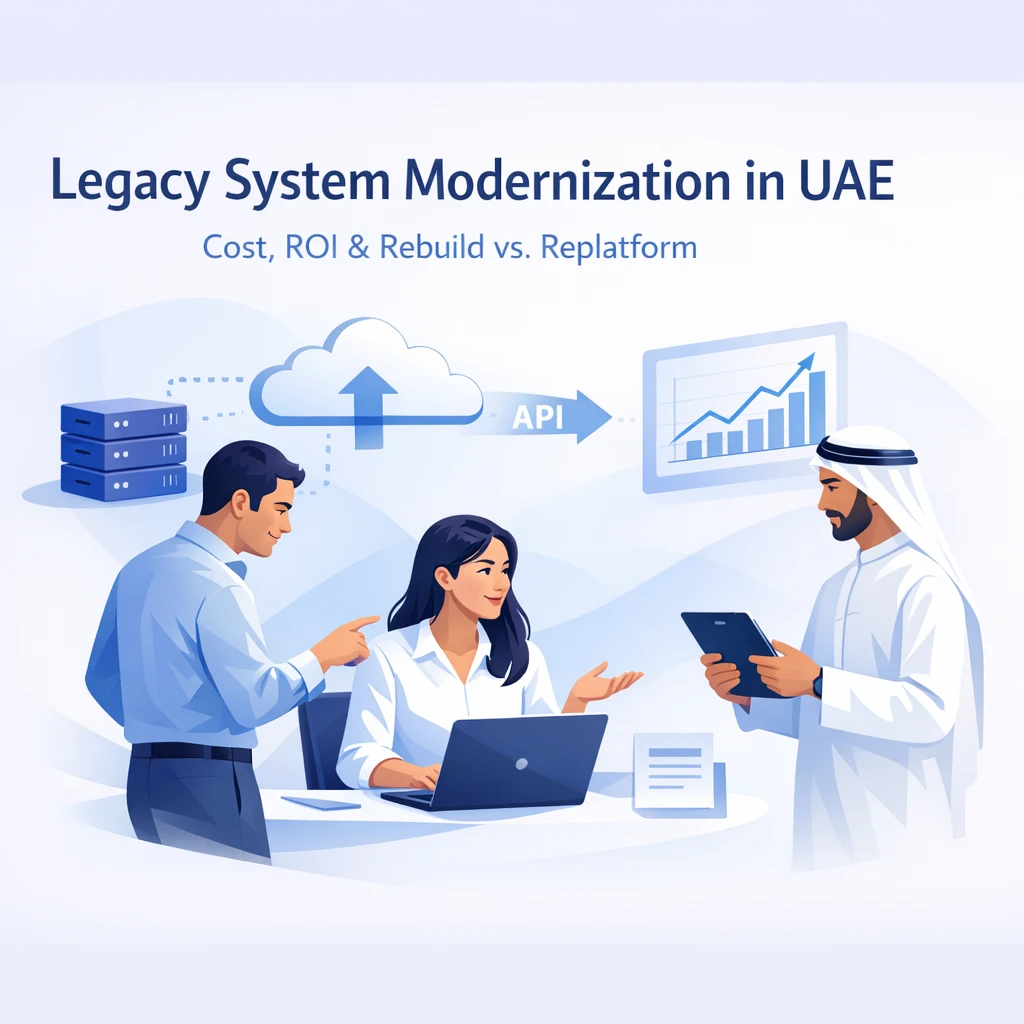
Across the UAE and broader GCC region, digital Transformation is no longer an option but a business necessity. Enterprises operate in a fast-moving economy where data-driven decision making, customer experience, and regulatory compliance dictate competitiveness. Many organizations currently rely on legacy systems that have served well for decades but struggle to scale, integrate, or support modern experiences. This article delves into legacy system modernization for UAE enterprises, exploring cost, return on investment (ROI), and practical guidance on when to rebuild versus replatform. We’ll ground the discussion in real-world patterns, provide actionable workflows, and show how Triostack Technologies partners with organizations around the world to deliver scalable digital products—remotely and securely.
What is the Topic?
Legacy system modernization is the structured process of updating, replacing, or augmenting aging software, data, and infrastructure to meet current business demands. Instead of a dangerous all-at-once rip-and-replace, modernization typically follows a measured path: rehost (lift-and-shift), replatform (upgrade for cloud compatibility), refactor (code optimization for cloud-native architectures), or rebuild (complete re-architecture or greenfield replacement). In practice, most UAE enterprises combine approaches—reusing critical business logic while switching to modular, API-first, cloud-native architectures that support rapid iteration and stronger security.
Triostack Technologies’ global delivery model enables teams to assess options, plan a modernization roadmap, and execute in a way that minimizes risk while maximizing business value. We emphasize clarity about cost, ROI, and timelines, and we tailor delivery to the preferences of UAE-based leadership teams, Saudi, Qatar, Oman, Kuwait, Bahrain, as well as global customers in the United States, the UK, Europe, Australia, Singapore, and beyond.
Why it Matters in 2026
- Cloud maturity and AI integration: Cloud-native architectures enable scalable data processing and faster AI/ML integration for analytics, forecasting, and automation.
- Security and regulatory alignment: Modern platforms make it easier to implement zero-trust security, data residency controls, and industry-specific compliance (e.g., GDPR-like privacy principles, UAE Data Law considerations).
- Agile and continuous delivery: Frequent releases reduce risk and improve time-to-value for new features, regulatory changes, and customer demands.
- Customer experience as a differentiator: Modern front-ends, omnichannel APIs, and real-time data enhance CX across web, mobile, and partners.
- Global talent and delivery flexibility: Access to global talent pools (including India-based delivery centers) supports cost efficiency while maintaining high quality.
For UAE, GCC, and global markets, modernization is less about a single project and more about establishing a repeatable, governed approach to software evolution. This is where Triostack’s experience with custom software, web and mobile development, AI development, CRM, ERP, SaaS, cloud migration, DevOps, UI/UX, API development, and QA can accelerate outcomes without compromising security or control.
Current Industry Challenges
Legacy ERP, CRM, and custom apps often don’t exchange data cleanly, limiting insights and automation possibilities. Older systems can struggle to enforce modern access controls, auditing, and data privacy requirements across borders. Maintenance, licensing, and custom integrations escalate over time, eroding ROI. A shrinking pool of legacy specialists increases risk when plans stall or teams are disrupted.
A well-planned modernization program addresses these challenges through a structured approach that emphasizes governance, risk management, and measurable business outcomes. Triostack works with CIOs, CTOs, and Digital Transformation leaders to align technical choices with strategic goals—whether in Dubai, Abu Dhabi, Jeddah, Riyadh, Doha, Muscat, Manama, or remotely with global teams.
How the Technology Works
Modernization isn’t just about new software; it’s about a cohesive platform that enables data flow, automation, and resilient operations. Key technology patterns include:
- API-first architecture: Expose business capabilities as APIs to enable integration with internal apps and external partners.
- Microservices and modular design: Break monoliths into focused services that can scale independently and be updated safely.
- Cloud-native foundations: Containerization (Docker), orchestration (Kubernetes), and serverless components for elasticity.
- Data modernization: Data lakes, data warehouses, and reliable ETL/ELT pipelines that improve analytics and governance.
- Security by design: Identity management, encryption, IAM policies, and continuous compliance monitoring.
Triostack combines architecture discipline with practical delivery methods to ensure modernization efforts deliver value early and continuously.
Architecture Overview
Below is a representative modern architecture that many UAE-based enterprises adopt when moving away from legacy stacks. It emphasizes API-driven integration, cloud-native services, and robust data governance.
- Legacy systems (ERP, CRM, legacy databases) exposed via adapters
- API Gateway and management layer
- Microservices for core business domains (Orders, Inventory, Customers, Billing)
- Event-driven messaging (Kafka / cloud equivalents) for asynchronous processing
- Frontend apps (Web, Mobile) consuming APIs
- Data ingestion into a data lake -> data warehouse for analytics
- Security, IAM, and monitoring at every layer
Architecture Diagram
Step-by-Step Workflow
- Discovery & Assessment: Inventory of existing assets, data models, and critical business processes. Identify regulatory constraints and alignment with UAE data residency requirements.
- Decide Build vs Buy: Evaluate whether to rebuild modules as cloud-native services or replatform existing code with modern frameworks. Consider time-to-value and risk tolerance.
- Roadmap & Prioritized MVP: Define an MVP that delivers measurable business impact within weeks to months, followed by iterative releases.
- Architecture & Platform Selection: Choose cloud providers, containerization strategies, and data governance frameworks aligned to security needs.
- Implementation & Migration: Incremental migration with backward compatibility and parallel data synchronization.
- Quality Assurance: End-to-end testing, security testing, performance validation, and user acceptance testing.
- Deployment & Cutover: Deploy to production with a staged rollout and rollback plans.
- Operate & Optimize: Ongoing monitoring, cost optimization, and feature-driven enhancements.
Business Use Cases
Below are representative modernization use cases that resonate with UAE and global enterprises. Each case highlights challenges, approaches, and outcomes without disclosing confidential metrics.
- Dubai-based Logistics Company: Modernize order management and logistics ERP, integrate with transportation partners, and enable real-time shipment tracking across multiple channels.
- UAE Healthcare Clinic: Rebuild a telemedicine portal and patient portal, integrate with electronic medical records (EMR), and improve appointment management and billing workflows.
- Saudi-based Retailer: Deploy a cloud-native e-commerce platform with omnichannel capabilities, inventory synchronization, and secure payments.
- Australian Startup: Build a cloud-native MVP for a scalable SaaS product, emphasizing rapid iteration and a modular architecture from day one.
- UK SaaS Company: Refactor a monolithic platform into microservices with API-first design, enabling easier international expansion and multi-tenant data isolation.
Industry Applications
Modernization strategies vary by sector. Key industry applications include:
Real-time visibility, route optimization, carrier integrations. Unified commerce, cart recovery, sub-second inventory updates. Asset management, predictive maintenance, mobile field apps. Fraud detection, customer onboarding, loan origination workflows.
Benefits
- Improved agility: Faster response to market changes and regulatory updates.
- Enhanced security & compliance: Modern IAM, auditing, data residency controls, and policy enforcement.
- Scalability & resilience: Cloud-native architectures that scale with demand and recover gracefully from failures.
- Better data quality & insights: Unified data governance, analytics-ready data, and actionable dashboards.
- Cost optimization: Reduced maintenance costs over time and more efficient resource usage.
Challenges
Data integrity, downtime, and user adoption concerns require careful planning. - Vendor and tool fragmentation: Choosing the right mix of cloud providers, tools, and integration patterns.
- Security & data governance: Maintaining compliance across borders and ensuring robust data protection.
- Budget and ROI uncertainties: Aligning investment with tangible business outcomes and time-to-value.
Common Mistakes
- Underestimating data migration complexity and data quality remediation requirements.
- Treating modernization as a single project instead of a program with governance and milestones.
- Choosing technology for the buzzword rather than business fit (e.g., chasing fashionable tech instead of aligning with objectives).
- Inadequate stakeholder alignment and change management planning.
Best Practices
Validate value early and evolve through iterations. - Embrace API-first and modular design: Enables reuse, partner integrations, and easier scaling.
- Prioritize data governance and security: Build security into every layer from day one.
- Leverage a hybrid delivery model: Combine onshore leadership with offshore/nearshore delivery for cost efficiency and talent access.
- Plan for change management: Invest in training, communication, and user enablement.
Build vs Buy: A Practical Comparison
Many UAE enterprises confront the decision to build custom software in-house or buy a packaged solution and tailor it. The right choice often depends on business context, timelines, and risk tolerance. The table below contrasts common characteristics.
| Aspect | Build (Custom) | Buy (Commercial) |
|---|---|---|
| Time to value | Longer (custom development) | Faster (baseline features) |
| Customization | High; tailor to unique processes | Limited to vendor’s roadmap |
| Control & IP | Full ownership | Vendor-owned with licensing |
| Cost variability | Often higher upfront; scalable over time | Predictable licensing; possible hidden costs |
| Maintenance | In-house or dedicated team required | Vendor-managed; updates may be slower |
Triostack helps clients evaluate these dimensions through structured workshops, architecture reviews, and a proof-of-concept phase when appropriate. We tailor engagement models to regional needs and budgets, including dedicated teams and flexible staffing.
Estimated Development Cost
Below are realistic ranges for common SMB/SME modernization initiatives. These figures are indicative and depend on scope, complexity, data migration needs, compliance requirements, and cloud strategy.
| Project Type | Typical Range (USD) |
|---|---|
| Business Website | 5,000 – 15,000 |
| Customer Portal | 10,000 – 40,000 |
| CRM | 15,000 – 100,000 |
| ERP | 40,000 – 200,000 |
| AI Chatbot | 5,000 – 25,000 |
| AI Automation | 15,000 – 80,000 |
| SaaS MVP | 20,000 – 80,000 |
| Enterprise Web App | 30,000 – 200,000 |
Pricing is influenced by data migration complexity, security requirements, compliance needs, integration with external systems, localization, and ongoing maintenance commitments. A typical engagement in the UAE might emphasize security and cross-border data flows, which can affect contingency planning and total cost of ownership.
Recommended Technology Stack
While every modernization program is unique, the following stack reflects current best practices for scalable, secure, cloud-native systems that serve SMBs, SMEs, and global teams.
- Backend: Node.js (NestJS), Java (Spring Boot), or .NET Core depending on existing skill sets.
- APIs: RESTful services and GraphQL as needed, with API management via gateway solutions.
- Cloud & Infra: AWS, Azure, or Google Cloud with managed services, containers (Docker), and orchestration (Kubernetes).
- Data & AI: PostgreSQL / MySQL, Data Lake (S3-compatible), Data Warehouse (BigQuery, Redshift, Snowflake), ML tooling (Python, PyTorch, TensorFlow).
- DevOps & Security: GitHub/GitLab for CI/CD, Terraform for IaC, IaC security tooling, IAM, encryption at rest/in transit, and policy-based security controls.
- QA & Testing: Selenium, Playwright, Jest for unit/integration tests, performance testing with k6 or similar.
Triostack combines these technologies with a disciplined governance framework, ensuring that architecture decisions align with business goals and regional compliance requirements.
Future Trends
As modernization matures, several trends are shaping the landscape for UAE enterprises and international teams:
Responsible AI, model versioning, and explainability integrated into product development lifecycles. Avoid vendor lock-in while optimizing cost and performance. For connected devices, logistics, and field services, enabling faster decisions at the source. Accelerates citizen development while maintaining security and governance. Proactive reliability engineering to reduce downtime and risk.
Triostack guides clients through these trends with practical roadmaps, safe pilot programs, and measurable milestones that align with business objectives.
How Triostack Delivers Projects Globally (Remote Delivery)
Triostack operates with a robust global delivery model that supports high-quality software delivery from multiple centers, including India-based teams, to serve UAE, GCC, and global clients. Our approach emphasizes collaboration, transparency, and pragmatic planning.
Delivery Model and Working Practices
- Agile methodology: Scrum or Kanban, with clearly defined sprints and predictable cadences.
- Dedicated teams: Cross-functional squads with product owners, architects, developers, QA, and DevOps engineers.
- Time zone overlap: Schedules designed for meaningful overlap with UAE-based stakeholders.
- Communication tools: Slack or Teams for daily updates; Zoom/Google Meet for key workshops and reviews.
- Collaboration tools: Jira/ClickUp for backlog, GitHub/GitLab for source control, Azure DevOps for release pipelines.
- CI/CD and cloud staging: Automated build, test, and deployment pipelines with cloud-staging environments for QA before production.
- Security & IP: NDA, formal IP ownership, secure data handling, and rigorous access controls.
- Documentation & governance: Comprehensive docs, architecture decisions records, and change logs.
- Quality & risk management: Early QA integration, formal risk registers, and compliance checks.
- Long-term support: Ongoing maintenance, optimization, and enhancement sprints post-deployment.
Why UAE Businesses Outsource to India
- Cost efficiency: Competitive rates with high-quality engineering talent.
- Large talent pool: Broad availability of engineers across software development, data science, and cloud engineering.
- Faster hiring: Access to senior engineers who can lead complex modernization efforts quickly.
- Flexible team scaling: The ability to scale teams up or down as project needs evolve.
- High-quality engineering: Strong engineering culture, rigorous QA, and mature DevOps practices.
- Strong communication: English-language capability and structured collaboration practices reduce friction.
Triostack’s remote delivery framework includes dedicated project managers, weekly demos, and transparent reporting, ensuring stakeholders stay informed and engaged.
Case Studies (Anonymized)
Below are anonymized examples drawn from real-world projects. They illustrate how modernization decisions translate into practical outcomes, without disclosing confidential details.
Case Study 1 — Dubai-based Logistics Company
Challenge: An established logistics operator relied on a patchwork of legacy systems for order management, inventory, and carrier integration. The goal was real-time visibility, better scheduling, and scalable partnerships with third-party couriers.
Approach: Triostack refactored the core logistics domain into modular microservices, exposed business capabilities through APIs, and migrated to a cloud-based data lake for analytics. We implemented an API gateway, improved security controls, and integrated with multiple carrier partners via standardized adapters.
Outcome: The modernization created a flexible platform for growth, enabling faster onboarding of partners and improved data consistency across operations. The architecture supports future expansions to AI-powered routing and predictive maintenance for fleet assets.
Case Study 2 — UAE Healthcare Clinic
Challenge: A multi-site clinic network required a secure patient portal, telemedicine capabilities, and integration with EMR/EHR systems while maintaining patient data privacy and regulatory compliance.
Approach: We built a cloud-native patient portal with role-based access controls, HIPAA-like security considerations tailored to local regulations, and secure EMR integrations. A mobile app complemented the portal for patient engagement and appointment management.
Outcome: The clinic gained a modern patient experience, improved data accuracy, and streamlined billing and appointment workflows, while aligning with data privacy requirements and auditability needs.
Case Study 3 — Saudi Retailer
Challenge: A regional retailer needed an omnichannel platform to unify inventory, pricing, and online storefronts across markets with localized payment and tax considerations.
Approach: Implemented a cloud-native e-commerce platform with modular services, event-driven inventory updates, and secure payment integrations. The project included localization and compliance checks for multiple jurisdictions.
Outcome: The retailer achieved consistent customer experiences across channels and prepared the business for regional expansion, supported by scalable infrastructure and reliable data synchronization.
Case Study 4 — Australian Startup
Challenge: A startup needed a cloud-native MVP to validate a new product idea, with a focus on rapid iteration and scalable architecture from day one.
Approach: Built a modular MVP with a strong API layer, automated testing, and a CI/CD pipeline. The team emphasized observability and security while enabling quick feature iterations.
Outcome: The product achieved market feedback quickly, with a scalable foundation that could grow to a full SaaS offering.
Risks and Mitigation
Modernization projects carry inherent risks. Proactive risk management reduces the likelihood of scope creep, budget overruns, or schedule delays:
- Scope clarity: Define MVPs, success criteria, and exit criteria for each phase.
- Data migration strategy: Plan for data quality remediation, migration cutover, and validation.
- Security by design: Implement security controls and compliance checks early and iteratively.
- Change management: Prepare stakeholders, train users, and establish adoption metrics.
Future Trends and Continuous Modernization
Legacy modernization is not a one-off project but a continuous capability. The most successful organizations embed modernization into ongoing product roadmaps, ensuring alignment with evolving business strategies, regulatory environments, and customer expectations.
Triostack supports ongoing modernization by providing maintenance, QA, technical consulting, and dedicated teams to keep systems current and secure.
Summary of Practical Guidance
- Start with a clear modernization strategy anchored in business outcomes and regulatory context.
- Evaluate build vs. buy with a structured framework and MVP-driven planning.
- Adopt a cloud-native, API-led architecture with modular services and robust data governance.
- Plan for security, privacy, and compliance from the outset, with ongoing oversight.
- Leverage remote delivery capabilities to access global talent while maintaining regional focus.
How Triostack Delivers Projects Globally (Recap)
Triostack combines expertise in Custom Software, Web Development, Mobile Apps, AI Development, CRM, ERP, SaaS, Cloud Migration, DevOps, UI/UX, API Development, Dedicated Teams, QA, Maintenance, and Technical Consulting to design, build, deploy, and maintain scalable digital products for organizations of all sizes. We emphasize practical architecture, risk-aware delivery, and transparent collaboration.
For those planning similar solutions, Triostack can help you design, build, deploy and maintain a scalable solution while maintaining governance, security, and IP ownership rights.
Conclusion
Legacy system modernization is a strategic priority for UAE enterprises and international organizations seeking sustainable growth, better customer experiences, and stronger competitive positions. By choosing the right balance between rebuilding and replatforming, aligning architecture with business goals, and leveraging a robust delivery model, organizations can achieve tangible benefits without disruption. Triostack stands ready to help you map a pragmatic modernization path, write a clear business case, and execute with confidence—whether you are in Dubai, Riyadh, Doha, Muscat, Kuwait City, Bahrain, or beyond.
If you're planning a similar software project, Triostack can help you design, build, deploy, and maintain a scalable solution.
Frequently Asked Questions
- What is the typical duration of a modernization project?
- Durations vary by scope, but many SMB/SME modernization programs begin with a 12–16 week MVP, followed by iterative releases every 6–12 weeks.
- How do you decide between rebuild vs replatform?
- A structured decision framework considers business value, risk tolerance, migration complexity, and time-to-market. We commonly start with a pilot to validate the chosen approach.
- What governance is required for cross-border data?
- Governance includes data residency, encryption standards, access controls, and auditable change management processes aligned with regional regulations.
- Can you support ongoing maintenance after deployment?
- Yes. Triostack offers long-term support, roadmap-based enhancements, and dedicated teams for continuous improvement.
Business leaders exploring modernization strategies often benefit from partnering with an experienced software development partner like Triostack Technologies. If you’re planning a similar project, we can help you design, build, deploy, and maintain a scalable solution.
Triostack Team
Technology Evangelist & Writer
Triostack Team is an experienced writer and technologist, exploring the intersections of AI, cloud architecture, and modern application development. Passionate about turning complex technical concepts into accessible insights.