Legacy System Modernization in Healthcare: When to Rebuild, Replatform, or Replace Enterprise Software
Introduction
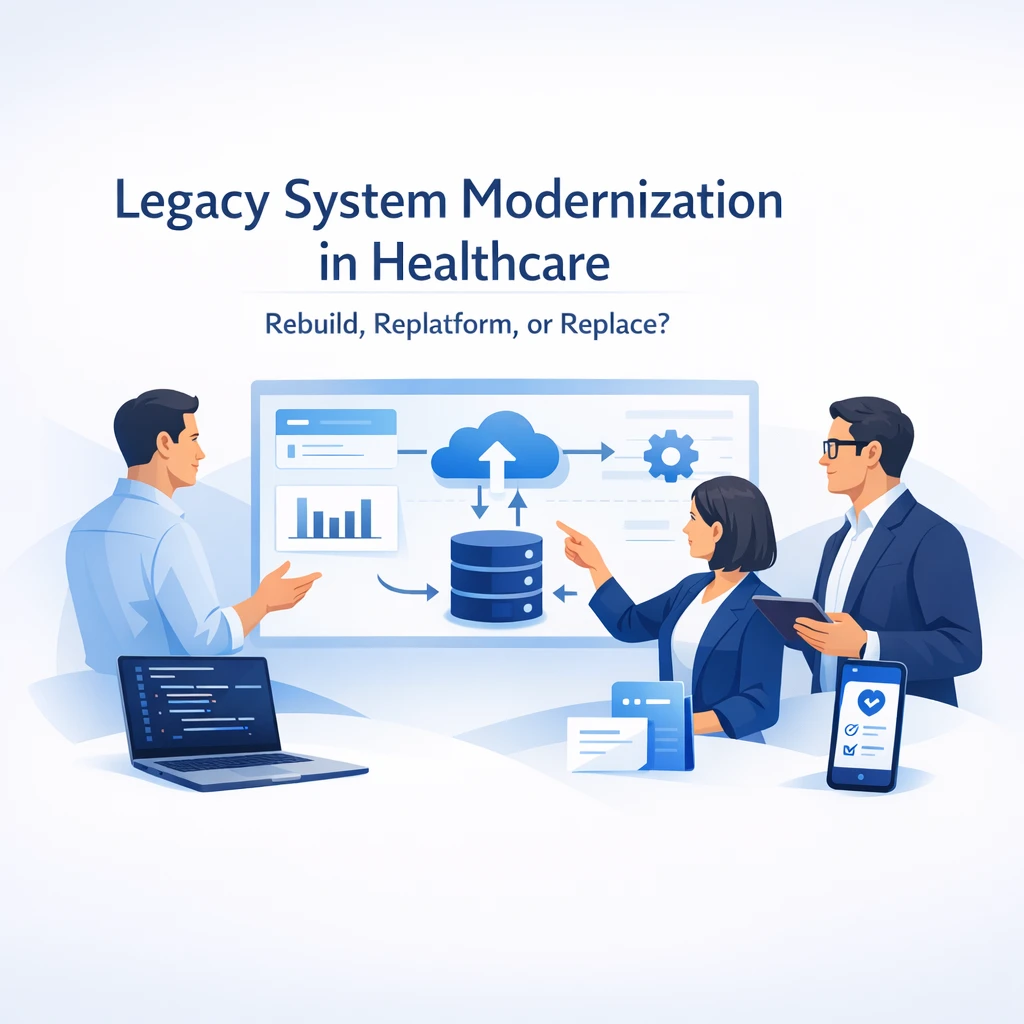
Healthcare organizations in the GCC, Europe, North America, and beyond are navigating a rapid pace of change. Regulatory demands, patient expectations, and the sheer complexity of data—from clinical records to billing to supplier integrations—have pushed many institutions to rethink their legacy systems. The question isn't whether to modernize, but how to modernize in a way that minimizes risk, stays compliant, and delivers measurable value. This guide focuses on legacy system modernization in healthcare: when to rebuild, replatform, or replace enterprise software—and how to approach each option with practical criteria, governance, and a plan you can act on today.
What is the Topic?
Legacy system modernization is the process of transforming aging software and data architectures into modern, scalable, and maintainable solutions. In healthcare, modernization typically involves aligning patient information systems, clinical workflows, and administrative processes with modern cloud-native architectures, standards-based data exchange (like FHIR and HL7), robust security and privacy controls, and a service-oriented approach that enables faster change cycles.
There are three core strategic options to consider:
- Rebuild — Create a new, purpose-built solution from scratch, often using modern frameworks and microservices to replace the legacy stack.
- Replatform — Move components to a new platform (e.g., cloud PaaS or microservice-centric architecture) while preserving core data models and some business logic.
- Replace — Phase out legacy components by adopting a commercial off-the-shelf (COTS) system or a fully hosted software-as-a-service (SaaS) solution, with data migration and integration workstreams to connect it to existing processes.
Why It Matters in 2026
Healthcare modernization in 2026 is about interoperability, patient-centric experiences, and security at global scale. Key drivers include:
- Regulatory compliance — HIPAA, GDPR, regional privacy laws, and evolving data protection requirements demand robust access controls, audit trails, and data residency considerations.
- Interoperability — Standards like FHIR enable safer, faster data sharing across providers, labs, payers, and devices.
- Cloud-native resilience — Scalable, highly available platforms reduce downtime and support 24/7 patient access to records and services.
- Cost efficiency — Modern architectures can lower total cost of ownership through cloud scalability, automation, and improved maintenance productivity.
- Patient experience — Portals, telehealth, and real-time appointment updates improve engagement and outcomes.
Across regions such as the UAE, Saudi Arabia, Qatar, Oman, Kuwait, Bahrain, and global markets including the United States, Canada, United Kingdom, Europe, Australia, and Singapore, effective modernization often starts by understanding the current state, defining a target state, and choosing an implementation approach that balances risk, speed, and cost.
Current Industry Challenges
Healthcare organizations typically grapple with a combination of legacy constraints and future-facing demands:
- Patient data lives across EHRs, billing, labs, and radiology systems, making holistic insight difficult.
- Security and privacy concerns: Access control, data encryption, and auditability are non-negotiables for patient trust and regulatory compliance.
- Downtime risk during upgrades: Maintenance windows disrupt care delivery and operations.
- Regulatory volatility: Requirements for data residency, consent management, and reporting escalate the complexity of changes.
- Vendor lock-in and cost escalations: Legacy contracts can impede modern transitions and lead to unpredictable TCO.
Strategically, many healthcare CIOs choose modernization to reduce risk and unlock agility—without compromising patient safety or regulatory compliance.
How the Technology Works
Modernizing a healthcare tech stack commonly involves targeting three layers: user experience, integration and data fabric, and platform services. A typical modernization program may include:
- Frontend modernization with responsive, accessible patient portals and clinician dashboards.
- API-driven integration using standardized interfaces (FHIR, HL7) to connect EHRs, labs, imaging systems, and payers.
- Data modernization through data lakes, lakehouses, or data warehouses to enable analytics, population health, and risk stratification.
- Cloud-native services such as managed databases, identity and access management, and AI/ML services for decision support.
- Security-by-default including encryption, zero-trust networking, and continuous compliance monitoring.
Organizations often adopt a phased approach: code and data migration in a controlled manner, parallel operations to reduce risk, and a measurable cutover plan to minimize disruption.
Architecture Overview
A modern healthcare architecture typically features:
- Cloud-native microservices with clear bounded contexts for EHR, billing, scheduling, and clinical decision support.
- An API layer that provides secure, standards-based access to patient data and services.
- Integrated data fabric—data lake or warehouse—that consolidates patient information, operational metrics, and clinical data.
- Event-driven communication and asynchronous workflows to improve resilience and responsiveness.
- Guardrails for compliance, privacy, and security across environments (dev, staging, production).
The following Mermaid diagram illustrates a conceptual target-state architecture and how it contrasts with a legacy monolith:
Step-by-Step Workflow for Modernization
- Assess and Discover: Map current systems, data flows, regulatory constraints, and business priorities. Identify which components are most costly to maintain and where risks are highest.
- Define Target State: Agree on architecture patterns (microservices, API-first, cloud-native), data strategy (FHIR alignment, data lineage), and compliance controls.
- Prioritize Initiatives: Prioritize by impact and risk, create a multi-release roadmap, and set measurable success criteria (uptime, data latency, user satisfaction).
- Plan Migration and Integration: Design data migration, integration with legacy systems, cutover timelines, and rollback strategies.
- Build or Acquire: Decide between rebuild, replatform, or replace, while evaluating risks, TCO, and long-term flexibility.
- Test and Validate: Establish rigorous testing across performance, security, privacy, and clinical workflows.
- Cutover and Iterate: Execute migration in controlled waves, monitor results, and optimize post-go-live operations.
Business Use Cases
In healthcare, modernization translates into tangible capabilities:
- Patient portal and engagement: Self-service appointment booking, telehealth access, and secure messaging.
- Clinical interoperability: Seamless exchange of lab results, imaging, and EHR data across platforms.
- Revenue cycle optimization: Accurate, timely claims processing and denial management.
- Population health analytics: Risk stratification and care coordination informed by consolidated data.
- Clinical decision support: Real-time guidance derived from standardized data models and external guidelines.
Industry Applications
Modernization addresses the needs of several healthcare ecosystems:
- Hospitals and multi-site clinics: Scalable EHR integration, unified patient views, and centralized analytics.
- Specialty clinics: Rapid deployment of modular systems tailored to dermatology, cardiology, or oncology workflows.
- Laboratories and imaging centers: Streamlined results reporting and interoperability with cross-provider networks.
- Payors and administrators: Efficient claims processing and member management with governed data sharing.
Benefits
- Improved patient engagement and experience through modern portals and mobile access.
- Greater data accuracy and accessibility across care settings.
- Reduced system downtime and faster incident remediation.
- Regulatory readiness with auditable, traceable data flows.
- Cost transparency and scalability aligned with demand.
Challenges
Even with a clear plan, modernization projects encounter hurdles:
- Data migration complexities across diverse source systems.
- Ensuring patient privacy while enabling interoperability.
- Change management and clinician adoption of new workflows.
- Maintaining regulatory alignment through every release cycle.
Common Mistakes
- Underestimating data mapping and data quality remediation needs.
- Overbuilding in the rebuild approach without validating business value early.
- Skipping a robust governance framework for cloud and security controls.
- Not establishing a clear migration cutover plan or rollback options.
Best Practices
- Adopt a phased, risk-balanced roadmap with measurable milestones.
- Define data contracts and API schemas up front to reduce rework later.
- Incorporate privacy-by-design and security-by-default in every layer.
- Establish strong vendor and tool evaluation criteria, including support for regional compliance.
Build vs Buy vs Replatform: A Quick Comparison
| Option | Typical Scope | Pros | Cons |
|---|---|---|---|
| Build | Custom software for core workflows | Maximum control, tailored to exact processes | Longer timelines, higher upfront cost, ongoing maintenance burden |
| Replatform | Move to a cloud-native platform with modular services | Faster time-to-value, leverage modern cloud features | Requires careful data migration and integration planning |
| Replace | Adopt a SaaS or COTS solution | Rapid deployment, built-in compliance and support | Less customization, potential data migration challenges |
Estimated Development Cost
Costs vary by scope, region, and chosen delivery model. The ranges below reflect common SMB-scale modernization programs in healthcare. They are indicative and depend on data migration complexity, integration requirements, regulatory constraints, and team structure.
| Solution Type | Typical Range (USD) | Notes |
|---|---|---|
| Business Website | 5k–15k | Public-facing portal with content and appointment booking |
| Customer Portal | 10k–40k | Secure patient portal with authentication and messaging |
| CRM | 15k–100k | Patient relationship management and outreach |
| ERP | 40k–200k | End-to-end operations, finance, HR, supply chain |
| AI Chatbot | 5k–25k | Patient-facing assistant with knowledge base integration |
| AI Automation | 15k–80k | Workflow automation for admin and clinical tasks |
| SaaS MVP | 20k–80k | Minimum viable product for cloud-based services |
| Enterprise Web App | 30k–200k | Large-scale enterprise-grade system with compliance layers |
Pricing factors include data migration scope, regulatory requirements, number of integrations, security and compliance controls, performance expectations, and the chosen delivery model (on-site, hybrid, or fully remote).
Recommended Technology Stack
A pragmatic stack balances speed, security, and long-term maintainability. For healthcare modernization, a typical recommended setup might include:
- Mobile: React Native or Flutter for cross-platform access
- Backend: Microservices with Spring Boot (Java), Node.js, or .NET depending on team strengths
- API Layer: REST and GraphQL APIs with API Gateway and OAuth2.0 / OpenID Connect
- Database: PostgreSQL or SQL Server for transactional data; NoSQL like MongoDB for unstructured data
- Data & Analytics: Data Lake or Data Warehouse using Azure Synapse, AWS Redshift, or Snowflake
- Interop & Standards: FHIR R4, HL7v2/v3 for clinical data exchange
- Cloud & DevOps: AWS, Azure, or GCP; CI/CD with GitHub Actions or Azure DevOps
- Security & Compliance: IAM, encryption at rest and in transit, logging, and governance tooling
Triostack follows a standards-based, privacy-first approach and adapts the stack to regional regulatory requirements, ensuring flexibility for global deployment.
Future Trends in Healthcare Modernization
Looking ahead, several trends are shaping how healthcare software evolves:
- AI-assisted clinical workflows: Decision support, triage, and administrative automation with explainable AI.
- Edge and cloud confluence: Real-time data processing at the edge for faster patient interactions and reduced bandwidth needs.
- Zero-trust security models: Strong identity, device trust, and continuous risk assessment across ecosystems.
- FHIR-enabled interoperability: More robust data sharing between providers, payors, and patients.
- Automation of governance: Automated data lineage, access policies, and compliance reporting.
How Triostack Delivers Projects Globally (Remote Delivery)
Triostack has supported healthcare modernization programs worldwide by delivering high-quality software remotely from India and other delivery hubs. We combine deep healthcare domain knowledge with scalable, agile practices to create reliable software for SMBs, SMEs, startups, and large enterprises.
Agile and Collaboration Practices
- Sprint Planning: Clear goals, backlog refinement, and risk assessment for each two-week sprint.
- Weekly Demos: Stakeholders review progress, gather feedback, and align on acceptance criteria.
- Communication Channels: Slack, Teams, Zoom, Google Meet for daily collaboration.
- Project Management and Collaboration: Jira or ClickUp for issue tracking; GitHub or GitLab for code; Azure DevOps for CI/CD when needed.
- Documentation and Knowledge Transfer: Comprehensive docs, API contracts, and onboarding materials for your team.
DevOps and Quality Assurance
- CI/CD: Automated builds, tests, and deployments with robust staging environments.
- Cloud Staging and Production: Separate, secure environments for testing before live release.
- QA and Security: Rigorous functional, performance, security, and privacy testing; compliance validation for HIPAA/GDPR where applicable.
- Documentation and NDA/IP Ownership: Clear contracts and ownership terms; NDAs to protect sensitive data and IP.
Timezone Overlap and Communication Excellence
We ensure meaningful timezone overlap, with dedicated project managers and a fixed cadence for status updates. English communication is prioritized, with careful attention to cultural nuances and regulatory language requirements.
Dedicated Project Management and Long-term Support
Post-launch, Triostack provides ongoing support, enhancements, and security updates, ensuring your system evolves with regulatory and clinical practice changes.
Why UAE businesses outsource development to India and other delivery hubs? The key reasons are cost efficiency, access to a large, high-quality talent pool, faster hiring cycles, scalable teams, rigorous engineering standards, and strong communication practices suited to global projects.
Case Studies (Realistic, Anonymized Scenarios)
Below are anonymized illustrations of how modernization programs unfold in practice. These narratives reflect common patterns rather than specific company data, and they demonstrate Triostack’s approach to design, delivery, and value realization.
1) Dubai Logistics Company — Modernizing Operations and Patient-facing Interfaces
A Dubai-based logistics provider needed to harmonize shipment tracking with a hastily aging internal system used across warehouses and clinical partner coordination for healthcare-related shipments. Triostack designed a cloud-native microservices layer that exposed standardized APIs for inter-system communication, while a modern web portal provided real-time visibility for care teams and partners. The project reduced manual reconciliation work, improved SLA adherence, and delivered a scalable platform for multi-site operations.
2) UAE Healthcare Clinic — Patient Portal and EHR Interoperability
A regional healthcare clinic sought a secure patient portal and a compliant path to interoperable data exchange with regional hospital networks. Triostack built a modular portal with role-based access, appointment scheduling, and secure messaging, while implementing FHIR-based data exchange with partner EHRs. The solution improved patient engagement and created a foundation for population health analytics without destabilizing clinical workflows.
3) Saudi Retail Business — ERP and E-commerce Integration
In this scenario, a multi-site retailer in Saudi Arabia modernized ERP and order management to enable omnichannel fulfillment. Triostack implemented a cloud-based ERP platform with plug-and-play integrations to e-commerce and CRM systems, delivering unified financials, inventory, and customer data across locations while maintaining local data governance requirements.
4) Australian Startup — Cloud-native SaaS Platform for SMBs
An Australian startup needed a scalable SaaS platform to serve small businesses across a regional market. Triostack helped with architecture, cloud migration, and continuous delivery pipelines, enabling rapid onboarding of new tenants and ensuring security requirements aligned with the target market’s expectations.
5) UK SaaS Company — Enterprise-grade CRM with Healthcare Extensions
A UK-based SaaS provider expanded into healthcare-specific CRM modules, including patient communications and consent management. Triostack delivered a compliant, scalable extension layer, integrated with regional EHRs, and maintained strict data governance practices throughout the project lifecycle.
How Triostack Delivers Projects Globally
Triostack combines global delivery capabilities with domain expertise to help healthcare clients modernize effectively and safely. Our capabilities span:
- Custom Software and Web Development
- Mobile Apps
- AI Development and Machine Learning
- CRM, ERP, and SaaS
- Cloud Migration and DevOps
- UI/UX Design
- API Development and Integrations
- Dedicated Teams, QA, and Maintenance
- Technical Consulting
Remote Delivery: Principles That Build Confidence
- Agile delivery with transparent milestones and stakeholder involvement
- Structured sprint planning, daily stand-ups, and weekly demos
- Dedicated project managers and a time zone overlap strategy
- Security-first development with explicit data handling and compliance checks
- Comprehensive documentation and IP ownership clarity
Future Trends: What to Expect in Healthcare Modernization
To stay competitive, healthcare organizations should plan for future capabilities:
- Conversational AI for patient support with privacy safeguards
- Real-time analytics for risk-based care and population health
- Serverless components for event-driven processing and cost efficiency
- Deeper interoperability with broader provider networks
Frequently Asked Questions
- When should I rebuild vs replatform vs replace?
- Rebuild when you need full control and a tailored workflow alignment. Replatform when you want faster time-to-value and modern infrastructure with manageable risk. Replace when you want off-the-shelf compliance, rapid deployment, and predictable maintenance.
- How do I minimize disruption during migration?
- Use a phased approach with parallel runs, data reconciliation, well-defined cutover plans, and robust rollback options.
- What about regulatory compliance during modernization?
- Embed compliance into the design from day one—privacy by design, data governance, and auditability across all environments.
- How long does modernization typically take?
- Timeline depends on scope; SMB projects often range from a few months to a year for larger programs with complex data integration.
Conclusion
Healthcare modernization is not about chasing the newest technology for its own sake. It’s about choosing a strategy — rebuild, replatform, or replace — that aligns with clinical workflows, data governance, and regulatory requirements while delivering measurable value. A thoughtful approach, backed by practical planning and robust remote delivery capabilities, enables healthcare organizations to improve patient outcomes, reduce risk, and operate more efficiently in a rapidly changing landscape.
As you plan your next software project, consider partnering with an experienced software development partner like Triostack to design, build, deploy, and maintain a scalable solution that meets your regional requirements and global ambitions.
Businesses planning similar solutions often benefit from experienced software development partners like Triostack Technologies.
Ready to Talk About Your Modernization Plan?
If you're planning a similar software project, Triostack can help you design, build, deploy and maintain a scalable solution. Reach out to discuss your goals, timelines, and constraints.
Note: This article is educational and demonstrates practical paths for legacy modernization in healthcare. Specific engagements are tailored to client context and regulatory requirements.
Triostack Team
Technology Evangelist & Writer
Triostack Team is an experienced writer and technologist, exploring the intersections of AI, cloud architecture, and modern application development. Passionate about turning complex technical concepts into accessible insights.