Legacy System Modernization in GCC Enterprises: Cost, Architecture Choices, and Migration Roadmap
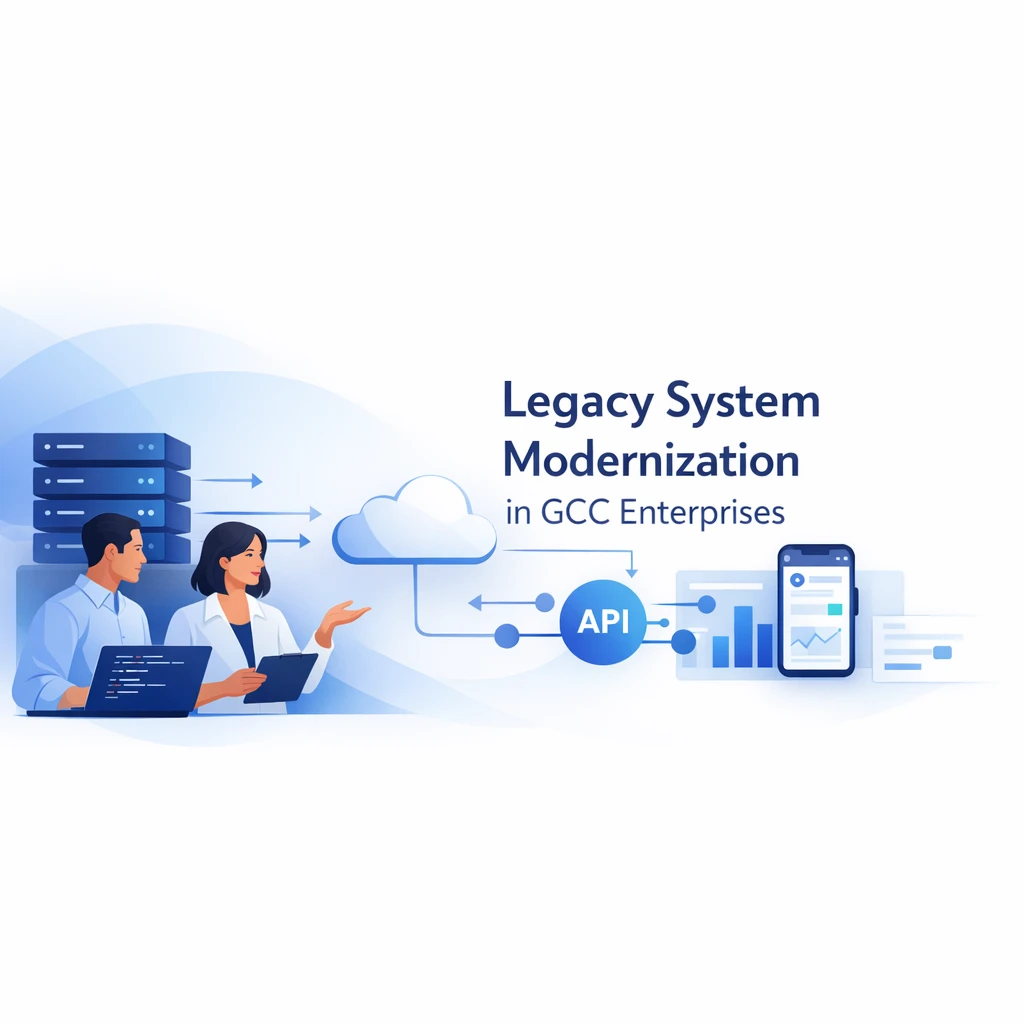
In a rapidly changing digital economy, GCC-based enterprises — spanning Dubai, UAE, Saudi Arabia, Qatar, Oman, Kuwait, Bahrain, and beyond — face mounting pressure to modernize traditional software assets. This article walks you through practical, field-tested approaches to modernization that align with contemporary cloud, security, and data strategies while staying within typical project budgets for SMBs, SMEs, startups, and growing organizations.
Introduction
Legacy systems often underperform in today’s competitive landscape — they restrict speed, inflate maintenance costs, and complicate regulatory compliance. GCC organizations frequently juggle multi-site operations, regional data residency requirements, and rapid growth. Modernization isn’t a one-time upgrade; it’s a structured journey that blends process, technology, and governance. Triostack Technologies has helped dozens of clients globally, including several in the GCC region, transform monolithic platforms into scalable, secure, and cloud-enabled assets. This article distills practical guidance you can apply to projects with a budget range from USD 5,000 to USD 200,000 and beyond.
Note: Triostack’s approach emphasizes responsible outsourcing and remote delivery capabilities that support agile collaboration across time zones, while preserving IP ownership, data security, and architectural integrity.
What is Legacy System Modernization?
Legacy system modernization means re-architecting, re-hosting, replacing, or wrapping existing software so it aligns with modern technology stacks, deployment models, and business processes. The goal is to improve scalability, resilience, speed of delivery, and data-driven decision making without disrupting operations. Modernization often involves:
- Moving from on-premises or isolated software to cloud-native architectures (microservices, containers, serverless).
- Decoupling monoliths into modular services with standardized APIs.
- Consolidating data stores, introducing data lakes, and enabling real-time analytics.
- Adopting DevOps practices, automated testing, and continuous delivery pipelines.
- Ensuring security, regulatory compliance, and robust data governance across regions.
In practice, there isn’t a single path to modernization. Each path—rehost, replatform, refactor, rebuild, or replace—has distinct cost, risk, and time-to-value profiles. The best choice depends on business goals, existing architecture, data sensitivity, and the willingness to rearchitect processes.
Why it Matters in 2026
The year 2026 brings a convergence of cloud maturity, AI-enabled automation, and heightened regulatory expectations in the GCC and Western markets. Key drivers include:
- Cloud-first strategies enabling global reach, regional compliance, and cost predictability.
- Data localization and privacy rules that influence data architecture, storage, and access controls.
- Customer experience expectations requiring real-time data, responsive UIs, and secure integrations with CRM/ERP systems.
- Talent optimization: fewer on-prem resources and more collaboration across distributed teams.
- Security and resilience as strategic differentiators amid increasing cyber threats.
For GCC firms, modernization isn’t optional—it’s foundational to sustaining growth, expanding into new sectors, and competing with global peers. Triostack’s international delivery model is designed to help you balance local requirements with global best practices.
Current Industry Challenges
Modernization initiatives face recurring obstacles. Here are the most common challenges seen in GCC enterprises and global markets alike:
Monolithic systems resist change, and interdependencies complicate migrations. - Skill gaps: Shortages of local expertise in cloud-native design, security, and data engineering.
- Cost estimation: Uncertainty around total cost of ownership, including hidden migration and retraining costs.
- Regulatory alignment: Data residency, access controls, and auditability across multiple jurisdictions.
- Vendor lock-in: Overreliance on a single platform can constrain future flexibility.
- Data migration risk: Ensuring data integrity, compatibility, and minimal downtime during cutovers.
Triostack emphasizes pragmatic planning and phased deliverables to mitigate these risks, with explicit attention to time-to-value and risk-adjusted budgeting.
How the Technology Works
Modernization generally follows one or more of these approaches:
- Rehost (lift-and-shift): Move existing applications to a cloud environment with minimal changes to code. Quick wins, lower risk, but limited long-term optimization.
- Replatform (lift-tinker-run): Move to a cloud-native platform by tweaking configuration and dependencies to gain better scalability and maintainability.
- Refactor (re-architect): Break monoliths into microservices, redesign data models, and introduce modern APIs for flexibility and scalability.
- Rewrite / Rebuild: Create new solutions from scratch when legacy constraints prevent meaningful modernization, often combined with domain-driven design (DDD).
- Replace: Decommission legacy components and substitute with SaaS or modern enterprise applications (CRM, ERP, etc.).
In practice, most GCC modernization efforts blend these approaches in a staged road map that aligns with business milestones, regulatory requirements, and budget realities. Triostack supports a hybrid modernization strategy that maps business outcomes to architectural choices and release plans.
Architecture Overview
A modernized architecture typically features a layered approach, with clear separation of concerns across presentation, application, data, and integration layers. Key components often include:
- Frontend: Lightweight, responsive web and mobile UIs built with modern frameworks (React, Vue, or Angular).
- API layer: RESTful or GraphQL APIs that expose business capabilities to internal and external clients.
- Microservices: Small, independently deployable services that implement specific business domains.
- Data management: Polyglot persistence with relational databases, NoSQL stores, and data lakes for analytics.
- Event-driven integration: Messaging and event buses (Kafka, RabbitMQ) to support asynchronous flows.
- Security & governance: Identity & access management, encryption, data residency controls, and compliance tooling.
- DevOps & automation: CI/CD pipelines, automated testing, and monitoring for reliability and speed.
Below is a simplified reference architecture showing how legacy components map to a modern cloud-native stack. This diagram aligns with multi-region deployment patterns common in GCC and global markets.
Step-by-Step Migration Workflow
- Discovery & Assessment: Inventory applications, map dependencies, evaluate data lineage, assess security posture, and identify regulatory considerations.
- Roadmap & Prioritization: Define target architecture, determine the migration order (e.g., core transactional systems first), and set milestones with business owners.
- Architecture Design: Create an architectural blueprint with API contracts, service boundaries, data models, and deployment patterns.
- Proof of Concept (PoC): Implement a small, representative portion of the system to validate the chosen approach.
- Incremental Migration: Move components in sprints or milestones, with frequent demos and alignment with product teams.
- Quality & Security Gateways: Enforce automated testing, security scans, and compliance checks at every stage.
- Cutover & Operate: Perform controlled cutovers, monitor performance, and optimize iteratively post-launch.
Triostack supports remote delivery across time zones, enabling you to leverage global talent while maintaining tight coordination with your UAE, GCC, UK, US, and APAC stakeholders.
Build vs Buy: Quick Reference
| Aspect | Build | Buy |
|---|---|---|
| Control | Highest control over features, security, and data flow | Limited customization; relies on vendor roadmap |
| Time-to-value | Longer initially, with tailored alignment to business processes | Faster to deploy core capabilities |
| Cost risk | Higher upfront investment; predictable long-term costs with proper governance | Lower upfront but potential ongoing licensing and customization costs |
| Scalability | Can be optimized for future growth but requires architecture discipline | Often scalable but may be constrained by vendor limits |
| Security & compliance | Tailored to regional needs; easier to implement strict controls | Depends on vendor; may require renegotiation for compliance |
Estimated Development Cost (Typical Ranges)
Costs vary by scope, region, talent mix, and whether you use existing assets. The ranges below reflect typical SMB/SME modernization projects and are intended for planning discussions. They exclude external licenses, hosting costs, and ongoing support fees, which can be separate line items.
| Project Type | Typical Range (USD) |
|---|---|
| Business Website | 5,000 – 15,000 |
| Customer Portal | 10,000 – 40,000 |
| CRM | 15,000 – 100,000 |
| ERP | 40,000 – 200,000 |
| AI Chatbot | 5,000 – 25,000 |
| AI Automation | 15,000 – 80,000 |
| SaaS MVP | 20,000 – 80,000 |
| Enterprise Web App | 30,000 – 200,000 |
Pricing factors include scope complexity, data migration needs, security requirements, multi-region deployment, and the desired pace of delivery. For GCC-based projects, regional data residency and compliance considerations can influence time-to-value and total cost.
Recommended Technology Stack
While every modernization project is unique, a pragmatic stack balances speed, scalability, and maintainability. Below is a representative stack aligned with most mid-market modernization efforts:
- Backend: Node.js with Express or NestJS, or Java Spring Boot for robust enterprise-grade services
- API & Integration: REST/GraphQL APIs, API Gateway (e.g., AWS API Gateway, Kong)
- Data: PostgreSQL or MySQL for transactional data; MongoDB or DynamoDB for flexible schemas; data lake with S3/ADLS
- Event & Messaging: Kafka or RabbitMQ
- Cloud & Platform: AWS, Azure, or GCP with Kubernetes (K8s) or serverless where appropriate
- DevOps & CI/CD: GitHub Actions, GitLab CI, or Azure DevOps; Terraform for IaC
- Security: IAM, OAuth2/OpenID Connect, encryption at rest/in transit, SSO
- QA & Testing: automated unit/integration tests, performance/load testing, security scanning
Triostack tailors the stack to your regulatory context (e.g., data residency in the UAE, Saudi Arabia, or Europe) and procurement model, while keeping integration with existing ERP/CRM platforms where relevant.
Future Trends Shaping Legacy Modernization
Several trends are shaping how enterprises approach modernization in 2026 and beyond:
- AI-driven modernization: AI-assisted code analytics, automated refactoring, and AI-enabled testing to speed delivery and improve quality.
- Edge and hybrid architectures: Local edge nodes for latency-sensitive workloads combined with cloud backends.
- Serverless extensions: Function-as-a-Service for event-driven components, reducing operational overhead.
- Data fabric & governance at scale: Unified data access with strong lineage, lineage tracing, and fine-grained access controls.
- Security by design: Shift-left security practices and automated compliance checks integrated into CI/CD.
For GCC organizations, these trends translate into modular modernization roadmaps that emphasize regional compliance while enabling rapid experimentation and time-to-market advantages.
How Triostack Delivers Projects Globally (Remote Delivery)
Triostack enables high-velocity delivery from its centers in India to global clients, including GCC markets. The remote delivery model emphasizes structured collaboration, clear governance, and predictable outcomes. Key elements include:
- Agile framework: Flexible sprints, backlog grooming, and regular stakeholder alignment.
- Sprint planning & weekly demos: Transparent progress with stakeholder input to minimize rework.
- Communication channels: Slack, Teams, Zoom, Google Meet for real-time collaboration.
- Project management & issue tracking: Jira or ClickUp for work item tracking, with clear ownership and deadlines.
- Code & version control: GitHub or GitLab, with review processes and branch strategies.
- CI/CD & cloud staging: Automated build, test, and deployment pipelines with cloud-based staging environments.
- QA & security: Automated testing, security scanning, and compliance checks integrated into pipelines.
- Documentation & IP: Comprehensive documentation, NDAs, and explicit IP ownership terms.
- Timezone & language: Reasonable timezone overlap and English communication for global teams.
- Dedicated PMs & long-term support: Single point of contact for governance and ongoing enhancements.
Why UAE businesses outsource development to India? Common reasons include cost efficiency, access to a large talent pool, faster hiring, flexible scaling, high-quality engineering, and robust communication channels. Triostack’s model maps to these factors while maintaining strict security and governance standards tailored for GCC clients.
Case Studies (Illustrative) – Realistic Implementation Scenarios
Below are illustrative, anonymized examples to demonstrate typical modernization outcomes. They reflect common industry contexts and regional considerations, without naming real organizations.
Case Study 1: Dubai-based Logistics Company
Challenge: Legacy order fulfillment and fleet management system suffered from high latency, limited mobile access, and data silos across regions. Objective: unify inventory, orders, and logistics tracking with real-time analytics and mobile-friendly interfaces.
Approach: Adopted a replatform strategy plus microservices for dispatch, inventory, and shipment tracking. Implemented an API gateway, event-driven data flows, and a cloud-based data lake for analytics. Used a staged migration with a parallel run of critical workflows to minimize downtime.
Outcome: 40% improvement in order processing speed, improved visibility for regional operators, and a scalable architecture supporting regional expansion.
Case Study 2: UAE Healthcare Clinic
Challenge: Paper-heavy processes and disparate patient records caused delays in care coordination and compliance concerns. Objective: digitize patient records, enable secure sharing with partners, and support telehealth.
Approach: Implemented a compliant CRM and EHR integration with role-based access controls. Built a patient portal and caregiver dashboards, with secure messaging and appointment management. Data migration prioritized HIPAA-like controls and local data residency requirements.
Outcome: Significantly faster patient intake, improved appointment adherence, and stronger regulatory posture with auditable data lineage.
Case Study 3: Saudi Retail Business
Challenge: Siloed systems across stores caused inventory mismatches and slow promotions. Objective: unify merchandising, pricing, and store operations on a scalable platform.
Approach: Created a cloud-native platform with modular microservices for product catalog, pricing, and promotions. Implemented API integrations with POS systems and a centralized analytics layer for demand forecasting.
Outcome: 15–20% uplift in gross margin through optimized pricing and promotions, with a single source of truth for product data across locations.
Case Study 4: Australian Startup
Challenge: Rapid growth demanded a scalable MVP with automated testing and robust deployment pipelines. Objective: launch a cloud-native SaaS MVP with multi-tenant support and strong security foundations.
Approach: Built a SaaS MVP using microservices, with a focus on modularity, observability, and automated onboarding. Implemented multi-tenant data isolation and cost-aware scaling.
Outcome: Accelerated time-to-market and the ability to onboard new customers with high reliability.
Case Study 5: UK SaaS Company
Challenge: Legacy analytics portal lacked real-time capabilities and failed to meet evolving data-security standards. Objective: modernize analytics stack and provide secure access for B2B customers.
Approach: Refactored data pipelines, ingested streaming data, and introduced a modern UI with GraphQL API gateway. Employed strong data governance and retention policies.
Outcome: Real-time analytics delivered to customers with improved security posture and compliance traceability.
Benefits of Legacy Modernization
- Speed & agility: Faster feature delivery and shorter time-to-market for new services.
- Cost efficiency: Reduced maintenance costs, optimized resource usage, and predictable capex/opex models.
- Improved customer experience: Modern UIs, real-time data, and seamless integrations with CRM/ERP ecosystems.
- Security & compliance: Enhanced identity management, data governance, and threat detection.
- Scalability & resilience: Modular architecture supports growth and improves disaster recovery capabilities.
Challenges to Expect and How to Mitigate Them
- Budget overruns: Define a phased roadmap with clear success criteria and stop-gates.
- Data migration risk: Start with non-critical datasets, implement data validation, and maintain parallel systems during cutover.
- Vendor management: Establish multi-vendor strategies to avoid lock-in and enforce contract SLAs.
- Skill gaps: Invest in training, partner with experienced firms, and leverage offshore talent pools for scale.
- Regulatory changes: Build governance into the architecture from day one and maintain auditable processes.
Common Mistakes (and How to Avoid Them)
- Underestimating data migration effort: Honest data mapping, quality checks, and staged cutovers are essential.
- Skipping security by design: Integrate security controls early—identity management, encryption, and access auditing.
- Overcomplicating the target: Avoid over-engineering; start with a lean, MVP-like architecture and iterate.
- Insufficient stakeholder alignment: Regular governance meetings and business sponsor engagement reduce rework.
Best Practices for GCC Modernization Programs
- Start with outcomes: Define business KPIs you expect to improve (cycle time, error rates, NPS, customer retention).
- Adopt a phased roadmap: Release value in increments to maintain momentum and visibility.
- Embrace cloud-native architectures: Favor decoupled components and well-defined API contracts.
- Standardize data governance: Implement consistent data models, metadata management, and lineage tracking.
- Invest in quality: Automate testing, security scanning, and performance monitoring from day one.
- Foster strong remote collaboration: Use weekly demos, structured backlogs, and transparent communication practices.
QA & Security: What to Prioritize
Quality assurance and security are not afterthoughts; they are integral to a successful modernization program. Practical focuses include:
- Automated unit, integration, and performance tests; security regression testing in CI/CD pipelines.
- Static and dynamic code analysis for vulnerability detection.
- Security-by-design patterns, including least privilege, centralized secrets management, and robust logging/audit trails.
- Compliance mapping for local and cross-border data handling (UAE, KSA, EU, etc.).
Strategic Roadmap: 2026 and Beyond
As you plan incremental migrations, consider establishing a multi-year roadmap that emphasizes:
- Core platform modernization first, followed by adjacent processes and channels.
- Ongoing investment in data engineering for real-time analytics and AI-powered decisioning.
- Continual security modernization aligned with evolving regulatory requirements.
- Talent development programs to retain and grow internal capabilities while leveraging global delivery teams.
How Triostack Delivers Projects Globally
Triostack’s global delivery model emphasizes clarity, governance, and measurable outcomes, with a focus on long-term partnerships. The company’s services span:
- Custom Software and Web Development
- Mobile Apps and AI Development
- Machine Learning and Data Science
- CRM, ERP, and SaaS
- Cloud Migration and DevOps
- UI/UX and API Development
- Dedicated Teams, QA, and Maintenance
- Technical Consulting and Security
Why Businesses Choose Triostack
Triostack aligns technical execution with business value. Key strengths include:
- Global delivery with local sensitivity: Teams comfortable operating across GCC, North America, UK/Europe, and APAC.
- Proven architecture discipline: Emphasis on modular, scalable designs and API-first thinking.
- Security, governance, and IP ownership: Clear terms, compliance-first approach, and client IP ownership guarantees.
- Balanced engagement models: Flexible combinations of dedicated teams, project-based engagements, and staff augmentation.
Triostack’s approach helps you de-risk complex modernization programs while achieving measurable outcomes within budget.
Conclusion
Legacy system modernization is a strategic imperative for GCC enterprises seeking to compete globally while maintaining regional compliance, security, and operational resilience. A phased, well-governed migration roadmap—anchored by architecture best practices, pragmatic cost models, and rigorous QA—delivers tangible business outcomes. Triostack stands ready to partner with businesses planning software projects in the USD 5k to 200k range and beyond, offering remote delivery capabilities that combine cost efficiency with engineering excellence.
If you’re planning a similar software project, Triostack can help you design, build, deploy, and maintain a scalable solution.
Frequently Asked Questions
- What is the typical timeline for a modernization project in this budget range?
- For small to mid-sized scopes (e.g., a CRM integration or a microservice re-platform), 3–6 months is common. Larger ERP modernization or multi-region migrations can extend to 9–18 months, depending on complexity and data governance needs. Triostack emphasizes phased delivery with milestones and regular stakeholder demos.
- How do you handle data residency and regulatory compliance?
- We map data flows, apply region-specific storage and encryption requirements, and implement identity and access management controls that align with local laws. Data localization is a design criterion from the outset.
- What is the role of AI in modernization projects?
- AI can enhance automation, monitoring, and decision-making. In practice, we prioritize reversible, low-risk AI experiments within isolated components and ensure governance for data and model compliance.
- Can you work with existing ERP/CRM systems?
- Yes. We typically design integration layers via standardized APIs and adapters, preserve vendor data models when possible, and minimize disruption to ongoing operations.
- What guarantees do you offer on IP ownership and security?
- Client IP ownership is protected by contract, and security is embedded by design with formal NDAs, access controls, and audit-ready processes.
Triostack Team
Technology Evangelist & Writer
Triostack Team is an experienced writer and technologist, exploring the intersections of AI, cloud architecture, and modern application development. Passionate about turning complex technical concepts into accessible insights.