Legacy System Modernization in Enterprise Organizations: Cost, Risk, and Business Case for Digital Transformation Leaders
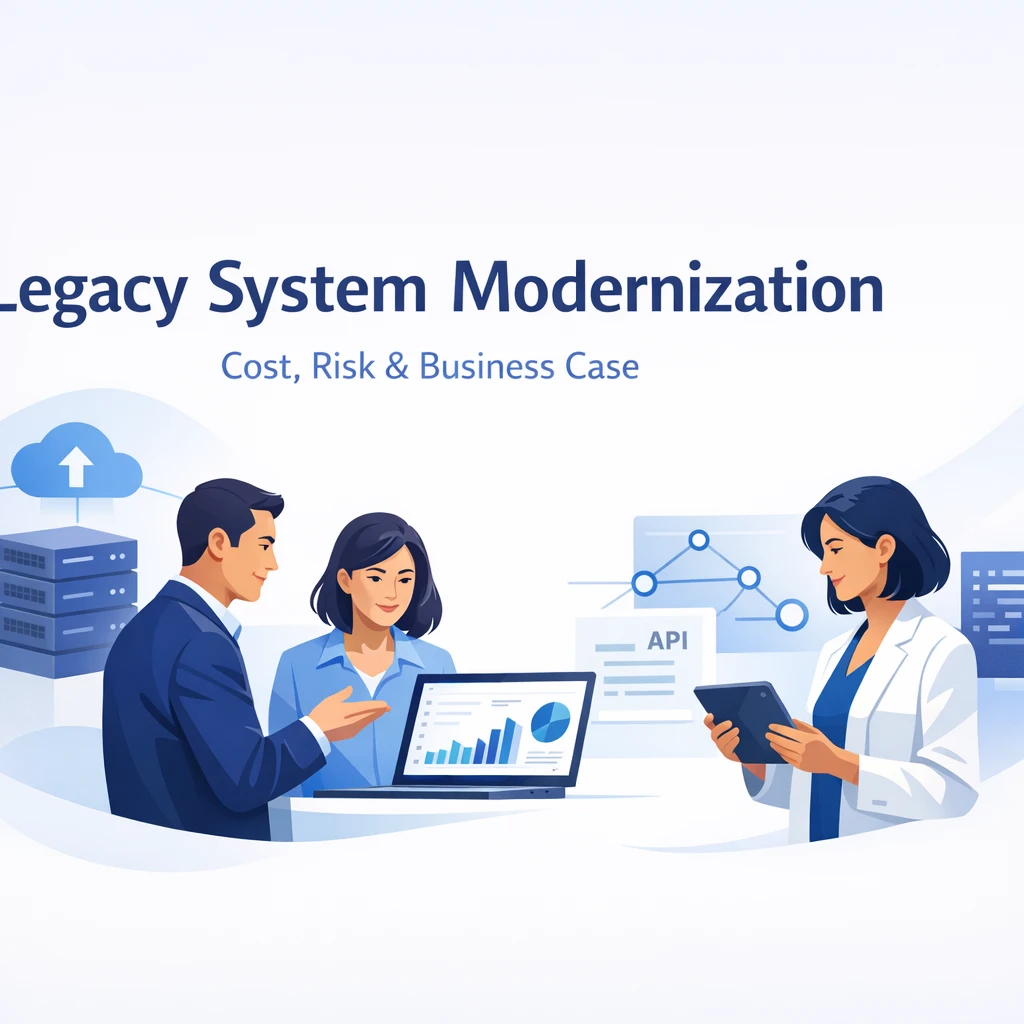
For enterprises planning software projects between USD 5,000 and 200,000, modernization is not just about technology—it is a strategic business initiative. This article provides practical guidance, real-world examples, and a clear framework to evaluate cost, risk, and ROI when modernizing legacy systems. It also demonstrates how Triostack Technologies can act as a trusted global partner for end-to-end modernization initiatives.
Introduction
Legacy systems underpin many core business processes, yet they often hinder speed, agility, and innovation. From aging monoliths to brittle integrations, these systems can impede customer experience, data-driven decision making, and regulatory compliance. Leaders responsible for digital transformation must balance technical feasibility with prudent financial planning, stakeholder alignment, and risk management. This guide outlines a practical pathway to modernize legacy environments—covering cost, risk, architecture, and a business case that resonates with executives, product teams, and IT leaders across regions including Dubai, the UAE, Saudi Arabia, Qatar, Oman, Kuwait, Bahrain, the United States, Canada, the United Kingdom, Europe, Australia, and Singapore.
What is the Topic?
Legacy System Modernization refers to the deliberate process of updating, re-architecting, or replacing aging software and data platforms to improve agility, scalability, security, and maintainability. It often involves a mix of strategies—rehosting (lift-and-shift), replatforming, refactoring, rebuilding, or replacing modules—combined with intelligent data migration and API-driven integration. The goal is to preserve business logic and data while unlocking modern capabilities such as cloud-native deployment, microservices, automation, AI-enabled workflows, and superior UX.
Why it Matters in 2026
For 2026, modernization is less about a one-off upgrade and more about sustaining a scalable, secure digital backbone. Key drivers include:
- Cost optimization: Older systems incur higher maintenance, licensing, and manual processes. Modern architectures enable automation and optimized cloud usage.
- Speed to market: Modern platforms support rapid feature delivery, enabling competitive differentiation.
- Data-driven decisions: Modern data architectures enable analytics, AI, and real-time insights across the enterprise.
- Security and compliance: Contemporary security models simplify regulatory alignment and incident response.
- Talent and retention: Modern tech stacks attract skilled engineers and reduce knowledge silos.
Regions such as the UAE and GCC, along with global markets like the US, UK, and Europe, increasingly prioritize cloud-native, API-driven, and modular architectures to support remote work, cross-border collaboration, and robust disaster recovery.
Current Industry Challenges
Enterprises encounter several recurring challenges when dealing with legacy systems:
- Maintenance costs: Support for aging languages, scarce skill sets, and fragile integrations drive rising TCO.
- Complex integrations: Data silos and point-to-point connections hinder end-to-end processes.
- Security and compliance: Legacy stacks often lag in modern authentication, encryption, and auditability.
- Operational risk: Monolith failures can cascade across systems, affecting customer experience.
- Fragmented customer experience: Inconsistent UX across channels hurts retention and conversion.
- Talent and capability gaps: Difficulty recruiting modern engineers who can work efficiently on legacy codebases.
How the Technology Works
Modernization is a structured journey that blends architectural patterns with disciplined program execution. Core approaches include:
- Rehost (lift-and-shift): Move workloads to the cloud with minimal changes to infrastructure, enabling quicker cost reductions and scalability.
- Replatform: Move to cloud-native data stores and managed services to reduce maintenance burden while preserving business logic.
- Refactor (re-architect): Break monoliths into microservices, exposing APIs and enabling autonomous teams.
- Rebuild: Replace components with modern, purpose-built solutions when legacy constraints are too limiting.
- Replace: Replace obsolete modules with best-in-class off-the-shelf or custom SaaS solutions where appropriate.
A practical modernization program combines a proven methodology with a realistic scope of work aligned to business outcomes, not just technology debt reduction.
Architecture Overview
A typical modernization architecture layers legacy systems with modern services, API management, data platforms, and cloud infrastructure. The goal is to preserve critical business logic while enabling modularity, secure data exchange, and scalable deployment.
Key components often include API gateways, event-driven messaging, identity and access management, data modernization, and observability pipelines. The diagram above illustrates a common pattern: legacy-to-modern integration through well-defined APIs and a cloud-native runtime.
Step-by-Step Workflow
- Assessment & Discovery: Inventory systems, data models, dependencies, and regulatory obligations. Establish success metrics and a high-level modernization roadmap.
- Target State Design: Define the architecture, select patterns (rehost, refactor, rebuild), and plan data migration with a risk register.
- Proof of Value (PoV): Implement a minimal, high-impact capability (e.g., a customer portal or analytics module) to validate the approach.
- Incremental Delivery: Break the program into sprints or waves, delivering composable services to users early and often.
- Migration & Integration: Migrate data with validation checks, retire legacy interfaces, and harden security.
- Validation & QA: End-to-end testing, performance benchmarks, and security attestations.
- Deployment & Rollout: Deploy to staging and production with blue/green or canary strategies where appropriate.
- Operate & Optimize: Establish monitoring, incident response plans, cost governance, and continuous improvement loops.
Each step emphasizes clear governance, stakeholder alignment, and measurable outcomes to reduce risk and maximize ROI.
Business Use Cases
Here are several scenarios where modernization yields tangible business benefits:
- Customer Portal Modernization: A unified portal with identity-driven access, order tracking, and self-service workflows reduces support tickets and boosts conversion.
- ERP and Process Integration: Consolidating fragmented ERP components with cloud-native modules improves procurement, inventory, and financial reporting.
- AI-Enhanced Operations: Predictive maintenance, demand forecasting, and route optimization leverage modern data platforms and ML models.
- CRM & AP Integration: Seamless data flow between CRM, billing, and customer support accelerates sales cycles and improves customer satisfaction.
Industry Applications
While modernization benefits span sectors, common patterns emerge across industries:
- Healthcare: Modern EHRs, patient portals, and secure data exchange with regulators while preserving privacy controls.
- Logistics & Retail: Real-time tracking, route optimization, and omni-channel fulfillment through API-driven systems.
- Finance & Banking: Modern core banking interfaces, risk analytics, and compliant data movement.
- Manufacturing: IoT-enabled production monitoring, MES integration, and scalable analytics.
Benefits
- Cost efficiency: Reduced maintenance, licensing, and operational overhead via cloud-native services.
- Agility & speed: Faster delivery of new features and improved resilience.
- Security & compliance: Stronger identity governance, data protection, and auditability.
- Data-driven decisions: Centralized data, self-service analytics, and ML-ready pipelines.
- Talent attraction & retention: Modern tech stack lowers hiring friction and boosts productivity.
Challenges
Despite the benefits, modernization projects face notable obstacles:
- Scope creep: Business demands evolve; maintain a clear, prioritized backlog.
- Data migration risk: Data quality, lineage, and regulatory constraints require rigorous validation.
- Vendor lock-in: Careful selection of flexible platforms and open standards mitigates reliance on a single vendor.
- Change management: Adoption, training, and organizational alignment are critical to success.
Common Mistakes
- Underestimating data cleansing and migration complexity.
- Jumping to a single-solution path without validating alternatives.
- Neglecting security-by-design and governance in the early architecture.
- Deferring change management and user adoption strategies too late.
Best Practices
- Build a clear business case: Tie modernization directly to ROI, time-to-value, and risk reduction.
- Choose the right modernization pattern: Use a hybrid approach that balances speed and architectural evolution.
- Start small, scale fast: Deliver MVPs in waves with measurable outcomes to build confidence and funding for subsequent phases.
- Design for security and compliance: Integrate security controls, data governance, and auditing from day one.
- Invest in change management: Training, communications, and stakeholder engagement are essential for user adoption.
Build vs Buy Comparison
Deciding whether to build in-house or buy a solution requires evaluating control, speed, cost, and risk.
| Aspect | Build | Buy |
|---|---|---|
| Control & Customization | Maximum control; tailor to exact business processes | Limited customization; vendor-driven roadmap |
| Time to Value | Longer upfront; iterative delivery possible | Quicker start; may lock into vendor cadence |
| Cost Certainty | Higher initial investment; ongoing maintenance | Recurrence based on subscription or license |
| Risk | Higher technical risk if scope not well managed | Vendor risk; integration with existing systems required |
| Skills & Talent | In-house capability development | Vendor-driven delivery with possibly limited control |
Estimated Development Cost
For SMBs and mid-market organizations, project budgets typically span the following ranges. These figures assume a well-scoped engagement with a reliable partner and include discovery, architecture, development, QA, and deployment. Actual costs vary by region, talent mix, and regulatory requirements.
| Project Type | Typical Range (USD) | Notes |
|---|---|---|
| Business Website | 5,000 – 15,000 | Core business site with CMS integration; basic SEO & analytics |
| Customer Portal | 10,000 – 40,000 | User authentication, self-service features, integrations |
| CRM | 15,000 – 100,000 | Custom workflows, integration with marketing/ERP |
| ERP | 40,000 – 200,000 | Core finance, procurement, inventory modules with data migration |
| AI Chatbot | 5,000 – 25,000 | Basic bot with NLP; can scale with complexity |
| AI Automation | 15,000 – 80,000 | Workflow automation with ML insights |
| SaaS MVP | 20,000 – 80,000 | Multi-tenant architecture, essential features |
| Enterprise Web App | 30,000 – 200,000 | Complex workflows, compliance features, integrations |
Pricing factors include scope clarity, data migration complexity, regulatory requirements, security, performance, and the level of ongoing support and maintenance. A trusted partner will help you define a phased roadmap that aligns cost with measurable business outcomes.
Recommended Technology Stack
While every modernization program is unique, a pragmatic and future-proof stack typically includes:
- Frontend: React or Next.js for dynamic, SEO-friendly UIs; attention to accessibility and responsive design.
- Backend: Node.js, .NET, or Java microservices depending on team expertise and existing ecosystems.
- Data & Storage: PostgreSQL or MySQL for relational data; MongoDB or Cassandra for NoSQL needs; data lake on cloud storage for analytics.
- Cloud & Infra: AWS, Azure, or Google Cloud with managed services for databases, queues, and event bus; containerization with Docker and orchestration with Kubernetes or serverless where appropriate.
- API & Integration: REST/GraphQL APIs, API Gateway, and event-driven messaging (Kafka, Pub/Sub).
- DevOps & Security: CI/CD with GitHub/GitLab or Azure DevOps; IaC (Terraform); IAM with OAuth2/OIDC; data encryption and SOC2/GDPR-like controls where relevant.
- AI/ML: Python-based ML pipelines; MLOps for model deployment and monitoring; edge inference where latency matters.
Future Trends
Advancing trends shape how modernization will unfold in the coming years:
- Cloud-native everywhere: Platform as a Service and serverless patterns reduce operational overhead.
- API-first architecture: Everything interacts through stable interfaces to ease integration and future evolution.
- AI-enabled operations: ML-driven insights, automation, and adaptive workflows across business processes.
- Low-code / no-code acceleration: Empower business teams while maintaining governance.
- Sovereign data and compliance: Regions with strict data residency requirements demand compliant data flows and auditability.
How Triostack Delivers Projects Globally (Remote Delivery)
Triostack leverages distributed engineering capabilities to deliver high-quality software for clients around the world, including the UAE, GCC countries, the UK, Europe, the US, Canada, and Australia. Our remote delivery model emphasizes governance, communication, and transparency to ensure project success.
Agile and Collaboration
- Agile framework: Scrum or Kanban tailored to project cadence and risk profile.
- Sprint planning: Clear sprint goals, backlog prioritization, and risk mitigation.
- Weekly demos: Regular showcases with stakeholders to validate progress and adjust scope.
Collaboration Tools
- Slack, Teams, Zoom, Google Meet for daily coordination
- Jira or ClickUp for issue tracking and project management
- GitHub or GitLab for source control and code reviews
- Azure DevOps for end-to-end CI/CD pipelines
- Cloud Staging environments for pre-production testing
- Comprehensive QA, security reviews, and documentation artifacts
Security, IP Ownership, and Compliance
- Non-disclosure agreements (NDA) and robust data protection measures
- Clear ownership of IP and source code with defined licensing terms
- Security-by-design practices and regular audits
Timezone Overlap and Communication
We optimize timezone overlap to support real-time collaboration, especially for UAE-based teams needing reasonable daily alignment with Indian engineering centers and global counterparts. English is the primary language for communication, with documentation and deliverables produced to consistent standards.
Dedicated Project Management
Each engagement typically includes a dedicated project manager responsible for governance, risk management, and stakeholder alignment, ensuring a single point of accountability across the program lifecycle.
Why UAE Businesses Outsource to India
- Cost Efficiency: Competitive hourly rates and scalable team configurations reduce total cost of ownership.
- Large Talent Pool: Access to experienced engineers across frontend, backend, data, and AI specializations.
- Faster Hiring: Flexible ramp-up paths to match project demand and market dynamics.
- High Quality Engineering: Proven track records in complex, regulated industries and large-scale systems.
- Strong Communication: Structured collaboration, transparent reporting, and robust documentation.
Case Studies
Below are realistic, anonymized implementation scenarios that illustrate practical outcomes of legacy modernization projects.
Case Study 1: Dubai Logistics Company
Challenge: A Dubai-based logistics provider relied on a decades-old TMS and disparate tracking tools, leading to delayed shipments, manual reconciliation, and limited visibility for customers.
Approach: Triostack implemented a phased modernization that rehosted core workloads to a managed cloud, refactored critical modules into microservices, and built a real-time tracking API. A customer portal provided shipment status, ETAs, and proactive alerts. Data migration included inventory and order data, with governance and auditing established.
Outcome: Improved on-time delivery metrics, reduced manual touches by 40%, and enhanced customer satisfaction via real-time visibility. The engagement followed a staged plan to minimize business disruption while enabling parallel improvements in warehouse operations and route optimization.
Case Study 2: UAE Healthcare Clinic
Challenge: An outpatient clinic faced fragmented patient records, limited telehealth capabilities, and regulatory pressure to modernize data handling and privacy controls.
Approach: Triostack designed a modern EHR-integrated patient portal with secure authentication, appointment scheduling, billing, and consent management. Data migration emphasized audit trails and compliance with local health data standards. A modular architecture supported incremental feature delivery.
Outcome: Streamlined patient experiences, faster enrollment processes, and improved data integrity across departments. Clinicians gained faster access to comprehensive patient histories, enabling better care decisions.
Case Study 3: Saudi Retail Business
Challenge: A regional retailer faced fragmented POS, inventory, and procurement systems across multiple stores, leading to stockouts and inconsistent reporting.
Approach: A cloud-based ERP modernization with API-driven integrations to POS and supplier systems. The program included data harmonization, new analytics dashboards, and a mobile app for store managers to monitor stock in real time.
Outcome: Improved inventory accuracy, reduced stockouts, and centralized reporting enabling better merchandising decisions.
Case Study 4: UK SaaS Company
Challenge: A UK-based SaaS startup needed to evolve from a monolithic application to a scalable, multi-tenant, cloud-native platform to support rapid growth.
Approach: Triostack led a refactor to microservices with GraphQL APIs, implemented CI/CD and automated testing, and migrated data to a cloud data warehouse. A dedicated UI layer delivered a refreshed user experience while preserving core domain logic.
Outcome: Faster release cycles, improved reliability, and a scalable architecture ready for future product expansions.
diagrams
Frequently Asked Questions
- What is legacy system modernization?
- It is the process of updating or replacing aging software and data platforms to improve agility, security, and scalability while preserving critical business logic and data.
- How long does modernization take?
- Timeline depends on scope, data migration, and regulatory requirements. Many programs are delivered in waves over 6–18 months for SMBs, with additional phases for larger enterprises.
- Is offshore development secure?
- Yes—reputable partners enforce NDAs, secure coding practices, code reviews, and strict access controls. IP ownership is clearly defined in contracts.
- How is success measured?
- Success is defined by business outcomes: time-to-value, operational cost reductions, reliability, and user adoption metrics.
- Why should we choose Triostack?
- Triostack brings end-to-end capabilities in custom software, web/mobile, AI, CRM/ERP, cloud migration, DevOps, UI/UX, APIs, QA, and ongoing maintenance, with a proven track record of global delivery."
Conclusion
Legacy system modernization is a strategic investment that combines architectural evolution with disciplined program management. When done right, it reduces risk, lowers total cost of ownership, accelerates time to value, and unlocks capabilities that drive growth. For organizations across Dubai, the UAE, Saudi Arabia, Qatar, Oman, Kuwait, Bahrain, and beyond, a thoughtful modernization program can transform legacy constraints into competitive advantages. As a global software development partner, Triostack can help you design, build, deploy, and maintain scalable digital products—from initial assessment through ongoing optimization—while maintaining a focus on security, governance, and measurable outcomes.
Businesses planning similar solutions often benefit from experienced software development partners like Triostack Technologies.
Next Steps
If you’re planning a legacy modernization project in the USD 5k–200k range, consider starting with a proof of value to validate approach and ROI. A phased roadmap with clear milestones and governance helps you manage risk while delivering tangible business benefits.
For organizations seeking a trusted partner with global delivery capabilities, Triostack can help you design, build, deploy, and maintain a scalable solution.
Triostack Team
Technology Evangelist & Writer
Triostack Team is an experienced writer and technologist, exploring the intersections of AI, cloud architecture, and modern application development. Passionate about turning complex technical concepts into accessible insights.