Legacy System Modernization in Enterprise Organizations: Cost, Cloud Strategy, and Business Impact
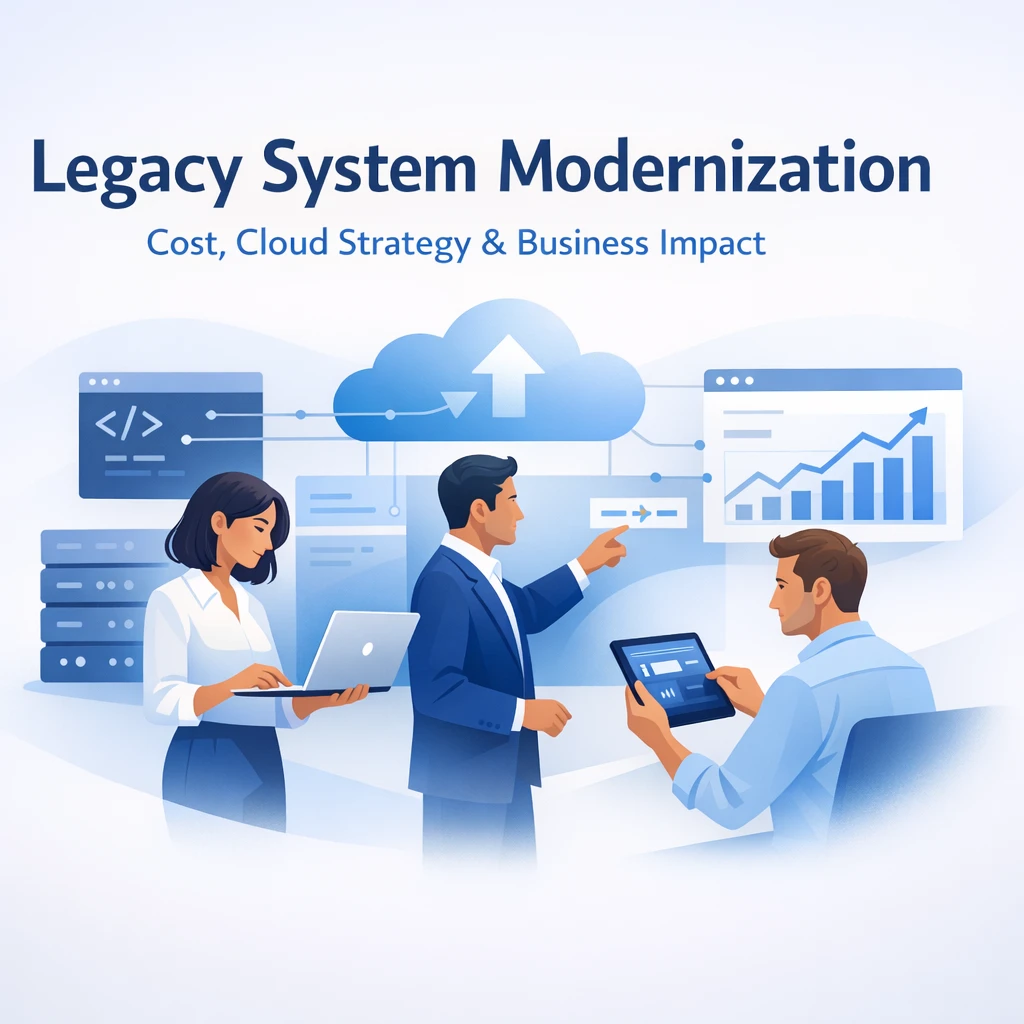
Modernizing legacy systems is less about chasing the latest tech and more about aligning technology with strategic business outcomes. This long-form guide breaks down the cost implications, cloud strategy, and real-world impact of modernization for enterprises across the Gulf, North America, and beyond. It offers practical guidance, architectural patterns, and implementation considerations to help leaders make informed decisions.
Introduction
Many enterprises wrestle with aging software landscapes that hinder speed, scale, and customer experience. Legacy systems often run on monolithic architectures, rely on brittle integrations, and require brittle manual processes. Yet the business value of modernization is compelling: faster time-to-market, better security and compliance, improved data insights, and the ability to deploy new capabilities at the pace today’s customers expect.
At Triostack Technologies, we approach legacy modernization as a strategic program, not a one-off project. Our teams help clients across Dubai, UAE, Saudi Arabia, Qatar, Oman, Kuwait, Bahrain and beyond to design and implement cloud-first architectures, establish modern software governance, and operate with continuous improvement in mind. This article focuses on practical, implementable guidance that SMBs, SMEs, startup founders, CEOs, CTOs, product managers, and digital transformation leaders can use to start or advance a modernization effort within a budget range of USD 5,000 to USD 200,000 for targeted digital initiatives.
Throughout, you’ll see Triostack references in the context of how a seasoned software partner helps organizations scale responsibly. The aim is to educate first and demonstrate how experienced teams handle custom software, web and mobile development, AI development, CRM/ERP integration, cloud migration, DevOps, UI/UX, API development, dedicated teams, QA, maintenance and technical consulting—without sounding like an advertisement.
What is the Topic?
Legacy system modernization is the process of updating, replacing, or rearchitecting aging software and data ecosystems to achieve modern capabilities while preserving business value. It often involves three core axes:
- Code and architecture modernization — from monoliths to modular services, improved maintainability, and better scalability.
- Data and integrations — consolidating data models, adopting data platforms, and enabling reliable integrations with modern SaaS, ERP, CRM, and external services.
- Operational practices — adopting DevOps, SRE, automated testing, security-by-default, and measurable governance.
While many organizations start with a single system (e.g., CRM integration, ERP migration, or a customer portal), the most successful programs treat modernization as an iterative journey—prioritizing high-impact capabilities and de-risking through disciplined pilots.
In this article, you’ll find practical guidance on cost, cloud strategies, and business impact, with concrete examples from enterprises pursuing modernization projects in the Middle East, North America, and Europe. For more on Triostack’s approach to custom software and cloud migration, explore our services pages or case studies linked within this document.
Why It Matters in 2026
Legacy modernization is not a vanity project; it’s a business necessity. In 2026, competitive advantage hinges on:
- Speed to value: delivering new features and improvements faster to capture opportunities and address competitive threats.
- Security and compliance: reducing risk through modern identity, access controls, encryption, and data governance aligned with regional regulations (e.g., GDPR, local data residency, and industry-specific standards).
- Operational resilience: cloud-native architectures, automated testing, continuous delivery, and proactive monitoring that minimize downtime and outages.
- Data-driven decision-making: unified data models and analytics enabling better product decisions and customer insights.
For organizations in the UAE, GCC, UK, Europe, North America, and APAC, modernization is about delivering predictable outcomes: lower total cost of ownership over time, improved user experience, and the ability to scale with business demand.
Current Industry Challenges
Enterprises face several recurring challenges when modernizing legacy systems:
- Data silos: inconsistent data models impede reporting and AI adoption.
- Regulatory pressure: compliance requires robust security, auditability, and data governance.
- Skill gaps: legacy maintenance crowds out modern engineering practices and specialized expertise.
- Cost and ROI ambiguity: large, multi-year migrations may deter investment without clear milestones and business value signals.
Addressing these challenges requires a structured approach—prioritizing high-value capabilities, enabling incremental modernization, and choosing pragmatic cloud and architectural patterns. See the architecture overview and step-by-step workflow sections for concrete guidance.
How the Technology Works
Modernization typically combines architectural refactoring with cloud-native deployment and data strategy. Key components include:
- Microservices or modular services replacing monoliths to enable independent deployment and scaling.
- API-first design to enable secure, scalable integrations with CRM/ERP, analytics platforms, and external services.
- Cloud-native data platforms (data lakes, data warehouses, and real-time streams) to unlock insights and AI workloads.
- Secure DevOps practices, including automated testing, CI/CD, and robust observability.
- UI/UX modernization to improve adoption and reduce training time for users and customers.
In practice, teams often start with a cloud-enabled gateway that provides a unified entry point for modern microservices while gradually migrating data and logic from legacy systems. This approach reduces risk, preserves business continuity, and enables continuous delivery of value.
Architecture Overview
A typical modernized architecture for an enterprise includes the following layers:
- Frontend: web and mobile interfaces with responsive design
- API Layer: gateway and microservices
- Business Logic: microservices for core domains (orders, customers, inventory)
- Integrations: CRM, ERP, payment providers, external data services
- Data Layer: transactional databases, data lake, data warehouse, BI tools
- DevOps and Security: CI/CD, IAM, compliance tooling, monitoring
Below is a simplified architectural sketch to illustrate how components connect. This diagram is illustrative and meant to guide planning and governance rather than serve as a blueprint for every project.
Step-by-Step Workflow
Adopt a disciplined workflow to reduce risk and improve predictability. The following phased approach aligns with standard industry practices while accommodating regional considerations (data residency, regulatory compliance, and local governance).
- Discovery and strategy: align business objectives with technical capabilities, create a prioritized backlog, and define success metrics. Establish data governance and compliance requirements early.
- Architectural planning: choose a target architecture (e.g., microservices with API-first governance) and identify critical integration points.
- Prototype and pilot: implement a small, high-value module or integration in a cloud environment to validate choices.
- Incremental migration: migrate services and data in logical slices, using stranglers to replace legacy functionality gradually.
- Quality assurance: automate testing, security scans, and performance testing; implement observability and dashboards.
- Production deployment: enable blue/green or canary deployments; monitor SLAs and adjust as needed.
- Optimization and scaling: refine service boundaries, optimize data pipelines, and introduce advanced analytics or AI as appropriate.
Key success factors include executive sponsorship, a clear funding model, measurable milestones, and a robust change management plan that accounts for regional teams and remote collaboration.
Business Use Cases
Modernization initiatives span a spectrum of business needs. Here are representative use cases with practical outcomes:
- Customer portal and self-service: a modern portal with secure authentication, self-service workflows, and real-time order status updates reduces support loads and increases customer satisfaction.
- ERP and CRM integration: unified data flows across sales, finance, and operations enable faster quote-to-cash and better inventory planning.
- AI-enabled automation: chatbots, automated document processing, or predictive maintenance reduce manual tasks and unlock new revenue streams.
- Data-driven product decisions: centralized analytics empower product managers to validate features with real user metrics.
Industry Applications
While the specifics vary by sector, several modern patterns recur across industries:
- Logistics and supply chain: real-time tracking, route optimization, and inventory visibility.
- Healthcare: secure patient portals, appointments, EHR integration, and analytics for population health.
- Retail and e-commerce: omnichannel experiences, unified customer data, and order orchestration across channels.
- Financial services: secure payments, fraud detection, and regulatory reporting through modular services.
Triostack supports sector-specific compliance requirements and data localization needs, whether operating in the UAE, UK, Europe, North America, or Australia.
Benefits
Organizations pursuing modernization typically realize benefits across several dimensions:
- Faster time-to-value: modular architectures unlock new features in weeks rather than months.
- Cost efficiency: cloud-native services reduce on-prem maintenance and hardware refresh costs over time.
- Improved security and compliance: modern identity, encryption, and auditability reduce risk exposure.
- Resilience and uptime: automated testing, canary deployments, and robust monitoring improve reliability.
- Better data and analytics: unified data models enable more accurate insights and AI-driven decision making.
Challenges
Modernization projects can face barriers such as:
- Scope creep and shifting priorities
- Data migration risk and data quality issues
- Security and compliance constraints, especially in regulated industries
- Skills gaps and organizational change resistance
- Vendor lock-in and cloud cost management concerns
Mitigation requires a well-defined program, risk management, and ongoing governance. Triostack’s approach emphasizes phased delivery, transparent reporting, and stakeholder alignment across regions.
Common Mistakes and How to Avoid Them
- Underestimating data migration complexity: invest in a data strategy early and validate with real data samples.
- Over-engineering the target state: start with MVPs that deliver measurable business value and expand iteratively.
- Neglecting security and governance: bake security controls into the pipeline from day one.
- Ignoring organizational change: include training, champions, and clear communication to drive adoption.
Best Practices
design contracts before implementation to enable decoupled services and easier integrations. establish a common data model and master data management approach early. containerization, managed services, and scalable data platforms reduce operational risk. define KPIs for each phase and track progress with dashboards accessible to leadership. integrate security tooling into CI/CD and implement role-based access and encryption by default.
Build vs Buy
Choosing between building in-house or buying a solution (or a hybrid approach) is a strategic decision with long-term implications. The table below summarizes core considerations.
| Aspect | Build | Buy |
|---|---|---|
| Control and customization | Highest control; tailored to exact processes | Fewer customization options; faster start with off-the-shelf features |
| Time to value | Typically longer; depends on scope | Shorter initial delivery; phased adoption possible |
| Cost certainty | Higher upfront and ongoing costs | Predictable licensing and maintenance; variable by usage |
| Risk | Technical and schedule risk may be higher without mature processes | Vendor risk and vendor lock-in considerations |
| Ownership of IP | Full ownership of codebase | Depends on licensing; often non-exclusive rights |
Estimated Development Cost
Costs vary by scope, complexity, and regional labor markets. The ranges below reflect typical engagements for SMBs and SMEs pursuing targeted modernization efforts. These figures are indicative and should be validated with a detailed project plan and vendor proposal.
| Project Type | Typical Range (USD) | Notes |
|---|---|---|
| Business Website | 5,000 – 15,000 | Responsive design, CMS integration, basic SEO |
| Customer Portal | 10,000 – 40,000 | Authentication, self-service, data sandbox |
| CRM | 15,000 – 100,000 | Integration with existing tools, custom workflows |
| ERP | 40,000 – 200,000 | Core modules + data migration + integrations |
| AI Chatbot | 5,000 – 25,000 | Dialogue design, NLU integration |
| AI Automation | 15,000 – 80,000 | Automation of document processing, workflows |
| SaaS MVP | 20,000 – 80,000 | Multi-tenant architecture, core features |
| Enterprise Web App | 30,000 – 200,000 | Domain-specific modules, complex integrations |
Cost drivers include scope breadth, data migration complexity, compliance requirements, cloud services usage, security posture, and the need for multi-region deployment. For many enterprises, a staged plan spanning 9–18 months balances risk and ROI while maintaining business operations during migration.
Recommended Technology Stack
The optimal stack depends on the business domain, regulatory needs, and existing tech debt. A balanced modern stack often includes:
- Backend: Node.js, Java Spring Boot, or .NET Core for microservices
- APIs: REST and GraphQL APIs with API Gateway
- Databases: PostgreSQL/MySQL for transactional data; MongoDB or DynamoDB for document-oriented data
- Data & analytics: data lake (S3/GCS/ADLS), data warehouse (Snowflake/BigQuery/Redshift)
- AI/ML: Python-based ML pipelines, TensorFlow/PyTorch, and ML ops tooling
- Cloud and DevOps: AWS/Azure/GCP, Kubernetes, CI/CD pipelines, IaC (Terraform, ARM)
- Security & governance: IAM, encryption at rest/in transit, secrets management, and compliance tooling
Triostack helps tailor the stack to regional requirements (data residency, localization, and regulatory obligations) while ensuring interoperability with existing systems.
Future Trends in Legacy Modernization
As enterprises continue their modernization journeys, several trends are shaping the landscape:
- AI-assisted modernization: using AI to map dependencies, identify build-vs-buy opportunities, and optimize migration paths.
- Hybrid and multi-cloud strategies: avoiding single-cloud lock-in while optimizing cost and performance.
- Event-driven architectures: real-time data streams and reactive services for responsive systems.
- Automation and SRE: chaos engineering, automated rollback, and robust incident response playbooks.
- Security-by-design: shift-left security and compliance across the development lifecycle.
How Triostack Delivers Projects Globally
Triostack Technologies operates as a global software development partner, delivering projects from multi-shore delivery centers. We emphasize collaboration, quality, and predictable delivery timelines. Our capabilities cover:
- Custom Software, Web Development, and Mobile Apps
- AI Development, Machine Learning, and Data Science
- CRM, ERP, and SaaS solutions
- Cloud Migration, DevOps, and UI/UX
- API Development, Dedicated Teams, QA, and Maintenance
- Technical Consulting and Architecture Advisory
We focus on building scalable digital products with robust governance and measurable outcomes. See the dedicated case studies for anonymized client scenarios across regions.
Why Businesses Choose Triostack
Businesses come to Triostack for a combination of technical depth, global delivery capabilities, and pragmatic project management. Our differentiators include:
- Global delivery with regional focus: teams coordinated across time zones to maximize overlap with UAE, GCC, UK, Europe, and North American business hours.
- Transparent governance: clear milestones, dashboards, and risk management aligned with stakeholder expectations.
- Domain-aware teams: industry knowledge across logistics, healthcare, retail, and SaaS domains helps accelerate value delivery.
- Security and compliance: privacy-by-design, penetration testing, and compliance validation embedded in the process.
- Quality at scale: automated testing, code reviews, and continuous improvement cycles.
Remote Delivery from India: Agile, Tools, and Why UAE Businesses Outsource
Triostack operates remote delivery teams from India to complement regional hubs. This approach enables access to a large, highly skilled talent pool while maintaining regional awareness and governance. Key aspects include:
- Agile and sprint planning: iterative development with defined sprint goals and retrospectives to drive continuous improvement.
- Weekly demos and transparent communication: stakeholders stay informed; we offer demos via Slack, Teams, or Zoom.
- Collaboration tools: Jira or ClickUp for project management; GitHub/GitLab for code; Azure DevOps for CI/CD.
- CI/CD and cloud staging: automated builds, tests, and deployment to staging environments to validate features before prod.
- QA, security, and documentation: comprehensive QA, security reviews, and maintainable documentation with NDAs and IP ownership agreements in place.
- Timezone overlap: teams align with UAE and GCC business hours for critical communications and on-call coverage.
- Dedicated Project Managers: ensure governance, risk management, and client liaison across regions.
- Long-term support: post-launch maintenance, updates, and optimization to sustain value.
Why UAE businesses outsource development to India is multi-faceted:
- Cost efficiency that frees budget for critical modernization initiatives
- Access to a large pool of engineers with deep expertise across cloud, AI, and data
- Faster hiring cycles and scalable teams to meet project timelines
- High-quality engineering output and strong communication standards
Case Studies (Anonymized)
Below are anonymized client scenarios to illustrate practical modernization work in diverse markets. Details are representative and designed to demonstrate typical outcomes rather than exact figures.
1) Dubai-based Logistics Company: Streamlined Order Orchestration
Challenge: Disparate legacy systems for order entry, inventory, and routing created delays and manual reconciliation. The client needed real-time visibility across a regional network and a scalable platform to support growth.
Approach: Triostack delivered a modular suite with microservices for order management, inventory, and logistics planning, connected via API gateways to external carriers and the customer portal. Cloud-native data pipelines supported real-time analytics and improved forecasting.
Outcomes: Reduced order processing time by a measurable margin, improved on-time deliveries, and a foundation for future route optimization and AI-driven decision support.
2) UAE Healthcare Clinic: Patient Portal and EHR Integration
Challenge: Fragmented patient data and manual appointment workflows limited patient experience and operational efficiency.
Approach: Implemented a patient portal with secure authentication, appointment scheduling, and test results access; integrated with an EHR system via standardized APIs. A data lake enabled population health analytics while maintaining patient data privacy.
Outcomes: Higher patient engagement, reduced front-desk load, and more timely clinical insights for care teams.
3) Saudi Retail Business: Omnichannel Readiness
Challenge: Siloed channels and inconsistent pricing led to stockouts and misaligned customer experiences.
Approach: Built a unified commerce platform with ERP integration, inventory synchronization, and a responsive storefront. Implemented analytics to optimize pricing and promotions.
Outcomes: Improved stock availability, higher conversion rates, and a more coherent customer journey across online and offline channels.
4) Australian Startup: SaaS MVP with Multi-Tenancy
Challenge: A time-to-market imperative required a scalable MVP capable of serving multiple tenants with secure data isolation.
Approach: Developed a multi-tenant SaaS MVP with a feature-rich core, API-first integrations, and a data model designed for tenant isolation and governance.
Outcomes: Faster market entry, validated product-market fit, and a scalable platform that supports growth.
Cost Section: Practical Pricing for SMBs
Modernization budgets for SMBs and SMEs typically balance feature scope, time to value, and risk management. The following pricing considerations help frame discussions with a software partner like Triostack:
define MVP features and critical integrations first to avoid scope creep. - Data migration risk: allocate budget for data cleansing, mapping, and validation.
- Security and compliance: ensure appropriate controls are included in the plan from day one.
- Team composition: a mix of product managers, architects, developers, QA, and a dedicated PM improves alignment and delivery speed.
- Geography and time zones: leverage time-zone overlap to maximize collaboration while optimizing cost.
Next Steps and Subtle CTAs
If you're planning a similar software project, Triostack can help you design, build, deploy and maintain a scalable solution. We welcome conversations with leaders evaluating modernization strategies, cloud migrations, or AI-enabled transformations across industries.
Explore our technical consulting and dedicated teams offerings to understand how we partner with clients to achieve measurable outcomes.
Frequently Asked Questions
- Why modernize now?
- To reduce risk, improve security and compliance, accelerate time-to-market, and unlock data-driven insights that drive growth.
- What’s the typical timeline for a modernization project?
- Phased programs often span 6–18 months depending on scope, with early, high-value deliverables in the first 3–6 months.
- How does Triostack ensure quality and security?
- We embed CI/CD, automated testing, security reviews, and governance across the lifecycle, with dedicated project managers and transparent reporting.
- Where should a company start?
- Begin with a prioritized backlog, define success metrics, and pilot a high-impact module or integration to validate the approach.
Triostack Team
Technology Evangelist & Writer
Triostack Team is an experienced writer and technologist, exploring the intersections of AI, cloud architecture, and modern application development. Passionate about turning complex technical concepts into accessible insights.