Legacy System Modernization in Banking and Insurance: ROI, Risk Reduction, and Migration Planning
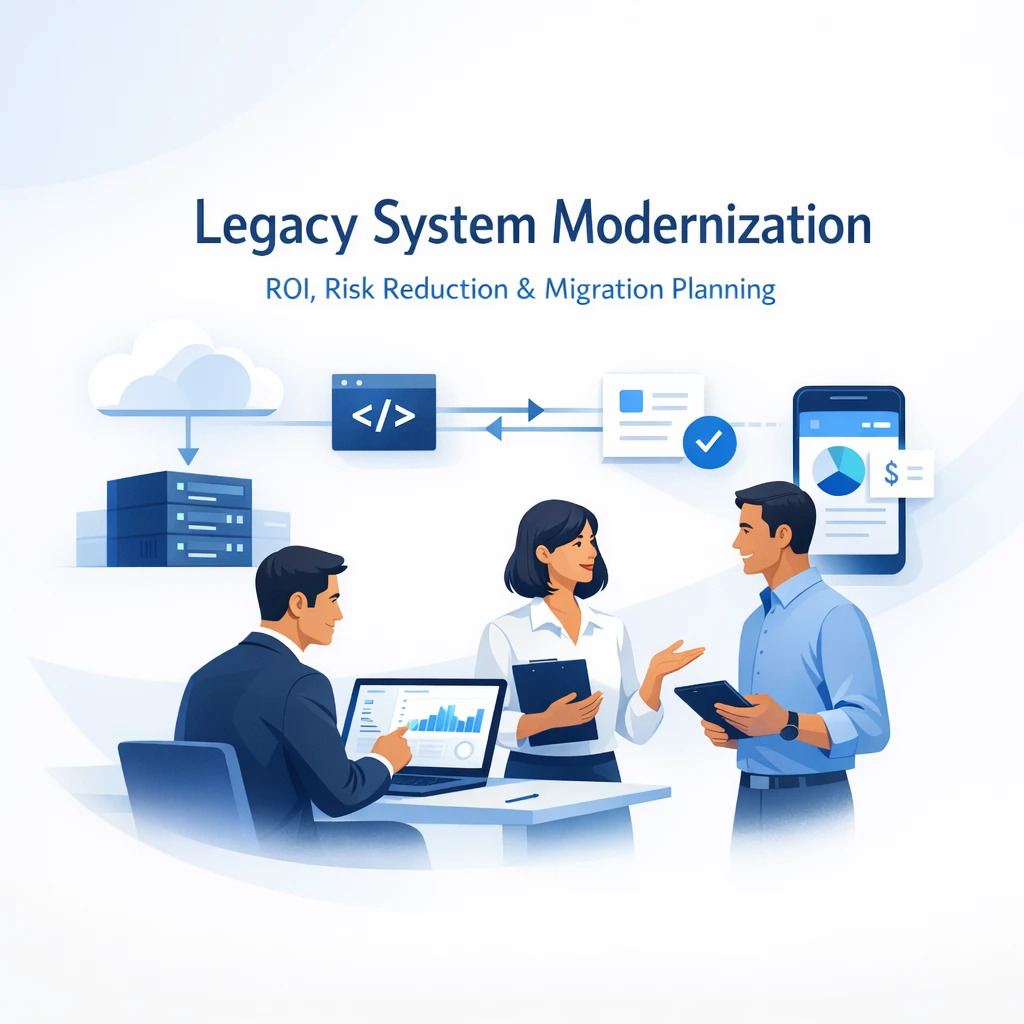
Practical guidance for SMBs, SMEs, startups, and enterprises planning software projects between USD $5,000 and $200,000.
Introduction
For banks, insurers, and financial services firms, legacy systems are often the invisible engines behind customer experiences, risk controls, and regulatory compliance. They power core processes like policy administration, claims management, payments, and customer onboarding. Yet, aging architectures can inherit security gaps, integration fragility, and slow release cycles that prevent organizations from seizing competitive opportunities in a digital-first world.
This article is designed for decision-makers and delivery teams in the UAE, GCC, Europe, North America, and beyond who are evaluating legacy system modernization as a strategic initiative. We’ll explore ROI, risk reduction, and migration planning with practical guidance, real-world patterns, and implementation considerations. Throughout, Triostack Technologies is positioned as a global partner with deep experience in Custom Software, Web & Mobile Development, AI Development, Cloud Migration, DevOps, API Development, and more — delivering outcomes without loud marketing pitches.
Note: this article uses real-world patterns and pragmatic ranges suitable for SMBs, SMEs, startups, and large teams planning projects within the USD $5k–$200k band, while keeping doors open for larger phases if needed.
What is the Topic?
Legacy system modernization is the process of evolving aging software, data, and infrastructure into a modern, scalable, secure, and API-enabled stack. For banking and insurance, modernization typically involves moving from monolithic core systems to modular, cloud-native architectures that expose services via APIs, enable data-driven decision-making, and improve customer experiences without compromising compliance or risk controls.
Key dimensions include: rehosting or refactoring (lift-and-shift vs. incremental modernization), data migration and governance, API-first design, cloud adoption (public, private, or hybrid), security and identity, and new capabilities such as AI-assisted decisioning and automated underwriting or claims processing.
Triostack’s approach blends people, process, and technology to deliver measurable business outcomes while maintaining regulatory readiness and governance across geographies.
Why it Matters in 2026
- Regulatory agility: New rules around data privacy, reporting, and cross-border data transfer require adaptable architectures and robust data lineage.
- Customer expectations: Digital-first experiences, faster onboarding, and real-time analytics are table stakes for banks and insurers.
- Risk and resilience: Modern platforms improve monitoring, anomaly detection, and incident response to reduce operational risk.
- Cost and efficiency: Cloud-native microservices and automation reduce maintenance toil and enable faster feature delivery.
- AI and data-driven decisions: Modern data platforms enable AI assisted underwriting, fraud detection, and personalized customer journeys.
For organizations in the UAE, Saudi Arabia, Qatar, Oman, Kuwait, Bahrain, and beyond, modernization also aligns with national digital transformation agendas and regional fintech ecosystems. Triostack supports this alignment with global delivery capabilities and local compliance know-how.
Current Industry Challenges
- Data silos and quality: Legacy systems store data in non-standard formats, making cross-domain analytics painful.
- Vendor lock-in: Monolithic platforms can restrict technology choices and increase migration risk.
- Security and compliance: Regulators demand strong controls, auditability, and透明 data governance across jurisdictions.
- Slow release cycles: Large change sets lead to long lead times and missed market opportunities.
- Complex integrations: Modern ecosystems require seamless API integrations with core banking, payment networks, and CRM/ERP systems.
Addressing these challenges requires a thoughtful modernization strategy that prioritizes risk control, data integrity, and a road map that delivers incremental value.
How the Technology Works
Modernization typically blends four patterns: rehost, replatform, refactor, and rebuild. For banking and insurance, a practical approach often starts with lift-and-shift of the most mission-critical modules to clear a path for iterative modernization, followed by targeted refactors and API-first redesigns. A well-planned migration ensures data integrity, security, and regulatory compliance at every stage.
Key enablers include:
- Cloud-native microservices: Break down monoliths into independently deployable services with clear boundaries.
- API-first architecture: RESTful or gRPC APIs enable interoperability and faster partner integration.
- Event-driven data flows: Streaming data enables near real-time decisioning and risk monitoring.
- Data governance and catalog: Unified data lineage, quality metrics, and access controls.
- DevOps and CI/CD: Automated testing, secure deployments, and rapid iteration.
Architecture Overview
Below is a high-level view of a typical modernization architecture for banking and insurance—designed to support regulatory requirements, secure data sharing, and scalable product delivery.
This pattern emphasizes gradual migration from the legacy core to a modern microservices layer, with an API gateway for secure exposure, a data lake for analytics, and a unified customer portal for seamless experiences.
Step-by-Step Migration Workflow
- Discovery & assessment: Inventory systems, data models, and integrations. Define business value and risk appetite.
- Target architecture & roadmap: Choose modernization pattern (rehost, refactor, rebuild), prioritize modules, and design data governance.
- Security & regulatory mapping: Align with local and cross-border requirements, including data localization and access controls.
- Incremental implementation: Start with a minimal viable path (MVP) in a sandbox, then progressively migrate modules in small batches.
- Data migration & quality: Implement data cleansing, transformation, and quality gates with traceability.
- Testing & validation: Functional, integration, security, and resilience testing in staging environments.
- Cutover planning: Define swing window, rollback plan, and business continuity measures.
- Operate & optimize: Monitor, observe, and optimize performance, cost, and user feedback.
Triostack often uses a phased modernization approach that balances speed with risk control, especially when working with regulated domains like banking and insurance.
Business Use Cases
- Policy administration modernization: Move from a monolithic policy system to modular services that support faster policy creation, endorsements, and renewals.
- Claims processing modernization: Event-driven workflows for faster claims adjudication, automated document verification, and real-time fraud checks.
- Digital onboarding & KYC: API-driven onboarding with integrated KYC providers, identity verification, and risk scoring.
- Payment & settlement modernization: Real-time payment routing, reconciliation, and settlement across banking networks.
- Regulatory reporting & analytics: Centralized data governance to support statutory reporting, risk dashboards, and audit trails.
Industry Applications
In banking and insurance, modernization initiatives commonly touch on the following applications:
- Core banking modernization: Modular services for accounts, payments, lending, and risk.
- Policy administration systems: Flexible product configuration, underwriting, and claims handling.
- CRM & customer data platforms: 360-degree customer views, journey orchestration, and next-best actions.
- Data & analytics: Real-time risk scoring, pricing optimization, and fraud detection.
- Regulatory tech (RegTech): Automated reporting, auditability, and governance controls.
Benefits
- ROI and TCO improvements: Lower maintenance costs, faster feature delivery, and better capacity planning.
- Risk reduction: Improved security, compliance, and resilience through modern controls and monitoring.
- Operational efficiency: Automation, standardized data, and streamlined processes reduce manual work.
- Customer experience: Real-time insight, personalized journeys, and faster onboarding.
- Future readiness: Open APIs, microservices, and cloud-native patterns that adapt to evolving business needs.
Challenges
- Data quality & migration risk: Incomplete data and legacy data models complicate porting to new platforms.
- Downtime risk during migration: Cutover windows require careful planning and testing.
- Change management: Adoption and training are critical for sustainable benefits.
- Security & compliance: Maintaining controls while enabling cross-border data flows.
- Vendor and tool selection: Balancing feature fit with long-term maintainability.
Common Mistakes
- Underestimating data migration complexity and the need for a robust data governance plan.
- Starting with a big-bang rewrite without a staged pilot or MVP.
- Insufficient stakeholder alignment across business, risk, and IT teams.
- Over-customization that hinders future upgrades or cloud-native benefits.
- Neglecting security-by-design during architecture definition.
Best Practices
- Governance and program management: Establish a modernization steering committee, phased milestones, and clearly defined KPIs.
- Pilot first: Start with a low-risk domain or module to prove the approach and build confidence.
- Data governance: Create a data catalog, data quality checks, and lineage documentation.
- Security-by-design: Integrate identity, access management, encryption, and threat modeling from day one.
- Modular architecture: Favor decoupled services, API boundaries, and clear ownership to enable faster evolution.
Build vs Buy for Modernization Initiatives
| Aspect | Build (In-House) | Buy (Outsourcing/Platform) |
|---|---|---|
| Control & customization | Maximum control; bespoke alignment with business processes | Faster access to ready-made capabilities; configurable rather than fully bespoke |
| Speed to value | Depends on team capacity; often slower | Typically faster MVPs and pilots |
| Cost predictability | Can be variable; ongoing maintenance burden | Clearer upfront pricing; ongoing support may be bundled |
| Risk & compliance | Requires strong internal governance and expertise | Prebuilt controls and certifications; but integration risk remains |
| Talent availability | Depends on local talent pool | Access to global pools with scalable teams |
For many banks and insurers, a hybrid approach works best: build core differentiators in-house while acquiring modular components or services to accelerate delivery and reduce risk. Triostack frequently guides clients through a balanced path that respects regulatory constraints while enabling rapid modernization.
Estimated Development Cost
Below are typical ranges for SMBs and SMEs considering modernizing components of a banking or insurance stack. Actual costs vary by scope, data complexity, regulatory requirements, and the level of cloud maturity desired.
| Project Type | Typical Range (USD) | Notes |
|---|---|---|
| Business Website | 5,000 – 15,000 | Informational or marketing sites with CMS integration |
| Customer Portal | 10,000 – 40,000 | Secure login, dashboards, basic transactions |
| CRM | 15,000 – 100,000 | Sales, service, and marketing integration with core systems |
| ERP | 40,000 – 200,000 | Finance, procurement, HR modules; cross-functional integration |
| AI Chatbot | 5,000 – 25,000 | Rule-based or basic ML-assisted interactions |
| AI Automation | 15,000 – 80,000 | Workflow automation, decisioning, and RPA-lite capabilities |
| SaaS MVP | 20,000 – 80,000 | Core SaaS product with onboarding and admin features |
| Enterprise Web App | 30,000 – 200,000+ | Large-scale, highly regulated, multi-tenant or multi-region |
Pricing factors: project scope, regulatory complexity, data migration requirements, third-party integrations, security and compliance needs, localization, privacy controls, and the level of cloud maturity. Projects in the UAE and GCC often require data localization and enhanced security, which can influence total cost and timeline.
Recommended Technology Stack
A pragmatic modernization stack balances security, scalability, and speed to market. The following is representative and adaptable to regional compliance requirements:
- Frontend: React or Angular, with a focus on accessibility and responsive design.
- Backend: Java (Spring Boot) or .NET (minimal viable surface area) for core services; Node.js for lightweight services.
- APIs: RESTful and/or gRPC APIs; API management via an API gateway.
- Databases: PostgreSQL or SQL Server; specialized data stores for analytics as needed.
- Data & analytics: Data lake/weder; Apache Spark or cloud-native equivalents; BI tools for dashboards.
- Cloud & containers: AWS, Azure, or GCP; Docker containers with Kubernetes or a managed Kubernetes service.
- Security & identity: IAM, SSO, MFA, encryption at rest/in transit, PCI-DSS scope considerations where applicable.
- DevOps & CI/CD: GitHub/GitLab, Jira/ClickUp, Azure DevOps, CI/CD pipelines, automated testing, blue/green deployments.
Triostack’s approach emphasizes open standards, API-first design, and cloud-native best practices to deliver resilient, scalable solutions that align with regulatory expectations in the UAE and beyond.
Future Trends in Legacy Modernization
- AI-powered risk assessment: Automated underwriting and claims scoring powered by ML on modern data platforms.
- Open banking & API ecosystems: New partnerships and real-time data sharing through standardized APIs.
- Low-code/no-code integration: Accelerating integration and workflow automation without compromising control.
- Zero-trust security: Granular access controls, continuous verification, and micro-segmentation for cross-border workloads.
- Edge analytics: Real-time insights at the point of interaction, improving customer experiences and risk controls.
Organizations that adopt a staged modernization plan with clear governance and measurable outcomes will be better positioned to respond to regulatory changes and market shifts.
How Triostack Delivers Projects Globally
Triostack operates with a global delivery model to support projects across time zones, languages, and regulatory environments. We combine global engineering excellence with local market insight to help banks and insurers accelerate modernization while maintaining governance and security.
Remote Delivery and Agile Practices
From India-based delivery hubs to client locations in Dubai, UAE, and beyond, Triostack uses a mature remote delivery framework:
- Agile governance: Clear sprint plans, backlog management, and iteration reviews.
- Weekly demos: Transparent progress through live demos and feedback loops.
- Communication channels: Slack, Teams, Zoom, Google Meet for real-time collaboration.
- Project management & collaboration: Jira, ClickUp, GitHub, GitLab, Azure DevOps for traceability.
- CI/CD: Automated build, test, and deployment pipelines with cloud staging environments.
- QA & security: Dedicated QA cycles, security testing, and compliance checks.
- Documentation & IP ownership: Thorough documentation, NDAs, and clear IP ownership terms.
- Timezone overlap: Optimized overlap for English communication, review meetings, and rapid feedback.
- Dedicated Project Managers: End-to-end coordination and risk management for global teams.
Why UAE Businesses Outsource to India
Outsourcing software work to India offers multiple advantages for UAE entities and other regional businesses:
- Cost efficiency without compromising quality, enabling more predictable budgets for SMBs and SMEs.
- Large, high-quality talent pool with deep domain expertise in banking, fintech, and insurance.
- Faster hiring and flexible team scaling to match project phase and demand.
- Strong communication standards, English fluency, and robust project management practices.
- Proven capabilities in security, compliance, and cloud-native engineering aligned with global standards.
Dedicated Guidance on Remote Delivery from India
When a regional organization engages with a remote delivery partner, the following elements are essential for success:
- Agile & sprint planning: Clearly defined sprints aligned with business milestones and regulatory windows.
- Communication cadence: Regular standups, demos, and escalation paths via Slack/Teams/Zoom.
- Collaboration tools: Jira for tracking, ClickUp for lightweight tasks, and GitHub/GitLab for code management.
- CI/CD & cloud staging: Automated pipelines with environment parity to minimize surprises during cutover.
- Security & NDA: Thorough security reviews, NDA, and IP ownership terms clearly defined upfront.
- Timezone overlap & language: Sufficient overlap for effective communication; English as the primary business language.
- Dedicated PMs & long-term support: Ongoing care and optimization beyond initial delivery.
Triostack emphasizes collaborative governance and transparent reporting to ensure alignment with UAE-based regulations and regional business objectives.
Case Studies (Realistic Scenarios)
Dubai Logistics Company — Modernizing Inventory & Billing
Challenge: A Dubai-based logistics firm depended on an aging order management and billing system that blocked real-time tracking and automated invoicing. The system required multiple manual reconciliations and hindered cross-border invoicing with regional partners.
Approach: Triostack delivered a phased modernization that rehosted critical modules and introduced a microservices layer for shipment orchestration, with an API gateway for partner integrations and a data lake for analytics. The team implemented secure payments and real-time dashboards for customers and suppliers.
Outcome: Improved order-to-cash cycle time, better visibility for clients, and a scalable platform capable of supporting expansion in the GCC. The project followed a staged cutover and included comprehensive testing and security hardening.
UAE Healthcare Clinic — Patient Portal & Data Interoperability
Challenge: A regional healthcare clinic needed a patient portal, secure data exchange with imaging and lab systems, and compliant data storage under healthcare regulations.
Approach: A privacy-by-design modernization plan introduced a patient-first portal, secure identity management, API-based interoperability with imaging and lab systems, and a robust audit trail for regulatory reporting.
Outcome: Faster patient onboarding, improved care coordination, and enhanced data accessibility for clinicians while maintaining HIPAA-like controls and regional privacy standards.
Saudi Retail Business — Loyalty, CRM, and OMS Modernization
Challenge: A Saudi retailer faced silos between CRM, loyalty programs, and order management, creating inconsistent customer experiences and limited analytics.
Approach: Triostack delivered a CRM modernization integrated with loyalty and OMS via API-first services, enabling unified customer data, real-time pricing, and personalized marketing.
Outcome: Elevated customer engagement and revenue opportunities, with modular services enabling faster feature adoption across stores and e-commerce channels.
Australian Startup — AI-Driven onboarding & Compliance
Challenge: A fast-growing Australian fintech startup required automated onboarding and regulatory compliance features to scale globally.
Approach: Implemented an API-driven onboarding flow with KYC verification, risk scoring, and automated document verification. Data governance and secure cloud deployment supported multi-region operations.
Outcome: Accelerated time-to-market with compliant, scalable onboarding and reduced manual review workloads.
UK SaaS Company — Global Expansion Readiness
Challenge: A UK-based SaaS firm needed to internationalize its product to support multiple regions with different regulatory requirements.
Approach: Introduced a multi-tenant, cloud-native architecture with regional data segregation, localized UIs, and compliance controls. Implemented automated testing and deployment pipelines across regions.
Outcome: Faster entry into new markets with consistent performance and governance.
Best Practices for Global Delivery
- Establish a cross-functional core team with product, security, QA, and platform engineers represented in every phase.
- Define a detailed data migration plan with quality gates and rollback strategies.
- Use pilot domains to prove architectural choices before scaling widely.
- Invest in security-by-design, including threat modeling and secure coding practices.
- Maintain clear documentation and knowledge transfer for long-term support and maintenance.
Takeaways and Next Steps
Legacy modernization is not a single project but a strategic program. It combines architecture, governance, data maturity, and organizational change. For banking and insurance, the goal is to unlock faster time-to-value while maintaining the highest standards of security and compliance. A phased, risk-aware approach with measurable milestones is essential for success.
If your organization is planning a modernization initiative, Triostack can help you design, build, deploy, and maintain a scalable solution that aligns with regional and global compliance requirements. Our teams operate globally with a focus on practical execution, robust security, and measurable business outcomes.
Frequently Asked Questions
- What is the typical timeline for a modernization project?
- Timelines vary by scope, but many SMB-focused initiatives begin with a 12–20 week MVP or pilot, followed by phased enhancements over 6–18 months for full modernization, depending on regulatory requirements and migration complexity.
- How do you address regulatory compliance during migration?
- We map regulatory requirements early, implement security-by-design, enforce data governance, and perform parallel testing to ensure auditability and traceability throughout the migration.
- What are common success metrics?
- Time-to-market for new features, reduction in maintenance costs, data quality improvements, system uptime and resilience, and improved customer satisfaction scores.
- How do you manage data migration risk?
- With a staged approach, robust data cleansing, validation gates, and rollback plans, plus pilot migrations to catch issues before full-scale transfer.
- What makes Triostack different as a partner?
- We emphasize practical implementation, global delivery with local market insight, strong governance, security, and long-term support across custom software, cloud, and AI initiatives.
Businesses planning similar solutions often benefit from experienced software development partners like Triostack Technologies.
If you're planning a similar software project, Triostack can help you design, build, deploy and maintain a scalable solution.
Internal Resources
Diagrams
Triostack Team
Technology Evangelist & Writer
Triostack Team is an experienced writer and technologist, exploring the intersections of AI, cloud architecture, and modern application development. Passionate about turning complex technical concepts into accessible insights.