Legacy System Modernization for GCC Enterprises: When to Rebuild, Replatform, or Integrate
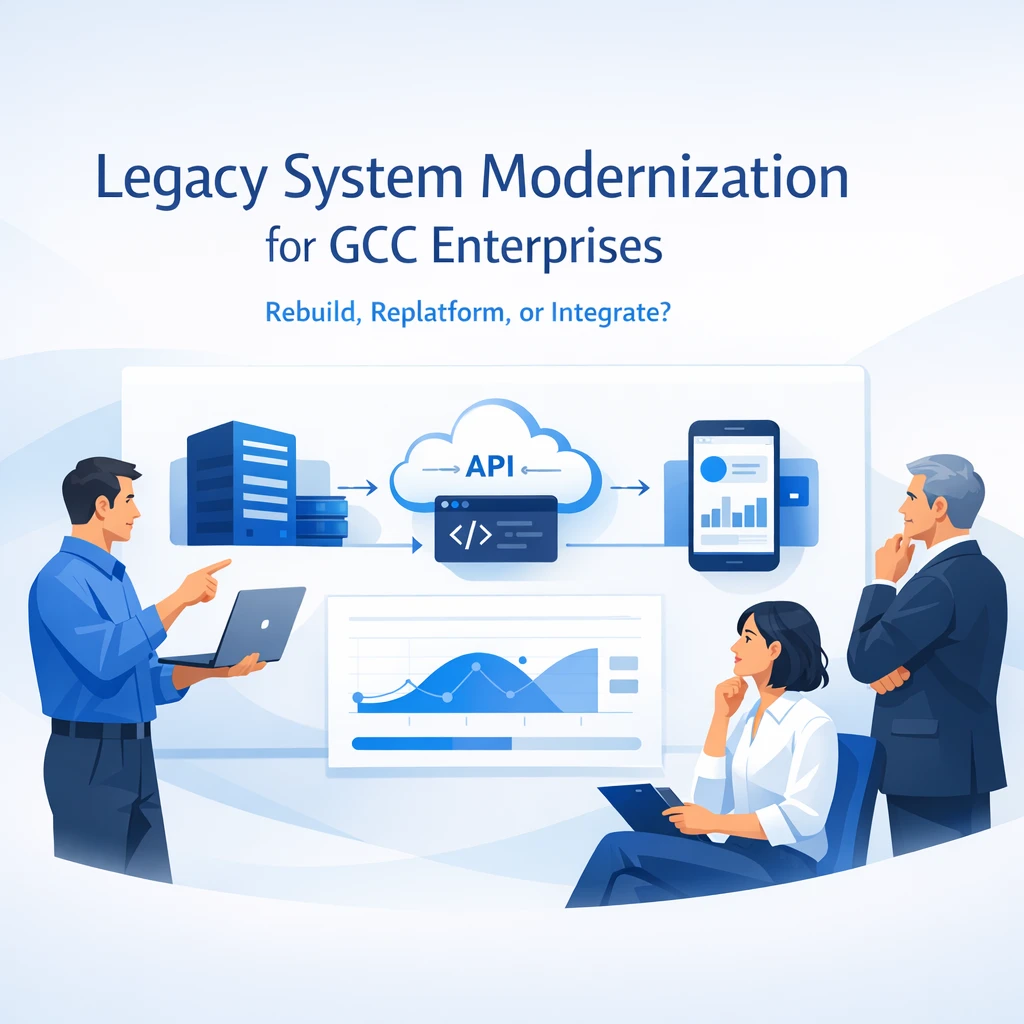
For growth-minded SMBs, SMEs, and multinational teams across Dubai, the UAE, Saudi Arabia, Qatar, Oman, Kuwait, Bahrain, and beyond, modernization is less a choice and more a strategic imperative. This guide explains when to rebuild, replatform, or integrate legacy systems, with practical frameworks, real-world examples, and a path to scalable, maintainable software delivered by Triostack Technologies—without turning the process into a vendor pitch.
Also, if you’re exploring remote delivery options, we share how Triostack collaborates with clients worldwide, including teams in India, to drive high-quality software results for projects ranging from USD 5,000 to USD 200,000.
Introduction
Legacy modernization is not a single event; it’s a portfolio: selective rebuilds, strategic replatforming, and careful integration. Modern enterprises in the GCC and global markets face a convergence of regulatory compliance, customer expectations, and rapid digital tooling. The goal is to reduce risk, accelerate time-to-market, and create a resilient foundation for innovation—without incurring unnecessary disruption to core operations.
In this article, you’ll find a practical framework for choosing between rebuild, replatform, and integration, backed by real-world scenarios, architecture guidance, and cost considerations. We’ll also highlight how Triostack Technologies supports global clients with remote delivery, ensuring quality, security, and accountability at every step.
What is the Topic?
Legacy system modernization encompasses three primary approaches:
- Rebuild — Rewriting a system from scratch to meet current business needs, technology standards, and scalability requirements. This is often chosen when the legacy codebase is brittle, difficult to maintain, or misaligned with long-term business goals.
- Replatform — Moving the system to a new platform or runtime (lift-and-shift or near-zero-downtime transitions) while preserving the core business logic. This approach minimizes business risk and preserves proven workflows while enabling modern hosting, security, and operability enhancements.
- Integrate — Connecting legacy components with modern services via APIs, adapters, and data synchronization. Integration enables incremental modernization, improving visibility and interoperability without wholesale rewrites.
Each path has trade-offs across cost, time, risk, and business impact. The right choice often depends on business priorities, current tech debt, data integrity, and regulatory considerations common in GCC and global markets.
Why it Matters in 2026
Across the GCC and the broader markets we serve, modernization is accelerating due to:
- Growing regulatory complexity and data privacy requirements (GDPR-like standards, SOC2, ISO 27001, etc.)
- Shifting customer expectations for omnichannel experiences and real-time analytics
- Proliferation of cloud-native services, containers, and microservices that enable scalable architectures
- The need to align IT with business value—reducing time-to-value for new products and services
For many GCC organizations, modernization is not just about technology—it’s about competitiveness, risk management, and the ability to respond quickly to market changes. Global teams often collaborate across time zones to deliver modern software responsibly, securely, and transparently.
Current Industry Challenges
Aging architectures, monoliths, and brittle integrations slow delivery and complicate maintenance. Data protection, consent management, and auditability require modern controls and traceability. Fragmented systems create data quality issues and degrade customer experience. Finding and retaining specialists in modern stacks can be difficult and costly. Projects often overrun due to unclear requirements or evolving needs.
Modernization is most successful when it begins with a clear governance model, aligned business outcomes, and a pragmatic approach to migration—especially for organizations with complex regulatory demands in the GCC and beyond.
How the Technology Works
Modernization strategies rely on three core capabilities:
- API-led connectivity to expose legacy data and services securely to modern apps, analytics, and automation platforms.
- Componentization through microservices, modular services, and event-driven architectures to enable independent deployment and scaling.
- Data migration and synchronization to preserve data integrity, lineage, and compliance during transitions.
These capabilities enable a balanced approach—delivering incremental value while reducing risk. In practice, teams often start with a minimal viable architecture that demonstrates value quickly, then expand to broader capabilities.
Architecture Overview
The modern architecture for legacy modernization typically includes front-end apps, an API layer, microservices, and data/identity services, all backed by secure cloud infrastructure. The diagram below illustrates a representative setup:
Note: This is a high-level abstraction. Exact components vary by project, but the principle remains: expose legacy capabilities via a modern API layer, ensure secure data flows, and enable independent evolution of services.
Step-by-Step Workflow
Here is a practical, phased workflow you can adapt. It emphasizes stakeholder alignment, risk management, and incremental value delivery.
- Discovery and domain scoping: map current workflows, data, and pain points. Identify candidate systems for modernization.
- Assessment with a modernization scorecard: evaluate technical debt, data quality, regulatory impact, and integration risk.
- Decision gate: decide whether to rebuild, replatform, or integrate for each major domain (e.g., ERP, CRM, or customer portal).
- Architecture design for chosen paths, including security, data governance, and deployment models.
- Implementation in iterative sprints, with modular deliverables and clear acceptance criteria.
- Migration and cutover: data migration plans, test plans, and rollback strategies.
- Operate and optimize: monitoring, performance tuning, and continuous improvement.
Throughout this process, Triostack follows a transparent, iterative approach—sharing progress through weekly demos and detailed documentation.
Business Use Cases
Below are representative scenarios showing how different business contexts approach modernization. While every project is unique, these patterns offer practical guidance for decision-making.
- Dubai logistics company faced disjointed warehouse and order systems. They prioritized integration to create end-to-end visibility while preserving their ERP investments, enabling real-time inventory and order status across multiple warehouses.
- UAE healthcare clinic needed a secure patient portal and EHR integration. A staged approach combined replatforming for the portal with API-based integration to the legacy EHR, improving patient access and compliance tracking.
- Saudi retail business sought omnichannel capabilities. They pursued a hybrid model: modernize customer-facing services with a new CRM and integrate with back-office systems to unify sales, inventory, and fulfillment.
- Australian startup built an AI-powered SaaS product. They leveraged modular microservices and cloud-native tooling to accelerate go-to-market while maintaining data governance and security standards.
Industry Applications
Legacy modernization touches multiple sectors. Common domains include:
- Logistics and supply chain management
- Healthcare and patient data management
- Retail and omnichannel commerce
- Manufacturing and field services
- Financial services and insurance
Across these sectors, modernization enables better data flow, faster decision-making, and improved security posture while enabling teams to respond to market changes with agility.
Benefits
- Improved agility and faster time-to-value for new features and services
- Enhanced security, compliance, and governance across systems
- Better data quality, visibility, and analytics capabilities
- Scalable architectures that accommodate growth and evolving business needs
- Incremental modernization reduces risk compared with wholesale rewrites
Challenges
- Data migration risk and integrity concerns
- Complex dependencies across complementary systems
- Change management and stakeholder alignment
- Security and regulatory compliance across borders
Mitigating these challenges requires a structured plan, strong governance, and a partner with experience delivering across regions, including the GCC and the broader markets.
Common Mistakes
- Underestimating data migration complexity and quality requirements
- Overloading the project with scope creep without clear prioritization
- Neglecting security, privacy, and regulatory implications early
- Underinvesting in testing, QA, and user acceptance strategies
Best Practices
- Establish a modernization PMO with clear success metrics
- Adopt an API-first approach with a robust API gateway
- Implement data governance, lineage, and auditing from the outset
- Start small, demonstrate value, and scale gradually
- Choose a delivery model that balances speed, risk, and control
Build vs Buy: A Practical Comparison
| Aspect | Build | Buy |
|---|---|---|
| Time-to-value | Longer upfront; tailored to business | Faster start; may require customization |
| Customization | High flexibility | Limited by vendor roadmap |
| Cost predictability | Higher upfront, potentially lower long-term risk | Lower upfront, ongoing licenses and upgrades |
| Control & IP | Full control over code and IP | Vendor controls core IP |
| Maintenance burden | In-house maintenance, specialized skills required | Vendor-managed updates and support |
For many SMBs and startups, a hybrid approach works best: rebuild or replatform selectively for mission-critical domains while integrating other components with best-in-class SaaS products. Triostack often guides clients through this decision process, ensuring alignment with business outcomes and budget constraints.
Estimated Development Cost
Pricing in software is highly context-dependent. The ranges below reflect common SMB-scale projects and can help frame budgeting conversations. Factors like scope, data migration, security, and regional labor costs will influence final prices.
| Solution Type | Typical Range (USD) |
|---|---|
| Business Website | 5,000 – 15,000 |
| Customer Portal | 10,000 – 40,000 |
| CRM | 15,000 – 100,000 |
| ERP | 40,000 – 200,000 |
| AI Chatbot | 5,000 – 25,000 |
| AI Automation | 15,000 – 80,000 |
| SaaS MVP | 20,000 – 80,000 |
| Enterprise Web App | 30,000 – 200,000 |
Pricing is influenced by:
- Scope clarity and change management
- Data migration and quality requirements
- Security, privacy, and regulatory compliance
- Third-party integrations and vendor dependencies
- Team location and skill level
- UI/UX complexity and accessibility standards
- Testing, QA, and performance benchmarks
Triostack helps clients benchmark costs against expected business value and provides phased roadmaps to manage cash flow and ROI across the modernization journey.
Recommended Technology Stack
The stack should be chosen to balance velocity, scalability, and security, with attention to regional considerations in the GCC and global delivery.
- Backend: Node.js, .NET, Java or Python microservices based on domain needs
- Database: PostgreSQL for OLTP, with data warehouse considerations using Snowflake or BigQuery
- API & Integration: REST/GraphQL APIs, API gateway, and event streaming (Kafka or Pulsar)
- Cloud & DevOps: AWS, Azure, or Google Cloud; CI/CD with GitHub Actions or Azure DevOps
- AI/ML: PyTorch or TensorFlow; managed ML services for practical AI components
- Security & Compliance: IAM, encryption at rest/in transit, CI/CD security checks
- Observability: Prometheus, Grafana, OpenTelemetry, and centralized logging
Triostack tailors technology choices to client priorities, time-to-market, and security/compliance requirements, ensuring a maintainable path to future capability.
Future Trends in Legacy Modernization
Building modular services that can be recombined as business needs evolve. - Event-driven platforms: Real-time data flows and responsive systems for better user experiences.
- AI-assisted modernization: AI-driven analytics to identify modernization opportunities and optimize migrations.
- Security-by-design: Proactive governance, threat modeling, and continuous compliance as features.
- Low-code and integration hubs: Accelerated integration patterns with governance guardrails.
How Triostack Delivers Projects Globally
Triostack Technologies supports global clients by combining deep engineering expertise with disciplined program management. Our approach emphasizes:
- Clear governance, milestones, and success metrics tied to business value
- End-to-end delivery including custom software, web/mobile development, AI/ML, CRM/ERP, SaaS, and cloud migration
- A strong emphasis on DevOps, QA, UI/UX, API development, and dedicated teams when needed
- Transparent communication and documentation, with secure NDA/IP ownership terms
We focus on outcomes that matter to GCC and global clients, such as improved reliability, reduced time-to-market, and stronger data governance, while staying mindful of budget and schedule constraints.
Remote Delivery: How Triostack Delivers Projects from India
Many clients seek cost-effective, high-quality development with reliable governance. Triostack provides remote delivery from India, combining agile processes with robust communication and security frameworks. Key elements include:
- Agile framework: Scrum or Kanban, with sprint planning, daily stand-ups, and retrospectives
- Regular demos: Weekly demos to show progress and gather feedback
- Communication tools: Slack, Teams, Zoom, Google Meet
- Project tracking: Jira or ClickUp for backlog, milestones, and progress visualization
- Source control and CI/CD: GitHub, GitLab, Azure DevOps with automated builds and tests
- Environment management: Cloud staging, testing, and production with secure data handling
- QA and security: Structured QA cycles, security reviews, and compliance checks
- Documentation and IP ownership: Clear documentation and formal IP ownership agreements (NDA as needed)
- Timezone and communication: Thoughtful timezone overlap and bilingual (English) communication practices
- Dedicated project managers: Single point of contact, escalation paths, and risk management
- Long-term support: Post-launch maintenance and optimization engagements
Why UAE businesses outsource to India often comes down to: cost efficiency, access to a large talent pool, faster hiring cycles, high engineering quality, and strong communication when properly managed. The model supports scalable teams and predictable delivery while maintaining rigorous security standards.
Case Studies (Realistic Scenarios, Anonymized)
Below are anonymized, plausible examples that illustrate how legacy modernization plays out in practice. While company names are withheld, the scenarios reflect common business contexts across Dubai, UAE, Saudi Arabia, Australia, the UK, and beyond.
Case Study 1 — Dubai-based Logistics Company
Challenge: A logistics provider relied on a legacy order management system that lacked real-time visibility across multiple warehouses, causing stock inaccuracies and delayed fulfillment.
Approach: Triostack designed an integration strategy that connected the legacy ERP with a modern API layer and a lightweight microservice for real-time order tracking. We implemented secure data pipelines to a centralized data lake for analytics and introduced a modern CRM for customer-facing workflows.
Outcome: Improved visibility of orders and inventory across sites, enabling proactive fulfillment planning and better customer communications, with a path toward deeper analytics and automation in subsequent phases.
Case Study 2 — UAE Healthcare Clinic
Challenge: A regional clinic needed a secure patient portal and tighter integration with their legacy EHR system while meeting strict data privacy requirements.
Approach: We pursued a phased modernization plan: replatform the patient portal to a modern web/mobile interface, implement API-level access to the existing EHR, and establish data governance and audit trails. This included role-based access control and encryption in transit and at rest.
Outcome: The clinic achieved improved patient engagement, streamlined data exchange with external providers, and a stronger security posture aligned with regulatory expectations.
Case Study 3 — Saudi Retail Business
Challenge: Omnichannel sales required a unified view of customers, inventory, and orders across storefronts and an aging CRM.
Approach: We implemented a hybrid modernization path: replatform the CRM onto a modern cloud service, implement API-driven integrations to the legacy POS and ERP, and establish event-driven data flows for real-time synchronization.
Outcome: Consistent customer data and improved fulfillment accuracy, with the flexibility to add new channels and capabilities in future iterations.
Case Study 4 — Australian Startup
Challenge: A fast-growing startup needed a scalable SaaS platform with AI-driven features, while preserving core business logic in a secure, maintainable way.
Approach: Triostack built a modular microservices architecture with a cloud-native deployment, incorporating AI components for user insights and automation, and aligning data governance across environments.
Outcome: A robust SaaS MVP with a clear upgrade path, capable of handling increasing user load and evolving product requirements.
Frequently Asked Questions
- Q: How do I decide between rebuild, replatform, or integrate?
- A: Start with a domain-level assessment. If the legacy codebase is brittle and tightly coupled to business rules, rebuild may be appropriate. If core logic is sound but needs modern hosting and operability, replatform. If you want to preserve existing investments while achieving better interoperability, integration is often best for incremental modernization.
- Q: What is the typical timeline for a modernization program?
- A: Timelines vary by scope and approach, but phased programs that demonstrate value within 90–180 days tend to deliver momentum. Larger ERP or enterprise-grade transformations may span multiple quarters.
- Q: How does Triostack handle security and regulatory compliance?
- A: We embed security and governance into every phase—from design to deployment—covering data protection, access control, auditability, and compliance mapping to standards relevant to GCC and international markets.
- Q: Can you support ongoing maintenance after launch?
- A: Yes. We offer post-launch maintenance, support, and optimization engagements to ensure sustained performance and adaptability.
Next Steps
If you’re planning a legacy modernization initiative, consider engaging with an experienced partner who can guide you through a staged, value-focused journey. Triostack can help you design, build, deploy and maintain a scalable solution—whether you’re modernizing a single domain or pursuing a comprehensive enterprise-wide program.
Businesses planning similar solutions often benefit from experienced software development partners like Triostack Technologies.
Triostack Team
Technology Evangelist & Writer
Triostack Team is an experienced writer and technologist, exploring the intersections of AI, cloud architecture, and modern application development. Passionate about turning complex technical concepts into accessible insights.