Legacy System Modernization for Banks and Insurers: How to Reduce Risk and Accelerate Digital Transformation
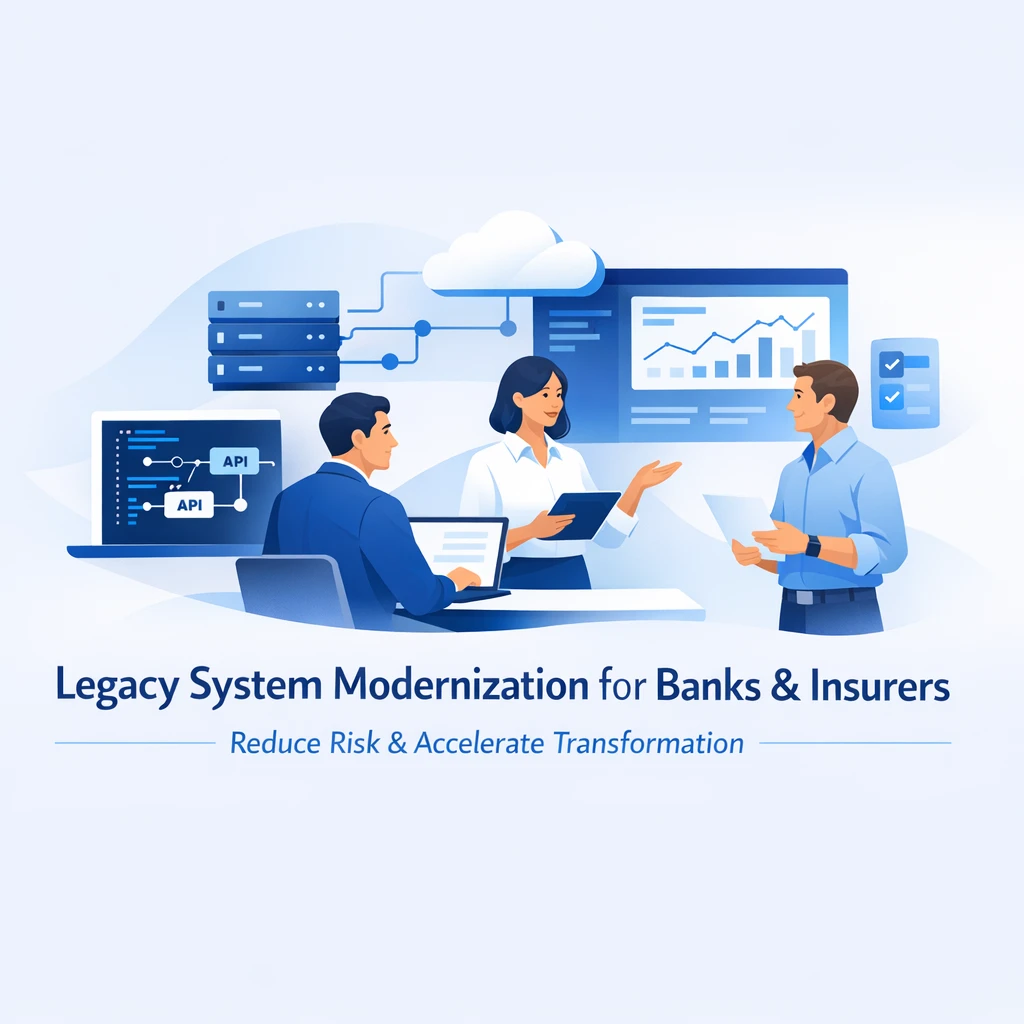
Practical guidance for financial services leaders planning modernization projects in the UAE, GCC, North America, Europe, and beyond. This article blends industry insights with actionable steps, showing how a trusted global software partner can help you migrate safely from legacy to modern digital platforms.
Why Modernize Legacy Systems in Banks and Insurers in 2026
Financial institutions face a unique convergence of regulatory pressure, customer expectations, and the need for rapid product delivery. Legacy monoliths can slow risk management, data analysis, and customer experience. Modernization isn’t about discarding history; it is about preserving a strong core while enabling flexibility, data integrity, and security at scale.
In regions like Dubai, the UAE, Saudi Arabia, Qatar, Oman, Kuwait, Bahrain, and across the US, UK, Europe, Australia, and Singapore, successful modernization unlocks opportunities to offer new products faster, enable real-time risk scoring, streamline regulatory reporting, and support omnichannel experiences for customers and partners.
What is Legacy System Modernization in Banking and Insurance?
Legacy system modernization is a deliberate, phased process to replace or evolve old software systems with modern architectures that improve scalability, resilience, and speed. For banks and insurers, typical modernization patterns include:
- API-first approaches exposing core capabilities to new channels
- Cloud-native microservices and modular platforms
- Data fabric and real-time analytics for risk and customer insights
- Automation and AI-driven decisioning in underwriting and fraud detection
- DevOps practices to shorten release cycles and improve governance
Triostack partners with financial institutions to architect and deliver programs that minimize risk, preserve regulatory compliance, and accelerate time-to-value.
Current Industry Challenges
Many banks and insurers in our target regions encounter a common set of obstacles as they begin modernization programs:
- Complex legacy data models and data silos that hinder analytics and reporting
- Regulatory risk management requirements across jurisdictions
- Rigid vendor contracts that slow technology refresh cycles
- Security concerns and the need for robust identity and access management
- Internal skills gaps and the challenge of scaling delivery capabilities
- Unclear ROI due to uncertain scope, architecture, and integration complexity
A phased, risk-aware approach helps mitigate these issues while keeping compliance and stakeholder alignment front and center.
How the Technology Works
Modernization usually starts with a discovery phase to map existing capabilities, data flows, and regulatory constraints. From there, a target architecture is defined—often moving from monoliths to event-driven, API-led ecosystems running on cloud platforms. Key technologies commonly employed include:
- API gateways and management for controlled exposure
- Microservices and container orchestration (Kubernetes)
- Data streaming and real-time analytics
- Cloud-native storage, data lakes, and data cataloging
- AI and machine learning for risk scoring, underwriting, and customer engagement
- DevOps tooling for continuous integration and delivery
Choosing the right combination depends on risk profiles, data residency, regulatory constraints, and business outcomes.
Architecture Overview
The following high-level architecture illustrates a modernized stack suitable for banks and insurers operating in diverse markets:
The diagram emphasizes API exposure, modular services, data fabric, and governance, which are critical for risk control and regulatory reporting.
Step-by-Step Workflow
- Discovery and regulatory alignment: Document risk controls, data lineage, and reporting requirements
- Target architecture design: Decide on API-first, microservices, cloud strategy, and data model
- Migration planning: Prioritize modules with the highest ROI and lowest risk
- Incremental deliverables: Rehost, refactor, or replace components in controlled sprints
- Platform modernization: Implement API management, event-driven patterns, and DevOps pipelines
- Quality and security gates: Continuous testing, security reviews, and regulatory validations
- Go-live and post-release support: Transition to new platforms with operational runbooks
Triostack uses a time-boxed agile process with weekly demos, ensuring stakeholders across regions stay aligned.
Business Use Cases
Customer Onboarding and KYC Modernization
Automated identity verification, risk-based routing, and e-signature integrations reduce onboarding friction while maintaining compliance with local AML rules.
Policy Administration and Claims Processing
AI-assisted underwriting, policy lifecycle management, and real-time fraud detection improve accuracy and speed of decisioning.
Payments and Risk Monitoring
Unified payment reconciliations, real-time risk scoring, and event-driven alerts help contain loss exposure and improve cash flow.
Industry Applications
Across banking and insurance, modernization programs typically focus on:
- Core banking modernization for transaction processing and product catalog management
- Digital wallets, card management, and merchant integrations
- Insurance core systems like policy, claims, and settlement engines
- Regulatory reporting and audit trails across jurisdictions
- Customer experience platforms with omnichannel capabilities
Benefits
- Faster time-to-value through incremental delivery
- Improved data quality, governance, and reporting capabilities
- Greater resilience and security through modern infrastructure
- Scalability to support growth in the UAE, GCC, UK, US, and other regions
- Enhanced customer experiences via API-enabled channels
Challenges
- Data migration risk and data quality remediation
- Regulatory and cross-border data residency constraints
- Vendor lock-in and contract renegotiations
- Change management and stakeholder alignment
Common Mistakes to Avoid
- Starting with a monolithic replacement rather than an API-first approach
- Underestimating data migration complexity and regulatory implications
- Failing to establish a clear operating model and governance framework
- Neglecting security and privacy-by-design throughout the pipeline
Best Practices
- Adopt an iterative, risk-based modernization plan with clear milestones
- Implement an API-first, contract-driven approach to integrations
- Establish a data governance framework and a robust data catalog
- Use cloud-native services with built-in security controls
- Involve regulators and compliance teams early in the design phase
Build vs Buy Comparison
In practice, many financial institutions choose a hybrid strategy. The table below compares typical considerations.
| Aspect | Build In-House | Buy from Vendor | Triostack Approach |
|---|---|---|---|
| Control and customization | Maximum control but higher delivery risk | Faster start, limited customization | Balanced customization with governance and speed |
| Time-to-market | Longer due to internal ramp-up | Faster to value | Structured sprints with measurable milestones |
| Cost predictability | Uncertain; variability in headcount | Fixed bids with scope risk | Transparent budgets with staged investments |
| Risk management | Requires mature internal controls | Regulatory gaps can occur without oversight | Explicit risk planning and regulatory alignment |
| Support and maintenance | Internal teams required | Vendor-led SLAs | Long-term support with dedicated teams |
Estimated Development Cost
The following ranges reflect SMBs and mid-market projects involving banking and insurance domains. They are indicative and vary by region, compliance requirements, and scope.
| Project Type | Typical Range (USD) | Notes |
|---|---|---|
| Business Website | 5k – 15k | Content managed sites, lead capture, basic portals |
| Customer Portal | 10k – 40k | Self-service features, authentication, dashboards |
| CRM | 15k – 100k | Lead, opportunity, and pipeline management with integrations |
| ERP | 40k – 200k | Finance, HR, procurement with compliance considerations |
| AI Chatbot | 5k – 25k | Industry-specific, chat-based customer support |
| AI Automation | 15k – 80k | RPA/ML-based automation for processes |
| SaaS MVP | 20k – 80k | Core product with core features and multi-tenant ready |
| Enterprise Web App | 30k – 200k | Scalable platforms for customers, partners, and internal teams |
Pricing factors include regulatory requirements, data residency, security controls, integration complexity, and the need for AI/ML components.
Recommended Technology Stack
When modernizing banking and insurance platforms, a balanced mix of proven, secure, and scalable technologies matters. The stack below represents a typical design that supports long-term growth and regulatory compliance.
| Layer | Example Technologies | Rationale |
|---|---|---|
| Frontend | React, Angular, Vue | Modern, accessible UIs with good developer experience |
| Backend | Java Spring Boot, .NET, Node.js | Reliability, performance, and ecosystem support |
| API & Integration | REST, GraphQL, gRPC, API Gateways | Controlled exposure and governance |
| Data & AI | Snowflake, Databricks, Spark, MLFlow | Analytics, risk scoring, and decisioning |
| Cloud & Infra | AWS, Azure, or GCP; Kubernetes | Elasticity, resilience, and security |
| Security & Compliance | OIDC, SAML, IAM, data masking, encryption | Regulatory alignment and data protection |
| DevOps & CI/CD | GitHub/GitLab, Jenkins, Azure DevOps, CircleCI | Automated testing, deployment, and governance |
Future Trends in Legacy Modernization
Expect the following to drive modernization programs in banks and insurers:
- AI-enabled risk analytics and decisioning with explainability
- API-led ecosystems enabling partnerships with fintechs and insurtechs
- Hybrid and multi-cloud strategies with strong data residency controls
- Secure by design and Zero Trust architectures
- Automated data lineage and governance across landscapes
How Triostack Delivers Projects Globally and Remotely from India
Organizations seeking cost-effective, high-quality software development often consider remote delivery options. Triostack has a proven model for agile, globally distributed teams with a strong track record in financial services projects.
Agile delivery and governance
- Sprint planning sessions with stakeholders in the time zones that matter
- Weekly demos to ensure alignment and early risk visibility
- Dedicated project managers who coordinate across time zones and regions
Communication and collaboration tools
- Slack, Teams, Zoom, Google Meet for daily interactions
- Jira, ClickUp for issue tracking and project planning
- GitHub, GitLab, Azure DevOps for source control and CI/CD
- Cloud staging environments for testing before production
Quality, security, and compliance
- QA at multiple gates with test automation and manual validation
- Security reviews, data protection controls, and privacy-by-design
- NDA agreements and IP ownership clarity for all engagements
Time zone and language considerations
- Timezone overlap to enable real-time collaboration for critical milestones
- English communication and documented decisions for auditability
- Dedicated project managers to maintain momentum and accountability
Why UAE and GCC clients outsource development to India
Key drivers include cost efficiency, a large talent pool with domain expertise in financial services, faster access to specialized engineers, scalable team models, and strong communication practices. Triostack emphasizes transparent velocity, robust security, and rigorous governance to meet regulatory expectations.
Case Studies
Dubai logistics company — Modernized order and payment workflows
Challenge: An on-premise order management and invoicing system could not scale with growth or provide real-time visibility. Outcome: A modular, API-driven platform integrated with ERP and logistics partners, improving order visibility and supporting dynamic pricing models. The project followed a staged migration plan with minimal disruption to operations.
UAE healthcare clinic — Patient portal and data interoperability
Challenge: Fragmented patient data and limited patient portal capabilities hindered care coordination. Outcome: A unified patient portal connected to EHR systems, enabling secure appointment scheduling, records access, and consent management while maintaining regulatory compliance.
Saudi retail business — Omnichannel platform modernization
Challenge: Siloed systems across online and in-store channels limited customer insights. Outcome: An omnichannel platform with unified product catalog, orders, and loyalty data, enabling real-time inventory checks and personalized marketing across channels.
Australian startup — SaaS MVP for property management
Challenge: Rapidly validated a market idea with a scalable backend. Outcome: A multi-tenant SaaS MVP with core features, quick onboarding, and a path to scale through modular services and APIs.
UK SaaS company — Legacy modernization and cloud migration
Challenge: A monolithic platform hindered feature delivery and resilience. Outcome: A phased migration to a cloud-native microservices architecture with automated testing and compliance reporting, enabling faster feature delivery and improved uptime.
How Triostack Delivers Projects Globally
Triostack operates as a trusted global software development partner, offering a broad set of capabilities to banks, insurers, and financial institutions. Our services include
- Custom Software and Web Development
- Mobile Apps
- AI Development and Machine Learning
- CRM and ERP implementations
- SaaS development and Cloud Migration
- DevOps, API Development, and UI/UX design
- QA, Maintenance, and Technical Consulting
- Dedicated Teams for long-term engagements
Why Businesses Choose Triostack
Triostack brings a practical blend of domain expertise, engineering excellence, and global delivery capabilities. We help clients build scalable digital products, from a well-defined roadmap to robust, secure, and maintainable systems. Our approach emphasizes risk reduction, governance, and measurable outcomes, aligning with regulatory expectations across regions including the UAE, GCC, North America, and Europe.
Dedicated Remote Delivery Model from India
- Agile with sprint planning and weekly demos
- Slack, Teams, Zoom, Google Meet for daily collaboration
- Jira, ClickUp for project management
- GitHub, GitLab, Azure DevOps for code, CI/CD, and version control
- Cloud staging environments for safe testing
- QA and security tests integrated into the CI/CD pipeline
- Comprehensive documentation and secure NDA/IP ownership governance
- Clear time zone overlap and dedicated project managers
- Long-term support and maintenance after go-live
Time zone overlap, English communication, and a robust project management framework ensure long-term collaboration and success for clients in Dubai, UAE, Saudi Arabia, Qatar, Oman, Kuwait, Bahrain, the United States, the UK, Europe, Australia, and Singapore.
Frequently Asked Questions
- Is modernization only about technology?
- No. It combines technology with governance, people, and processes to reduce risk and deliver business value.
- How long does a typical modernization project take?
- Timelines vary by scope, regulatory requirements, and migration strategy, but most SMB projects progress in staged iterations with quarterly milestones.
- Can you work with enterprises in the UAE and GCC?
- Yes. We tailor programs to local regulations and regional business practices while leveraging our global delivery capability.
- What about data residency and security?
- Security by design and regulatory alignment are embedded from the outset, including data residency considerations where required.
Conclusion
Legacy system modernization is not merely a technology upgrade; it is a strategic movement toward safer, faster, and more intelligent financial services platforms. By adopting an API-led, cloud-native approach, and by leveraging a capable partner with global delivery experience, banks and insurers can reduce risk, accelerate digital transformation, and unlock new value for customers and stakeholders across regions—from Dubai and the UAE to Saudi Arabia, Qatar, Oman, Kuwait, Bahrain, the United States, the United Kingdom, Europe, Australia, and Singapore.
Businesses planning similar solutions often benefit from experienced software partners who can design, build, deploy, and maintain scalable solutions. If you are planning a project in the USD 5k to 200k range, Triostack can help you outline a practical road map, select the right tech stack, and manage the delivery with strong governance and clear outcomes.
Triostack Team
Technology Evangelist & Writer
Triostack Team is an experienced writer and technologist, exploring the intersections of AI, cloud architecture, and modern application development. Passionate about turning complex technical concepts into accessible insights.