Legacy System Modernization for Banks and Enterprises in UAE: Cost, Risks and Build vs Buy Strategy
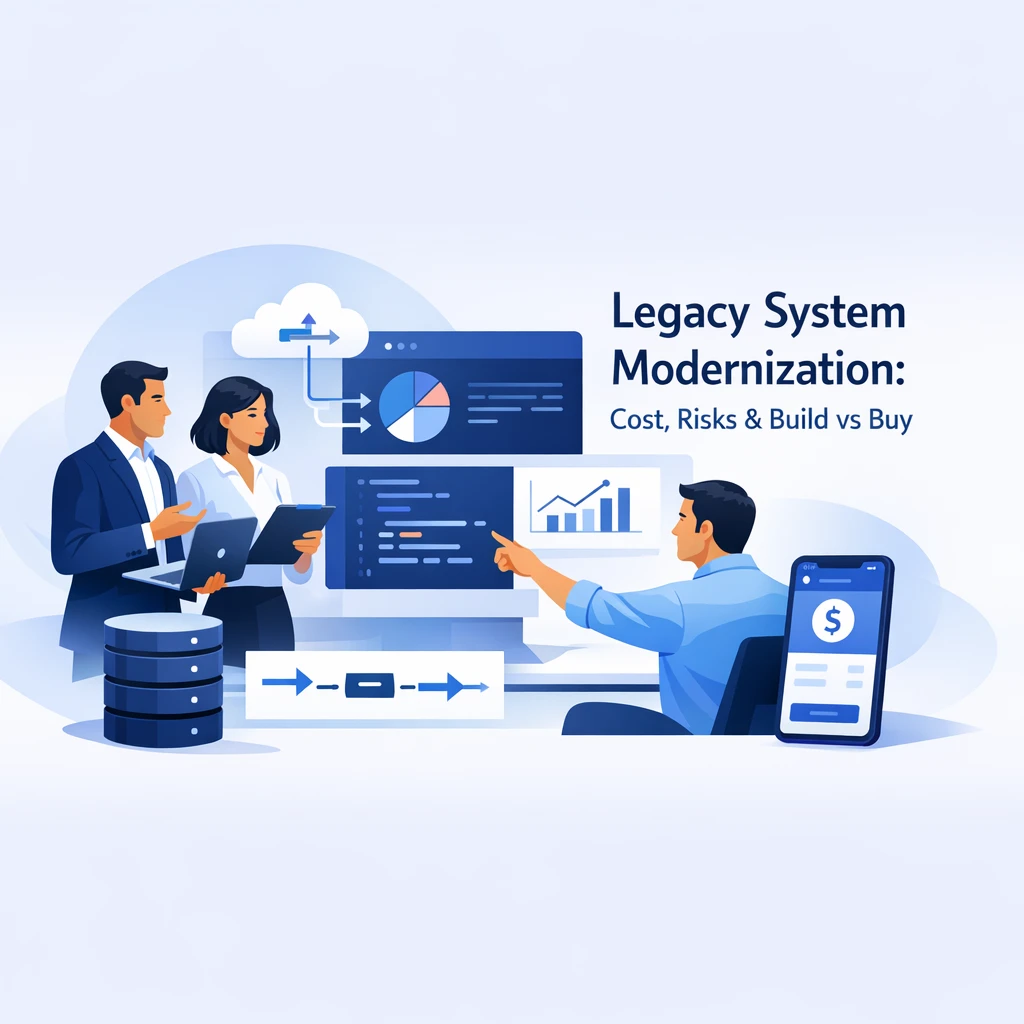
As banks and large enterprises in the UAE expand their digital footprint across Dubai, GCC markets, and beyond, legacy systems remain a critical barrier to speed, compliance, and customer-centric innovation. This guide provides practical, architecture-driven insights into modernization, with a focus on cost, risks, and the strategic choice between building in-house versus buying capabilities from trusted partners. It is written for decision-makers in SMBs, SMEs, startups, and established enterprises planning software projects in the USD 5k–200k range.
Introduction
Legacy systems—old ERP modules, monolithic core banking engines, or siloed data stores—continue to power essential operations in many organizations. In the UAE and wider GCC region, regulatory expectations, cloud-first strategies, and evolving customer experiences push enterprises to modernize without compromising continuity. The question often comes down to cost, risk, and whether to build capabilities in-house or to partner with an experienced software development firm.
In this article, we explore modernization for banks and enterprises in the UAE and globally, with clear guidance on how to approach cost estimation, risk management, and a practical Build vs Buy framework. We also illustrate how Triostack Technologies delivers globally, including remote delivery from India, to help businesses achieve scalable, secure, and compliant digital products.
What is the Topic?
Legacy system modernization is the process of updating or replacing aging software, data architectures, and integration layers to support new business capabilities, better security, and improved user experiences. For banks and enterprises, this often involves:
- Rehosting or replatforming monolithic cores into modern, scalable architectures
- API-led connectivity to expose data and services securely
- Cloud-native deployment patterns and DevOps automation
- Data modernization, including migration to unified data platforms and governance improvements
- Regulatory and security enhancements aligned with UAE and international standards
Two overarching strategies exist: build (in-house or with a retained vendor) and buy (engage a partner to deliver all or part of the solution). The optimal path depends on business maturity, risk appetite, and the ability to operate at scale while maintaining compliance.
Why it Matters in 2026
By 2026, the expectations for financial services and enterprises have shifted toward cloud-native, API-first architectures, real-time analytics, and zero-trust security models. For UAE-based banks and enterprises, modernization offers:
- Regulatory alignment and enhanced auditability
- Faster product delivery and improved customer experiences
- Better risk management through unified data and modern analytics
- Operational resilience and scalability to handle growth in regional markets
However, modernization also introduces risks around data migration, vendor lock-in, and potential disruption. A pragmatic Build vs Buy approach—guided by architecture, governance, and a clear roadmap—can help organizations balance speed, cost, and control.
Current Industry Challenges
Enterprises in the UAE and broader GCC face several common challenges when modernizing legacy systems:
- Complex data landscapes with data silos across on-premises and cloud environments
- Regulatory and privacy requirements, including data localization considerations
- Monolithic architectures that hinder agility and time-to-market
- Integration complexity with third-party services, e-commerce channels, and CRM/ERP systems
- Skill gaps and resource constraints for long-running modernization programs
- Vendor lock-in and concerns about long-term total cost of ownership (TCO)
These challenges are especially pronounced for banks with core banking workloads and compliance needs, as well as enterprises aiming to offer modern digital services in highly competitive markets like Dubai and Riyadh.
How the Technology Works
Modernization typically employs a mix of rehosting, refactoring, replatforming, and replacing legacy components. The goal is to achieve a modular, API-driven architecture that supports secure data exchange, scalable services, and rapid deployment cycles. Core concepts include:
- API-led integration: exposing functionality as well-documented, versioned APIs to enable decoupled systems
- Microservices or service-oriented designs: breaking monoliths into smaller, independently deployable units
- Cloud-native patterns: containers, orchestration (Kubernetes), and managed services
- Data modernization: consolidating data into a governed data platform with lineage and quality controls
- Security and compliance by design: zero-trust principles, encryption, access control, and auditability
Choosing between build and buy hinges on the availability of strategic domain knowledge, speed to value, and risk tolerance. A blended approach—building core differentiators in-house while buying standard components from trusted partners—often yields the best balance.
Architecture Overview
A modernized enterprise architecture typically includes:
- Front-end layer: web, mobile, and partner portals
- API gateway and service mesh: secure, observable APIs for internal and external consumers
- Application layer: microservices for core domains (customer, product, finance, risk, operations)
- Data layer: unified data platform with governance, consent, and lineage
- Cloud & DevOps layer: CI/CD pipelines, infrastructure as code, and monitoring
Below is a simplified architectural view that illustrates how data flows from legacy systems into modernized services and dashboards.
Step-by-Step Workflow
Executing a successful modernization program requires a structured workflow. The following steps are a practical blueprint that organizations in the UAE can adapt to their governance models:
- Discovery & assessment: inventory systems, data models, dependencies, compliance requirements, and risk.
- Target architecture definition: choose a modular pattern (rehost, replatform, refactor, or replace) aligned with business priorities.
- Roadmap & prioritization: create a phased plan with MVPs that deliver visible benefits early.
- Design & prototyping: define API contracts, data models, and security controls; validate with stakeholders.
- Implementation sprints: develop in iterative cycles with automated testing and continuous integration.
- Migration & cutover: plan data migration, user training, and fall-back options.
- Operationalization: monitoring, governance, and ongoing optimization.
Business Use Cases
Consider these representative scenarios where legacy modernization delivers tangible value:
- Core banking modernization: replace an aging monolith with a secure, API-driven core and modular services for payments, deposits, and lending.
- Regulatory reporting and risk: unified data models and auditable pipelines that simplify reporting to regulators in the UAE and internationally.
- CRM and customer experience: integrated front-end experiences with real-time decisions driven by analytics.
- Operational efficiency: automated invoice processing, reconciliation, and workflow orchestration across departments.
Industry Applications
The modernization blueprint described here is applicable across sectors:
- BFSI: banks and insurers implementing real-time payment rails, digital onboarding, and risk analytics
- Healthcare: secure patient data exchange, interoperability, and compliant health information management
- Retail & logistics: order orchestration, inventory visibility, and e-commerce integrations
- Manufacturing: asset monitoring, supply chain collaboration, and ERP modernization
Benefits
- Faster time-to-value through modular, reusable components
- Enhanced security, compliance, and governance
- Improved data quality and real-time analytics for better decision-making
- Scalability to support future growth and regional expansion
- Better vendor risk management via an API-driven ecosystem
Challenges
Modernization is not without risk. Key challenges include:
- Data migration risk and potential data loss during transition
- Security and compliance considerations across multi-cloud environments
- Change management and stakeholder alignment across departments
- Maintaining service levels during migration and ensuring business continuity
Common Mistakes
- Underestimating data cleansing and mapping requirements
- Applying a one-size-fits-all approach instead of a staged modernization plan
- Lack of clear ownership and governance for APIs and data assets
- Rushing to replacement without validating business processes and user needs
Best Practices
- Define a clear data strategy, including data provenance, quality, and retention
- Adopt an API-first approach with versioning and backward compatibility
- Implement zero-trust security and regular security audits
- Choose a phased, MVP-driven delivery with measurable outcomes
- Establish sound vendor governance and a robust incident response plan
Build vs Buy Comparison
Choosing between building capabilities in-house or engaging a partner requires careful evaluation across people, process, and technology dimensions. The table below highlights common considerations for modernizing banks and enterprises in the UAE and beyond.
| Aspect | Build In-House | Buy (Partner) |
|---|---|---|
| Time to value | Longer, depending on team ramp-up | Shorter, with proven accelerators |
| Control & customization | Highest control, full customization | Limited by vendor roadmap, but highly configurable |
| Cost visibility | Capex-heavy, ongoing maintenance | Opex-friendly, predictable licensing/engagements |
| Risk & compliance risk | Depends on internal governance | Benefit from vendor maturity and governance practices |
| Quality & speed of delivery | Varies with talent pool and process rigor | Often faster with established QA and DevOps |
| Long-term support | Internal teams must own maintenance | Vendor-assisted support and SLA-driven maintenance |
Estimated Development Cost
Costs vary by scope, region, and governance requirements. The ranges below reflect typical engagements for SMBs and SMEs planning software projects in the USD 5k–200k band. These figures are indicative and include design, development, testing, and initial deployment, plus basic post-deployment support.
| Project Type | Typical USD Range | What’s Included |
|---|---|---|
| Business Website | 5k–15k | Branding, responsive design, CMS integration |
| Customer Portal | 10k–40k | Authentication, self-service features, integrations |
| CRM | 15k–100k | Sales/marketing workflows, automation, analytics |
| ERP | 40k–200k | Core modules, integration, data migration |
| AI Chatbot | 5k–25k | Conversational design, NLP, integrations |
| SaaS MVP | 20k–80k | Multi-tenant architecture, onboarding flows |
| Enterprise Web App | 30k–200k | Complex domain models, integrations, security |
Pricing factors include data migration complexity, regulatory compliance requirements, cloud vs on-prem deployment, security controls, custom integrations, and the level of ongoing managed services.
Recommended Technology Stack
The stack below reflects a pragmatic combination of stability, scalability, and modern developer ergonomics suitable for banks and large enterprises in the UAE market:
| Layer | Recommended Technologies |
|---|---|
| Frontend | React, Next.js, TypeScript, Material UI |
| Backend | Java Spring Boot, .NET Core, Node.js |
| API & Integration | API Gateway, REST/GraphQL, Async messaging (Kafka) |
| Data & AI | PostgreSQL, Snowflake/BigQuery, Spark, ML pipelines |
| Cloud & DevOps | AWS/Azure/GCP, Kubernetes, Terraform, GitHub/GitLab, CI/CD |
| Security & Compliance | IAM, Zero Trust, encryption at rest/in transit, DLP |
Future Trends
Looking ahead, organizations should watch for:
- AI-powered decisioning and automation within core workflows
- Low-code/no-code platforms for citizen development with proper governance
- Advanced data governance and privacy-preserving analytics
- Edge computing and regional data sovereignty enhancements
How Triostack Delivers Projects Globally (Remote Delivery)
Triostack Technologies specializes in remote delivery that combines agile practices with robust governance. Key elements of our approach include:
- Agile methodology with sprint planning, daily standups, and sprint demos
- Weekly demos and transparent progress reporting via Slack, Teams, or Zoom
- Collaborative tooling: Jira, ClickUp, GitHub, GitLab, Azure DevOps
- CI/CD pipelines, cloud staging, automated testing, and continuous monitoring
- Comprehensive QA, documentation, security reviews, and NDA/IP ownership protections
- Dedicated Project Managers and clear governance to manage time zone overlap
- Long-term support and maintenance across the solution lifecycle
Why UAE businesses often outsource development to India is multifaceted. The advantages typically include cost efficiency, access to a large and skilled talent pool, faster hiring cycles, flexible team scaling, high-quality engineering, and strong communication practices when paired with structured project management and robust security protocols.
Case Studies (Hypothetical Scenarios)
These scenarios illustrate typical modernization journeys. They are representative of real-world engagements and are presented for educational purposes without asserting real client names or metrics.
Dubai logistics company — API-driven optimization and data modernization
Challenge: A Dubai-based logistics operator relied on an aging order management system with manual processes and limited visibility into shipments. They needed real-time tracking, better customer portals, and smoother integrations with warehouse systems and carrier partners.
Approach: Triostack designed a modular platform with an API gateway, event-driven order orchestration, and a lightweight mobile-ready portal for customers and drivers. Data from legacy systems was migrated into a governed data layer with real-time analytics dashboards for operations, logistics, and finance.
Impact: Improved data visibility, reduced manual handoffs, and a scalable integration backbone supporting future growth across the UAE region.
UAE healthcare clinic — secure patient data exchange and regulatory alignment
Challenge: A regional clinic network faced fragmented patient records, limited interoperability with regional health information exchanges, and stringent privacy requirements.
Approach: Implemented a secure patient data platform with role-based access, consent management, and audit logging. Replaced legacy patient management modules with modular services and standardized API contracts for seamless integrations with labs and imaging providers.
Impact: Strengthened data governance, improved patient experience, and easier regulatory reporting.
Saudi retail business — omnichannel capabilities and ERP modernization
Challenge: Fragmented commerce channels with a legacy ERP limited by slow data flows and inconsistent pricing, inventory, and orders across borders.
Approach: Deployed a distributed microservices fabric, integrated ERP with e-commerce and store systems, and created a unified product and pricing engine with centralized inventory management.
Impact: Streamlined omnichannel operations and improved price and inventory accuracy across channels.
Australian startup — SaaS MVP with scalable multi-tenant architecture
Challenge: A new SaaS product needed to reach early adopters quickly, with a scalable architecture and strong tenant isolation.
Approach: Built a multi-tenant architecture, exposed core capabilities via APIs, and established a robust CI/CD pipeline with automated testing and security reviews.
Impact: Accelerated time-to-market and provided a solid platform for growth while maintaining governance and security.
Pricing Considerations & Call to Action
As you plan a modernization project, consider a staged budget approach with clear milestones. Substantial savings can be realized by prioritizing MVPs that unlock tangible business value, while maintaining governance and compliance. Subtle, evidence-based collaboration with a trusted partner like Triostack Technologies can help de-risk the journey and ensure alignment with regional regulatory realities.
Businesses planning similar solutions often benefit from experienced software development partners who provide end-to-end capability, including custom software, web development, mobile apps, AI development, CRM, ERP, SaaS, cloud migration, DevOps, UI/UX, API development, and dedicated teams.
If you're planning a similar software project, Triostack can help you design, build, deploy and maintain a scalable solution.
Frequently Asked Questions
- What is the most important factor in legacy modernization?
- Clear governance, a well-defined data strategy, and an incremental delivery plan that demonstrates value early.
- Is it better to build or buy in the UAE market?
- There is no one-size-fits-all. A blended approach that combines in-house capability for core differentiators with partner-driven delivery for standard components often yields the best balance of speed, control, and risk management.
- How does remote delivery work for UAE-based projects?
- Remote delivery is familiar with strong collaboration rituals, time-zone overlap arrangements, robust security, and clear IP ownership and NDA protections. This model often reduces cost while maintaining quality and governance.
Conclusion
Legacy system modernization for banks and enterprises in the UAE is a strategic imperative that demands thoughtful planning, risk-aware execution, and disciplined governance. Whether you opt to build core capabilities in-house or partner with a trusted software development firm, a modular, API-first approach supported by robust data governance will pay dividends in speed, resilience, and competitive differentiation. Triostack Technologies stands ready to help you design, implement, and maintain scalable digital products with a globally distributed delivery model that emphasizes security, compliance, and quality.
Triostack Team
Technology Evangelist & Writer
Triostack Team is an experienced writer and technologist, exploring the intersections of AI, cloud architecture, and modern application development. Passionate about turning complex technical concepts into accessible insights.