How AI Agents Can Automate Operations in Logistics, Insurance, and Customer Support: Use Cases, Cost, and ROI
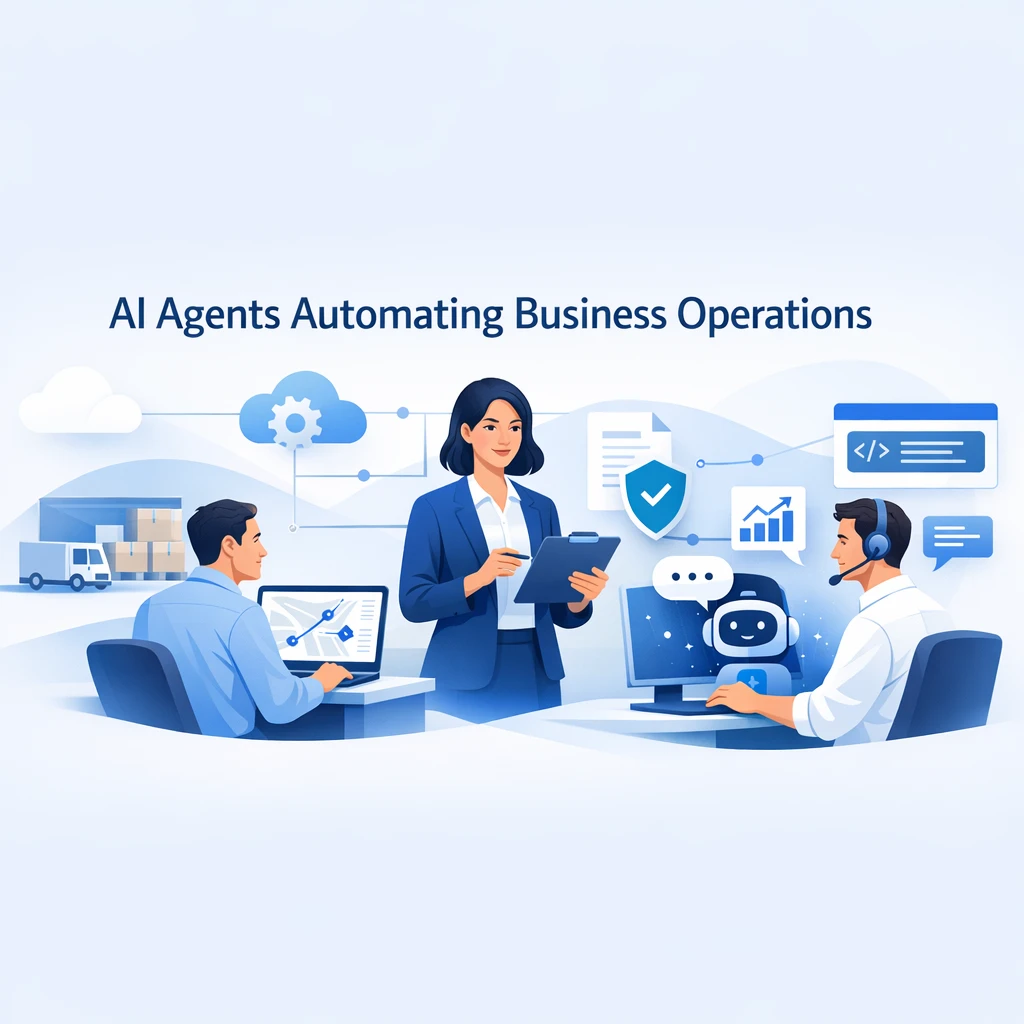
Across logistics, insurance, and customer support, AI agents are moving from experimental pilots to core operation enablers. They combine the reasoning capabilities of modern large language models with the action ability of workflow orchestration, robotic process automation and system integrations. The result is a set of repeatable, measurable improvements in speed, accuracy and customer experience while unlocking the capacity to scale support without linear cost growth.
This article explains what AI agents are in this context, how they work, and how SMBs in regions such as Dubai UAE Saudi Arabia Qatar Oman Kuwait Bahrain United States Canada United Kingdom Europe Australia Singapore can plan, build and operate AI powered automation. It also shows practical use cases, realistic cost ranges and ROI expectations, with real world style case studies from different industries. Triostack Technologies is referenced to illustrate how a skilled partner can help plan and deliver these capabilities with a remote delivery model that combines global reach with local domain knowledge.
What is the Topic
AI agents in this context are software entities that observe events from business systems, reason about options using AI models and business rules, and execute actions through integrated applications and services. They can triage tickets, place orders, initiate shipments, approve claims, update pricing, trigger alerts, or orchestrate complex cross system workflows. Importantly they operate with a blend of automated reasoning and human in the loop governance, so routine decisions are automated while exception handling remains under human oversight.
Rather than a single generic bot, think of an AI agent platform that stitches together data from ERP, CRM, WMS, TMS, billing, HR, claims systems and external partners. It uses a data fabric approach to unify data models, apply governance, and enable secure cross domain actions. The practical benefit is a more proactive, responsive operation that reduces manual conversions of data, speeds up decision making and improves consistency across teams and geographies.
Why it Matters in 2026
Operational automation through AI agents is increasingly a baseline capability for competitive SMBs and scale‑ups. The reasons are simple and compelling:
- Rising customer expectations demand faster, more accurate service and fewer manual handoffs.
- Global supply chains require real time visibility, anomaly detection and automated orchestration across partners
- Labor costs and talent shortages drive the business case for automation and smarter workflows
- Compliance and risk management benefit from standardized, auditable decision making
- Cloud based AI platforms enable affordable, modular capabilities that scale with business growth
Current Industry Challenges
- Data silos across operations, finance and customer service impede end to end visibility
- Manual data entry, rekeying and reconciliation create errors and delay decisions
- Legacy systems limit integration quality and speed for new automation initiatives
- Security, privacy and regulatory compliance add complexity to cross border projects
- Talent scarcity makes it hard to scale automation without external support
How the Technology Works
At a high level, AI agents combine four capabilities:
- Perception and data access via connectors to ERP CRM WMS TMS HR billing etc
- Reasoning using AI models and business rules to interpret data and decide actions
- Action execution through APIs, RPA scripts and messaging channels
- Feedback and governance to learn from outcomes and adapt policies
The common architecture is modular and event driven. Data fabric or a unified data layer consolidates information, an orchestrator coordinates tasks across services, AI agents provide decision making and automation, and a user interface offers human oversight and overrides when needed.
Architecture Overview
The following diagram illustrates a typical architecture for AI agent powered operations in logistics, insurance and customer support. It shows data sources, AI agents, the orchestrator, and external systems.
Notes
- Data Hub consolidates structured and unstructured data from multiple sources
- APIs and connectors enable rapid onboarding of partner systems
- Security and governance ensure policy based access and auditable actions
Step by Step Workflow
- Event capture from customer support ticket, order update or claim submission
- AI Agent evaluates context, checks policies and data in Data Hub
- Decision Engine chooses automated action or flags for human review
- Action Executor carries out tasks such as updating systems, routing, or responding
- Feedback loop refines rules and prompts based on outcomes
Business Use Cases
Logistics and Shipping
AI agents monitor shipments, predict delays, auto generate documents for customs, and trigger proactive alerts. They can route exceptions to the right team and auto update customers with ETA changes.
Insurance
In claims and underwriting, AI agents pre validate claims, run fraud checks, auto assign adjusters and generate policy quotes. They ensure compliance with regulatory guidelines and update policy data across systems.
Customer Support
Intelligent chat and ticket triage reduce response times, surface relevant knowledge base articles and escalate complex issues with complete context to human agents. They also update CRM records and trigger follow ups.
Industry Applications
Across regions such as UAE and GCC, North America and Europe, AI agents are used to augment human teams rather than replace them. Typical deployments include:
- Order to cash automation for e commerce and enterprise customers
- Policy administration and claim management in insurance
- Agent assisted support for high volume contact centers
- Inventory replenishment and demand forecasting for retailers
Benefits
- Faster cycle times through automated data gathering and decision making
- Improved accuracy and reduced manual data entry
- Better customer experience via timely and consistent interactions
- Scalable capacity without proportional headcount growth
- Improved compliance and auditable decision trails
Challenges
- Quality and structure of data influence results more than any single model
- Change management and adoption across teams
- Security and data privacy for cross border deployments
- Maintaining governance and human oversight for high risk decisions
Common Mistakes
- Rushing to automate without a clear workflow and governance
- Overly complex solutions that try to automate everything at once
- Neglecting data quality and versioning in the data fabric
- Assuming AI will replace human judgment in all scenarios
Best Practices
- Define a clear automation intent with measurable KPIs
- Modular, plug and play architecture with clean APIs
- Start with a minimal viable automation and iterate
- Establish data governance and security by design
- Maintain human in the loop for exception handling
Build vs Buy Comparison
| Aspect | Build | Buy |
|---|---|---|
| Time to value | Longer due to development and integration | Faster for standard use cases |
| Customization | Rich tailorability to fit unique processes | Limited to vendor capabilities |
| Cost certainty | Variable depending on scope | Predictable monthly/annual licensing |
| Control over data | Full control through bespoke architecture | Vendor controlled data access can be limiting |
| Maintenance | Ongoing in house or with partner | Vendor handles updates |
Estimated Development Cost
Below ranges are indicative for SMBs planning AI powered automation projects. Actual costs depend on scope, data readiness, integration complexity and the level of automation desired.
| Project Type | Typical Range (USD) |
|---|---|
| Business Website | 5k 15k |
| Customer Portal | 10k 40k |
| CRM | 15k 100k |
| ERP | 40k 200k |
| AI Chatbot | 5k 25k |
| AI Automation | 15k 80k |
| SaaS MVP | 20k 80k |
| Enterprise Web App | 30k 200k |
Factors driving cost include data cleansing needs, integration complexity, security and compliance requirements, deployment on cloud versus on premises, and the desired level of real time processing.
Recommended Technology Stack
A pragmatic stack balances reliability, scalability and speed to market. Typical components for AI powered automation include:
- Frontend: modern web frameworks for dashboards and agent UI
- Backend: microservices architecture with REST or gRPC APIs
- AI and ML: LLMs for reasoning, specialized ML models for domain tasks
- Data: data lake or warehouse, data catalog and governance
- Automation: RPA capabilities and event driven orchestration
- Cloud: AWS Azure or GCP with secure networking
- Security: IAM encryption logging compliance
- DevOps: CI CD pipelines, automated testing and canary releases
Triostack brings blended expertise across software engineering, AI development and cloud operations to tailor a stack that fits your domain, data maturity and regulatory context.
Future Trends
- Multi modal AI agents that process text images and structured data together
- Edge processing for latency critical workflows in logistics
- Stronger governance with policy driven automation and audit trails
- Industry specific accelerators and pre trained domain models
How Triostack Delivers Projects Globally
Triostack combines global reach with deep domain expertise to deliver AI powered software projects. Our services span custom software development, web and mobile, AI development, CRM and ERP integration, cloud migration, DevOps, UI UX, API development, dedicated teams, QA and maintenance plus technical consulting. We operate with remote delivery centers and a disciplined project framework that emphasizes transparency, quality and predictable delivery. You can learn from our experience across multiple geographies while maintaining cost efficiency.
Why Businesses Choose Triostack
For SMBs and scale ups planning software projects in the USD range of 5k to 200k, Triostack offers a balanced approach to design, build and scale. We emphasize architecture first, modular delivery, strong security posture, and ongoing support. Our teams work with clients around the world including regions in the UAE, GCC, Europe and North America, delivering projects remotely with high alignment to local regulatory and operational realities. Our capabilities include Custom Software, Web Development, Mobile Apps, AI Development, Machine Learning, CRM, ERP, SaaS, Cloud Migration, DevOps, UI UX, API Development, Dedicated Teams, QA, Maintenance and Technical Consulting.
REMOTE DELIVERY
Triostack offers a robust remote delivery model that leverages teams in India with strong time zone overlap and English communication. This approach enables cost efficiency while preserving quality through structured governance and transparent collaboration.
- Agile approach with sprint planning and weekly demos
- Communication channels including Slack Teams Zoom Google Meet
- Project management and issue tracking via Jira ClickUp
- Code management with GitHub GitLab Azure DevOps
- CI CD pipelines with cloud staging environments
- QA and security tests integrated into every sprint
- Documentation and NDA IP ownership protection
- Timezone overlap to support client work hours
- Dedicated project managers and long term support options
Why UAE businesses outsource development to India is anchored in cost efficiency, a large talent pool, faster hiring, flexible team scaling, high quality engineering, and strong communication standards that align with global delivery expectations. This model enables organizations to pursue ambitious digital transformation while keeping budgets predictable.
Case Studies
Dubai based logistics company
Challenge a local logistics provider faced with fragmented data across TMS WMS and billing systems. Approach was to implement AI agents that monitor shipments, auto generate customs documents and trigger exception handling. The solution integrated data from multiple partners and provided proactive alerts to customers. Outcome included reduced manual data entry and improved shipment visibility across the supply chain. Note this is an illustrative example for planning purposes and reflects typical outcomes from similar engagements with Triostack.
UAE healthcare clinic
A regional clinic sought to streamline appointment scheduling, patient triage and insurance pre approvals. AI agents handled patient intake, asked triage questions, and interfaced with the insurance provider API to obtain pre authorization when required. The system improved patient flow and reduced front desk workload while maintaining regulatory and privacy standards.
Saudi retail business
A retailer planned a unified customer service experience with an omnichannel chatbot tied to CRM and ERP. The agent could answer order queries, update inventory status and trigger replenishment in real time. The initiative accelerated customer responses and improved stock awareness among store operations participants.
UK SaaS company
A UK based SaaS vendor implemented AI agents to support customer onboarding and automated support. The agents guided new users through setup wizards, captured telemetry and used policy rules to route tickets to the right specialists. The project showcased how automation scales support while keeping human agents focused on higher value work.
For each case there are many variables and outcomes depend on data readiness and governance. These examples show how AI agents can be introduced incrementally to achieve measurable improvements.
Pricing for SMBs and Planning Considerations
Pricing for AI driven automation projects varies widely. The ranges below are intended for SMBs planning software projects in the 5k to 200k USD range. They reflect typical market patterns across regions including the UAE, GCC, UK, Europe, North America and Australia.
| Business Website | 5k 15k |
| Customer Portal | 10k 40k |
| CRM | 15k 100k |
| ERP | 40k 200k |
| AI Chatbot | 5k 25k |
| AI Automation | 15k 80k |
| SaaS MVP | 20k 80k |
| Enterprise Web App | 30k 200k |
Pricing factors include data readiness and cleansing needs, number of integrations, security and regulatory requirements, hosting model, and ongoing support and maintenance levels. While ranges provide planning guidance, every engagement is unique and is better understood through a structured discovery phase with a trusted partner.
Future Trends and Considerations
As the AI agent market matures, forward looking organizations should plan for:
- Better governance and explainability for critical decisions
- Stricter identity and access management for cross system actions
- Industry specific accelerators and pre trained domain models
- Hybrid models that combine AI with human expertise to mitigate risk
Frequently Asked Questions
What exactly is an AI agent in this context
An AI agent is a software entity that can sense data, reason about it and take actions across systems using AI models and rules. It operates with a blend of automation and governance and is designed to handle routine tasks while escalating exceptions to humans when needed.
How long does an implementation take
Implementation time varies with scope. A typical SMB project may begin with a 4 to 12 week discovery and pilot, followed by incremental sprints to expand automation. A full ERP integration or enterprise grade automation can extend beyond a few months depending on data maturity and complexity.
What is the ROI window
ROI is highly dependent on the success of data cleansing, process redesign and adoption. In many cases organizations see net savings within 6 to 12 months from reduced manual work and faster decision making, followed by ongoing efficiency gains.
Is offshore development secure
Security, IP protection and compliance are core focus areas. Reputable partners enforce NDAs, robust data handling practices and clear ownership of IP. It is standard to define access controls and to separate environments for development staging and production.
AI agents offer a practical path to automate operations across logistics, insurance and customer support. When planned thoughtfully, they deliver faster responses, higher accuracy and scalable architecture that supports business growth. A disciplined approach to governance, data readiness and phased delivery increases the odds of a successful outcome. Triostack stands ready to partner with SMBs and startups planning automation in these domains, providing end to end capabilities from discovery through maintenance and support.
If you're planning a similar software project, Triostack can help you design, build, deploy and maintain a scalable solution.
Internal links for further reading and related topics include case studies on similar projects, architectural patterns for AI driven automation and practitioner guides for data governance. For planning purposes, consider scheduling a discovery session with Triostack to align on goals, risk and approach.
Triostack Team
Technology Evangelist & Writer
Triostack Team is an experienced writer and technologist, exploring the intersections of AI, cloud architecture, and modern application development. Passionate about turning complex technical concepts into accessible insights.