Generative AI Implementation for Real Estate Companies in the UAE: ROI, Use Cases, and Adoption Strategy
Introduction
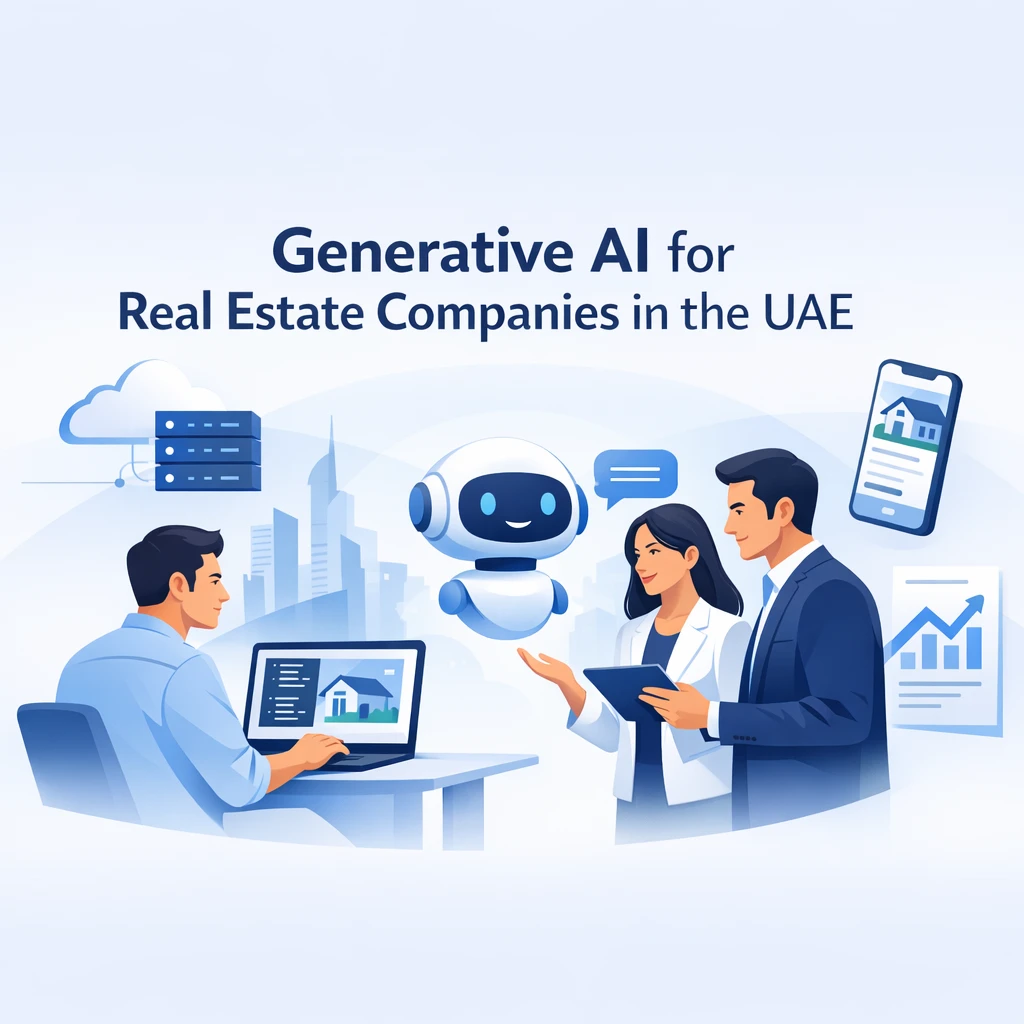
In a market as dynamic as real estate, technology is moving from a nice-to-have to a must-have. Generative AI offers real estate teams in the UAE and across the Gulf as well as global markets a practical path to improve lead conversion, speed up property workflows, and unlock new revenue streams. This article is written for SMBs, SMEs, startup founders, CEOs, CTOs, product managers and digital transformation leaders who are planning software projects with budgets ranging roughly from USD 5k to 200k. It is an educational guide with pragmatic, field-tested guidance and real-world examples rather than marketing rhetoric.
Triostack Technologies brings deep experience in Custom Software, Web & Mobile Development, AI Development, CRM, ERP, SaaS, Cloud Migration, DevOps, UI/UX, API Development, and QA. Our aim is to help you assess, design, and adopt generative AI in a way that improves ROI while staying compliant with data governance and regional regulations. This article is designed to be educational first and practical second, with actionable steps you can adapt to your organization, whether you operate in Dubai, Abu Dhabi, Riyadh, Doha, Muscat, Kuwait City, Manama, or beyond.
What is the Topic?
Generative AI refers to models capable of creating new content, such as text, images, summaries, and code, based on learned patterns from large datasets. In real estate, these models enable automation and augmentation across marketing, sales, operations, and customer service. Practical deployments include generation of property descriptions, dynamic pricing insights, automated response to client inquiries, and even code-free workflows for internal teams. Importantly, generative AI is not a silver bullet; it is a capability that must be integrated with existing data, governance, and domain workflows to deliver reliable business outcomes.
Why it Matters in 2026
Across the UAE and international markets, real estate teams face rising client expectations, fragmented data, and the need to move from manual processes to intelligent automation. Generative AI helps organizations:
- Scale marketing and listing operations without proportional headcount
- Improve response times and client engagement with natural language interfaces
- Automate routine documentation, approvals, and reporting
- Provide data-driven insights for site selection, pricing, and lease optimization
- Accelerate digital transformation initiatives in line with national visions for smart cities and data-driven governance
For UAE and GCC businesses, adopting a well-governed AI strategy also means aligning with data-privacy requirements and local regulations while benefiting from global best practices in software engineering and security. Triostack supports compliant, scalable AI programs by combining domain expertise with robust delivery practices.
Current Industry Challenges
Real estate organizations encounter several persistent barriers to AI adoption. Some of the most impactful include:
- Data fragmentation: Data sits in multiple systems (CRM, ERP, property management software, marketing platforms) with inconsistent schemas and quality.
- Governance and compliance: Data privacy, consent, and regional regulations require careful control of inputs, outputs, and model access.
- Time to value: Building reliable AI solutions end-to-end takes time, especially when data cleaning and integration are substantial.
- Change management: Adoption requires process redesign, user training, and alignment with sales and operations rituals.
- Cost discipline: Budgets for AI projects must be tied to measurable ROI and staged investments.
How the Technology Works
Generative AI in real estate combines large language models (LLMs), retrieval augmented generation (RAG), domain-specific data, and automation layers. A typical architecture includes:
- Data ingestion and storage: Data from listings, CRM, property management systems, marketing platforms, leasing documents, and external data sources are consolidated in a secure data lake.
- Model layer: LLMs generate content or insights; domain fine-tuning or adapters tailor the model to real estate semantics.
- Retrieval and memory: A vector store or feature store enables fast retrieval of relevant documents or past cases to ground model outputs.
- Application layer: Frontend apps, chat widgets, portals, and workflows that consume AI outputs and trigger actions in CRM, ERP or marketing systems.
- Governance and security: Access control, data lineage, audit trails, model monitoring, and compliance controls.
Architecture Overview
The following schematic highlights a practical, scalable architecture for real estate AI initiatives. It balances speed of delivery with strong governance and security.
High level components
- Data sources: listings, CRM, ERP, facility management, leasing contracts, marketing analytics
- Data lake and feature store: centralized data store with curated features
- Model layer: generative models plus retrieval augmented generation
- Automation and orchestration: workflows that trigger actions in CRM, marketing, or ERP
- Applications: customer portals, agent dashboards, internal tools
- Security and governance: access, data lineage, model monitoring
Step-by-Step Workflow
- Discovery and data assessment: Identify data sources, quality, privacy constraints, and alignment with business goals.
- Pilot design: Choose a high-value use case, define success metrics, and plan data integration and governance must-haves.
- Data preparation: Clean, normalize, and annotate data; establish privacy controls and data lineages.
- Model selection and customization: Pick an appropriate LLM, apply domain adapters, and configure prompts for deterministic output where needed.
- Development and testing: Build integrations, UI components, and verification tests; run controlled experiments.
- Deployment and monitoring: Roll out to staging, then production with monitoring for accuracy, latency, and governance.
- Optimization and scale: Iterate on prompts, features, and automation; expand to additional use cases and markets.
Business Use Cases
Generative AI can support many capabilities across the real estate value chain. Here are practical categories with concrete examples.
- Marketing and listing automation: Auto generate compelling property descriptions, social posts, and email campaigns from structured data and photos.
- Lead engagement and chat assistants: Natural language chatbots on websites and portals that understand intent, qualify leads, and route to the right agent.
- Document understanding and generation: Draft leases, addenda, and disclosures; summarize PDFs or scanned contracts for faster reviews.
- Site and investment analytics: Scenario analysis for site selection, pricing, cap rates, and occupancy projections using live data feeds.
- Lease management and renewals: Proactive reminders, renewal terms suggestions, and automated communications with tenants.
- Customer support and service requests: AI-assisted ticketing, maintenance requests, and SLA-driven responses.
- Internal operations: AI-assisted reporting, performance dashboards, and policy-compliant knowledge bases for staff.
Industry Applications
Different segments of the real estate ecosystem can benefit from AI in slightly different ways:
- Brokerage and agencies: Accelerated content creation, faster response times, and improved client nurturing.
- Property management: Automated communications, lease renewals, and work order triage.
- Developers and asset owners: Market intelligence, site feasibility studies, and performance reporting.
- Facilities and operations: Predictive maintenance scheduling and energy optimization insights.
Benefits
- Faster time to value: Quicker generation of marketing content and client responses reduces lead friction.
- Improved conversion: AI-assisted interactions can improve engagement with buyers and tenants while maintaining a consistent brand voice.
- Operational efficiency: Automation of repetitive tasks frees up human talent for higher value work.
- Data-driven decisions: Unified view of property economics guides pricing, site selection, and portfolio strategy.
- Scalability: AI enables consistent outputs across multiple markets and assets without linear increases in headcount.
Challenges
- Data quality and consistency across systems
- Regulatory compliance and privacy considerations
- Model governance and output reliability
- Change management and adoption resistance
- Maintaining a positive ROI through staged investments
Common Mistakes
- Starting with a single AI feature without a governed data foundation
- Overfitting models to niche data without generalization plans
- Underestimating security, access control, and data lineage
- Ignoring long-term maintenance, model drift and retraining needs
- Skipping user training and change management activities
Best Practices for a Stable Adoption
- Data governance first: Define data ownership, access rights, retention, and compliance controls up front.
- Modular architecture: Build in reusable components, APIs, and services for quick re-use.
- ROI-focused pilot: Start with a constrained use case and track concrete metrics before expanding.
- Transparency and safety: Establish guardrails around content generation and ensure outputs are reviewable.
- Stakeholder alignment: Involve sales, marketing, operations, and IT from day one to ensure cross-functional buy-in.
Build vs Buy Comparison
Choosing between building in-house capabilities or buying a managed AI service depends on factors like speed, cost, control, and future roadmap. The table below summarizes typical considerations for real estate AI projects.
| Aspect | Build | Buy |
|---|---|---|
| Time to value | Longer, higher initial effort | Faster, off-the-shelf integration |
| Customization | High flexibility; tailored to unique processes | Limited by vendor capabilities |
| IP ownership | Full ownership of code and models | Vendor ownership of base models and outputs |
| Cost profile | CapEx and ongoing maintenance | OpEx with predictable licensing |
| Speed of upgrades | Depends on internal team capacity | Vendor-driven iteration and updates |
Estimated Development Cost
Below are representative ranges for common scopes of work. Prices reflect typical efforts for SMBs and SMEs implementing AI in real estate environments. Actual costs vary with data quality, integration complexity, regulatory requirements, and the chosen delivery model.
| Scope | Typical Range (USD) | Notes |
|---|---|---|
| Business Website | 5k – 15k | Content pages, SEO basics, responsive design |
| Customer Portal | 10k – 40k | Listings, inquiries, user management |
| CRM | 15k – 100k | Sales workflows, lead routing, analytics |
| ERP | 40k – 200k | Financials, asset management, resource planning |
| AI Chatbot | 5k – 25k | Conversational agent with domain prompts |
| AI Automation | 15k – 80k | Workflow orchestration and data-to-action pipelines |
| SaaS MVP | 20k – 80k | End-to-end vertical solution with multi-tenant architecture |
| Enterprise Web App | 30k – 200k | Complex integrations, governance, and scalability |
Recommended Technology Stack
The following stack reflects a pragmatic approach used by real estate clients such as developers, brokers, and managers. It balances speed, scalability, security, and interoperability with existing systems.
- Frontend: React or Vue, TypeScript, responsive design
- Backend: Node.js or Python, RESTful APIs, or GraphQL
- AI and data: Large language models from providers such as Azure OpenAI or OpenAI; domain adapters; retrieval stores
- Data storage: Cloud data lake (S3/GCS), relational databases (PostgreSQL), and a vector store (faiss or Pinecone)
- DevOps and MLOps: Docker, Kubernetes, GitHub Actions or Azure DevOps, MLflow or Kubeflow
- Cloud and security: AWS or Azure, identity and access management, encryption at rest and in transit
- Integrations: API-first approach with CRM, ERP, and property management systems
Future Trends
- Localized models: UAE and GCC domain-specific prompts and fine-tuning for legal, leasing, and marketing use cases
- Privacy-preserving AI: Edge inference, on-prem components, and synthetic data where necessary
- Data mesh and governance: Domain-owned data products with standardized interfaces
- AI-assisted decision platforms: Integrating AI insights into executive dashboards and portfolio planning
How Triostack Delivers Projects Globally (Remote Delivery)
Triostack offers remote delivery with a structured, transparent process that emphasizes quality, communication, and governance. We work with clients across time zones, including the UAE, Europe, North America, and beyond, while maintaining strong timezone overlap and fluency in English. Key practices include:
- Agile methodology: Scrum or Kanban tailored to project needs, with clear sprint goals and measurable outcomes
- Sprint planning and reviews: Collaborative planning, mid-sprint reviews, and weekly demos
- Communication channels: Slack, Teams, Zoom, Google Meet for real-time collaboration
- Project tracking: Jira or ClickUp with transparent backlogs and progress dashboards
- Code and collaboration: GitHub or GitLab for source control and pull request reviews
- CI/CD and staging: CI/CD pipelines with cloud-based staging environments for QA
- Security and IP: NDA, secure development practices, and explicit IP ownership terms
- Documentation: Technical and user documentation maintained as part of the delivery
- Dedicated Project Managers: Point of contact for governance, risk, and delivery
- Long-term support: Post-launch maintenance and optimization services
Why UAE businesses outsource development to India often comes down to a mix of cost efficiency, a deep talent pool, faster hiring, flexible scaling, and strong communication. Triostack leverages these advantages while maintaining rigorous security and governance aligned with regional requirements.
Why UAE Businesses Outsource to India
- Cost efficiency: Competitive rates for high-quality software engineering without compromising on delivery standards
- Large talent pool: A broad range of specialized skills across AI, data engineering and software architecture
- Faster hiring: Access to accelerators and teams to shorten time-to-start
- Flexible team scaling: Easily ramp up or down to match project scope
- High quality engineering: Strong practices in architecture, testing, and DevOps
- Strong communication: English-speaking teams with clear governance and collaboration rituals
Case Studies (Anonymized)
The examples below illustrate how real estate clients used generative AI to accelerate initiatives without disclosing company names or sensitive metrics. Each case focuses on the problem, approach, and qualitative outcomes.
Dubai logistics company — property management and marketing automation
Challenge: A portfolio of warehousing assets required faster, more consistent listing content, tenant communications, and lease-related document handling. Data lived across multiple systems with inconsistent taxonomies.
Approach: Triostack implemented a unified data layer with domain-specific prompts and a content generation module. An AI-powered assistant helped agents draft listings and respond to inquiries. Automated workflows surfaced key lease metrics to portfolio managers.
Outcomes: The pilot demonstrated improved productivity in content generation and client communication, with cleaner data flows and a more predictable content cadence across channels.
UAE healthcare clinic — site selection and facility management
Challenge: The clinic network sought data-driven guidance for new site selection and optimization of existing facilities, balancing patient access with operating costs.
Approach: Triostack built AI-enabled decision support that ingested patient demand data, demographics, and clinic performance metrics, generating scenario analyses and automated reporting for leadership and real estate teams.
Outcomes: Stakeholders gained faster, more informed decisions about expansions, relocations, and lease terms, with streamlined reporting processes.
Saudi retail business — site selection and portfolio optimization
Challenge: A multi-market retailer needed a scalable approach to evaluate new store sites and optimize a mixed-use portfolio.
Approach: An AI-assisted site scoring model integrated with market data and historical performance to rank candidate locations and forecast performance under several scenarios.
Outcomes: The team adopted data-driven site selection and improved portfolio visibility for executives, with faster feasibility studies.
UK SaaS company — real estate management platform for global clients
Challenge: A SaaS provider aimed to embed AI capabilities within its product for real estate asset management, including automated content, summaries and dashboards.
Approach: Triostack delivered a modular AI layer connected to the client product, including AI-generated summaries, templated documents, and dashboards tailored to asset managers.
Outcomes: The product gained new value propositions for customers and expanded market reach with a faster route to market.
Pricing Factors and Practical Guidance
Pricing for AI-enabled real estate projects is driven by data complexity, integration requirements, governance needs, and the desired level of customization. When engaging with a partner like Triostack, it is common to see staged engagements: discovery and pilot, core platform build, and scale phases. Factors that influence cost include:
- Data readiness and integration complexity
- Number of use cases in scope
- Model choice, fine-tuning, and licensing costs
- Security, compliance, and governance requirements
- Team size, expertise, and location
- UX complexity and multi-channel delivery (web, mobile, chat)
- Deployment scale and support commitments
Frequently Asked Questions
- What is the typical ROI timeline for AI in real estate?
- ROI timelines vary by use case and data readiness. A well-scoped pilot can start delivering measurable improvements within months, with broader ROI realized as adoption expands and processes stabilize.
- Can AI-generated content be trusted for regulatory documents?
- AI can draft content that is then reviewed by qualified professionals. Governance and review processes are essential to ensure accuracy and compliance.
- What data governance practices are essential?
- Data lineage, access controls, data retention policies, and clear ownership are foundational. Privacy requirements should be addressed in data handling and model outputs.
- Is outsourcing to India risky for regional regulations?
- With proper contracts, security measures, data localization where required, and clear IP ownership terms, outsourcing can be safe and compliant. Triostack maintains strict governance and collaboration practices to safeguard data and outputs.
- What is the difference between a pilot and a scale program?
- A pilot validates a focused use case with clear success metrics in a controlled scope. A scale program expands to additional use cases, assets, markets, and more robust governance.
Conclusion
Generative AI is a practical lever for real estate teams seeking to improve efficiency, client engagement, and decision quality. The UAE and GCC markets offer compelling opportunities to implement AI in a compliant, scalable way that aligns with broader digital transformation goals. By starting with a well-governed data foundation, choosing the right mix of in-house and external capabilities, and partnering with a trusted advisor like Triostack, organizations can design, build, deploy and maintain AI-enabled real estate platforms that deliver real business value.
Businesses planning similar solutions often benefit from experienced software development partners who can guide the journey, manage risk, and deliver reliable, scalable outcomes. If you're planning a similar software project, Triostack can help you design, build, deploy and maintain a scalable solution.
Mermaid Diagram: Architecture
Mermaid Diagram: Workflow
Mermaid Diagram: Deployment
How Triostack Delivers Projects Globally
Triostack combines domain expertise in real estate with broad software engineering capabilities. Our services span:
- Custom Software
- Web Development
- Mobile Apps
- AI Development
- Machine Learning
- CRM
- ERP
- SaaS
- Cloud Migration
- DevOps
- UI/UX
- API Development
- QA
- Maintenance
- Technical Consulting
We emphasize remote delivery with strong governance, transparent reporting, and rigorous QA processes to ensure predictable outcomes across borders and time zones.
Why Businesses Choose Triostack
Businesses engage Triostack to design, build, deploy and maintain scalable digital products that combine AI with robust software engineering. Our approach emphasizes output quality, secure data handling, and sustainable governance across all engagement types.
We collaborate with product managers, CTOs and business owners to translate strategic goals into concrete deliverables, balancing speed with reliability and ensuring compliance with regional standards.
Further Reading and Next Steps
For more on how AI can transform real estate workflows and portfolio management, explore our services page and related case studies. Case Studies and AI Development offerings provide practical reference points for planning and execution.
Triostack Team
Technology Evangelist & Writer
Triostack Team is an experienced writer and technologist, exploring the intersections of AI, cloud architecture, and modern application development. Passionate about turning complex technical concepts into accessible insights.