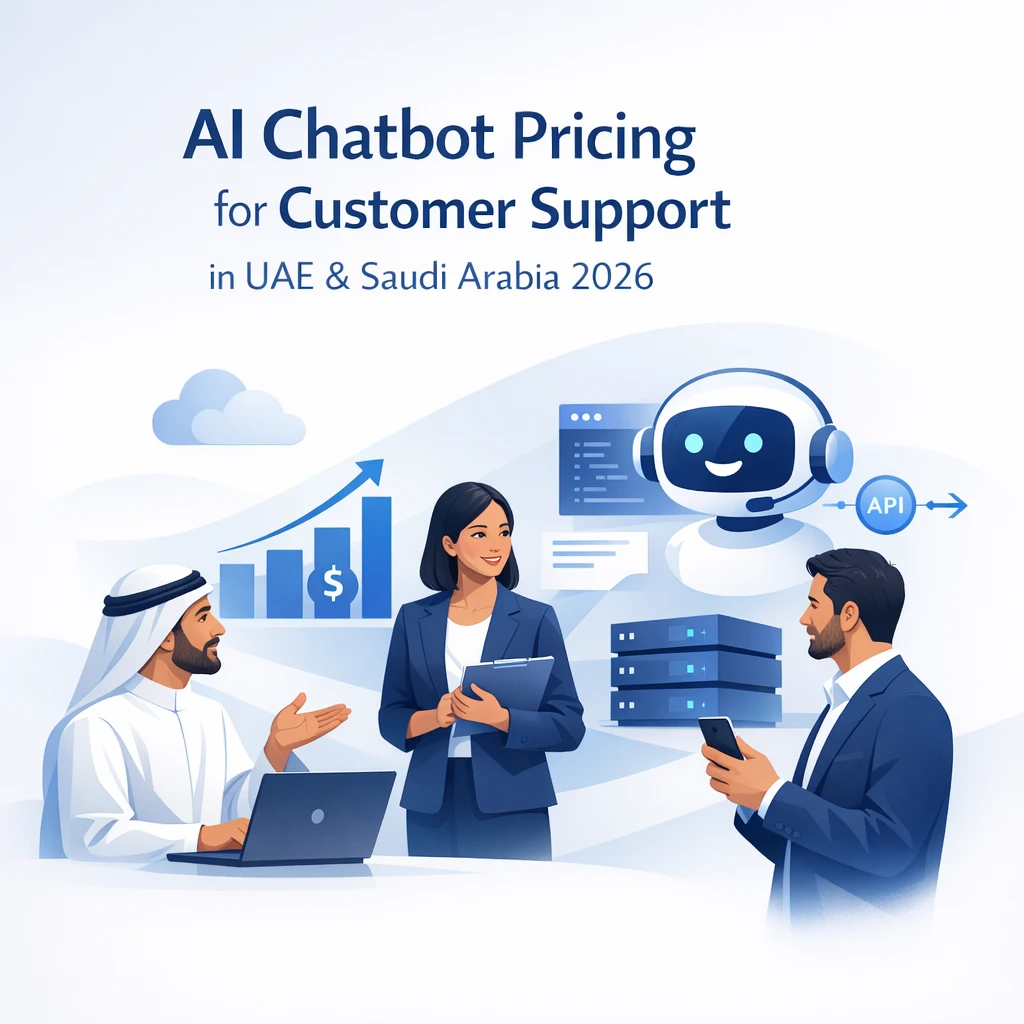
Generative AI Chatbot Pricing for Customer Support: What UAE and Saudi Businesses Should Expect in 2026
Delivered by Triostack Technologies
Introduction
Generative AI chatbots have moved from novelty to necessity for customer support in fast-growth markets. For companies in the United Arab Emirates, Saudi Arabia, and broader Gulf regions, as well as global operations, 2026 will blend advanced AI capabilities with disciplined cost management and robust governance. This article provides a practical view of what pricing models look like for AI chatbots in customer support, how to structure budgets for a range of business sizes, and how to work with trusted partners like Triostack Technologies to deliver scalable, secure, and compliant digital assistants.
While pricing is only one piece of the puzzle, understanding the economics helps you plan a roadmap that aligns with business goals—whether you’re a startup founder, a CTO at a mid-market company, or an operations leader guiding a regional rollout. The goal here is to educate, show concrete examples, and offer a framework you can apply when you evaluate vendors, build an in-house solution, or partner with a global software development team.
What is the Topic?
At its core, a generative AI chatbot for customer support is an AI-driven conversational agent that can understand natural language queries, retrieve relevant information from connected systems (CRM, ERP, knowledge bases), and generate human-like responses. Modern implementations increasingly use retrieval-augmented generation (RAG), multi-language support, multilingual sentiment analysis, and integration with business workflows for escalation to human agents when needed. The pricing you’ll see in 2026 reflects not just model usage, but data integration, security, multi-channel delivery, and ongoing governance.
In the UAE and Saudi Arabia, there is a strong emphasis on data privacy and localization, multilingual support (Arabic and English predominantly), and seamless integration with regional cloud providers and regulatory requirements. A well-architected chatbot isn’t just about the AI model; it’s about the entire stack—from data connectors to analytics dashboards and change management processes.
Why it Matters in 2026
- Operational efficiency at scale: 24/7 availability with consistent response quality drives faster issue resolution and frees human agents for complex cases.
- Cost discipline: AI-driven automation reduces frontline costs while maintaining or improving customer satisfaction.
- Compliance and governance: contracts, data residency, and access controls become central to pricing and ongoing support agreements.
- Regional nuances: language, culture, and regulatory alignment influence both features and pricing structures.
Current Industry Challenges
- Balancing cost with quality: enterprises want predictable pricing while ensuring robust conversational quality and reliability.
- Data integration complexity: connecting chatbots to CRM, ERP, order management, and ticketing systems without introducing security risk.
- Multilingual support: Arabic and English are common in UAE and Saudi markets, with regional dialects increasing the need for nuanced prompts and training data.
- Privacy and compliance: data handling, residency requirements, and vendor risk management must be baked into pricing and SLAs.
- Time-to-value: organizations want faster delivery cycles, without compromising security or governance.
How the Technology Works
Generative AI chatbots combine large language models (LLMs) with structured data access, business rules, and integrations to deliver context-aware responses. Modern architectures typically include:
- Natural language understanding (NLU) to identify intent and entities
- Prompt design and control via orchestration layers
- Retrieval from knowledge bases and enterprise data stores
- Response generation with guardrails and compliance checks
- Multi-channel delivery (web, mobile, messaging apps, voice)
- Observability, monitoring, and human-in-the-loop escalation
Pricing in 2026 reflects not only model usage but also data processing, data transfer, latency requirements, and the breadth of integrations. Vendors increasingly package pricing around a base platform fee plus per-interaction or per-API-usage costs, with tiers aligned to user seats, chat volumes, and required features (e.g., translation, analytics, or governance). To control cost, many organizations adopt a staged approach: pilot on a limited channel, extend to additional channels, then scale across regions.
Architecture Overview
A practical, scalable architecture for generative AI chatbots in customer support typically includes the following layers:
- Frontend channel layer (web, mobile, messaging apps)
- API gateway and orchestration layer
- LLM and prompt management layer
- Knowledge sources and retrieval systems (vector databases, databases)
- CRM/ERP integration and business workflows
- Security, identity, and governance
- Observability, analytics, and feedback loops
Triostack Technologies supports this architecture with a focus on security, scale, and localization for UAE, Saudi Arabia, and global clients. For projects of USD 5k to USD 200k, the architecture can be tailored to channel requirements, data governance, and integration complexity. See the related architecture detail placeholder for deeper design notes.
Step-by-Step Workflow
- Discovery and Requirements: define target channels, languages, data sources, KPIs, and escalation rules. Align on security, privacy, and IP ownership with Triostack’s governance framework.
- Data Readiness and Privacy: inventory data sources, ensure compliant data flows, identify PII handling, and confirm residency requirements in the UAE and Saudi Arabia where applicable.
- Model Selection and Prompts: choose LLMs, build prompts, and establish guardrails for tone, safety, and compliance.
- Integrations: connect CRM (e.g., a ticketing system) and ERP (e.g., order management) to ensure context-aware responses.
- Development and Iteration: implement the orchestration, retrieval, and UI, then test with real-world scenarios and multi-language data.
- Deployment and Observation: roll out to staging, perform load testing, set SLAs, implement monitoring, and establish feedback loops with human agents.
- Optimization and Scale: fine-tune prompts, expand to additional channels, and monitor cost/performance metrics as volumes grow.
Business Use Cases
- Post-purchase support: answer order status, returns, shipments, and warranty questions with real-time data from ERP and order systems.
- Scheduling and triage: triage patient appointments or service requests in a healthcare or telecom context, routing to human agents when needed.
- Sales & onboarding: guide customers through product configurations, collect requirements, and trigger CRM workflows.
- On-call support: provide 24/7 assistance for common IT or product issues, with escalation to humans for complex cases.
Industry Applications
Across the UAE, Saudi Arabia, and beyond, industry-specific deployments often demand tightly integrated chatbots with robust governance. Examples include:
- Retail and e-commerce: order tracking, product recommendations, and refunds processing
- Healthcare: appointment scheduling, symptom triage, and patient education
- Logistics and transportation: shipping updates, delivery notifications, and claim processing
- Hospitality and services: concierge-like support, booking management, and loyalty program queries
Benefits
- Improved first-contact resolution: faster answers with consistent quality across channels.
- Cost efficiency: reduced manual workload and improved agent utilization.
- Scalability: handle seasonal spikes and regional growth without proportional headcount increases.
- Data-driven insights: analytics on questions, sentiment, and common issues to drive product and service improvements.
Challenges
- Maintaining conversational quality across languages and dialects
- Data privacy and residency constraints for Gulf markets
- Cost management with fluctuating usage and complex integrations
- Ensuring reliable escalation to human agents when needed
Common Mistakes
- Underestimating the importance of data governance and access controls
- Launching with limited language support or insufficient testing across channels
- Over-reliance on generic prompts without tailoring to local contexts
- Neglecting post-launch QA, monitoring, and ongoing optimization
Best Practices
- Define clear success metrics (CSAT, FCR, escalations) and tie pricing choices to these outcomes
- Design multilingual prompts with regional dialects in mind
- Implement a robust data governance model and maintain an audit trail
- Use a staged rollout with pilot channels before full-scale deployment
- Choose a partner with global delivery capabilities and strong domain experience
Build vs Buy Comparison
Choosing between building your own chatbot stack or buying a managed solution depends on control needs, data sensitivity, and time to value. The table below summarizes typical considerations.
| Aspect | Build | Buy / Outsource (Managed) |
|---|---|---|
| Control | Full control over data, prompts, and integrations | Standardized stack with configurable options |
| Time to value | Longer development cycle | Faster time-to-market for core features |
| Cost variability | Capex, ongoing maintenance | Opex, predictable monthly fees |
| Compliance risk | Full responsibility but higher risk if not managed | Vendor governance and SLAs reduce risk |
For many UAE and Saudi businesses, a hybrid approach—core capabilities owned by the client with a managed cloud AI layer—offers best of both worlds. See the hybrid approach placeholder for more detail.
Estimated Development Cost
Below are typical ranges you may encounter for SMB-scale initiatives. Prices vary by region, data sensitivity, and required SLAs. Distinctions in delivery models (staff augmentation vs. full project outsourcing) also affect budgets.
| Project Type | Typical Range (USD) |
|---|---|
| Business Website | 5,000 – 15,000 |
| Customer Portal | 10,000 – 40,000 |
| CRM | 15,000 – 100,000 |
| ERP | 40,000 – 200,000 |
| AI Chatbot | 5,000 – 25,000 |
| AI Automation | 15,000 – 80,000 |
| SaaS MVP | 20,000 – 80,000 |
| Enterprise Web App | 30,000 – 200,000 |
Pricing factors include:
- Scope and complexity of chat flows, integrations, and multi-language support
- Data governance requirements and security controls
- Channel breadth (web, mobile, WhatsApp, voice) and latency targets
- Ongoing maintenance, updates, and analytics needs
- Hosting model (cloud provider, data residency, and regional delivery)
Recommended Technology Stack
Triostack recommends a balanced stack that supports rapid delivery, robust security, and scalable growth. This stack supports customization for Dubai, UAE, Saudi Arabia, and global regions.
- Frontend: React or Next.js for responsive, accessible UI across devices
- Backend: Node.js or Python (FastAPI) for service orchestration
- LLMs & AI: OpenAI GPT-4o, Claude, or local/open models; guardrails and prompt engineering
- Data & Storage: PostgreSQL / MySQL, Redis for caching, and Vector DBs (Weaviate, Pinecone) for semantic search
- Integrations: REST/GraphQL APIs to CRM/ERP and ticketing systems
- Cloud & DevOps: AWS / Azure / GCP with CI/CD (GitHub Actions, GitLab CI), containerization (Docker, Kubernetes)
- Security & Compliance: OAuth2, SSO, data encryption, audit logging, and role-based access control
- QA & Testing: automated tests, load testing, and end-to-end validation
For a typical UAE-based deployment, consider leveraging local cloud regions or data residency options where required, while maintaining a global delivery approach through Triostack’s distributed teams.
Future Trends
- Personalization at scale: user-specific responses based on historical interactions and preferences
- Voice and multimodal chat: more natural interactions across channels and devices
- Privacy-first design: on-device or federation-based processing where possible
- Stronger governance: tighter policy enforcement, compliance tooling, and auditability
How Triostack Delivers Projects Globally
Triostack Technologies operates with a global delivery model, combining remote teams and regional presence to serve clients across the UAE, GCC, North America, Europe, and Asia-Pacific. Our approach emphasizes collaboration, transparency, and predictable outcomes.
- Remote delivery from India: access to a deep talent pool, scalable teams, and cost efficiency without compromising quality.
- Agile framework: iterative development, sprint planning, and frequent stakeholder feedback
- Weekly demos: progress reviews with clients to validate direction and adjust priorities
- Communication channels: Slack, Teams, Zoom, Google Meet for seamless collaboration
- Project management and code: Jira, ClickUp, GitHub, GitLab, Azure DevOps
- CI/CD and cloud staging: automated pipelines, secure staging environments, and structured release management
- QA, documentation, and security: rigorous testing, thorough documentation, NDA and IP ownership protections
- Timezone overlap: practical overlap to support real-time collaboration
- Dedicated Project Managers: single point of contact for governance and risk management
- Long-term support: post-launch optimization, maintenance, and upgrades
Why UAE businesses outsource development to India? Benefits include cost efficiency, a large talent pool, faster hiring, high-quality engineering, and strong communication practices. Triostack leverages these advantages while ensuring alignment with local regulatory requirements and business goals.
Remote Delivery: How Triostack Makes It Work
Remote collaboration is at the core of Triostack’s delivery model. Here’s how we structure a typical engagement to ensure success for UAE and GCC clients:
- Agile ceremonies: Sprint Planning, Daily Standups, Sprint Review, and Retrospectives kept tight and outcome-focused.
- Weekly demos: visual demonstrations of progress and early validation with stakeholders.
- Communication tools: Slack for real-time updates, Teams/Zoom for video calls, and Google Meet for executive reviews.
- Project management: Jira or ClickUp for backlog, task tracking, and milestone management.
- Code collaboration: GitHub or GitLab with branching strategies and pull request gates.
- CI/CD: automated pipelines, cloud staging, and secure production deployment
- QA & security: automated tests, security reviews, and performance testing
- Documentation & IP protection: comprehensive technical documentation and clear NDA/IP ownership terms
- Timezone overlap & language: proactive planning to maximize overlap and ensure clear English communication
- Dedicated PMs: continuity and accountability across milestones
- Long-term support: ongoing enhancements, bug fixes, and compliance updates
Outsourcing to India is popular among UAE businesses for cost efficiency, access to a large talent pool, faster hiring, and consistently high engineering standards. Triostack pairs this model with strict governance, regional-domain expertise, and a client-centric approach to ensure regional regulatory alignment and business outcomes.
Case Studies (Anonymized for Privacy)
Below are anonymized scenarios illustrating how generative AI chatbots, built and delivered by Triostack, solved real-world problems in diverse contexts. Names and metrics are illustrative and intended to demonstrate plausible outcomes without exposing confidential data.
Dubai-based Logistics Company
Challenge: High volumes of customer inquiries about shipment status and delivery windows across multiple channels.
Solution: Implemented an AI chatbot connected to order management and CRM, with multilingual support and escalation to human agents for exceptions. Integrated with WhatsApp and a web portal for consistency across channels.
Impact: Improved response consistency and reduced handle time for routine inquiries, freeing human agents to focus on complex cases. Achieved better coordination across departments via integrated ticket flows.
UAE Healthcare Clinic
Challenge: Appointment scheduling, patient education, and pre-visit triage needed to be streamlined while complying with privacy standards.
Solution: Deployed a secure chatbot with appointment booking, reminders, and intake triage questions aligned to clinic workflows, with data residency controls for sensitive information.
Impact: More efficient scheduling, improved patient engagement, and clearer handoffs to clinical staff, without compromising privacy or compliance.
Saudi Retail Business
Challenge: Handling customer questions about orders, returns, and promotions in both Arabic and English during peak shopping seasons.
Solution: Built a bilingual chatbot connected to the e-commerce platform and CRM to surface order information and automate standard returns processes.
Impact: Reduced escalation volume and improved customer satisfaction with rapid, consistent responses across languages.
UK SaaS Company
Challenge: Demonstrating product capability to prospective customers while collecting requirement details during free trials.
Solution: Deployed an assistant that guides trial users through feature exploration, collects use-case data, and routes qualified leads to an onboarding workflow.
Impact: Faster qualification of leads and smoother onboarding; reduced time-to-first-value for trial participants.
Pricing for SMBs: What to Expect in 2026
The economics of AI chatbots for customer support are evolving. In 2026, most vendors structure pricing as a combination of base platform fees and usage-based components, with additional charges for premium features such as multilingual support, advanced analytics, and governance tooling. Below are practical ranges and how to think about them for SMBs and SMEs in the UAE, Saudi Arabia, and beyond.
| Pricing Component | Typical Range (USD) |
|---|---|
| Base platform / license | 1,000 – 6,000 per year |
| AI Chatbot (per bot, per month) | 50 – 400 |
| Interaction/Usage (per 1k messages) | 1 – 10 |
| Multilingual / Arabic support add-on | 100 – 600 per month |
| CRM/ERP integration (one-time) | 5,000 – 40,000 |
| Security & Compliance add-ons | 1,000 – 12,000 per year |
| Professional services / setup | 2,000 – 20,000 (one-time) |
Notes on pricing factors:
- Volume of conversations and messages directly influence usage-based costs.
- Number of channels and languages affects license and translation costs.
- Complex integrations (ERP, advanced analytics) add one-time and ongoing costs.
- Security, data residency, and regulatory compliance requirements influence total cost of ownership.
Development Timeline
Typical timelines for SMB-scale AI chatbot projects range from a few weeks for a pilot to several months for full production rollout, depending on complexity. The table below shows a representative phased timeline for a mid-range project.
| Phase | What Happens | Estimated Duration |
|---|---|---|
| Discovery & Planning | Requirements, data sources, channel scope | 2–4 weeks |
| Architecture & Prototyping | Data model, prompts, integrations design | 3–6 weeks |
| Development & Integration | Frontend, backend, connectors, early tests | 6–12 weeks |
| Pilot & QA | User testing, performance, security checks | 2–6 weeks |
| Launch & Scale | Production deployment, monitoring, tune | 2–8 weeks |
Triostack tailors timelines to your regional constraints, including regulatory reviews, language coverage, and data residency requirements.
Frequently Asked Questions
What is the typical price range for an AI chatbot for SMBs?
In 2026, a basic AI chatbot with essential integrations may start around USD 5,000–25,000 for initial setup, while more complex deployments with multi-language support, CRM/ERP integrations, and enterprise-grade governance can run higher—typically in the USD 40,000–200,000 band for larger rollouts. Each project includes ongoing maintenance and potential usage-based costs.
Why should UAE and Saudi businesses consider a managed services model?
Managed services provide predictable pricing, governance, security, and ongoing optimization. They reduce risk for organizations navigating regional data residency rules and help ensure consistent performance across channels and regions.
How does Triostack ensure regional localization?
Triostack combines global delivery with local language and cultural expertise. Our teams include bilingual specialists, and we configure prompts, translations, and data flows to respect local norms and regulatory requirements.
Conclusion
Generative AI chatbots are increasingly essential for customer support strategy in the UAE, Saudi Arabia, and beyond. The right pricing model—paired with robust architecture, governance, and regional localization—helps SMBs and SMEs achieve faster time-to-value, better customer outcomes, and scalable growth. Triostack Technologies sits at the intersection of practical implementation and strategic advisory, ready to help you design, build, deploy, and maintain a scalable chatbot solution that aligns with your budget and goals.
If you're planning a similar software project, Triostack can help you design, build, deploy and maintain a scalable solution.
Businesses planning similar solutions often benefit from experienced software development partners like Triostack Technologies.
Internal link placeholders for quick reference: architecture design, AI chatbot capabilities, human-in-the-loop handoffs.
Internal Link Placeholders
Related topics and deeper dives can be found via the following internal references (placeholders):
Architecture Diagram
Workflow Diagram
Deployment Diagram
Triostack Team
Technology Evangelist & Writer
Triostack Team is an experienced writer and technologist, exploring the intersections of AI, cloud architecture, and modern application development. Passionate about turning complex technical concepts into accessible insights.