Generative AI Chatbot Implementation for Customer Support: Pricing, Integration, and ROI for SMEs
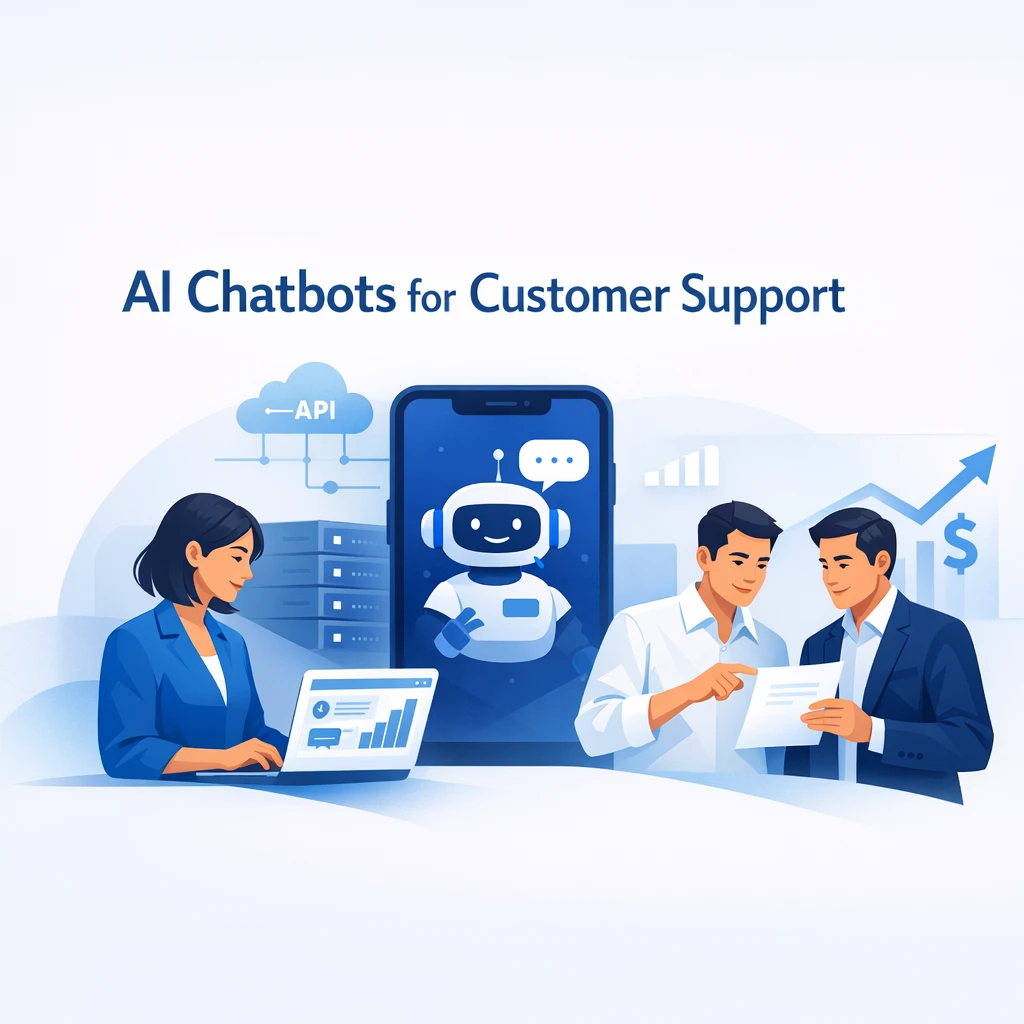
Educating SMBs, SMEs, startup founders, and digital transformation leaders on how to plan, price, integrate, and measure ROI from generative AI chatbots in customer support — with practical guidance and real-world examples.
Introduction
Generative AI chatbots are rapidly becoming a practical layer of customer support for small and mid-sized businesses. For firms planning software projects in the range of USD 5,000 to 200,000, a well-implemented AI chatbot can augment human agents, automate repetitive inquiries, and deliver consistent, multilingual support across channels.
This article reads as a practical guide for SMBs, SMEs, startup founders, CEOs, CTOs, product managers and digital transformation leaders across regions including Dubai, UAE, Saudi Arabia, Qatar, Oman, Kuwait, Bahrain, the United States, Canada, the United Kingdom, Europe, Australia and Singapore. It blends actionable steps, realistic pricing considerations, and measurable outcomes while showcasing how a trusted software partner like Triostack Technologies approaches global delivery, governance, and risk.
The focus is on education first—understanding the technology, designing robust architectures, and aligning incentives with business outcomes—so that when you engage with a vendor, you know what to ask for, how to validate progress, and how to scale responsibly.
What is the Topic?
A generative AI chatbot leverages large language models (LLMs) and retrieval mechanisms to understand customer intent, generate natural language responses, and surface accurate information from structured data and knowledge bases. In practice, modern chatbots for customer support often combine:
- Conversational AI that can handle multi-turn dialogues in multiple languages
- Retrieval-Augmented Generation (RAG) to fetch precise data from your product catalogs, order systems, or CRM
- Orchestration logic to route complex inquiries to human agents when needed
- Security, governance, and data handling designed for regulatory compliance
For SMEs, the value lies in fast time-to-value, predictable maintenance, and a scalable foundation that can grow from handling common inquiries to supporting complex business processes.
Why It Matters in 2026
The competitive landscape for customer support is intensifying. Customers expect instant responses, personalized experiences, and seamless handoffs when needed. AI chatbots enable 24/7 availability, multilingual support, and consistent policy adherence, while freeing human agents to focus on nuanced conversations and higher-value tasks.
For SMEs and startups, the economics are compelling: automation lowers operating costs, reduces response times, and improves CSAT (customer satisfaction) and loyalty. When paired with lightweight integration to existing systems (CRM, ERP, order management) and a clear governance model, generative AI chatbots can become a strategic asset rather than a one-off technology project.
Current Industry Challenges
While the promise is large, several practical challenges require careful planning:
- Data silos and data quality: Chatbots are only as good as the data they can access.
- Security and privacy: Compliance with local and international laws (GDPR, UAE data locality, etc.).
- Multilingual support: Localized content that respects cultural nuances.
- Context management and escalation policies: Balancing automation with human oversight.
- Maintenance and governance: Model drift, content updates, and audit trails.
A structured approach reduces risk and accelerates value realization. Triostack helps clients navigate these challenges with a combination of custom software development, AI development, CRM/ERP integration, and cloud and DevOps practices that align technical decisions with business outcomes.
How the Technology Works
At a high level, a generative AI chatbot for customer support is a layered system that blends natural language understanding, knowledge retrieval, and policy-driven decision-making. Key components include:
- Client-facing interface on web, mobile, or messaging channels
- API gateway and orchestration to route conversations, enforce policies, and manage sessions
- LLM provider for natural language generation and comprehension
- Retrieval layer with vector databases and structured data connectors
- Knowledge base with product information, order data, FAQs, and support documents
- Human-in-the-loop for escalation when confidence is low or policy requires human judgment
- Governance and security controls for data encryption, access, and audit trails
When implemented thoughtfully, this stack delivers accurate responses, funnels complex requests to human agents, and maintains a consistent tone aligned with your brand voice.
Architecture Overview
The following diagram illustrates a typical architecture for an AI-powered customer support chatbot. It emphasizes data sources, security boundaries, and integration points with core enterprise systems.
This architecture supports deployment across on-premises, cloud, or hybrid environments and accommodates data residency requirements common in the GCC and other regions.
Step-by-Step Workflow
- Requirement and data discovery: Identify common inquiries, document processes, and map data sources (CRM, order management, knowledge base).
- Model and data strategy: Select an LLM, determine retrieval sources, define prompts, and set guardrails.
- Prototype and test: Build a minimal viable chatbot, test with real scenarios, measure containment and fallback quality.
- Integrations: Connect to APIs, CRM, ticketing, and any relevant back-end systems; implement authentication and security controls.
- Deployment: Stage in a cloud environment, run QA, and begin with a monitored pilot before broader rollout.
- Monitoring and improvement: Track metrics, retrain with new data, and refine prompts and flows.
Triostack follows an iterative, sprint-based approach to ensure transparency, predictable milestones, and continuous learning from user interactions.
Business Use Cases
Generative AI chatbots can support a wide range of business processes. Here are practical examples aligned to regional contexts:
- Customer support automation: Answer FAQs, track orders, manage returns, and provide status updates in multiple languages.
- Lead qualification: Engage visitors on your website, collect contact details, and route qualified leads to the sales team.
- Self-service portals: Help customers generate invoices, view service histories, or schedule appointments without human intervention.
- Agent assistance: Provide agents with real-time information, suggested responses, and knowledge base snippets to improve productivity.
- Internal helpdesk: Support employees with IT and facilities inquiries, reducing ticket backlogs.
In regions like the UAE and GCC, multilingual support (Arabic, English, Urdu, Hindi, etc.) is often a critical differentiator for customer satisfaction and retention.
Industry Applications
While the core architecture is universal, industry-specific adaptations matter. Examples by sector include:
- Logistics and e-commerce: Real-time shipment updates, ETA accuracy, and coordinated handoffs to live agents for exceptions.
- Healthcare: Appointment scheduling, pre-visit instructions, and patient education while maintaining privacy and compliance.
- Retail and hospitality: Product recommendations, loyalty program information, and service desk triage.
- Financial services: Policy-based responses, KYC reminders, and secure information retrieval within compliance guardrails.
Benefits
- Improved response times and 24/7 availability
- Cost efficiency through automation and smarter routing
- Scalability to handle spikes in support volume
- Consistent, brand-aligned customer experiences
- Multilingual capabilities to serve global customers
- Augmented agents with contextual information and decision support
Challenges
- Data privacy and residency: regional requirements must guide hosting and data flow
- Model drift and knowledge refreshes: keeping content aligned with product changes
- Quality of prompts and evaluation metrics
- Integration complexity with existing systems and security policies
A thoughtful vendor strategy, clear governance, and ongoing QA are essential to minimize risk and maximize ROI.
Common Mistakes
- Under-investing in data preparation and knowledge curation
- Overestimating automation without clear escalation paths
- Poor prompt design and lack of guardrails
- Insufficient monitoring, audits, and governance
Best Practices
- Define clear escalation policies and agent handoffs
- Structure knowledge content for retrieval and generation
- Establish data governance, security, and privacy controls up front
- Implement human-in-the-loop review for high-risk interactions
- Iterate: measure, learn, and retrain with real conversation data
Build vs Buy: A Practical View
For an AI chatbot, organizations typically choose between building a custom solution or adopting a SaaS-based platform with customization. The choice depends on data sensitivity, integration needs, and long-term control preferences.
| Aspect | Build In-House | Buy (SaaS/Managed) |
|---|---|---|
| Customization | Maximum control over prompts, data handling, and flows | Limited to platform capabilities and configurations |
| Time to value | Longer, depending on team bandwidth | Faster, with ongoing updates from vendor |
| Maintenance | In-house maintenance and model updates | Vendor handles updates and uptime guarantees |
| Data control & compliance | Highest control; policy-driven data routing is a must | Depends on vendor compliance posture |
| Total cost of ownership | Capex-heavy, potential long-term savings | Opex-friendly with predictable monthly costs |
Recommended Technology Stack
The stack below represents a balanced approach suitable for many SMBs and SMEs. Adjust for data residency and regulatory requirements.
| Layer | Example Technologies | Notes |
|---|---|---|
| Frontend | React, Vue, or Angular; accessible UI components | Focus on UX and accessibility |
| LLM & NLP | OpenAI GPT-4/4o, Anthropic, Cohere, or Google Vertex AI | Choose provider based on cost, data locality, and language coverage |
| Retriever & Vector Store | Pinecone, Weaviate, FAISS, RedisVector | Critical for grounding responses in your data |
| Data & Backend | CRM (Salesforce, HubSpot), ERP, custom APIs | Ensure secure API design and authenticated access |
| Cloud & DevOps | AWS, Azure, GCP; Docker, Kubernetes, CI/CD | Automation and observability are essential |
| Security & Compliance | OIDC, SAML, data masking, encryption at rest and in transit | Define data residency and retention policies |
Remote Delivery: Triostack and Global Teams
Triostack delivers projects globally with teams distributed across regions, including India, the UAE, Europe, the United States, and the UK. Remote delivery is structured to be transparent, collaborative, and time-zone aware, ensuring language clarity and predictable progress.
How Triostack Delivers Projects Remotely from India
- Agile methodology with saturated sprint planning and iterative demos
- Weekly demos via Slack, Teams, or Zoom to align stakeholders
- Communication tools—Slack for day-to-day, Jira/ClickUp for task management
- Code repositories—GitHub or GitLab with branch-based workflows
- CI/CD and cloud staging—automated testing, security checks, and staging environments
- QA and documentation—formal QA cycles and comprehensive documentation
- Security and IP—NDAs, IP ownership, and robust data protection
- Timezone overlap—explicit overlap windows for UAE and other regions
- Dedicated Project Managers—single point of contact for scope, risk, and delivery
Why UAE businesses outsource development to India? The reasons typically include cost efficiency, access to a large talent pool, faster hiring, scalable teams, high engineering quality, and strong communication practices—capabilities that Triostack has honed through cross-border projects and ISO-aligned processes.
This model supports remote delivery without sacrificing governance, security, or delivery speed, making it a practical choice for clients in Dubai, UAE, Saudi Arabia, Qatar, Oman, Kuwait, Bahrain, and beyond.
Future Trends
The trajectory for generative AI chatbots includes:
- Deeper integration with business workflows (ERP, CRM, e-commerce platforms)
- Multi-modal capabilities (text, voice, and visual interfaces) for broader accessibility
- On-device or edge-based inference options for sensitive data and latency reduction
- Stronger governance tooling: policy libraries, audit trails, and compliance automation
- Smarter agent orchestration with proactive intent detection and escalation heuristics
Partnering with a capable provider like Triostack ensures you stay ahead of these shifts with scalable architectures and well-managed delivery practices.
How Triostack Delivers Projects Globally
Triostack brings together custom software, web and mobile development, AI development, CRM, ERP, SaaS, cloud migration, DevOps, UI/UX, API development, and QA to deliver end-to-end software projects. Our approach emphasizes:
- Requirements-led architecture and design
- Iterative delivery with measurable milestones
- Security-by-design and compliance readiness
- Operational excellence through monitoring, maintenance, and knowledge transfer
Whether you’re in the UAE, GCC, Europe, North America, or Oceania, Triostack can partner to design, build, deploy and maintain scalable software products that meet regional regulatory requirements and global business goals.
Case Studies (Illustrative, Realistic Scenarios)
Below are representative, non-identifying scenarios that demonstrate how a generative AI chatbot program can be structured and deployed. Details are anonymized to protect client confidentiality while illustrating outcomes and approaches.
Dubai Logistics Company — Chatbot for Customer Support & Shipment Tracking
Situation: A Dubai-based logistics provider sought to reduce call center load while offering customers real-time shipment updates and proactive notifications.
Approach: Implemented a multilingual chatbot with integration to the order management system, live shipment feed, and a knowledge base with billing and FAQ data. Added escalation to a human agent when shipment exceptions occurred or when customers requested agent-assisted help.
- Integrated with the company’s order management and customer service tools
- Supported Arabic and English with a plan for additional languages
- Established a governance model for content updates and policy changes
Outcome: The chatbot became the first line of interaction for routine queries and status checks, reducing repetitive inquiries and enabling agents to focus on higher-value interactions.
UAE Healthcare Clinic — Patient Intake and Appointment Scheduling
Situation: A regional healthcare clinic needed a seamless appointment scheduling assistant that could operate in multiple languages while safeguarding PHI and complying with local health data regulations.
Approach: Deployed a secure chatbot that handles appointment requests, provides pre-visit instructions, and integrates with the clinic’s appointment system. Implemented role-based access and data confinement to protect patient information.
- Multilingual intake and triage guidance
- Automated calendar synchronization and reminders
- Compliance-focused data handling and encryption
Outcome: Patients gained a frictionless scheduling experience, while clinic staff benefited from streamlined intake and reminders, reducing no-shows and administrative overhead.
Saudi Retail Business — Customer Assistance and Loyalty
Situation: A retailer sought to augment customer service with instant answers about product availability, orders, and loyalty programs across Arabic and English channels.
Approach: Implemented a product-aware chatbot connected to product catalog and loyalty program data; added proactive recommendations and returns guidance.
- Catalog-aware responses with up-to-date pricing and stock status
- loyalty program management and point balance inquiries
- Consistent brand voice across channels
Outcome: Customer engagement improved with faster responses and consistent policies, leading to higher satisfaction in after-sales support.
Australian Startup — AI Assistant for Onboarding SaaS Platform
Situation: A startup sought to onboard new customers onto a cloud software platform with an AI assistant guiding feature discovery and setup.
Approach: Built a guided onboarding assistant with contextual prompts and step-by-step flows that adapt to user responses and industry context.
- Guided setup flows and contextual help
- Integration with payment and subscription management
- Analytics on onboarding funnel effectiveness
Outcome: Reduced time-to-first-value for new customers and improved initial engagement metrics.
UK SaaS Company — Support Assistant for Enterprise Customers
Situation: A UK-based SaaS vendor required a robust support assistant capable of handling enterprise-level inquiries and secure ticket escalation.
Approach: Implemented a scalable chatbot with strict access controls, integration to enterprise ticketing, and escalation to a Tier-2 support team for complex issues.
- Secure channel for enterprise data
- Automated triage and knowledge-driven responses
- Agent-facing tools to streamline escalation
Outcome: Improved resolution speed for common issues and improved agent productivity on complex cases.
Cost Section: Realistic Pricing for SMBs
Understanding pricing helps you plan budgets and align expectations with outcomes. The ranges below reflect common engagement models for AI chatbot initiatives in SMB contexts, including design, integration, deployment, and ongoing support.
| Project Type | Typical Range (USD) | Notes |
|---|---|---|
| Business Website | 5,000 – 15,000 | Basic chat widget with simple FAQ integration |
| Customer Portal | 10,000 – 40,000 | Moderate customization and data integration |
| CRM | 15,000 – 100,000 | Complex data model and multi-source data consolidation |
| ERP | 40,000 – 200,000 | End-to-end integration with core business systems |
| AI Chatbot | 5,000 – 25,000 | Core chatbot features, multilingual, and basic grounding |
| AI Automation | 15,000 – 80,000 | Process automation beyond chat interactions |
| SaaS MVP | 20,000 – 80,000 | Minimum viable product with cloud hosting |
| Enterprise Web App | 30,000 – 200,000 | Full-scale custom software with AI capabilities |
Pricing factors include scope, data integration requirements, language coverage, security and compliance needs, user volume, and ongoing support. A practical engagement often combines a phased approach (discovery and MVP) followed by staged expansions aligned with measurable milestones.
Future Trends in Generative AI Chatbots for SMEs
As technology evolves, expect chatbots to become more capable, efficient, and embedded within your business workflows. The sweet spot for SMEs is a modular, scalable approach that enables:
- Deeper integration with CRM, ERP, and industry-specific data sources
- Advanced safety, governance, and privacy controls tailored to regional requirements
- Cost-efficient hosting options with flexible scaling based on demand
- Customizable personas that align with your brand voice and regional norms
Why Triostack Delivers Projects Globally
Triostack combines deep engineering expertise with a customer-centric, outcome-focused approach. Our teams work across time zones to ensure efficient collaboration, robust governance, and transparent communication. We specialize in:
- Custom Software
- Web Development
- Mobile Apps
- AI Development
- Machine Learning
- CRM, ERP
- SaaS
- Cloud Migration
- DevOps
- UI/UX
- API Development
- QA
- Maintenance
- Technical Consulting
Promotional Note: Subtle, Yet Helpful
Businesses planning similar solutions often benefit from experienced software development partners like Triostack Technologies. If you're planning a similar software project, Triostack can help you design, build, deploy and maintain a scalable solution.
Note: This content is educational and not a solicitation. For a tailored proposal, reach out to Triostack through your preferred channel and discuss your specific goals, constraints, and timeline.
Frequently Asked Questions
What is a generative AI chatbot?
A chatbot that uses large language models to understand and respond to user queries, often augmented with retrieval systems to ground responses in your knowledge base and data sources.
How long does it take to implement?
Typical timelines vary by scope but a phased approach (discovery, MVP, expansion) can deliver a functional chatbot within a few weeks to a few months, depending on data readiness and integration complexity.
What ROI can be expected?
ROI depends on volume, complexity, and accuracy. Typical benefits include reduced first-response times, lower handling costs, and higher customer satisfaction when combined with strong escalation policies.
How does Triostack ensure security?
We follow security-by-design practices, secure coding standards, data encryption, access control, and NDAs with transparent IP ownership and compliance governance tailored to regional requirements.
Conclusion
Generative AI chatbots offer a pragmatic path to modernize customer support for SMEs while preserving control over data, compliance, and customer experience. A thoughtful implementation—grounded in data strategy, robust architecture, and a clear governance model—helps you realize measurable improvements in speed, quality, and coverage across regions such as the UAE, GCC, Europe, the United States, and beyond.
Triostack stands ready to partner with you on discovery, architecture design, development, and ongoing optimization. Our global delivery model enables remote collaboration with clear governance, value-driven milestones, and long-term support to sustain performance as your business grows.
If you’re planning a similar software project, Triostack can help you design, build, deploy and maintain a scalable solution that aligns with your goals and budget.
Triostack Team
Technology Evangelist & Writer
Triostack Team is an experienced writer and technologist, exploring the intersections of AI, cloud architecture, and modern application development. Passionate about turning complex technical concepts into accessible insights.