How to Enhance the UX of a Mobile App with Design Thinking: A Comprehensive Guide
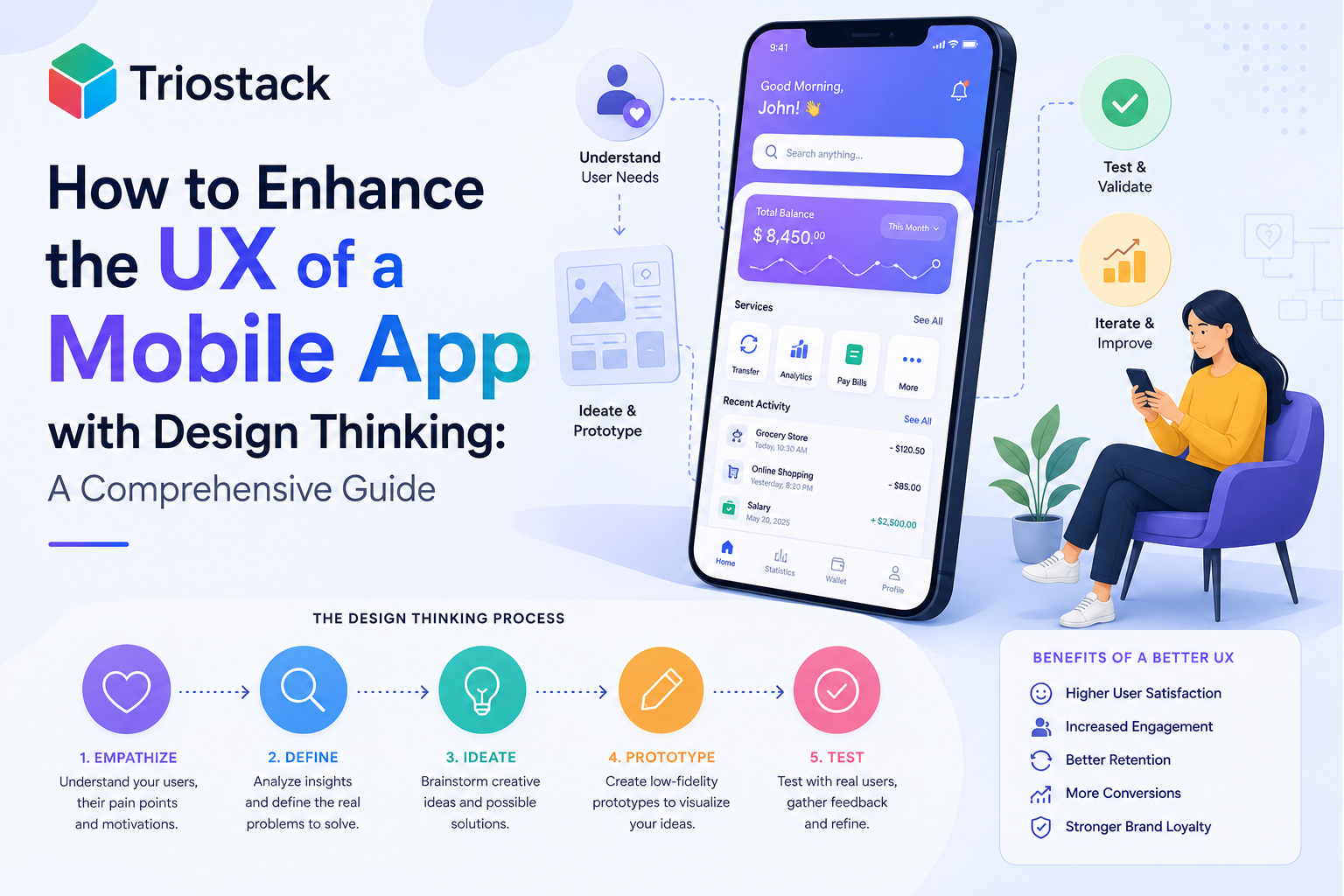
Great mobile app UX rarely happens by accident. Teams that consistently ship intuitive, delightful apps tend to share one thing in common: a repeatable process for understanding users and validating design decisions before writing production code. Design thinking is that process.
What is Design Thinking in App UX
Design thinking is a human-centered problem-solving framework built around understanding real user needs before jumping to solutions. Applied to mobile app UX, it shifts the conversation from "what features should we build" to "what problem are we actually solving for this user, in this context."
The 5 Stages Applied to Mobile App UX
Empathize
Talk to real users, watch them use your app or a competitor's, and understand their frustrations in their own words rather than assumptions from the product team.
Define
Turn research into a clear, specific problem statement — not "users want more features" but "users abandon checkout because the form asks for too much information upfront."
Ideate
Generate a wide range of possible solutions without judging them too early. The goal is breadth before narrowing down to the strongest ideas.
Prototype
Build low-fidelity mockups or clickable prototypes fast, so ideas can be tested before committing engineering time to them.
Test
Put the prototype in front of real users, observe where they struggle, and feed what you learn back into another round of ideation. Design thinking is a loop, not a one-time exercise.
Practical Techniques to Improve UX Today
- Run short, unmoderated usability tests on key flows like onboarding and checkout every few weeks.
- Map your app's critical user journeys and identify every point of friction or drop-off.
- Use heatmaps and session recordings to see where users hesitate or misclick.
- Simplify forms and reduce the number of decisions a user has to make per screen.
Measuring the Impact of Design Thinking
The value of design thinking shows up in metrics that matter: higher onboarding completion rates, lower support ticket volume, improved retention, and faster time-to-value for new users. Tie every design change back to a measurable hypothesis so the team can tell whether it actually worked.
Conclusion
Design thinking isn't a one-off workshop — it's an operating habit. Teams that build empathy, definition, ideation, prototyping, and testing into their regular product cycle consistently ship better mobile app experiences than teams relying on intuition alone.
Frequently Asked Questions
How long does a design thinking cycle take for a mobile app feature?
It varies, but many teams run a lightweight cycle — from user research to a tested prototype — within one to two weeks for a single feature or flow.
Do I need a dedicated UX researcher to apply design thinking?
It helps, but small teams can still apply the framework informally through structured user interviews and low-fidelity prototype testing.
What is the most commonly skipped stage of design thinking?
Empathize is skipped most often, with teams jumping straight to solutions based on internal assumptions rather than real user research.

Triostack Editorial Team
Technology Evangelist & Writer
Triostack Editorial Team is an experienced writer and technologist, exploring the intersections of AI, cloud architecture, and modern application development. Passionate about turning complex technical concepts into accessible insights.