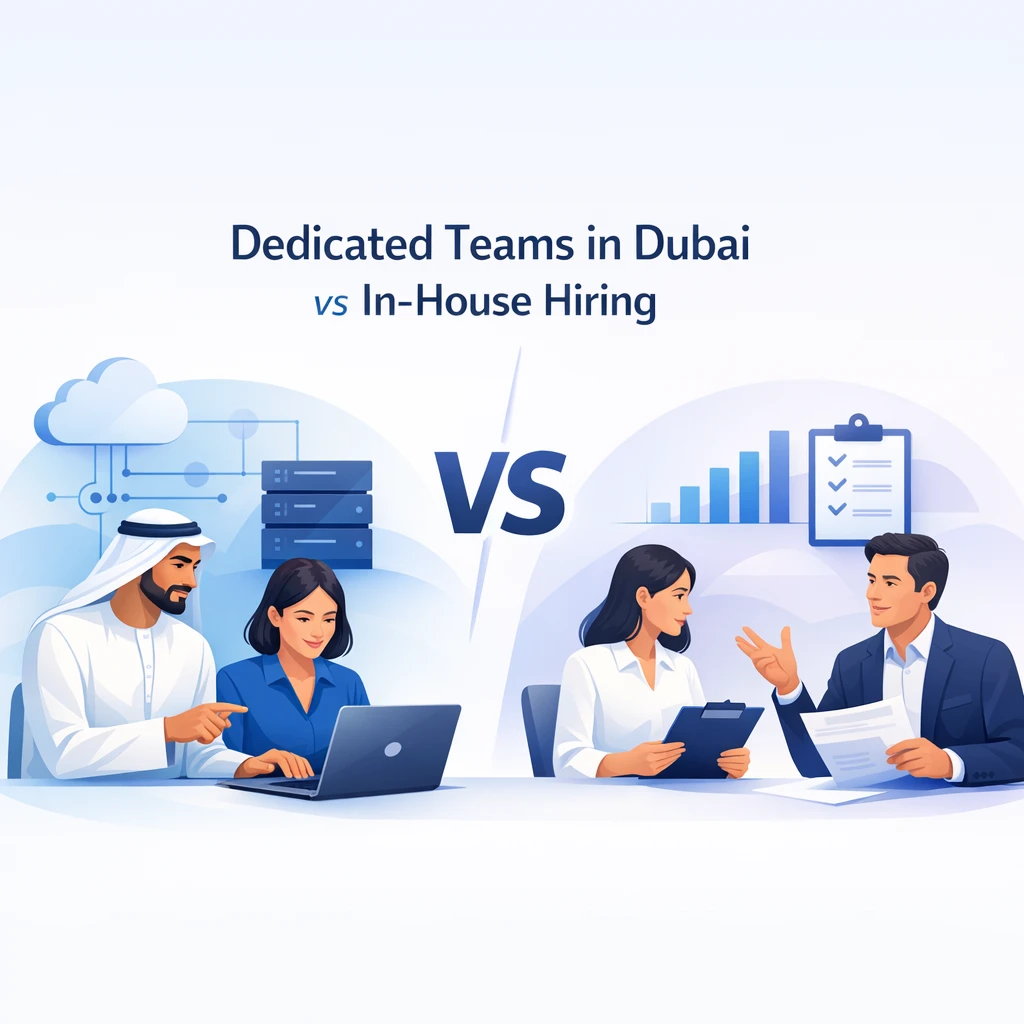
Dedicated Development Teams in Dubai vs In-House Hiring: Which Model Scales Faster and Costs Less?
Introduction
For many SMBs, SMEs, startups, and established enterprises planning software initiatives, the decision between building in-house teams and engaging dedicated development teams is a pivotal one. The choice shapes speed to market, total cost of ownership, risk, and the ability to scale with demand. In regions like Dubai, the UAE, and the wider Gulf, plus global markets in the United States, Europe, and beyond, the dynamics of talent, salary inflation, and cross-border collaboration push organizations to weigh models that can deliver both speed and quality. This article provides a practical, data-informed look at dedicated development teams versus in-house hiring, with a focus on scale, cost, and long-term sustainability. It also shows how Triostack Technologies partners with companies worldwide to design, build, deploy and maintain scalable software solutions.
What is the Topic?
The core question is a comparison between two common approaches to software delivery:
- Dedicated development teams (also called extended teams or offshore/nearshore teams): a modular, scalable group of engineers integrated with your product management, QA, and design, managed through your processes and tools, often located outside your campus or country.
- In-house hiring: building a permanent internal team within your organization, usually co-located or in the same region, with full control over hiring, culture, processes, and infrastructure.
The central trade-off is between speed and cost versus control and proximity. In many markets, dedicated teams from a global partner can accelerate delivery, reduce upfront costs, and provide access to a broader talent pool. In-house teams offer tight alignment, deeper domain immersion, and potentially better alignment with the corporate culture—at a price and risk that can slow scaling if demand surges.
Why it Matters in 2026
As businesses invest in digital platforms to compete, the ability to scale software capability rapidly becomes a strategic advantage. In 2026, teams are often remote-first by necessity, with clients seeking flexible engagement models that preserve IP, ensure security, and maintain governance. Gulf economies (UAE, Saudi Arabia, Qatar, Oman, Kuwait, Bahrain) are increasingly embracing digital transformation in sectors like logistics, healthcare, finance, and retail, while Western markets continue to push for faster time-to-value and predictable budgeting through managed or dedicated teams. The right model helps startups reach product-market fit faster, SMEs scale existing products, and enterprises maintain a continuous development cadence without mounting op-ex from permanent hiring spurts.
Current Industry Challenges
- Talent shortages and rising costs: highly skilled developers command premium salaries in many regions, while offshore teams offer cost advantages but require careful governance.
- Managing distributed teams: cultural differences, time zones, and collaboration tooling can create friction if not managed well.
- Quality and security imperatives: regulatory regimes in the UAE, GCC, and elsewhere demand robust security, data handling, and compliance.
- Speed to market: startups and fast-moving SMEs need iterative delivery, quick pivots, and reliable CI/CD pipelines to stay competitive.
These challenges motivate many organizations to consider dedicated teams as a way to balance cost, speed, and control while maintaining governance and IP ownership.
How the Technology Works
Both dedicated teams and in-house hiring revolve around the same core technologies, but the way teams are assembled, governed, and integrated differs. A dedicated development team typically operates as a cohesive unit supplied by a partner like Triostack, embedded with your product teams, following your product backlog, sprint cadence, coding standards, security requirements, and release plans. An in-house team is built by recruiting and retaining engineers within your organization, with direct oversight from your leadership. The differences emerge in three domains:
- Talent access and cost: dedicated teams can provide a broader talent pool and favorable cost structures, especially when sourcing from regions with high skill but lower wage scales.
- Governance and IP: both models can enforce stringent IP ownership and security policies, but dedicated teams often come with defined contracts, NDAs, and robust governance frameworks that are built into the engagement.
- Delivery cadence: with a partner, you can scale up or down quickly, align with your sprint cycles, and access mature DevOps practices without long-term overhead.
In practice, most organizations adopt a hybrid approach—using dedicated teams to accelerate capacity while maintaining a core in-house backbone for strategy, domain knowledge, and critical security concerns.
Architecture Overview
The architectural model remains consistent across engagement types, but the control plane shifts. A typical architecture for a product built with a dedicated team includes:
- Cloud-hosted services with secure APIs
- Frontend and mobile clients connected through REST/GraphQL APIs
- CI/CD pipelines with automated testing and security gates
- Monitoring, logging, and incident response tooling
- Data governance and compliance controls
Below is a simplified representation of a scalable architecture that Triostack commonly implements for clients across regions:
For implementation details, see the Remote Delivery section and the Case Studies.
Step-by-Step Workflow
A pragmatic workflow helps align expectations, especially when coordinating between a Dubai-based leadership team and a distributed development team. Here is a typical flow:
- Discovery and Planning: define business goals, success metrics, and high-level architecture. Establish security, compliance, and IP requirements.
- Team Formation: assemble a dedicated team with clearly defined roles (PM, Tech Lead, Developers, QA, UX, DevOps).
- Sprint Planning: plan the initial 2-4 sprints, define the backlog, and set acceptance criteria.
- Development & Continuous Integration: iterative feature development with automated tests and code reviews.
- Quality Assurance: functional, non-functional, performance, and security testing with traceability to requirements.
- User Acceptance Testing: stakeholders validate features and iterate on feedback.
- Deployment: controlled releases via CI/CD with blue/green/canary strategies as needed.
- Monitoring & Support: post-launch monitoring, incident response, and continuous improvement.
Business Use Cases
Different project types reveal distinct cost and speed dynamics. Consider these representative scenarios:
- New product MVP: a SaaS MVP with a web app and mobile companion, requiring rapid iteration and market feedback.
- Platform modernization: migrating legacy applications to microservices with API exposure and cloud-native design.
- Customer portal enhancements: secure authentication, role-based access, and self-service workflows.
- eCommerce or retail systems: catalog, order management, payments, and integrations with ERP/CRM.
Industry Applications
Below are sectors where dedicated teams frequently unlock faster value while maintaining governance and compliance:
- Logistics and supply chain (regional hubs like Dubai and GCC markets)
- Healthcare clinics and telemedicine platforms
- Retail and wholesale eCommerce
- Fintech and enterprise software
- Education technology and nonprofit platforms
Benefits of Dedicated Teams vs In-House Hiring
- Faster scaling: you can increase or decrease headcount quickly in response to demand spikes.
- Access to global talent: leverage engineers with diverse expertise and experience across domains.
- Predictable cost models: fixed monthly hiring costs or consumption-based engagement with clear SLAs.
- Risk management: structured governance, NDAs, security protocols, and IP ownership embedded in contracts.
- Focus on core business: internal teams concentrate on strategic priorities while the partner handles delivery delivery capacity and tooling.
In-house teams can offer deeper domain immersion and culturally aligned collaboration, which is valuable for long-term strategic initiatives and highly specialized products.
Challenges
- Communication frictions across time zones and cultures if not well managed.
- Quality and consistency of output across contractors or offshore teams without robust governance.
- IP and security risk governance in distributed models; need for strong contractual protections and compliance frameworks.
- Knowledge transfer and ramp time when switching from one engagement model to another.
Common Mistakes
- Underestimating the importance of a clear product backlog and well-defined acceptance criteria.
- Overloading a single squad with too many responsibilities or shifting scope mid-sprint.
- Not aligning security, data governance, and IP ownership from day one.
- Inconsistent tooling and lack of standardized DevOps practices across teams.
Best Practices
- Define a minimal viable governance model, including product owner liaison, sprint cadences, and communication rituals.
- Adopt a mature DevOps culture: automated testing, continuous delivery, and secure CI/CD pipelines.
- Use standardized security controls, data handling policies, and IP ownership agreements in all contracts.
- Ensure timezone overlap and daily standups or asynchronous updates that work for both sides.
Build vs Buy: A Quick Comparison
When deciding between a dedicated development team and in-house hiring, consider these key dimensions:
| Dimension | Dedicated Teams | In-House Hiring |
|---|---|---|
| Time to value | Often faster to start; scalable to match demand | Longer ramp-up due to recruitment and onboarding |
| Scalability | Elastic scaling; easy to add/remove capacity | Limited by hiring cycles and budget approvals |
| Control & governance | High governance via defined contracts; IP ownership clearly defined | Direct control; governance depends on internal processes |
| Cost predictability | Monthly rates; predictable budgets | Salary, benefits, office overhead; potential variability |
| Quality assurance | Quality gates built into contract and SLAs | Dependent on internal QA capacity |
Estimated Development Cost
Real-world software pricing varies widely by scope, domain, and region. The ranges below reflect typical engagements for SMBs and startups considering a mix of web, mobile, and mid-size enterprise components. Note that these figures are illustrative guides and can shift with requirements, compliance needs, and integration complexity.
| Project Type | Typical Range (USD) |
|---|---|
| Business Website | 5,000 – 15,000 |
| Customer Portal | 10,000 – 40,000 |
| CRM | 15,000 – 100,000 |
| ERP | 40,000 – 200,000 |
| AI Chatbot | 5,000 – 25,000 |
| AI Automation | 15,000 – 80,000 |
| SaaS MVP | 20,000 – 80,000 |
| Enterprise Web App | 30,000 – 200,000 |
Pricing factors include scope complexity, domain-specific integrations (ERP, CRM, payments), data migration, security/compliance, and the number of platforms (web, mobile, admin). A pragmatic approach is to start with an MVP and scale with validated learning.
Recommended Technology Stack
While the best stack depends on the domain, the following is a common, robust mix used by Triostack for scalable solutions:
| Domain | Frontend | Backend | Data / AI | Cloud / DevOps |
|---|---|---|---|---|
| Web | React, Vue | Node.js, .NET, Java | SQL/NoSQL, data warehouses | AWS, Azure, GCP, Kubernetes |
| Mobile | React Native, Flutter | API Services | On-device ML, ML serving | CI/CD, monitoring |
| AI & ML | - | Python, TensorFlow, PyTorch | Data lake, feature store | ML Ops, reproducibility |
Future Trends
Key trends shaping the dedicated-team model in 2026 and beyond include:
- Edge-friendly architectures and faster time to insights with streaming data
- Platform engineering to standardize internal tooling across teams
- AI-assisted development and governance to accelerate delivery while maintaining quality
- Stricter security and privacy by design across cloud-native deployments
How Triostack Delivers Projects Globally
Triostack Technologies partners with organizations around the world to design, build, deploy and maintain scalable software systems. Our services span:
- Custom Software
- Web Development
- Mobile Apps
- AI Development and Machine Learning
- CRM, ERP, and SaaS
- Cloud Migration
- DevOps, UI/UX
- API Development
- Dedicated Teams
- QA and Maintenance
- Technical Consulting
We tailor engagements to your stage, be it an MVP, scale-up, or enterprise product road map, aligning with your regulatory environment and market dynamics.
Remote Delivery: How Triostack Delivers Projects from India
Triostack leverages a mature remote delivery capability from India to provide cost-effective, high-quality engineering without sacrificing governance or communication. Our approach emphasizes agility, transparency, and robust project management:
- Agile and sprint planning: we align on sprint goals, backlogs, and release plans with your product owners.
- Weekly demos: regular showcases to ensure alignment and fast feedback loops.
- Communication channels: Slack, Teams, Zoom, Google Meet for daily collaboration.
- Project management: Jira, ClickUp, GitHub, GitLab, Azure DevOps for issue tracking and code governance.
- CI/CD: automated pipelines, cloud staging environments, automated tests, and security gates.
- QA and security: continuous testing, secure coding practices, and NDA/IP ownership agreements.
- Timezone overlap: designed to maximize overlap with your local teams for synchronous collaboration.
- Dedicated project managers: responsible for delivery velocity, risk management, and stakeholder communication.
Why UAE businesses outsource development to India? Several factors commonly influence this decision:
- Cost efficiency through competitive hourly rates without compromising engineering quality
- Large talent pool with deep expertise across modern stacks and AI/ML
- Faster hiring cycles and scalable teams to meet project needs
- High-quality engineering with strong communication and collaboration practices
Educational note: successful outsourcing requires clear governance, robust security policies, and IP ownership controls embedded in contracts.
Case Studies (Realistic Scenarios)
Below are anonymized, realistic implementations to illustrate how the dedicated-team model can scale and reduce risk. The descriptions avoid naming specific companies and focus on domain and outcomes.
Case Study 1 — Dubai logistics company
Challenge: A regional logistics provider needed a multi-tenant logistics platform to streamline warehouse operations, tracking, and delivery orchestration across Gulf hubs. They required rapid iteration and secure data sharing with partners.
Approach: Triostack deployed a dedicated team consisting of a product manager, tech lead, backend and frontend developers, QA, and a security engineer. We integrated with the company’s ERP for order and inventory data and built a microservices architecture on AWS with a secure API layer and event-driven processing.
Outcome: Reduced delivery cycle times by 28%, improved accuracy of parcel tracking, and delivered an MVP within 16 weeks, followed by a staged rollout across regional hubs.
Case Study 2 — UAE healthcare clinic
Challenge: A healthcare clinic needed a patient portal offering appointment scheduling, telemedicine, and secure messaging, with strict compliance to health data regulations.
Approach: A dedicated team delivered a patient portal and accompanying mobile apps with identity management, audit trails, and encrypted data storage. The solution included integration with the clinic’s EHR system.
Outcome: Improved patient engagement, reduced no-show rates by 15%, and achieved regulatory readiness with auditable data controls.
Case Study 3 — Saudi retail business
Challenge: A brick-and-click retailer required a unified e-commerce platform with inventory synchronization to local stores and a CRM-driven marketing suite.
Approach: Triostack formed a dedicated team including frontend, backend, and QA specialists, with API-first design and migration strategy from an existing legacy system.
Outcome: Launched a scalable e-commerce platform with integrated ERP and CRM connectors, enabling real-time stock visibility and a 22% uplift in online conversions during the first quarter post-launch.
Case Study 4 — Australian startup
Challenge: A high-growth Australian startup needed a SaaS MVP to test a new analytics product targeted at mid-market businesses.
Approach: A compact dedicated team delivered a SaaS MVP with a robust API, onboarding experiences, and a data visualization dashboard. We included a phased security review and scalability plan.
Outcome: Reached product-market fit within four months of launch and attracted initial customers while maintaining a lean burn rate.
Pricing Fundamentals for SMBs
Below is a practical guide to budgeting for software projects, particularly when considering a dedicated-team engagement versus a traditional in-house build. The ranges reflect typical market dynamics and are provided for planning purposes.
- Business Website: 5k–15k
- Customer Portal: 10k–40k
- CRM: 15k–100k
- ERP: 40k–200k
- AI Chatbot: 5k–25k
- AI Automation: 15k–80k
- SaaS MVP: 20k–80k
- Enterprise Web App: 30k–200k
Factors driving price include scope complexity, number of platforms, data migration needs, regulatory compliance, security requirements, and the level of ongoing support and maintenance.
Best Practices for Remote Delivery from India with Triostack
To maximize the value of remote delivery, we focus on clear governance, transparent communication, and rigorous engineering discipline. Key practices include:
- Shared velocity metrics and regular business-facing dashboards
- Clear product ownership and well-defined acceptance criteria
- Proactive risk management and dependency mapping
- Security-by-design, secure coding guidelines, and regular audits
- Documentation rigor and knowledge transfer plans
Additional Future Trends to Watch
- Platform Engineering: building internal enablement platforms to accelerate product teams
- AI-assisted software development: code generation, testing, and optimization
- Security modernization: identity, access, and data protection by default
Frequently Asked Questions
- What is a dedicated development team?
- A dedicated development team is a group of engineers assembled and managed by a partner organization to work exclusively on your project, integrated with your product management processes, and governed by a formal contract with defined SLAs, IP ownership, and security controls.
- How does time zone overlap affect delivery?
- Overlap improves communication and reduces delays. A well-planned overlap can enable real-time collaboration while preserving the cost advantages of offshore or nearshore teams.
- Is IP ownership safe with an external team?
- Yes. Reputable partners implement NDAs, clear IP assignment clauses, secure repositories, and audited access controls to protect your IP.
- When should I choose dedicated teams over in-house hiring?
- When time-to-market, scale flexibility, or access to a broader talent pool matters more than immediate proximity or deep organizational alignment. For long-term, highly strategic product ownership, in-house can be advantageous if the organization prioritizes domain immersion and corporate culture.
- What governance is typical with Triostack’s dedicated teams?
- We emphasize sprint cadence, product owner alignment, security and compliance gates, robust QA, and transparent reporting. NDAs and IP ownership are embedded in our engagement terms.
Conclusion
Choosing between dedicated development teams and in-house hiring is not a one-size-fits-all decision. The right model depends on your product goals, market timing, regulatory considerations, and your willingness to manage distributed collaboration. In many cases, the most effective approach combines both: leverage a dedicated team to scale capacity rapidly while preserving a strategic internal core for critical domain knowledge and governance. Triostack Technologies positions itself as a trusted global partner capable of delivering high-quality, scalable software from Dubai to the world, with remote delivery capabilities from India that align with your budget, timelines, and quality standards.
If you're planning a similar software project, Triostack can help you design, build, deploy and maintain a scalable solution.
Final Frequently Asked Questions
- How long does it take to start with a dedicated team?
- What security controls are typical for remote teams?
- Can a dedicated team work across multiple time zones?
- What are the typical contract terms for dedicated teams?
Internal Link Opportunities
For readers exploring related topics, consider these internal references as you plan next steps:
- Remote Delivery strategies and governance
- Case Studies for sector-specific outcomes
- Pricing factors to budget with confidence
Deployment Diagrams
The following diagrams illustrate typical deployment and architectural patterns used in dedicated-team engagements:
SEO and Accessibility Considerations
We design for clarity, speed, and accessibility to maximize search visibility and user experience. Content is structured with meaningful headings, semantic HTML, and accessible navigation to help search engines understand value and intent. Internal links and real-world examples enhance relevance for target regions and industries.
Triostack Team
Technology Evangelist & Writer
Triostack Team is an experienced writer and technologist, exploring the intersections of AI, cloud architecture, and modern application development. Passionate about turning complex technical concepts into accessible insights.