Dedicated Development Team vs In-House Hiring in Canada: Which Model Scales Faster?
Introduction
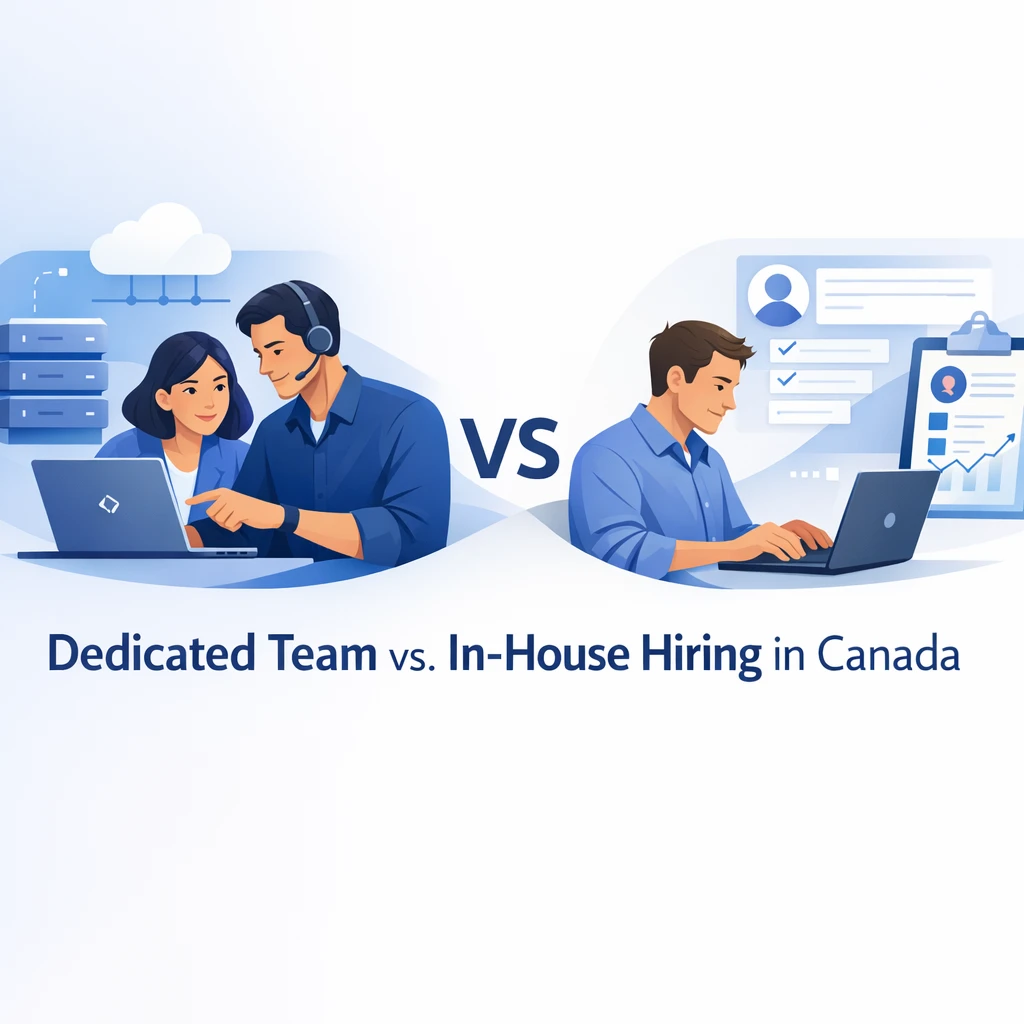
For SMBs, SMEs, startups, and established enterprises planning software projects, the decision often boils down to one question: should you hire in-house or engage a dedicated development team to accelerate growth? In markets as diverse as Canada, the United States, the UAE, and Europe, the answer isn’t one-size-fits-all. Each model has distinct advantages, risks, and scaling trajectories depending on project scope, talent access, regulatory considerations, and time-to-market pressures.
What is the Topic?
This article explores the core differences between a dedicated development team model and traditional in-house hiring, with a focus on speed to scale for software initiatives ranging from USD 5,000 to USD 200,000. We’ll dissect:
- What each model means in practice (structure, governance, and delivery velocity).
- The factors that influence scalability, including talent availability, time zones, and project complexity.
- Practical guidance, implementation steps, and real-world examples that help leadership decide what to pursue.
Why it Matters in 2026
Global software development continues to evolve toward more flexible, distributed delivery models. Key drivers include:
- Talent accessibility: Markets like Canada, the UAE, Saudi Arabia, and Europe face different talent pools and salary benchmarks. A dedicated team can bridge gaps quickly without relocating staff.
- Speed to market: Startups and product teams must validate ideas rapidly; the right model reduces ramp-up time for design, development, and QA.
- Focus on core business: In-house teams often get stretched with maintenance and non-core activities. A dedicated team can own a product vertical end-to-end while you retain strategic direction.
- Compliance and security: For regulated industries (healthcare, finance, logistics), partner firms with global delivery experience can enforce robust security and governance without sacrificing agility.
Current Industry Challenges
Whether you’re in Dubai, Canada, the United States, or Europe, several shared challenges shape how teams scale software projects:
- Talent scarcity and turnover in specialized roles (AI, backend, security) which disrupts continuity.
- Rising costs and hiring timelines for in-house staff, especially for niche skill sets.
- Coordination overhead across time zones and remote work environments.
- Coordination between product management, design, and engineering to maintain velocity and quality.
- Managing IP, security, and regulatory compliance in cross-border engagements.
How the Technology Works
Both models ultimately deliver software, but the day-to-day dynamics differ. Here’s a practical way to think about it:
- In-House Hiring: A traditional approach where a company builds a local or nearshore team, typically with full control over recruitment, onboarding, culture, and long-term retention. The benefits include proximity, alignment with corporate culture, and direct oversight, but ramp-up can be slow and expensive.
- Dedicated Development Team: A model where a partner (like Triostack Technologies) provides a cohesive cross-functional team that integrates with your product unit. The team becomes an extension of your organization, responsible for delivery velocity, architecture, and quality, while you retain product ownership and roadmap decisions.
Architecture Overview
Regardless of model, a well-defined architecture is critical for scaling. A typical architecture for a mid-sized digital product might include:
- Frontend: React, Next.js, or Vue for responsive, scalable UIs
- Backend: Node.js, Java, .NET, or Python microservices
- APIs: RESTful or GraphQL for modular communication
- Data: PostgreSQL or MySQL for relational data; Redis for caching
- AI/ML components: Python-based pipelines with TensorFlow or PyTorch
- Cloud: AWS, Azure, or Google Cloud with CI/CD pipelines
Step-by-Step Workflow
A practical workflow helps teams move quickly with clarity. Below is a typical lifecycle when engaging a dedicated development team:
- Discovery and scope alignment: product goals, success metrics, constraints.
- Architecture design: target state, tech choices, data models, security posture.
- Prioritized backlog: break down features into deliverable increments.
- Sprint planning: capacity planning, definition of done, acceptance criteria.
- Development and unit testing: iterative builds with automated tests.
- QA and integration testing: end-to-end flows, performance checks.
- Staging and UAT: user validation before production release.
- Deployment and monitoring: CI/CD, observability, and incident response.
Business Use Cases
Across industries, certain patterns emerge when choosing a dedicated team or in-house model. Here are representative scenarios:
- Dubai logistics company: Needed a scalable order management and real-time tracking dashboard integrated with legacy ERP. A dedicated team delivered a modular platform with phased migrations.
- UAE healthcare clinic: Required a compliant patient portal with telemedicine capabilities, appointment scheduling, and secure patient data handling. A remote delivery model accelerated compliance readiness and feature delivery.
- Saudi retail business: Built a multi-channel e-commerce and CRM system to unify customer data across channels. The team scaled with market needs, enabling rapid feature rollouts during peak seasons.
- Australian startup: Launched an AI-powered analytics MVP to test product-market fit quickly. A dedicated team adapted rapidly to feedback and iterated on model accuracy.
- UK SaaS company: Migrated to a microservices-based cloud platform to improve resilience and time-to-market for new modules.
Industry Applications
Different sectors demand different capabilities. Here are some common focus areas where scalable delivery matters most:
- CRM and ERP integrations for mid-market firms expanding digital core systems
- SaaS product development with multi-tenant architecture
- AI and ML enhancements for data-driven decision making
- Cloud migration and DevOps maturity for reliable, scalable platforms
- UI/UX improvements to boost adoption and reduce churn
Benefits
Both models offer tangible benefits when aligned to the right project and governance structure. Key advantages of the dedicated team approach include:
- Faster ramp-up and flexible scaling, especially for projects with evolving scope
- Access to specialized skills on demand without long-term hiring commitments
- Consistent delivery velocity through dedicated cross-functional squads
- Global delivery capabilities that support nearshore and offshore collaboration
- Stronger focus on product outcomes while maintaining strategic ownership
Challenges
Even with advantages, there are potential drawbacks to manage:
- Communication gaps across time zones if not structured properly
- Dependency on partner processes and controls for critical security and compliance
- IP ownership and contract clarity to avoid disputes
- Need for robust governance to maintain alignment with business goals
Common Mistakes
- Assuming price alone guarantees quality or speed—quality requires mature processes and a strong product culture.
- Underplanning for knowledge transfer, onboarding, and domain alignment.
- Neglecting security, data governance, and regulatory constraints in the initial architecture.
- Over-customizing the contract without clear acceptance criteria and exit options.
Best Practices
- Define a clear RACI and success metrics (velocity, defect rate, customer satisfaction).
- Choose a partner with proven remote delivery capability and regional experience in your market.
- Establish tight sprint cadences, weekly demos, and transparent reporting in collaboration tools like Jira or ClickUp.
- Invest in robust security, NDA, IP ownership, and data governance from contract signing.
Build vs Buy Comparison
Choosing between building in-house or engaging a dedicated team involves evaluating control, speed, cost, and risk. The table below highlights typical considerations.
| Aspect | In-House Hiring | Dedicated Development Team |
|---|---|---|
| Control & governance | Very high; direct supervision | High; product owner governs outcomes; vendor aligned |
| Time to first delivery | Longer due to recruitment | Faster with ready-made cross-functional squad |
| Scalability | Challenging; hiring cycles slow | Flexible; scale team up or down quickly |
| Cost predictability | Variable; salaries, benefits, attrition | More predictable; fixed sprint-based engagement |
| Focus on core business | Depends on management bandwidth | Better; product team concentrates on strategy |
| Risk and compliance | Internal; control is higher | Managed by partner; requires due diligence |
Practically, many organizations adopt a hybrid approach: core in-house teams handle strategic architecture and domain knowledge, while a dedicated team handles rapid feature delivery and scaling. This hybrid model is a frequent pattern in Canada and other regions seeking both control and speed.
Estimated Development Cost
Pricing varies by project type, geography, and scope. Below are realistic ranges observed for SMBs and mid-market initiatives. These ranges assume a typical mid-sized product with a lean governance model and standard QA practices. The figures are indicative and should be refined through a detailed discovery with your technology partner.
| Project Type | Estimated Range (USD) |
|---|---|
| Business Website | 5,000 – 15,000 |
| Customer Portal | 10,000 – 40,000 |
| CRM | 15,000 – 100,000 |
| ERP | 40,000 – 200,000 |
| AI Chatbot | 5,000 – 25,000 |
| AI Automation | 15,000 – 80,000 |
| SaaS MVP | 20,000 – 80,000 |
| Enterprise Web App | 30,000 – 200,000 |
Factors that influence pricing include: project scope and complexity, integration requirements (ERP/CRM/legacy systems), data migration needs, compliance and security constraints, cloud hosting choices, team location, and the level of ongoing maintenance and support.
Recommended Technology Stack
Triostack collaborates with clients to select a stack that balances performance, maintainability, and scalability. A typical modern stack for a cross-border product includes:
- Frontend: React or Next.js, with TypeScript for robustness
- Backend: Node.js (Express/Koa), Java/Spring Boot, or Python (FastAPI)
- Mobile: React Native or Flutter
- AI/ML: Python with PyTorch or TensorFlow; ML Ops for deployment
- Database: PostgreSQL/MySQL; Redis for caching
- Cloud: AWS, Azure, or GCP; Kubernetes for orchestration
- CI/CD: GitHub Actions, GitLab CI, or Azure DevOps
In addition to core product development, Triostack offers specialized capabilities such as CRM, ERP, SaaS engineering, API development, and cloud migration, with a strong emphasis on UI/UX excellence and QA.
Future Trends
Several trends will shape how teams scale software in the next few years:
- Generative AI-assisted development to accelerate design and coding (while maintaining guardrails).
- Microservices and serverless architectures to improve scalability and cost-efficiency.
- DevSecOps as the default, integrating security and compliance into every sprint.
- Hyperautomation and AI-driven testing for faster, higher-quality releases.
- Deeper global delivery networks that balance speed, quality, and regulatory requirements.
How Triostack Delivers Projects Globally
Triostack Technologies operates as a global software development partner with a strong remote-delivery capability. We implement a proven framework designed to minimize risk while maximizing velocity for clients in diverse regions, including the UAE, GCC, Europe, North America, and beyond.
Remote Delivery from India: A Structured, Accelerated Model
Developing in a distributed model requires more than just time zone overlap; it requires disciplined processes and clear communication. Here’s how Triostack ensures successful outcomes when delivering from India:
- Agile leadership: We start with a validated product backlog and a transparent sprint plan, ensuring alignment with your business goals.
- Sprint planning and demos: Weekly demos and sprint planning sessions keep stakeholders informed and engaged.
- Communication channels: Slack for ongoing conversations, Teams and Zoom for meetings, and an always-on information flow.
- Collaboration tools: Jira or ClickUp for task tracking; GitHub or GitLab for code management; Azure DevOps for end-to-end delivery pipelines.
- CI/CD and testing: Automated pipelines, cloud staging, and comprehensive QA to ensure quality at every release.
- Documentation and security: Centralized documentation, secure coding practices, NDAs, and clear IP ownership terms.
- Dedicated project managers: Experienced PMs who manage scope, risks, and stakeholder expectations across time zones.
- Long-term support: Post-release maintenance, monitoring, and iterative improvements to sustain product health.
Why UAE businesses outsource development to India? The answer lies in a combination of cost efficiency, a large talent pool, faster hiring cycles, high-quality engineering, and strong communication practices that support nearshore-like collaboration across time zones.
Case Studies
Dubai-based logistics company: Digital transformation of warehouse and order management
Challenge: Needed a scalable system to handle complex routing, real-time inventory tracking, and order orchestration with legacy ERP integration.
Approach: Triostack deployed a dedicated team to build a modular platform with a microservices architecture, integrated with the client’s ERP, and implemented an analytics dashboard for operators.
Outcome: Improved operational visibility and scalability for peak seasons, with faster feature delivery and reduced manual intervention.
UAE healthcare clinic: Patient portal and telemedicine
Challenge: Traditional systems struggled with patient scheduling, secure data handling, and telemedicine capabilities under regulatory requirements.
Approach: A dedicated team delivered a compliant patient portal with appointment management, secure messaging, and telemedicine sessions, complemented by a robust data governance model.
Outcome: Enhanced patient experience, streamlined scheduling, and improved data security and accessibility.
Australian startup: AI-powered analytics MVP
Challenge: Validate a data analytics product with real customers while controlling costs and timeline.
Approach: Triostack formed a cross-functional team to build an MVP, enabling rapid experimentation and iteration with customer feedback.
Outcome: Accelerated time-to-market and a scalable foundation for future enhancements.
UK SaaS company: Cloud-based platform migration
Challenge: Move from monolithic architecture to a microservices-based platform to support growth and resilience.
Approach: A phased migration plan with automated testing, security hardening, and performance optimization.
Outcome: Increased reliability, faster rollout of new modules, and better scalability.
Remote Delivery: Why It Works
Remote delivery is not merely about location; it’s about process discipline, cultural alignment, and governance. For many mid-market and SMB projects, a well-managed remote engagement with a trusted partner offers better leverage than a large in-house expansion. Key reasons include:
- Access to a broad, multi-disciplinary talent pool with diverse experiences.
- Ability to scale quickly in response to market feedback and changing requirements.
- Cost efficiency without compromising on code quality, architecture, or security.
- Proven practices for security, NDA protection, and IP ownership in cross-border collaborations.
In regions like the UAE and GCC, where digital transformation cycles are rapid, partnering with an experienced team in India provides a pragmatic balance of cost, capability, and speed. The model supports timezone overlap, transparent communications, and rigorous project governance that keeps everyone aligned on outcomes.
Future Trends
What should buyers plan for in the next 12–36 months?
- Increased adoption of AI-assisted development workflows to accelerate coding and testing while maintaining high standards of governance.
- Wider use of modular, API-first architectures to enable seamless integrations with legacy systems and third-party services.
- Stronger emphasis on security by design and privacy-by-default across all software projects.
- More flexible pricing models and outcome-based engagements to reduce upfront risk for SMBs.
FAQ
- What is a dedicated development team?
- A dedicated development team is a cross-functional group provided by a partner that works exclusively on your product. The team is integrated with your product team and operates with sprint-based delivery, owning end-to-end execution from design to deployment.
- How do you measure success in a remote delivery model?
- Success is typically measured by velocity (sprint throughput), quality (defect rates, test coverage), reliability (uptime, MTTR), and business outcomes (time-to-market, user adoption).
- Is in-house better for highly regulated industries?
- Not inherently. The critical factor is governance, security, and compliance. A partner with strong controls can meet regulatory requirements while delivering speed and flexibility.
- What are the cost considerations for SMBs?
- Costs vary by scope, but dedicated teams often provide better cost visibility and scalability than a full-time in-house expansion, especially for projects with evolving requirements.
Conclusion
The choice between dedicated development teams and in-house hiring is not simply a function of cost. It is about speed, risk, control, and long-term strategic alignment with your product roadmap. For many SMBs, SMEs, and startups planning software projects in the USD 5k–USD 200k range, a well-structured dedicated team delivers faster time-to-value, greater flexibility, and robust scalability while maintaining clear governance and IP protection. Triostack Technologies has helped diverse clients navigate these decisions, delivering high-quality software with a focus on outcomes, not just outputs.
If you're planning a similar software project, Triostack can help you design, build, deploy and maintain a scalable solution that fits your budget and timelines. Our team of domain experts, engineers, and product specialists collaborates to accelerate your journey from idea to impact.
Frequently Asked Questions
- How quickly can a dedicated team start a project? With a pre-formed, cross-functional team, many engagements can begin within a few weeks, depending on requirements and onboarding needs.
- Can a dedicated team work with existing in-house teams? Yes. A common approach is to integrate with your product management, design, and QA functions to align on architecture and delivery goals.
- What about data security and IP ownership? Reputable partners implement NDAs, clear IP ownership terms, and security protocols from day one in your contract.
- Is Triostack suitable for both startups and large enterprises? Yes. The dedicated team model scales from MVP-focused projects to complex, multi-module platforms across industries.
Ready to scale with a trusted partner?
Businesses planning similar solutions often benefit from experienced software development partners like Triostack Technologies. If you’re planning a software project, we can help you design, build, deploy and maintain a scalable solution.
Note: This article emphasizes practical insights and implementation guidance rather than promotional messaging.
Triostack Team
Technology Evangelist & Writer
Triostack Team is an experienced writer and technologist, exploring the intersections of AI, cloud architecture, and modern application development. Passionate about turning complex technical concepts into accessible insights.