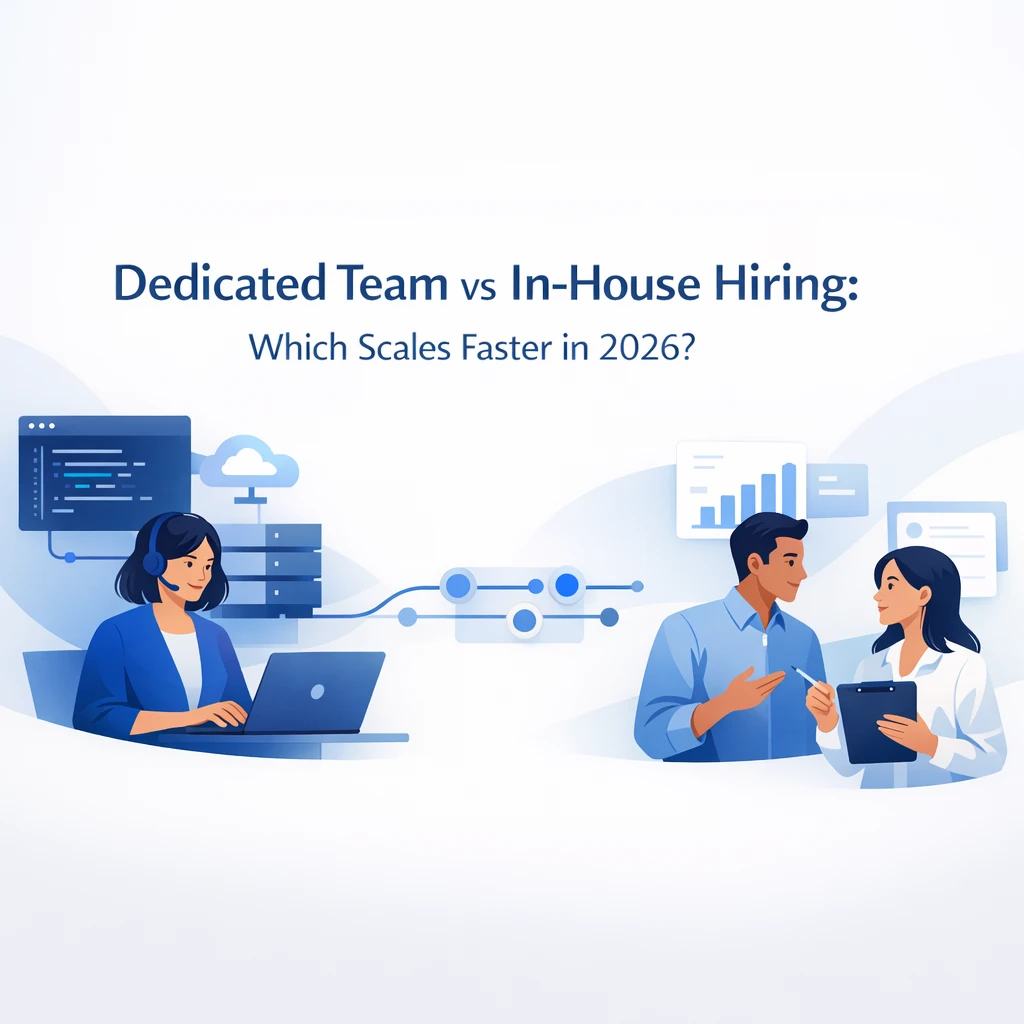
Dedicated Development Team vs In-House Hiring for Product Companies: Which Model Scales Faster in 2026?
Introduction
Product companies—from ambitious startups to established SMBs—are increasingly evaluating how they scale software development in a fast-changing market. The traditional in-house model remains familiar, but a dedicated development team can offer flexible capacity, access to specialized skills, and global delivery advantages. In 2026, many businesses in the UAE, GCC, Europe, North America, and beyond are weighing the trade-offs between building with an in-house team and partnering with a trusted software development partner that can assemble a dedicated team tailored to the project.
This article explores the core differences, practical considerations, and real-world implications for SMBs, SMEs, startup founders, CTOs, and product leaders planning software projects in the USD 5,000 to 200,000 range. Our aim is educational first: to help you choose a model that accelerates delivery, maintains quality, and scales with your product roadmap—and to show how Triostack Technologies can support this journey with a global delivery ethos, rigorous governance, and proven delivery patterns.
Note: this piece is written to inform strategic decisions. It includes actionable guidance, architecture patterns, case study insights, and practical workflows you can adapt to your context. It also highlights how Triostack reliably delivers projects remotely from India while maintaining strong alignment with UAE, GCC, UK, US, Australia, and European clients.
What is the Topic?
The central question is this: should a product company opt for a dedicated development team (a coordinated group of engineers, product specialists, and QA hired via a partner) or continue with in-house hiring (full-time employees embedded in your offices)? The answer isn’t binary. In practice, many organizations use a hybrid approach, blending dedicated teams for specific modules with in-house product ownership. The goal in 2026 is to achieve faster iteration cycles, higher software quality, better risk management, and a clearer path to scale—without sacrificing security or IP control.
The distinction matters not just for technical delivery but for governance, cost predictability, time-to-market, talent availability, and regional considerations (for example, time-zone overlap with remote teams, regulatory compliance, and cultural alignment).
Why it Matters in 2026
In 2026, product teams face three pivotal pressures: speed, complexity, and uncertainty. AI-enabled features, multi-tenant SaaS architectures, and data-driven product strategies demand rapid experimentation with minimal risk. Global delivery removes traditional bottlenecks: you can access specialized skills on demand, scale up or down quickly, and maintain a lean core team focused on strategic decisions.
For many organizations, the dedicated team model is attractive because it:
- Facilitates scalable capacity without long-term payroll commitments
- Brings cross-functional expertise (UI/UX, AI, CRM/ERP integration, QA, DevOps) into one aligned group
- Enables faster onboarding and domain knowledge transfer through structured governance
- Improves risk management with defined IP ownership and security controls
However, in-house hiring still has benefits—culture, close collaboration, and deep product familiarity that can be critical for certain regulated industries or complex enterprise deployments. The right choice depends on your product type, budget, and strategic direction.
Current Industry Challenges
Across regions—Dubai, UAE, Saudi Arabia, Qatar, Oman, Kuwait, Bahrain, the United States, UK, Europe, Australia, Singapore—product teams encounter common obstacles:
- Talent scarcity in high-demand tech stacks, especially AI/ML, cloud-native architectures, and security-focused roles
- Time-to-market pressure for MVPs and feature-rich products with rigorous QA and regulatory compliance
- Rising operating costs and salary inflation, making long-term in-house payroll commitments risky
- Coordination challenges across time zones, languages, and diverse development practices
- Governance, IP protection, and data security requirements in multi-jurisdiction projects
A well-structured dedicated team can address many of these while preserving strategic product ownership and ensuring consistent quality. Nonetheless, organizations must design practices that minimize misalignment and maximize knowledge transfer between client teams and remote specialists.
How the Technology Works
Whether you choose dedicated teams or in-house hiring, successful software delivery hinges on a few core mechanics:
- Clear product vision, a prioritized backlog, and measurable success criteria
- Robust architecture that supports modularity, scalability, and secure data flows
- Efficient collaboration tools and transparent governance models
- Continuous integration, automated testing, and production-grade deployment pipelines
A dedicated team approach emphasizes long-term collaboration with established rituals and a shared API surface for rapid iteration, while in-house models focus on embedding product thinking and domain expertise within core teams.
The decision should reflect your product’s lifecycle stage, regulatory requirements, and the market dynamics you face in 2026.
Architecture Overview
A scalable architecture typically combines a frontend layer, a service layer (APIs), and a data layer. For many product companies, a cloud-native stack with microservices, container orchestration, and secure data management is the baseline for growth. Whether you assemble this in-house or with a dedicated partner, an architecture blueprint should emphasize :
- Decoupled front-end experiences for web and mobile
- API-first design with well-documented contracts
- Observability, tracing, and robust security controls
- CI/CD pipelines, automated QA, and staging environments that mirror production
The following mermaid diagram illustrates a typical architecture you might implement with a dedicated team:
Step-by-Step Workflow
A pragmatic workflow helps teams, whether dedicated or in-house, stay aligned from discovery to production.
- Discovery & scope alignment: define outcomes, risk, and success metrics.
- Architecture and data modeling: decide on tech stack, data contracts, and hosting strategy.
- Backlog prioritization: rank features by business value and technical risk.
- Iterative development: two-week sprints, with weekly demos and stakeholder reviews.
- QA & security validation: automated tests, security scans, and compliance checks.
- Deployment & monitoring: CI/CD, feature flags, and production telemetry.
The dedicated team model is built to standardize these steps through defined rituals, while in-house teams may adapt slightly to internal processes. Either way, continuity in planning and communication drives faster delivery cycles.
Business Use Cases
Different business scenarios benefit from different delivery models. Here are representative use cases:
- SDLC acceleration for a Dubai logistics company: rapid feature enrichment for tracking, routing, and dispatch optimization.
- Healthcare clinic digital transformation in the UAE: patient portal, telehealth scheduling, and secure data exchange.
- Saudi retail business: omnichannel storefront, CRM integration, and loyalty programs.
- Australian startup: MVP for a B2B SaaS product with modular integrations and analytics.
- UK SaaS company: multi-tenant architecture with compliance-ready data handling and governance.
Industry Applications
The demand for scalable software spans industries. Key verticals that commonly leverage dedicated teams include:
- Logistics, supply chain, and field services
- Healthcare and life sciences
- Financial services and fintech
- Retail, e-commerce, and CRM/ERP integrations
- Education technology and research platforms
Triostack collaborates across these sectors by aligning domain knowledge with technical excellence—an approach that reduces the risk of misalignment and accelerates time-to-market.
Benefits of Dedicated Teams vs In-House Hiring
| Aspect | Dedicated Team | In-House Hiring |
|---|---|---|
| Cost predictability | Higher predictability with fixed team composition | Variable depending on headcount, benefits, and ramp time |
| Access to specialized skills | Broad access via partner network; known transitions between **modules** | Dependent on local recruiting market and wait times |
| Speed to value | Often faster onboarding for new capabilities; modulars can be deployed quickly | Longer ramp-up and onboarding; culture integration takes time |
| IP ownership & governance | Clear contracts on IP, security, and data handling | Requires careful vendor governance and policy alignment |
| Scalability | Flexible scaling up/down by module or feature set | Requires hiring cycles and budget adjustments |
Common Mistakes
- Underestimating the importance of domain knowledge transfer between client and partner teams
- Treating a dedicated team as purely a vendor rather than a partner with shared objectives
- Skipping security, compliance, or data residency considerations in early design phases
- Neglecting documentation and decision records, leading to knowledge erosion during team scaling
Best Practices
- Define a shared product roadmap with a single product owner and clear acceptance criteria
- Use a services-oriented contract with SLAs for quality, uptime, and delivery velocity
- Establish a robust security and IP policy, including NDAs and data handling guidelines
- Adopt a modular architecture and API contracts to enable independent team delivery
- Implement agile rituals: sprint planning, daily standups, weekly demos, and retrospective reviews
Build vs Buy: A Practical Comparison
For many product teams, the choice is not strictly one or the other. A hybrid approach—building core capabilities in-house while outsourcing non-core modules to a dedicated team—often yields the best balance of control and speed.
| Dimension | Dedicated Team | In-House Hiring |
|---|---|---|
| Time-to-value | Faster for modular features due to pre-existing delivery patterns | Longer lift due to recruitment and onboarding |
| Flexibility | High; scale by feature, contract period, or budget | Moderate; limited by payroll and org structure |
| Control & governance | Strong governance via contractual SLA; clear IP terms | Deep control over culture and product decisions |
| Quality & consistency | Consistent quality through repeatable delivery patterns | Quality varies with hire quality and training investment |
Estimated Development Cost
The cost of software development varies by type, scope, and region. The ranges below reflect typical SMB-to-SME projects and provide a framework for budgeting. All figures are in USD and indicative; actual pricing depends on scope, vendor rates, and contract structure.
| Project Type | Typical Range (USD) |
|---|---|
| Business Website | 5,000 – 15,000 |
| Customer Portal | 10,000 – 40,000 |
| CRM | 15,000 – 100,000 |
| ERP | 40,000 – 200,000 |
| AI Chatbot | 5,000 – 25,000 |
| AI Automation | 15,000 – 80,000 |
| SaaS MVP | 20,000 – 80,000 |
| Enterprise Web App | 30,000 – 200,000 |
Pricing factors include scope, UX requirements, integration needs (CRM/ERP), data migration, security/compliance, hosting and maintenance, AI capabilities, and the number of platforms involved. For a precise quote, Triostack can help you map features to a transparent plan with milestones.
Recommended Technology Stack
The following stack is representative of what many product teams adopt to support durable, scalable software:
- Frontend: React, TypeScript, responsive design systems
- Backend: Node.js, Python (FastAPI), or Java microservices
- Datastore: PostgreSQL, Redis, and a data warehouse for analytics
- API & Integration: REST/GraphQL, API gateways, and event-driven architectures
- AI/ML: Python libraries, ML inference services, and data pipelines
- Cloud & DevOps: AWS/Azure/GCP, Kubernetes, CI/CD pipelines, IaC
- Security & Compliance: OAuth 2.0, JWT, encryption at rest/in transit, SOC2-type controls
Triostack helps map these technologies to your product goals, selecting the right mix to balance performance, cost, and risk.
Future Trends
As organizations scale in 2026 and beyond, several trends shape how dedicated teams and in-house teams collaborate:
- Deeper integration of AI capabilities into core product features
- Expanded use of platform engineering to maintain reliable developer experiences across teams
- Platform-agnostic deployment patterns enabling multi-cloud resilience
- Hybrid models that combine in-house product ownership with external engineering muscle
- Stronger emphasis on security-by-design, privacy, and data governance
How Triostack Delivers Projects Globally
Triostack Technologies brings a global delivery model that emphasizes responsible offshore collaboration, transparent governance, and predictable outcomes. We help clients across the UAE, GCC, Europe, North America, and Oceania with:
- Custom Software, Web Development, and Mobile Apps
- AI Development, Machine Learning, and Data Ops
- CRM, ERP, and SaaS development with multi-tenant readiness
- Cloud Migration, DevOps, and ongoing maintenance
- UI/UX design, API development, and QA
- Dedicated Teams and Technical Consulting
Remote delivery is structured around agile sprints, weekly demos, and tight feedback loops using a suite of collaboration tools. The result is a predictable cadence that aligns with your time zones and business hours.
REMOTE DELIVERY: How Triostack Delivers Projects from India
Triostack operates with a robust remote delivery model designed to maximize efficiency, security, and communication across time zones. Key components include:
- Agile Framework: Scrum-based with optional Kanban for maintenance work. Sprint planning, daily standups, and sprint reviews keep progress visible.
- Weekly Demos: Stakeholders review shippable increments and adjust priorities for the next sprint.
- Communication Channels: Slack for daily updates; Teams/Zoom/Google Meet for meetings; email for formal notes.
- Project Management & Collaboration: Jira or ClickUp for backlogs; GitHub/GitLab for source control; Azure DevOps for CI/CD.
- Environment & Deployment: Cloud staging environments mirroring production; automated QA and security checks.
- Documentation & IP: Comprehensive docs, versioned architectures, and clear NDA/IP ownership terms.
- Security & Compliance: Data handling policies, encryption, and access control aligned with regional norms.
- Time-zone Overlap & Communication Quality: Teams rotate to maximize overlap with client business hours.
- Dedicated Project Managers: Single points of contact to coordinate priorities, risks, and milestones.
- Long-term Support: Post-launch maintenance and knowledge transfer to client teams.
UAE businesses outsource development to India for several reasons: cost efficiency, a deep and diversified talent pool, faster hiring, flexible scaling, high-quality engineering, and strong communication. This model supports rapid growth without compromising governance or IP protection.
Case Studies (Realistic Scenarios, Not Public Data)
Dubai Logistics Company – Dedicated Team Engagement
Challenge: A logistics provider needed to modernize dispatch, tracking, and analytics without disrupting their ongoing operations. Approach: Triostack assembled a dedicated cross-functional team working alongside the client’s product owner, focusing on modular enhancements and API integration with existing ERP systems. The team used sprints and weekly demos to maintain alignment with logistics schedules.
Outcome: Improved delivery visibility and automation capabilities were achieved through incremental releases and secure data sharing.
UAE Healthcare Clinic – Digital Transformation
Challenge: A regional clinic sought a patient portal, secure messaging, and scheduling enhancements while complying with local data privacy regulations. Approach: A dedicated team delivered the portal in iterative releases, with emphasis on UX accessibility and secure data exchange with hospital systems.
Outcome: The clinic gained a modern patient experience, enabling safer appointment management and better information flow.
Saudi Retail Business – CRM & Omnichannel
Challenge: The business needed to unify customer data across channels and enable targeted campaigns while maintaining a lean internal team. Approach: Triostack provided a dedicated team focused on CRM integration, data quality, and analytics dashboards.
Outcome: A cohesive view of customer interactions emerged, supporting more effective marketing and service delivery.
Australian Startup – MVP for B2B SaaS
Challenge: An early-stage company required a minimum viable product with scalable architecture and multi-tenant readiness. Approach: A cross-border dedicated team built modular features, integrated identity management, and laid groundwork for future AI features.
Outcome: The MVP facilitated early adopters and investor demonstrations, with a clear path to feature expansion.
Future Trends & Considerations
As you plan for 2026 and beyond, consider how dedicated teams can be combined with in-house capabilities to form a resilient delivery model. Trends to watch include:
- Platform engineering as a service model, enabling internal teams to focus on product strategy while platforms handle consistency
- Stricter data sovereignty and localization requirements shaping architecture and data flows
- AI-powered product telemetry for proactive maintenance and user-centric feature evolution
- More sophisticated vendor governance with outcome-based contracting and risk-sharing mechanisms
Why Businesses Choose Triostack
Triostack is a global software development partner with deep experience delivering dedicated teams and full-stack services. We focus on outcomes, security, and long-term collaboration rather than short-term engagements. Our capabilities include:
- Custom Software, Web Development, and Mobile Apps
- AI Development and Machine Learning
- CRM, ERP, and SaaS solutions
- Cloud Migration and DevOps
- UI/UX design, API Development, and QA
- Dedicated Teams, Technical Consulting, and Maintenance
By combining global delivery with strict governance and domain-focused teams, Triostack helps product companies scale faster while preserving IP ownership and quality.
Conclusion
The decision between a dedicated development team and in-house hiring is nuanced and context-dependent. In 2026, many product companies find that a hybrid approach—leveraging dedicated teams for scalable, modular capabilities while maintaining in-house product ownership for strategic direction—delivers speed, quality, and flexibility.
Triostack’s experience in remote delivery, agile governance, and platform-agnostic architectures positions us to support organizations across the UAE, GCC, North America, Europe, and beyond. Whether you want to accelerate a CRM rollout, modernize an ERP, or build a new SaaS MVP, a well-defined partnership can unlock faster growth with lower risk.
If you're planning a similar software project, Triostack can help you design, build, deploy and maintain a scalable solution. Learn how a dedicated team model can align with your business goals and regulatory needs—without compromising IP or control.
Frequently Asked Questions
- What is a dedicated development team?
- A dedicated development team is a group of engineers, designers, and QA professionals assembled by a partner to work exclusively on your project for a defined period, with clear governance and IP ownership terms.
- When should I choose in-house hiring over a dedicated team?
- In-house hiring may be preferable when you require deep domain knowledge, highly integrated culture with core product ownership, or strict regulatory alignment that benefits from long-term internal control.
- Can I blend both models?
- Yes. A hybrid model often works best: keep strategic development in-house while outsourcing non-core modules to a dedicated team for speed and scalability.
- What levels of governance and security does Triostack provide?
- Triostack enforces IP ownership terms, NDA protections, secure data handling, and compliance controls within all engagements.
Next Steps
If your team is evaluating how to scale software in 2026, consider a conversation with Triostack about a discovery session to map your backlog to a pragmatic delivery plan. This is not a sales pitch; it’s a strategic exercise to illuminate options, risks, and milestones.
Businesses planning similar solutions often benefit from experienced software development partners like Triostack Technologies. Contact us to discuss your goals, timeline, and constraints.
Triostack Team
Technology Evangelist & Writer
Triostack Team is an experienced writer and technologist, exploring the intersections of AI, cloud architecture, and modern application development. Passionate about turning complex technical concepts into accessible insights.