Dedicated Development Team Pricing for Startups and Enterprises: UAE, India, and Eastern Europe Cost Comparison
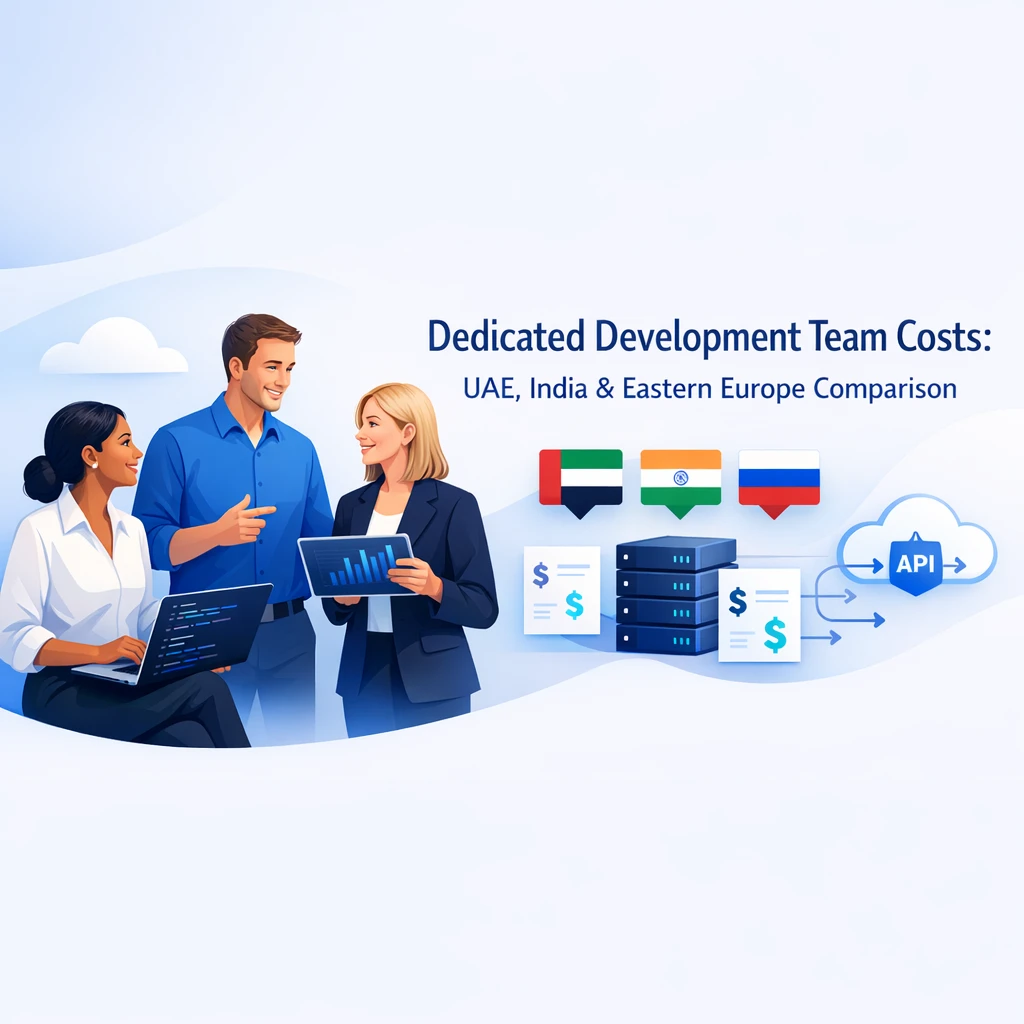
Understanding pricing dynamics across regions helps startups and established businesses plan scalable software initiatives without surprises. This guide breaks down costs, workflows, and practical considerations when partnering with dedicated development teams in the UAE, India, and Eastern Europe — with real-world use cases and implementation guidance from Triostack Technologies, a global software development partner focused on delivering high-quality, scalable solutions.
For context, Triostack helps organizations across the Middle East, Europe, North America, and beyond with custom software, web and mobile development, AI/ML solutions, DevOps and cloud migration, and dedicated development teams that scale with your business needs.
Introduction
Many SMBs, SMEs, startups, and even larger enterprises rely on dedicated development teams to accelerate product delivery while controlling risk and cost. The model pairs client leadership with a fully managed team that operates like an extension of your in-house staff, but with the advantage of global talent pools, varied time zones, and flexible scaling. Pricing is a key lever in this decision, shaped by geographic location, talent mix, engagement duration, and the level of managed services you require.
In this article, we compare dedicated team pricing across three major regions frequently considered for offshore and nearshore software delivery: the United Arab Emirates (UAE), India, and Eastern Europe. We’ll discuss how pricing translates into real outcomes, what factors influence cost, and how a mature partner like Triostack helps organizations plan, deploy, and maintain software projects—from a USD 5,000 startup MVP to multi-year enterprise digital transformations.
Whether you’re in Dubai, Riyadh, Doha, Muscat, Kuwait City, or further afield such as the United States, Canada, the UK, Europe, Australia, or Singapore, the same principles apply: define the right team structure, establish clear governance, and align cost with value delivered over time. The goal is not just to minimize price, but to maximize velocity, quality, and long-term total cost of ownership (TCO).
Throughout this piece, Triostack’s experience as a global software development partner is woven into practical guidance, case studies, and actionable steps you can apply to your next software project.
What is the Topic?
A dedicated development team is a staffed, fully managed unit that acts as an extension of your in-house capabilities. You typically own product backlog and roadmap, while the vendor handles recruitment, onboarding, office infrastructure (where applicable), project management, quality assurance, and ongoing maintenance. The core benefits include predictable cost, faster ramp-up, scalability, and a governance model designed to minimize risk during growth or pivot moments.
Pricing for a dedicated team is usually structured as a monthly retainer per developer, plus any specialized roles (such as a Scrum Master, UX Designer, or QA Engineer) and any ongoing managed services (CI/CD, security, cloud hosting, etc.). Unlike fixed-scope project pricing, dedicated teams align with an evolving product backlog and continuous improvement, which is particularly valuable for startups iterating toward product-market fit and enterprises pursuing digital transformation at scale.
In practical terms, you can expect a typical dedicated team to include roles such as a Technical Lead, Product Manager, Front-end/Back-end Developers, QA Engineer, and often a UI/UX Designer. Some teams also include a DevOps Engineer and a Data/ML Specialist depending on the product domain. The exact composition is tailored to your project’s stage, domain complexity, and the technology stack you choose.
Triostack emphasizes architecture-first thinking, robust discovery, and a pragmatic approach to costs. Rather than chasing the cheapest option, you gain value by pairing the right talent with mature processes, transparent governance, and predictable delivery milestones.
Why it Matters in 2026
- Global talent access: Mature markets struggle with talent shortages in core tech roles. Regions like India, Eastern Europe, and the UAE offer deep pools of specialists with demonstrated project experience.
- Spreads in cost-to-value: Eastern Europe generally offers high engineering quality with strong communication and collaboration practices at a favorable total cost of ownership compared to some Western markets.
- Time-to-market pressure: Startups demand fast MVPs, while enterprises pursue ongoing modernization. A properly structured dedicated team can meet aggressive timelines while maintaining quality.
- Remote work maturity: Hybrid and remote delivery models have become standard. Clear governance, tooling, and security controls reduce risk and improve predictability.
In practice, organizations in the UAE, GCC, North America, Europe, and beyond partner with teams in India and Eastern Europe to balance cost with quality, while leveraging time-zone overlaps and robust communication practices. Triostack supports this balance with a structured remote delivery model that emphasizes agile cadence, transparent reporting, and rigorous security and IP controls.
Current Industry Challenges
- Talent availability and cost volatility: Rates shift with demand cycles, visa policies, and local markets. Companies must plan around attrition and ramp-up time.
- Time zone and communication: Misalignment between client teams and offshore delivery centers can slow decision-making. Regular demos and clear rituals help.
- Security and IP: Enterprises require strict data protection, NDA agreements, and robust encryption, even when teams are remote.
- Governance and quality: Without mature delivery processes, projects drift, budgets overrun, and QA gaps emerge.
Triostack addresses these challenges with a proven governance model, rigorous security controls, and transparent cost management. Our approach emphasizes alignment of business outcomes with technical milestones, quarterly business reviews, and proactive risk management.
How the Technology Works
A dedicated team typically works in close alignment with your product backlog and architectural standards. The core components of the delivery model include:
- Structured team composition: PM, tech lead, developers, QA, and optional UX, DevOps, data science, or security specialists.
- Defined governance: Agile rituals, sprint planning, daily stand-ups, sprint reviews, and retrospectives.
- Tooling ecosystem: Jira/ClickUp for work management, Slack or Teams for collaboration, GitHub/GitLab for source control, CI/CD pipelines, and cloud environments for deployment.
- Security and compliance: NDA, data handling policies, role-based access control, and secure coding practices.
From a technology perspective, the team can work across modern stacks (web, mobile, cloud-native) and can integrate AI/ML components, CRM/ERP modules, and API layers to connect with your existing systems. A typical output includes a scalable microservices architecture, well-documented APIs, and an automated deployment pipeline that enables rapid, safe releases.
Architecture Overview
Below is a high-level reference architecture for a typical modern software product developed by a dedicated team. It demonstrates how frontend, backend, data stores, and services interact in a scalable, secure manner. The architecture is technology-agnostic in concept, allowing teams to tailor the stack to your needs.
In practice, Triostack tailors this architecture to your domain, whether you require monolithic modernization, microservices, or a hybrid approach. The diagram above illustrates the critical separation of concerns and the guardrails that keep delivery predictable as teams scale.
Step-by-Step Workflow
- Discovery and scoping: Align on business goals, user journeys, and success metrics. Produce a high-level system sketch and an initial backlog.
- Team onboarding and planning: Establish the dedicated team, define roles, set up collaboration tooling, and run a kickoff planning session.
- Sprint cadences: Typically 2-week sprints with defined increments, demos, and retrospective action items.
- Development and QA: Continuous integration, automated testing, code reviews, and performance checks.
- Staging and deployment: Cloud staging environment for end-to-end testing, with controlled production releases and rollback plans.
- Monitoring and maintenance: Post-release monitoring, incident response, and incremental improvements.
Triostack supports this workflow with transparent weekly demos, automated reporting, and clear handoffs between client stakeholders and the dedicated team. Tools like Jira, ClickUp, GitHub, GitLab, Azure DevOps, and Slack are commonly used to keep everyone aligned.
Business Use Cases
Dedicated teams are particularly well-suited for cases where business priority shifts quickly, where long-term product evolution is needed, or when you require a strong partner to drive modernization. Here are representative scenarios:
- Startup MVP to scale: A lean team builds an MVP for a customer portal and iterates toward product-market fit with rapid onboarding of new users.
- CRM migration and integration: Moving from a legacy CRM to a modern platform with seamless data migration and integration to ERP and marketing tools.
- SaaS MVP to multi-tenant product: Rapid development of a cloud-native SaaS MVP with a plan for multi-tenant architecture and onboarding flows.
- Digital transformation in regulated industries: Building compliant workflows for healthcare, finance, or logistics with stringent security requirements.
Triostack has partnered with organizations across multiple sectors to deliver durable, scalable software that respects regulatory constraints while maintaining velocity. You can explore related stories in our case studies section for broader context.
Industry Applications
While dedicated teams are versatile, certain domains tend to benefit most from this model:
- Logistics and supply chain platforms
- Healthcare and patient engagement portals
- Retail and ecommerce ecosystems
- Financial services and fintech tooling
- ERP and CRM modernization initiatives
- AI-enabled analytics and decision-support systems
In each case, Triostack emphasizes a balance between domain knowledge and engineering excellence, with a focus on secure data handling, scalable architectures, and reliable delivery pipelines.
Benefits
- Predictable cost and flexible scaling: You pay a fixed monthly rate per team member, with room to adjust headcount as requirements evolve.
- Faster time-to-market: Established Agile rituals and cross-functional teams reduce cycle times and accelerate feedback loops.
- Access to global talent pools: Regions like India and Eastern Europe provide depth in engineering and product disciplines.
- Quality assurance baked in: QA, automation, and security are integrated into every sprint, not bolted on at the end.
- Risk management: Mature governance structures, NDA/IP controls, and transparent reporting reduce project risk.
Triostack’s approach emphasizes measurable business outcomes, not just technology delivery. The result is a scalable, maintainable product you can own and evolve over time.
Challenges
- Misalignment on backlog ownership: Clarify who owns the product backlog and decision rights to avoid drift.
- Quality vs speed tension: Balance fast iteration with solid automated testing and performance targets.
- Cultural and language nuances: Establish a common communication framework and escalation paths.
- Security and regulatory compliance: Maintain data protection, access controls, and audit trails from day one.
With clear governance and experienced leadership, these challenges can be mitigated. Triostack provides structured onboarding, a dedicated project manager, and ongoing governance checks to keep delivery aligned with business goals.
Common Mistakes
- Underestimating the discovery phase: Skipping or rushing discovery leads to scope drift and rework later.
- Overcustomization too early: Building complex architectures before validating core assumptions slows progress.
- Inadequate security planning: The fastest path to MVP can become a long-term risk without proper security controls.
- Poor vendor alignment: Without a shared governance model, teams can diverge on standards and processes.
Best Practices
- Invest in discovery: Allocate time for user research, architecture spikes, and risk assessment before development begins.
- Define a clear RACI: Who is Responsible, Accountable, Consulted, and Informed for major decisions?
- Standardize tooling and processes: Use a common stack for CI/CD, code reviews, and deployment to reduce friction.
- Establish security and IP controls early: NDA, data handling policies, and access controls baked into the contract.
Build vs Buy Comparison
When deciding between building a custom solution with a dedicated team and buying an off-the-shelf platform, consider the following factors:
| Aspect | Build with Dedicated Team | Buy (Off-the-Shelf) |
|---|---|---|
| Customization | High; tailor UX, workflows, integrations | Limited to vendor roadmap |
| Time-to-Value | Longer initial setup but optimized for your use case | Faster initial deployment |
| Cost Predictability | Monthly rate with scalable headcount; variable by backlog | Upfront license, ongoing renewal fees |
| Ownership & Control | High ownership of code and IP | Vendor-owned solution, limited customization |
For many growing companies, a blended approach works well: start with an MVP using a dedicated team to validate value, then transition to a platform-centric solution as requirements stabilize. Triostack supports both paths with flexible engagement models and a structured governance framework.
Estimated Development Cost
Pricing for dedicated teams varies by region and skill mix, but the following ranges illustrate what SMBs and enterprises might expect when budgeting for a typical 6-person dedicated team. All figures are indicative and depend on seniority, domain expertise, and the complexity of the project.
| Region | Typical Monthly Rate per Developer (USD) | Notes |
|---|---|---|
| India | $1,800 – $3,000 | Broad talent pool; cost-effective; strong in web/mobile and AI/ML |
| Eastern Europe | $4,000 – $6,500 | High quality coding, strong English, robust time-zone overlaps with Europe/UK |
| United Arab Emirates (UAE) | $6,000 – $10,000 | Premium options with established regional delivery centers and regulatory familiarity |
Note: These ranges correspond to typical seniority mixes (Junior to Senior levels). A full team might include PM, Tech Lead, Front-end/Back-end Engineers, QA, and optional UI/UX designer or DevOps. In practice, the composition is tailored to your product and stage. For example, an early MVP might run with 1 PM, 2 developers, and 1 QA, while a more mature product could scale to 1 PM, 3-4 developers, 1-2 QA, and 1 DevOps engineer.
Additionally, consider regional nuances beyond base rates, such as hiring speed, onboarding efficiency, and the availability of niche expertise (e.g., data engineering, security architecture, or AI research).
Recommended Technology Stack
Triostack tailors technology choices to your product, but here is a practical reference that often aligns with ROI-focused projects:
- Frontend: React or Vue with TypeScript, or Angular for enterprise-grade applications
- Backend: Node.js, Spring Boot (Java), .NET, or Python (FastAPI) depending on domain and team expertise
- APIs: RESTful services or GraphQL for flexible data access
- Data & ML: PostgreSQL/MySQL, Redis, and optional Python-based ML microservices
- Cloud & DevOps: AWS, Azure, or Google Cloud; CI/CD pipelines; containerization with Docker and Kubernetes
- Security & Compliance: OAuth2/OpenID Connect, encryption at rest/in transit, and regular security reviews
Triostack helps you chart a stack that balances performance, maintainability, and cost, then implements it with a disciplined governance model and clear migration paths from legacy systems where needed.
Future Trends
The landscape of dedicated development teams continues to evolve. Notable trends shaping 2026 and beyond include:
- AI-assisted development: AI copilots and automated testing help accelerate coding and quality assurance, while still requiring human oversight for architecture and domain-specific decisions.
- Platform-centric partnerships: Enterprises increasingly favor long-term partnerships with vendors who can operate as strategic technology partners rather than one-off suppliers.
- Security-by-design: Vendors embed security considerations into every stage of the lifecycle, from architecture to deployment and monitoring.
- Hybrid/multi-region delivery: Clients increasingly combine regional centers with remote teams to optimize cost, risk, and latency.
Triostack positions itself as a partner capable of blending regional strengths—India for scalable engineering depth, Eastern Europe for high-quality delivery and English proficiency, and the UAE for regional familiarity and regulatory alignment—into a coherent, future-ready delivery model.
How Triostack Delivers Projects Globally (Remote Delivery from India)
Triostack offers a mature remote delivery model designed to preserve the advantages of close collaboration while unlocking cost and talent benefits from India. Core elements include:
- Agile mindset and sprint planning: Regular planning, demos, and backlog refinement ensure alignment with business goals
- Weekly demos and transparent reporting: Stakeholders review progress and adjust priorities without delay
- Communication tooling: Slack, Teams, Zoom or Google Meet for daily interactions
- Project management and collaboration: Jira, ClickUp, and GitHub/GitLab for code and issue tracking
- CI/CD and cloud staging: Automated builds, tests, and deployments to secure, repeatable environments
- Quality assurance and security: Rigorous QA, security reviews, and documented code ownership
- Documentation and knowledge transfer: Structured handoffs, API docs, and architectural decision records
- NDA and IP ownership: Clear contractual protections and ownership rights
- Timezone overlap and language proficiency: Planning that respects overlap with client teams for timely decision-making
- Dedicated Project Managers: A PM oversees delivery cadence, risk management, and stakeholder communications
- Long-term support: Post-launch maintenance and optimization as part of the relationship
Why UAE businesses often outsource development to India is a common and pragmatic question. The reasons go beyond price:
- Cost efficiency: Substantial cost advantage without compromising essential engineering capabilities
- Large talent pool: A broad range of specialties, from core software engineering to data science
- Faster hiring: Readily available profiles with scalable onboarding timelines
- Flexible team scaling: Quick adjustments to headcount as your product priorities shift
- High-quality engineering: Strong fundamentals in software design, testing, and modern tooling
- Strong communication: English proficiency and structured collaboration practices
Triostack’s remote delivery routine is designed to minimize risk while maximizing transparency. You’ll have a dedicated PM who acts as a bridge between your business and the development team, ensuring alignment with your strategic goals.
Case Studies (Illustrative)
Below are anonymized, representative scenarios that illustrate how dedicated teams can be applied across regions and industries. Names and statistics are fictional for privacy and accuracy purposes.
Case Study 1 — Dubai logistics company (fictional)
Challenge: A logistics company in Dubai needed a real-time tracking portal, driver app, and back-office tools to optimize last-mile operations. The solution required secure data handling, real-time updates, and easy integration with existing ERP software.
Approach: A 6-person dedicated team (PM, tech lead, frontend and backend developers, QA, and DevOps) was assembled with a 6-month engagement. The team delivered a microservices-based tracking platform, an accompanying mobile driver app, and an admin portal. An API layer enabled integration with the company’s ERP system and external courier networks.
Impact: 25% faster delivery times, reduced manual data entry, and improved customer visibility across the supply chain. The team implemented ongoing improvements through quarterly roadmaps and continuous delivery.
Case Study 2 — UAE healthcare clinic (fictional)
Challenge: A regional healthcare clinic needed a patient portal, scheduling module, and secure patient data exchange with partners, while maintaining compliance with local regulations.
Approach: A 5-person dedicated team delivered a HIPAA-like secure portal, appointment management, and a consent/consent-tracking module. The project included robust identity management, audit logs, and encryption at rest/in transit.
Impact: Improved patient engagement, reduced no-show rates, and streamlined data sharing with affiliated providers. The engagement included post-launch monitoring and iterative enhancements.
Case Study 3 — Saudi retail digital transformation (fictional)
Challenge: A regional retailer aimed to modernize its ecommerce, loyalty program, and in-store analytics to compete with global platforms.
Approach: A multi-disciplinary team worked on a unified platform with modular micro frontends, a scalable backend, and an analytics layer. The project included data migration, an omnichannel storefront, and a loyalty API.
Impact: Accelerated time-to-market for new features, improved customer insights, and a scalable architecture that supported growth across GCC.
Case Study 4 — Australian startup (fictional)
Challenge: An early-stage AI-powered marketplace needed an MVP with core search, matching, and payment capabilities, all hosted on a scalable cloud platform.
Approach: A 4-person dedicated team delivered an MVP with a reusable component library, API-first design, and automated testing. The team followed a lean experimentation approach with a fast feedback loop.
Impact: The MVP validated market demand, enabling the startup to attract investors and scale to a broader geography.
Case Study 5 — UK SaaS company (fictional)
Challenge: A UK-based SaaS vendor needed to modernize its core product with a multi-tenant architecture, a modern UX, and a robust security model to meet enterprise clients’ requirements.
Approach: A dedicated team worked on product modernization, including service decoupling, a new UI, and secure authorization. The project included migration plans and a transition strategy to minimize client disruption.
Impact: Strengthened enterprise traction, smoother onboarding for new tenants, and long-term support for future enhancements.
Future Trends (Continued)
As organizations continue to pursue digital modernization, dedicated teams will play a central role in bridging strategy and execution. The most successful engagements emphasize a clear path from MVP to scalable, secure product delivery, with governance that evolves alongside the product and the market.
How Triostack Delivers Projects Globally
Triostack focuses on delivering high-quality software with predictable outcomes. Our practice areas cover
- Custom Software
- Web Development
- Mobile Apps
- AI Development and Machine Learning
- CRM and ERP Integrations
- SaaS and Cloud Migration
- DevOps and QA
- UI/UX
- API Development
- Dedicated Teams
- Maintenance and Technical Consulting
For organizations planning similar solutions, Triostack can help you design, build, deploy, and maintain a scalable solution. Our approach emphasizes collaboration, governance, and long-term support, ensuring that your software stays resilient as your business evolves.
To learn more about how a dedicated team can align with your product vision, explore our services at Triostack Services or contact our teams for a confidential discovery session.
Pricing Factors to Consider
Pricing for dedicated teams is influenced by several factors beyond regional rates. You should consider:
- Team composition: Seniority levels, niche skills, and leadership roles influence monthly costs.
- Engagement duration: Longer engagements may unlock favorable terms but require more robust governance.
- Managed services: Security, cloud hosting, and ongoing maintenance can add to monthly costs but reduce risk.
- Domain complexity: Highly regulated sectors or AI-heavy applications may require specialized expertise.
- Time zone strategy: Overlaps with client teams affect collaboration efficiency and perceived cost.
Strategic partnerships with a clear plan for onboarding, knowledge transfer, and risk management help optimize cost over the project lifecycle. Triostack emphasizes value-based governance, with transparent reporting and a clear path to scale.
For a personalized estimate, you can request a discovery workshop with our team to map your backlog, architecture, and delivery milestones. See our discovery workshop page for details.
Frequently Asked Questions
- What is a dedicated development team?
- A dedicated development team is a cross-functional group contracted to work exclusively on your project. They operate as an extension of your team, with a defined governance model, clear roles, and responsibility for delivering features within an agreed cadence.
- How do I choose between UAE, India, and Eastern Europe?
- Consider factors such as cost, language and communication quality, time-zone overlaps, domain expertise, and regulatory alignment. Eastern Europe often offers a balance of cost and quality, India provides strong scale and cost efficiency, and UAE can offer regional familiarity and proximity with compliance advantages.
- What is the typical team size?
- Common configurations range from a small 4–6 person team for MVPs to larger 8–12 person teams for complex platform initiatives, plus optional DevOps and data specialists as needed.
- What about security and IP?
- Security and IP protection are core to the engagement. NDAs, data handling policies, encryption standards, access controls, and ownership rights are defined in the contract and supported by the working practices of the team.
- How long does a typical engagement last?
- MVPs may begin in weeks, with ongoing scale or modernization engagements lasting months to years depending on scope and governance. Triostack focuses on long-term value creation and predictable delivery.
Conclusion
Pricing for dedicated development teams is a critical input when planning software initiatives for startups and enterprises alike. UAE, India, and Eastern Europe each offer distinct advantages in terms of cost, talent, and delivery maturity. A thoughtful approach that combines the right team composition, governance, and tooling can transform a promising idea into a resilient digital product. Triostack’s global delivery model demonstrates how to balance cost efficiency with quality, security, and long-term maintainability.
As you plan your next software project, consider starting with a structured discovery session to quantify risks, define milestones, and validate assumptions. If you’re evaluating dedicated-team options, Triostack can help you design, build, deploy, and maintain a scalable solution that aligns with your business objectives.
Triostack Team
Technology Evangelist & Writer
Triostack Team is an experienced writer and technologist, exploring the intersections of AI, cloud architecture, and modern application development. Passionate about turning complex technical concepts into accessible insights.