Custom Software Development Cost in Saudi Arabia: 2026 Pricing, Timelines, and ROI for Enterprises
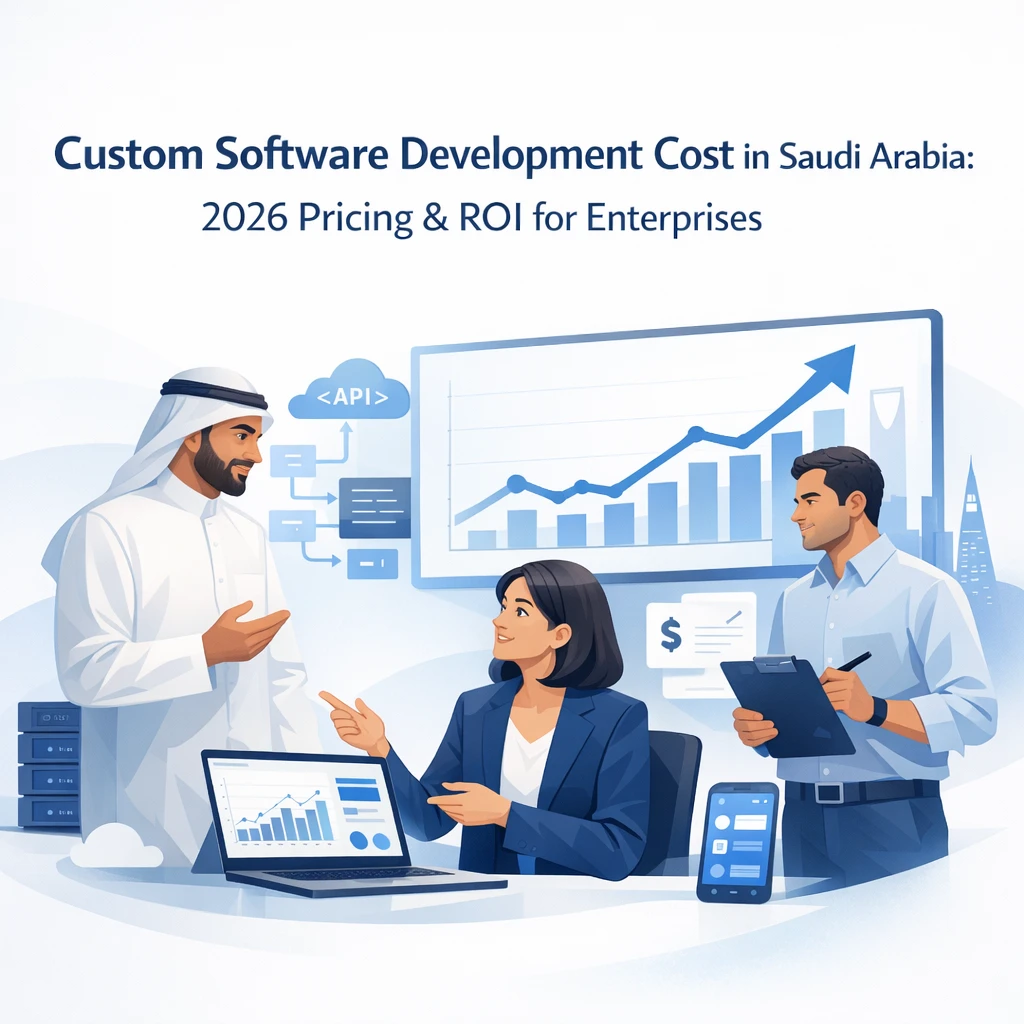
As enterprises in the Gulf region and beyond pursue rapid digital transformation, understanding the true cost, timeline, and ROI of custom software projects becomes essential. This guide provides practical insights, benchmarks, and implementation guidance to help SMBs, startups, and large organizations plan and execute software initiatives with confidence. It also showcases how Triostack Technologies can partner with regional and global teams to deliver high-quality software from remote delivery hubs without compromising speed or security.
Introduction
Custom software development costs vary widely by scope, complexity, location, talent mix, and governance. In 2026,Saudi Arabia and the broader Gulf market continue to blend onshore and offshore delivery models to optimize cost and speed, while meeting strict data security and localization requirements. For SMBs, SMEs, startup founders, CEOs, CTOs, and product leaders planning software projects in the USD 5,000 to 200,000 range, it’s crucial to align business outcomes with a realistic roadmap, architecture that scales, and a vendor that can operate effectively across time zones and cultures.
This article unfolds in a practical, practitioner-friendly way. We walk through typical pricing bands, timelines, ROI expectations, and the tradeoffs between building vs buying. Throughout, you’ll see how Triostack Technologies approaches projects with a global delivery mindset, rigorous governance, and disciplined software engineering practices—while keeping the emphasis on business value and real-world results.
What is the Topic?
The topic is custom software development cost—the total price tag associated with designing, building, testing, deploying, and maintaining a software product that is tailored to a specific business need. In Saudi Arabia and the surrounding region, costs are influenced by:
- Project scope and complexity (e.g., a small business website vs. an enterprise ERP).
- Architecture choices (monolith vs. microservices, cloud vs. on-premises).
- Technology stack, integrations, and data migration requirements.
- Security, compliance, and localization needs (Arabic UX, local data privacy laws).
- Resource mix and delivery model (onshore, nearshore, offshore).
- Project governance, QA rigor, and change-management needs.
In practice, many enterprises in the region balance remote delivery with local product ownership. This approach allows access to global engineering talent, accelerates hiring, and maintains competitive cost structures—without sacrificing quality or regulatory compliance.
Why it Matters in 2026
2026 marks a convergence of AI-enabled automation, cloud-native architectures, and heightened data governance expectations. For Gulf-based and global organizations, the implications are twofold:
- ROI and total cost of ownership (TCO): Early scoping and phased delivery reduce waste, while cloud-based hosting lowers capex and increases operational predictability.
- Time to value: Shorter delivery cycles enable faster feedback loops, enabling executives to pivot based on measurable business outcomes (revenue growth, cost savings, customer experience).
Moreover, regional demands for localization, data sovereignty, and sovereign cloud options mean that cost models must capture not only development hours but also regulatory alignment and ongoing security investments.
Current Industry Challenges
- Talent scarcity and cost volatility: The Gulf region faces competition for skilled software engineers, QA experts, UX designers, and data scientists, which can push daily rates upward.
- Regulatory and data localization requirements: Local data residency, privacy, and healthcare or financial services compliance add validation and architecture overhead.
- Integration complexity: Connecting new systems with legacy ERP, CRM, or bespoke platforms remains a top source of risk and cost.
- Security and resilience: Modern apps demand robust identity, access controls, encryption, and secure software development lifecycle (SDLC) practices.
- Localization and UX: Arabic localization, right-to-left UI, and culturally relevant UX require thoughtful design and testing.
For many enterprises, a pragmatic approach is to combine a strong product owner team with a capable offshoring partner, apply agile governance, and invest early in security and compliance documentation. Triostack helps clients navigate these complexities with a framework that aligns technical delivery to business outcomes.
How the Technology Works
At a high level, modern custom software development follows a lifecycle that emphasizes iterative delivery, modular architecture, and continuous validation. The core stages are:
- Discovery and requirements: Define goals, identify stakeholders, map processes, and draft a high-level product roadmap.
- Architecture and design: Establish the target architecture, security posture, data models, and integration points.
- Implementation: Develop in prioritized increments using agile sprints, with continuous integration and automated testing.
- Quality assurance and security: Test across functional and non-functional requirements, including performance and security testing.
- Deployment and operations: Deploy to staging and production with rigorous release management and monitoring.
- Maintenance and evolution: Ongoing enhancements, bug fixes, and lifecycle management to sustain ROI.
Triostack’s approach blends global engineering capabilities with local product ownership and strong governance to ensure alignment with business KPIs from day one.
Architecture Overview
For mid-market and enterprise-grade applications, a typical, scalable architecture in 2026 looks like this:
- Frontend: React/Next.js or Angular with responsive, accessible UI.
- Backend: API-first services using Node.js, Java, or .NET, exposed via REST or GraphQL.
- Data layer: Relational databases (PostgreSQL/MySQL) or modern data stores (NoSQL) with a data warehouse for analytics.
- Service layer: Microservices or modular monoliths, with clear service boundaries.
- Cloud: Cloud-native hosting (AWS, Azure, or GCP) with Kubernetes or serverless components where appropriate.
- Security and compliance: Identity and access management, encryption at rest and in transit, and container security scanning.
- Observability: Centralized logging, tracing, metrics, and dashboards for proactive operations.
In the Gulf region, teams often design for multi-cloud or vendor-agnostic strategies to avoid lock-in and to support regulatory requirements. Triostack helps clients choose the right mix based on risk, cost, and time-to-market considerations.
Step-by-Step Workflow
- Discovery & alignment: Stakeholder interviews, process mapping, and success criteria. Draft a lean product roadmap and high-level estimates.
- Architecture & estimates: Define tech stack, integrations, data model, security plan, and an initial cost estimate with scenarios (minimum viable product vs. full feature set).
- Design & prototyping: UX flows, wireframes, and a clickable prototype to validate user experience before code-intensive work begins.
- Iterative development: Incremental delivery in sprints (2–4 weeks), with continuous integration and automated tests.
- QA, security, and compliance: Functional testing, performance benchmarks, security reviews, and audit trails for regulatory readiness.
- Deployment & go-live: Staging demonstrations, production release, and post-release monitoring.
- Post-launch optimization: Data-driven enhancements, feature rollouts, and ongoing support.
Business Use Cases
1) Dubai-based logistics company — Order management & real-time tracking
A mid-size logistics provider in Dubai needed a centralized order management system connected to fleet tracking, customer portals, and driver apps. The project involved API development for carrier integrations, real-time event streaming, and a KPI-driven dashboard for operations managers.
Outcome: 25–40% faster order processing, improved on-time delivery, and a single source of truth across departments. The project followed a phased delivery plan to minimize disruption to existing operations.
2) UAE healthcare clinic — Patient portal integrated with EHR
A regional healthcare clinic required a patient portal that securely interfaces with an Electronic Health Record (EHR) system, enabling appointment scheduling, telehealth, and patient data access. Compliance, role-based access, and audit trails were central to the design.
Outcome: patient engagement increased, with smoother scheduling and reduced administrative load on staff. Security and privacy were validated through formal risk assessments.
3) Saudi retail business — Omnichannel CRM & ERP integration
A retailer expanding across multiple channels wanted a unified CRM and ERP that could reconcile sales, inventory, and customer data. The solution integrated e-commerce, store POS, and marketing automation with real-time analytics.
Outcome: better inventory control, streamlined order processing, and personalized marketing segments that improved conversion rates.
4) Australian startup — SaaS MVP
A global startup sought aMinimum Viable Product (MVP) for a B2B SaaS offering targeting mid-market teams. The MVP emphasized core capabilities, scalable architecture, and a cloud-first deployment strategy, enabling rapid feedback from early adopters.
Outcome: validated market fit faster, with a lean feature set and a clear evolution path toward a full product roadmap.
In every case, Triostack emphasizes a pragmatic balance between speed, quality, and governance—delivering value without over-engineering. For more details on how these patterns translate to your sector, explore related sections like architecture and cost considerations.
Industry Applications
Custom software development supports a wide range of industries in the Gulf region and globally. Key use cases include:
- Banking and financial services: secure core banking modules, customer portals, and workflow automation.
- Healthcare: patient portals, EHR integrations, telehealth, and compliance monitoring.
- Logistics and manufacturing: supply chain visibility, fleet optimization, inventory management.
- Retail and e-commerce: omnichannel storefronts, loyalty programs, and ERP integration.
- Public sector and education: service portals, student information systems, and digital governance solutions.
Across these industries, the same core principles apply: modular architecture, reliable delivery, robust security, and a clear path to measurable ROI. Triostack has deep experience helping enterprises map business goals to technology roadmaps that scale over time.
Benefits
- Strategic ROI: Clear alignment between features, user value, and business metrics such as revenue, cost savings, and customer satisfaction.
- Faster time-to-value: Incremental releases allow early wins and iterative improvements.
- Scalability and flexibility: Modular architectures adapt to growth, regulatory changes, and new business models.
- Improved risk management: Early security and compliance integrated into the SDLC reduce risk exposure.
- Enhanced customer experience: Consistent UX and integrated data flows improve engagement and retention.
These benefits are amplified when a partner like Triostack provides disciplined delivery, transparent governance, and a pragmatic path from MVP to production-scale systems.
Challenges
- Changing requirements: Business priorities can shift, requiring flexible roadmaps and adaptable architectures.
- Data migration complexity: Moving data between systems without disruption requires careful planning and test data management.
- Vendor management: Coordinating multiple stakeholders across regions can slow decisions if governance isn’t clear.
- Security and compliance: Meeting local and global standards requires ongoing investment in secure development practices.
Proactively addressing these challenges with a well-defined engagement model, robust QA, and clear SLAs is essential for maximizing ROI.
Common Mistakes
- Underestimating data migration: Projects often fail to budget for data cleansing, mapping, and validation.
- Over-engineering early: Building too much upfront can delay delivery and inflate cost.
- Ignoring change management: Without user training and adoption planning, new software underperforms.
- Assuming a single vendor fits all: Offshoring can deliver cost benefits, but requires strong governance and collaboration.
Best Practices
- Phased delivery: Start with a minimal viable product (MVP) and iterate based on feedback.
- Architecture governance: Define service boundaries, data ownership, and security controls up front.
- Security by design: Integrate identity management, encryption, and secure coding standards from day one.
- Quality at every step: Automate testing, performance benchmarks, and security scanning in CI/CD pipelines.
- Localization and compliance: Plan for Arabic UX, local privacy laws, and data residency requirements.
Build vs Buy: A Practical View
Choosing between building a custom solution and buying an off-the-shelf system depends on business needs, customization, and total cost of ownership. Use the table below to compare typical scenarios:
| Aspect | Build (Custom) | Buy (Off-the-Shelf) |
|---|---|---|
| Time to value | Longer upfront, but tailored to your process | Faster to deploy but may require process changes |
| Customization | High fidelity to unique needs | Limited customization |
| Cost trajectory | Potentially higher upfront, predictable OPEX in maintenance | Lower initial cost, ongoing licensing fees |
| Vendor dependency | High dependency on development partner | Vendor support along with upgrade cycles |
In many cases, a hybrid approach—core capabilities built in-house with strategic off-the-shelf components for non-differentiating features—delivers the best balance of cost, speed, and differentiating value. Triostack guides clients through this decision with a structured evaluation, including a short-term MVP plan and a long-term platform strategy.
Estimated Development Cost
Below are typical ranges for common software project scopes in USD, reflecting market norms in Saudi Arabia, UAE, and globally. Prices can vary based on the exact scope, complexity, integrations, localization, and regulatory requirements. Use these ranges as a starting point for budgeting discussions with your partner.
| Scope | Typical Range (USD) |
|---|---|
| Business Website | 5,000 – 15,000 |
| Customer Portal | 10,000 – 40,000 |
| CRM | 15,000 – 100,000 |
| ERP | 40,000 – 200,000 |
| AI Chatbot | 5,000 – 25,000 |
| AI Automation | 15,000 – 80,000 |
| SaaS MVP | 20,000 – 80,000 |
| Enterprise Web App | 30,000 – 200,000 |
Pricing factors that influence these ranges include:
- Project scope depth and number of features
- Required integrations (ERP/CRM, payment gateways, BI tools)
- Localization, Arabic UI, and regulatory compliance efforts
- Security hardening, audit readiness, and data migration needs
- Quality assurance rigor, accessibility standards, and performance targets
- Team composition (onsite vs. remote, nearshore/offshore ratios)
For Saudi Arabia and the broader GCC, clients frequently adopt a staged pricing approach: a defined MVP budget to prove value, followed by a funded expansion plan aligned to business milestones. Triostack helps structure these stages to balance speed, quality, and governance.
Recommended Technology Stack
A pragmatic, future-proof stack balances performance, security, and developer productivity. The following is a representative setup used for regional and global projects:
- React or Next.js, with TypeScript for type safety; responsive design strategies and accessibility (WCAG) baked in.
- Backend: Node.js (Nest.js) or Java (Spring Boot) or .NET (ASP.NET Core) for robust APIs and service layers.
- Database: PostgreSQL or MySQL for relational data; MongoDB or DynamoDB for flexible data models when needed.
- Cloud & DevOps: AWS, Azure, or GCP with Kubernetes; CI/CD via GitHub Actions, GitLab CI, or Azure DevOps.
- AI/ML: Python-based ML pipelines, hosted on managed services with strong MLOps practices; integration for AI features (NLP, personalization) as needed.
- CRM/ERP: Salesforce, Microsoft Dynamics 365, or integrated open-source alternatives depending on the business case.
- Security & Compliance: IAM, SAML/OIDC, encryption, vulnerability scanning, and compliance tooling (ISO, SOC2, GDPR where applicable).
Triostack tailors the stack to the client’s domain, latency requirements, and regulatory constraints. We emphasize choosing technologies with thriving ecosystems to reduce long-term maintenance risk.
Future Trends
- Generative AI and AI-powered development: Code generation, smart assistants for developers, and AI-assisted UX personalization.
- Low-code / no-code with governance: Complementary to traditional development, enabling rapid prototyping and citizen development with guardrails.
- Edge computing and hybrid cloud: Data locality and latency reductions for real-time use cases in manufacturing, logistics, and healthcare.
- Security-by-design: Zero trust, identity governance, and continuous risk assessment become standard expectations.
- Explainable AI and governance: Auditable AI decisions, particularly in regulated industries.
For enterprises evaluating 2026 roadmaps, the strategy should emphasize modularity, data integrity, and governance as much as speed. Triostack helps translate these trends into practical, staged implementations that fit budget and timeline constraints.
How Triostack Delivers Projects Globally
Triostack operates a mature global delivery model that emphasizes remote execution with clear governance, strong communication, and predictable outcomes. We help clients realize the benefits of distributed engineering while maintaining local product ownership and regulatory compliance.
Key elements of our remote delivery approach include:
- Agile process: Scrum or Kanban, with sprint planning, backlog grooming, and stakeholder demos.
- Weekly demos: Transparent progress check-ins to align expectations and adjust scope as needed.
- Communication channels: Slack, Teams, Zoom, and Google Meet for real-time collaboration.
- Project management tooling: Jira, ClickUp, GitHub, GitLab, or Azure DevOps for issue tracking and version control.
- CI/CD and cloud staging: Automated builds, tests, and deployments with staging environments mirroring production.
- QA and security: Rigorous testing, security reviews, and documentation for audit readiness.
- IP ownership & NDA: Clear agreements to protect intellectual property and ensure data privacy.
- Time-zone overlap & English communication: Optimized overlap for daily collaboration and clear written deliverables.
- Dedicated project managers: Single point of contact responsible for schedule, risks, and stakeholder communication.
- Long-term support: Structured maintenance and upgrade plans, with defined SLAs.
Why UAE businesses outsource development to India is a combination of cost efficiency, a large talent pool, faster hiring, flexible team scaling, high-quality engineering, and strong communication practices. Triostack harnesses these advantages while ensuring regulatory and security considerations are tightly managed.
Case Studies (Realistic Scenarios)
Dubai logistics company — Integrated order & tracking platform
Scope: Centralized order management, carrier integrations, real-time tracking, and a driver app. Duration: 6–9 months in phases. Outcomes: improved order visibility, fewer delays, and a 20–30% reduction in manual intervention for operations teams.
How Triostack helped: We defined a pragmatic MVP, then expanded to a multi-carrier integration layer and a data-driven dashboard for KPI monitoring. The project leveraged a hybrid delivery model to balance speed with control.
UAE healthcare clinic — Patient portal with EHR connectivity
Scope: Patient portal, appointment scheduling, telehealth, and secure EHR integration. Duration: 4–8 months for MVP and 12+ months for full integration. Outcomes: higher patient engagement, reduced administrative workload, and secure data handling validated by security audits.
How Triostack helped: We partnered with the clinic’s IT team to design an API-first integration approach, implemented robust authentication, and delivered a patient-centric UX that met local privacy requirements.
Saudi retail business — Omnichannel CRM + ERP integration
Scope: Customer 360, real-time inventory, order orchestration across channels, and analytics. Duration: 8–14 months. Outcomes: unified data model, improved stock visibility, and a more personalized marketing approach resulting in higher conversion rates.
How Triostack helped: A staged approach with a strong data governance layer, enabling seamless data synchronization and a scalable integration architecture.
Australian startup — SaaS MVP for mid-market
Scope: Core SaaS features, multi-tenant architecture, and a cloud-first deployment strategy. Duration: 3–6 months for MVP. Outcomes: validated market demand with rapid feedback loops and a clear path to feature expansion.
How Triostack helped: We emphasized a lean MVP with strong telemetry and a plan for scale, ensuring investments aligned with validated customer needs.
Pricing Factors and Business Considerations
Pricing for custom software in Saudi Arabia and neighboring regions is influenced by several factors beyond raw engineering hours. When budgeting, consider:
- Scope clarity: A well-defined MVP creates a strong cost baseline; expanding scope later generally costs more than planned initial investments.
- Integrations: Connections to ERP, CRM, payment gateways, and legacy systems often drive both complexity and risk.
- Localization: Arabic UI, local content, and regulatory compliance add design and testing overhead.
- Security & compliance: Data residency, privacy regulations, audit requirements, and certifications influence OD costs and schedules.
- Quality assurance: Automated tests, performance benchmarks, and security testing are essential investments for ROI.
- Delivery model: Mixed onshore/offshore teams can optimize cost and speed but require strong governance.
Triostack helps clients choose the right blend of local product ownership and remote delivery to balance cost, quality, and time-to-value.
Remote Delivery: How Triostack Delivers from India
Triostack leverages a mature remote delivery model that prioritizes:
- Agile governance with clear milestones and dashboards
- Regular, transparent communication across time zones
- Formal NDA and IP ownership terms
- Rigorous security reviews and compliance validation
- Dedicated project managers and client-facing rituals
Why UAE and GCC clients choose to outsource development to India includes:
- Cost efficiency through favorable rates and productive teams
- A large, diverse talent pool with strong engineering roots
- Faster hiring and scalable team bandwidth
- High-quality engineering and mature delivery practices
- Clear communication and professional project management
Future Trends and Triostack’s Roadmap
As enterprises plan for 2026 and beyond, the most impactful technology investments tend to be those that combine automation, data insights, and user-centric design. Triostack’s roadmap emphasizes:
- Structured experimentation with AI features in pilot projects
- Composable architectures enabling plug-and-play capabilities
- Security and privacy-by-design at every layer
- Operational excellence through telemetry, observability, and proactive maintenance
In short, the best projects establish a clear link between software capabilities and measurable business outcomes, supported by a scalable, maintainable architecture and a governance framework that matches organizational maturity.
Frequently Asked Questions
- How long does a typical project take?
- A wide range exists: an MVP might span 3–6 months for smaller projects, while mid-sized ERP integrations may require 8–14 months or more. Agile sprints and phased delivery help manage expectations and reduce risk.
- Why is remote delivery viable in this region?
- Remote teams offer access to global talent, cost efficiency, and scalable capacity while maintaining strong governance, security, and local product ownership through dedicated managers and regular demos.
- How do I estimate ROI?
- ROI is driven by increased revenue, cost savings, improved customer experience, and risk reduction. A typical ROI model includes baseline metrics, success criteria, and a phased improvement plan aligned with the MVP and subsequent releases.
- What about data security and compliance?
- Security is built into the SDLC, with encryption, IAM, auditing, and compliance frameworks tailored to the domain (healthcare, finance, etc.). NDAs protect IP, and data handling adheres to applicable local and international standards.
For more tailored guidance, consider how your company will balance local regulatory requirements with global delivery capabilities. Triostack can help you design a compliant, scalable plan that aligns with your strategic goals.
Conclusion
In 2026, custom software development cost in Saudi Arabia and the broader Gulf region is best understood through the lens of business value, timelines, and governance as much as hours and rates. By embracing a modular, security-forward architecture and combining onshore product ownership with offshore delivery, enterprises can achieve meaningful ROI while reducing risk and time to market. Triostack Technologies stands ready to partner with you on this journey—bringing global engineering excellence, proven delivery processes, and a client-centric approach to every engagement.
If you're planning a similar software project, Triostack can help you design, build, deploy and maintain a scalable solution. Learn more about how we work with clients in the region and beyond by visiting our services pages or reaching out to discuss your unique needs.
Explore Triostack's Custom Software services | Contact Triostack
Additional Resources
For readers who want to dive deeper into specific topics, use the internal links sprinkled throughout this article to jump to related sections. You can also review case studies of Dubai logistics, UAE healthcare, Saudi retail, and global SaaS projects to see practical outcomes and timelines in action.
Triostack Team
Technology Evangelist & Writer
Triostack Team is an experienced writer and technologist, exploring the intersections of AI, cloud architecture, and modern application development. Passionate about turning complex technical concepts into accessible insights.