Custom Software Development Cost in Saudi Arabia: 2026 Pricing, Timelines, and ROI for Enterprises
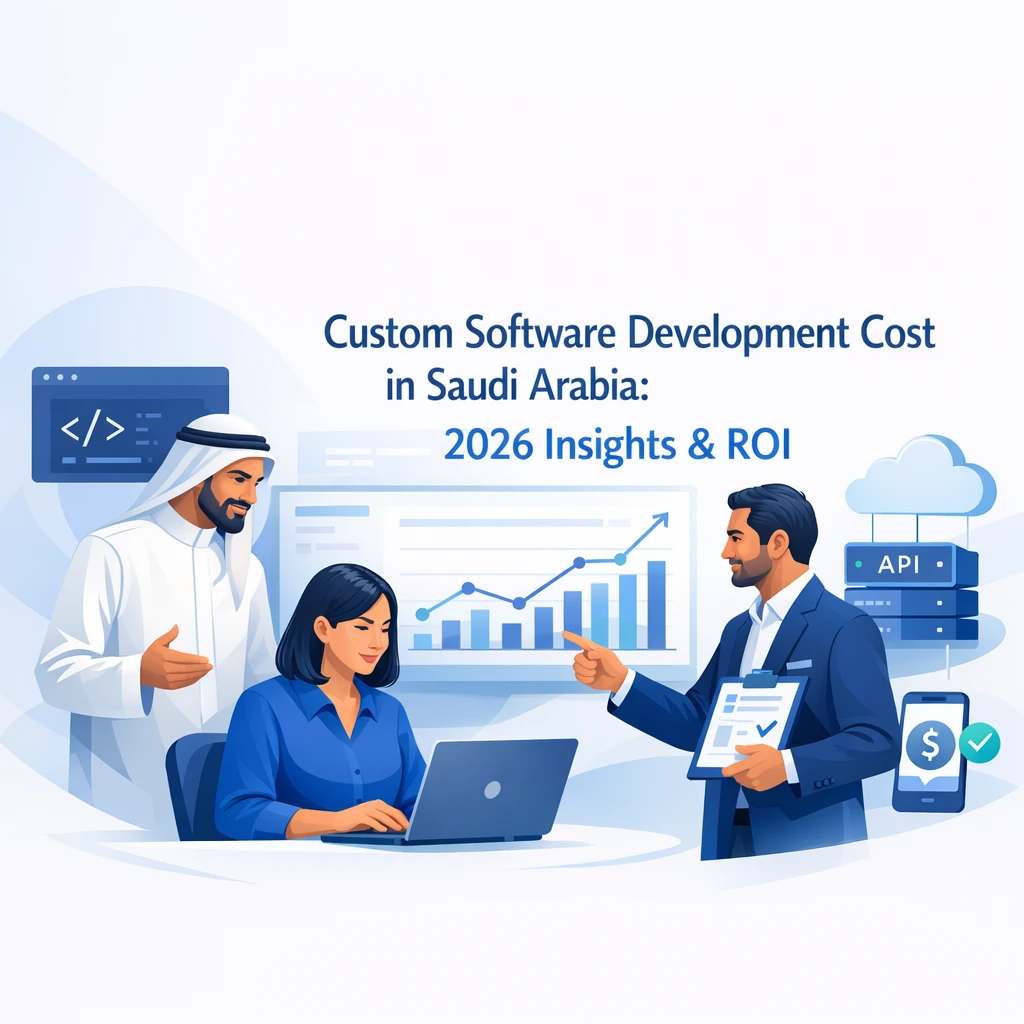
As enterprises in Saudi Arabia and the GCC accelerate digital transformation, understanding cost drivers, timelines, and ROI becomes essential. This guide blends practical cost models with actionable delivery guidance, helping SMBs, SMEs, startups, and large organizations plan effectively and select a trusted partner for long‑term success.
Introduction
Custom software is not a one‑size‑fits‑all purchase. It is a strategic investment that aligns technology with business goals, regulatory requirements, and local market dynamics. In 2026, Saudi Arabia and the broader GCC region continue to mature in cloud adoption, AI enablement, and data governance. Enterprises seek software that not only solves today’s problems but scales with growth, integrates with existing ERP and CRM systems, and remains adaptable as market conditions shift.
This article offers a practical, practitioner‑oriented view of what you should expect in terms of pricing, timelines, and return on investment (ROI) when building custom software in Saudi Arabia. We’ll walk through the cost factors, typical timelines, and how to structure a project for maximum value. Throughout, you’ll see how Triostack Technologies approaches projects globally, with a focus on delivering high‑quality software in collaboration with local teams and remote delivery centers.
What is the Topic?
The topic covers the end‑to‑end process of designing, building, deploying, and maintaining custom software solutions for enterprises. This includes web and mobile applications, CRM and ERP extensions, AI‑enabled features, data analytics, cloud migration, API development, and ongoing QA and support. In practice, a typical engagement combines product discovery, architectural design, iterative development sprints, quality assurance, and post‑launch optimization. The goal is to deliver a solution that fits the business model, regulatory landscape, data governance requirements, and user expectations of a modern enterprise.
Why it Matters in 2026
Two forces define 2026: the maturity of regional digital ecosystems in the GCC and the maturation of global delivery models. For Saudi Arabia and neighbors, key drivers include:
- Policy and regulation: Compliance with data localization, privacy, and industry standards (healthcare, financial services, logistics).
- Talent and cost dynamics: A growing pool of engineers in Asia and Eastern Europe, partnered with nearshore and regional hubs, creates cost‑efficient delivery without compromising quality.
- Cloud and AI enablement: Cloud platforms, API‑driven architectures, and AI tooling reduce time‑to‑value but require strong governance and security practices.
- Digital transformation maturity: Enterprises expect software ecosystems that integrate with ERP, CRM, finance, and procurement while enabling analytics and automation.
For SMBs and startups in the region, this means modern, scalable software can be delivered faster than in previous decades—without sacrificing security or reliability. The question becomes not whether to build or buy, but how to balance internal capability, vendor capacity, and long‑term value realization.
Current Industry Challenges
While the appetite for custom software is strong, there are persistent challenges to manage in 2026:
- Cost volatility: Rates for talent and subcontractors can shift with demand, visa policies, and regional economic cycles.
- Cross‑border collaboration: Time zone differences, language, and cultural nuances require clear communication norms and robust tooling.
- Security and compliance: Data protection, IP rights, and regulatory compliance (including sector‑specific rules) demand security‑by‑design and mature governance.
- Legacy integration: Many organizations operate on on‑prem or legacy ERP systems that complicate data migration and process re‑engineering.
- Scope management: Agile but disciplined scope definition helps prevent feature creep and budget overruns.
Understanding these challenges helps you choose a partner with the right risk management, architecture discipline, and delivery model to minimize surprises during the project lifecycle.
How the Technology Works
Modern custom software combines user experience, scalable architecture, and secure data practices. A typical modern stack for enterprise projects includes:
- Frontend: React or Next.js for responsive web apps; React Native or Flutter for cross‑platform mobile experiences.
- Backend: Node.js, Java Spring, or .NET for services, with microservices or modular monolith patterns as appropriate.
- APIs and integration: REST/GraphQL APIs to connect ERP, CRM, data warehouses, and external services.
- Data storage: PostgreSQL, MySQL for relational data; MongoDB or Redis for high‑velocity or structured data needs.
- Cloud and DevOps: AWS, Azure, or Google Cloud; CI/CD pipelines; automated testing and security scanning.
- AI and analytics: ML models, natural language processing, and data analytics dashboards to unlock business insights.
In Saudi Arabia and the GCC, this architecture is often coupled with data localization considerations, regional DNS routing, and compliance frameworks that ensure data sovereignty where required by law or policy.
Architecture Overview
Below is a representative multi‑tier architecture that balances performance, security, and maintainability. It emphasizes modularity so teams can evolve features without large rewrites.
- Presentation layer: Responsive web UI and native mobile interfaces.
- API gateway and service mesh: Centralized authentication, rate limiting, and inter‑service communication.
- Domain services: Separate modules for product, order, customer, and analytics domains; potential microservices or modular monoliths.
- Data and analytics: OLTP databases for operational data; data lake and data warehouse for analytics; event streaming for real‑time insights.
- Security and governance: Identity management, encryption, and compliance tooling embedded from the start.
Triostack emphasizes security‑by‑design and governance as core success factors, ensuring that the architecture meets regulatory requirements and scales with business growth.
Step‑by‑Step Workflow
Adopting a structured workflow helps ensure transparency, reduces risk, and aligns stakeholders. A typical cycle looks like this:
- Discovery & Strategy: Business goals, user research, regulatory constraints, and high‑level architecture are defined. A product roadmap and MVP scope are established.
- Architecture & UX Design: Detailed system design, data models, API contracts, and user experience are crafted. Security and compliance considerations are baked in.
- Development Sprints: Iterative development with short sprints, daily standups, and continuous feedback loops.
- QA & Testing: Unit, integration, performance, and security testing are performed; automated test suites run in CI.
- CI/CD & Deployment: Automated pipelines enable frequent, reliable releases to staging and production environments.
- Launch & Post‑Launch: Monitoring, incident response, user training, and ongoing optimization.
Remote and distributed delivery is common for Saudi and GCC projects. The key is to maintain rigorous governance, documentation, and communication rituals that keep all parties aligned.
Business Use Cases
Organizations in the region pursue a range of software solutions. Here are representative use cases that align with common market needs:
- CRM & Marketing Automation: Centralized customer data, pipeline automation, multi‑channel campaigns, and analytics to improve retention and revenue per customer.
- ERP Extensions: Inventory, procurement, order fulfillment, and financial integrations that unify back‑office processes.
- AI‑Driven Customer Support: AI chatbots, intent recognition, and case routing to improve service levels while reducing support costs.
- Data Analytics & BI: Real‑time dashboards, KPI tracking, and predictive insights to inform strategic decisions.
- Cloud Migration & Modernization: Replatforming legacy apps, consolidating data stores, and enabling scalable, secure operations.
Industry Applications
Across sectors in the GCC and globally, custom software supports many business processes. Notable applications include:
- Logistics and supply chain: Route optimization, inventory visibility, and carrier integrations.
- Healthcare: Patient management, appointment scheduling, secure medical records, and telehealth capabilities.
- Retail and commerce: Omnichannel storefronts, loyalty programs, and personalized recommendations.
- Manufacturing: Production planning, quality control, and maintenance scheduling.
- Financial services: Client onboarding, KYC, risk analytics, and compliance reporting.
Triostack works with clients across these industries, bringing domain expertise and global delivery excellence to each engagement.
Benefits
- Strategic alignment: Software directly maps to business outcomes, not just features.
- Faster time‑to‑value: MVPs and iterative releases deliver functional value sooner.
- Scalability: Architecture and platform choices support growth, new modules, and regional expansion.
- Quality and security: Security by design reduces risk and improves trust with customers and regulators.
- Cost efficiency over time: Balanced vendor mix and remote delivery models help optimize TCO.
Challenges
- Estimating total cost: Hidden integrations, data migration, and training can surprise projects if not planned.
- Maintaining alignment: Stakeholders must stay engaged across discovery, design, and delivery to prevent scope drift.
- Security complexity: Compliance with data privacy and regional regulations is not optional.
- Vendor management: Effective governance, contract clarity, and IP ownership policies are crucial.
Common Mistakes
- Underestimating data migration effort and data quality remediation.
- Overreliance on a single technology stack or vendor without considering future needs.
- Rushing the discovery phase to start development without clear requirements.
- Neglecting security and compliance in the initial design phase.
Best Practices
- Discovery first: Invest time up front to define success criteria, data flows, and integration boundaries.
- MVP approach: Deliver essential functionality quickly, then iterate with real user feedback.
- Security by design: Implement identity, access control, encryption, and audit trails from day one.
- Data governance: Establish data standards, lineage, and privacy controls aligned with local regulations.
- Hybrid delivery model: Combine local domain expertise with a capable remote delivery team for speed and cost efficiency.
Build vs Buy Comparison
Choosing between building in house, outsourcing, or working with a hybrid model depends on goals, time to market, and control needs. The table below simplifies the tradeoffs.
| Aspect | Build (In‑House) | Buy / Outsource (Vendor) |
|---|---|---|
| Control & Customization | Maximum control; bespoke tailoring | Often strong alignment, but some limits on customization |
| Time to Market | Longer due to hiring and ramp‑up | Faster when leveraging pre‑built patterns and managed services |
| Cost Certainty | Capex heavy; ongoing salary commitments | Opex model; predictable monthly/annual costs with variable scope |
| Quality & IP | Ownership of code; potential risk if skills drift | Quality depends on vendor; IP ownership typically defined in contracts |
| Scalability & Maintenance | Depends on internal capabilities | Vendor provides ongoing maintenance and platform updates |
Estimated Development Cost
Prices for software projects vary widely based on project scope, technology choices, data migration needs, security requirements, and regulatory constraints. The ranges below reflect typical SMBs and mid‑market projects, with a focus on Saudi Arabia and GCC deployment contexts. The numbers are illustrative and depend on team composition, location mix, and engagement model.
Pricing by Software Type (Typical SMB Ranges)
| Software Type | Typical SMB Range (USD) |
|---|---|
| Business Website | 5,000 – 15,000 |
| Customer Portal | 10,000 – 40,000 |
| CRM | 15,000 – 100,000 |
| ERP | 40,000 – 200,000 |
| AI Chatbot | 5,000 – 25,000 |
| AI Automation | 15,000 – 80,000 |
| SaaS MVP | 20,000 – 80,000 |
| Enterprise Web App | 30,000 – 200,000 |
Cost Drivers
- Scope and complexity: The number of modules, integrations, and data entities directly affect effort.
- Data migration: Cleaning, mapping, and migrating legacy data is often a significant effort.
- Security & compliance: Industry‑specific requirements (healthcare, finance) can add controls and testing.
- Integrations: ERP, CRM, and external APIs add coordination and testing overhead.
- Quality assurance: Automated test coverage, performance testing, and security scanning contribute to cost but reduce risk.
- Delivery model: Nearshore/remote teams vs onshore resources impact hourly rates and overhead.
Timeline Considerations
Typical delivery timelines depend on scope. A minimal MVP might take 8–12 weeks, while a full enterprise application can require 6–12 months or more. A staged approach with a 3–6 month MVP allows you to validate product viability early and adjust budgets accordingly.
Development Timeline
The following table provides a high‑level view of a typical project journey, assuming a mid‑sized team working across a regional delivery model with 2–3 week sprints. Timelines assume stable requirements and active stakeholder participation.
| Phase | Typical Duration | Key Deliverables |
|---|---|---|
| Discovery & Planning | 2–4 weeks | Requirements, high‑level architecture, MVP scope, risk register |
| Architecture & UX Design | 3–6 weeks | Technical design, data model, API specs, UI/UX wireframes |
| Development | 8–24+ weeks | Feature implementations, unit tests, integration points |
| QA & Security | 4–8 weeks | Test plan, automated tests, penetration/secure coding checks |
| Deployment & Launch | 1–3 weeks | Staging release, production release, user training |
| Post‑Launch Support | Ongoing | Monitoring, incident response, iterative upgrades |
REMOTE DELIVERY: How Triostack Delivers Projects Globally from India
Triostack operates a mature remote delivery model that pairs centralized engineering hubs with local domain experts. The goal is to blend cost efficiency with deep sector understanding, without sacrificing communications or quality. Key elements include:
- Agile alignment: Sprints, product backlogs, and stakeholder reviews keep visibility high and changes manageable.
- Weekly demos: Regular reviews ensure feedback loops remain short and actionable.
- Communication channels: Slack or Teams for daily interactions; Zoom or Google Meet for deep dives; Jira or ClickUp for task management; GitHub or GitLab for code reviews.
- CI/CD & cloud staging: Automated pipelines, environment parity, and secure staging to production release processes.
- QA & security: Dedicated QA cycles, security testing, and vulnerability management are baked in.
- Documentation & IP ownership: Clear ownership, NDAs, and comprehensive documentation accompany every project.
- Timezone overlap: Strategic overlap windows enable real‑time collaboration and quick decision making.
- Dedicated project managers: PMs coordinate cross‑site teams and maintain governance across the engagement.
- Long‑term support: Post‑go‑live maintenance, enhancements, and monitoring for continuous value.
Why UAE businesses outsource development to India often comes down to: cost efficiency, a large talent pool, faster hiring, flexible team scaling, high quality engineering, and strong communication practices. Triostack aligns these advantages with your local context to deliver predictable outcomes.
Case Studies
These are illustrative, anonymized examples drawn from typical engagements with Dubai, UAE, and GCC clients. They reflect practical outcomes rather than public statistics.
Dubai logistics company: Route optimization and carrier integration
A Dubai‑based logistics provider sought a unified platform to optimize last‑mile routing, carrier integrations, and shipment tracking. The project delivered a modular suite with a web portal for operations and a mobile app for field drivers. Outcomes included improved routing efficiency, better asset visibility, and streamlined carrier communications. The engagement emphasized security, data integrity, and scalable scheduling to accommodate seasonal demand spikes.
UAE healthcare clinic: Patient scheduling, records, and telehealth
A healthcare clinic in the UAE needed a secure patient management system with appointment scheduling, electronic medical records, and telehealth capabilities. The delivered solution balanced patient privacy with clinician workflow, integrated with the clinic's existing systems, and provided analytics dashboards for operational oversight. The project prioritized regulatory compliance, user‑friendly interfaces for clinicians and patients, and robust audit trails.
Saudi retail business: Omnichannel order management
A Saudi retailer integrated inventory, order management, and customer service workflows across online and brick‑and‑mortar channels. The solution unified stock visibility, automated order routing, and real‑time analytics for supply performance. The engagement demonstrated how modular architecture allowed the retailer to scale features as the business grew and added new channels.
Australian startup: MVP for a fintech platform
An Australian startup required a lightweight MVP to validate a fintech concept, including onboarding, payments integration, and risk checks. The project employed a lean design, rapid prototyping, and a strong emphasis on security and compliance in the early stages, enabling a faster path to market and investor confidence.
How Triostack Delivers Projects Globally
Triostack operates with a strong emphasis on outcomes, governance, and long‑term partnerships. The company brings:
- End‑to‑end capabilities: Custom software development, web and mobile apps, AI development, CRM, ERP, SaaS, cloud migration, DevOps, UI/UX, API development, and QA.
- Global delivery experience: Distributed teams with local domain expertise and robust communication practices.
- Security and compliance excellence: Security by design, data governance, and industry‑specific controls.
- Ongoing support: Maintenance, monitoring, and iterative improvements after go‑live.
- Transparent collaboration: Clear milestones, documentation, and IP ownership terms.
Why Businesses Choose Triostack
Triostack is not about selling a package; it is about solving real problems with proven processes. Key differentiators include:
- Deep domain partnering: We work to understand your industry, regulatory requirements, and business goals to shape the software strategy.
- Balanced delivery model: A mix of local stakeholders and global technical teams enables faster delivery without compromising quality.
- Outcome‑driven engagements: Roadmaps, measurable success criteria, and transparent governance ensure alignment with business objectives.
- Comprehensive services: From Custom Software and Web/Mobile Development to AI, CRM, ERP, Cloud, and DevOps—covering the full lifecycle.
- Quality assurance and security: Rigorous QA, automated testing, and security practices baked in from Day 1.
Future Trends in Custom Software for 2026 and Beyond
Forward‑looking organizations are focusing on:
- AI‑assisted development and intelligent automation to accelerate delivery and improve decision making.
- Edge computing and hybrid clouds enabling lower latency and better data sovereignty control.
- Low‑code/no‑code augmentation for rapid prototyping while preserving core architecture discipline.
- DevSecOps maturity to strengthen security and compliance across teams and vendors.
- Continued emphasis on data governance, privacy, and auditability as regulatory landscapes evolve.
Recommended Technology Stack
The following stack reflects modern, scalable approaches suitable for enterprise projects in Saudi Arabia and the GCC. It supports secure integrations with ERP and CRM systems and scales with business growth.
- Backend: Node.js, Java Spring, or .NET for microservices or modular monoliths.
- APIs & Integrations: REST and GraphQL; API gateway with authentication and rate limiting.
- Data: PostgreSQL or MySQL; MongoDB or Redis for high‑velocity data; data warehouse for analytics.
- Cloud & DevOps: AWS, Azure, or Google Cloud; CI/CD, IaC, automated testing, and security scanning.
- AI & Analytics: MLOps pipelines, NLP capabilities, and business intelligence dashboards.
Conclusion
Understanding custom software development cost in Saudi Arabia for 2026 requires a practical view of the drivers, methodologies, and partner capabilities that ensure a successful outcome. By combining a thoughtful discovery process, secure architecture, and a delivery model that blends local domain knowledge with global engineering excellence, enterprises can achieve meaningful ROI while reducing risk. Triostack stands ready to partner with organizations across the GCC and beyond, offering a comprehensive suite of services that align with business goals and regulatory realities while maintaining a client‑focused, non‑advertising posture.
Frequently Asked Questions
- What is the typical budget range for a mid‑sized enterprise web app in 2026?
- Budget ranges vary by scope and region, but a mid‑sized enterprise web app can range from roughly 30,000 to 200,000 USD depending on features, integrations, and security requirements. The majority of projects with multi‑module ERP or CRM extensions frequently land in the 60,000 to 150,000 USD band for a solid baseline with room for growth.
- How long does it take to deliver an MVP?
- A practical MVP often takes 8–16 weeks, depending on scope and the degree of integration with existing systems. A phased approach lets you validate core functionality early and iterate with user feedback.
- Is offshore or nearshore delivery viable for Saudi projects?
- Yes. A well‑governed offshore or nearshore model can deliver high quality at scale, provided there is strong alignment on requirements, security, governance, and communication channels.
- What should I look for in a software partner?
- Look for domain understanding, architecture discipline, a track record with similar engagements, transparent governance, and a clear plan for data security, IP ownership, and long‑term support.
- What is the ROI horizon for software investments?
- ROI typically materializes through faster time‑to‑value, improved operational efficiency, better customer experiences, and data‑driven decision making. A well‑designed solution often starts yielding measurable benefits within 6–12 months post‑launch and continues to compound as the platform evolves.
Triostack Team
Technology Evangelist & Writer
Triostack Team is an experienced writer and technologist, exploring the intersections of AI, cloud architecture, and modern application development. Passionate about turning complex technical concepts into accessible insights.