Custom ERP Development vs Off-the-Shelf ERP in GCC: Cost, ROI, and Implementation Risks for Growing Enterprises
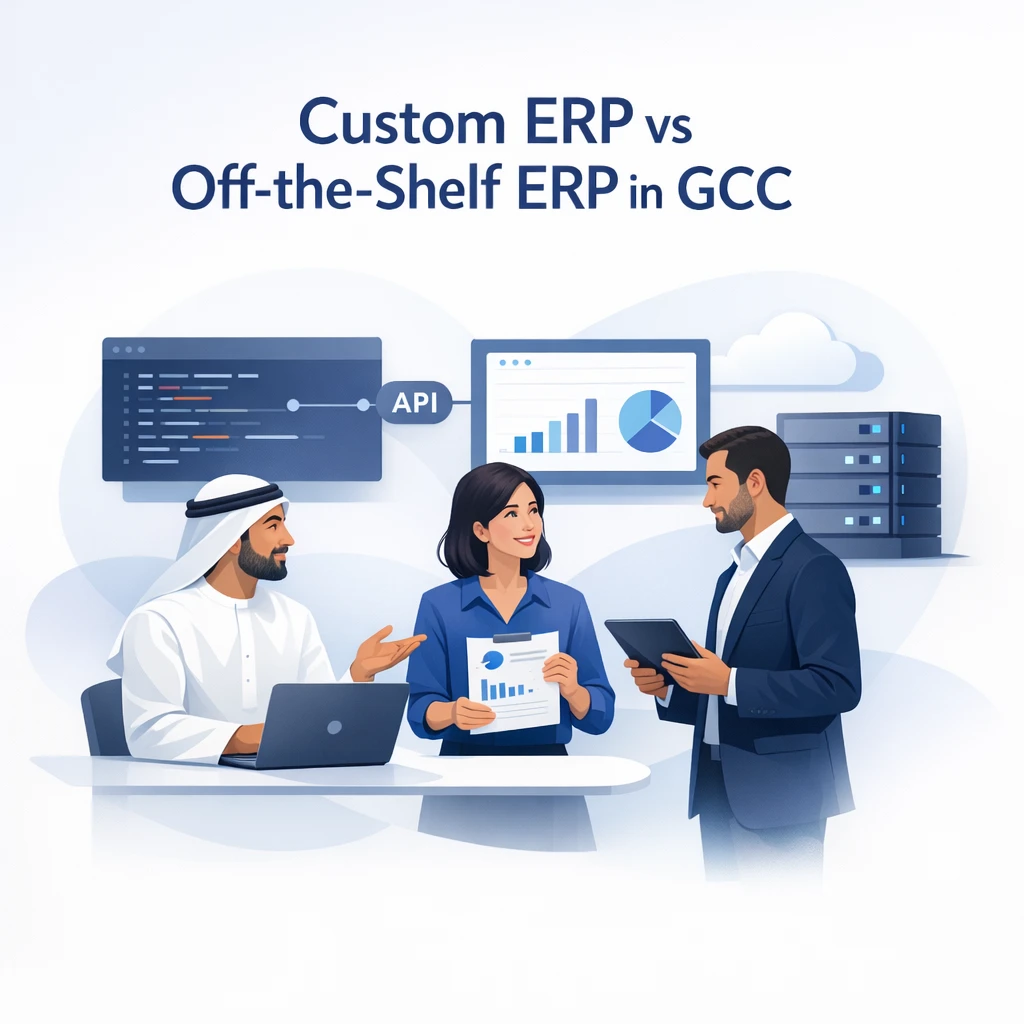
Growing businesses in the GCC and beyond face a pivotal decision when selecting an enterprise resource planning (ERP) system. Do you build a custom ERP tailored to your unique processes, or do you adopt an off the shelf ERP that comes with ready-made modules? The choice shapes everything from daily operations to long term ROI and regulatory compliance. This article explores the tradeoffs, with practical guidance, real world considerations, and examples that help SMBs, SMEs, startups, and established teams plan a scalable ERP strategy.
Throughout, Triostack Technologies is positioned as a global partner with deep experience in custom software, ERP, SaaS, and cloud native solutions. The goal is to equip you with practical insights to inform a decision that aligns with your business model, regulatory context, and growth trajectory.
What is the Topic
ERP systems integrate core business processes across finance, procurement, inventory, manufacturing, supply chain, human resources, and customer relationship management. A custom ERP is built to match your unique workflows, data models, and reporting needs. An off the shelf ERP is a commercial product designed to serve many organizations with configurable, but predefined, modules.
Key decision factors include process complexity, regulatory requirements, data governance, integration with legacy systems, and the pace of growth. In the GCC context, localization, multilingual support, tax compliance (for VAT and other regimes), and partner ecosystems for logistics and manufacturing are all critical considerations.
Why It Matters in 2026
- Digital transformation remains a strategic driver for competitiveness in GCC markets and globally.
- Businesses increasingly require true end-to-end integration to optimize supply chains, customer experiences, and regulatory compliance.
- Talent availability and cost pressures push organizations toward scalable architectures and efficient partnerships for software delivery.
- Remote delivery models enable access to global talent pools while maintaining time zone overlap and strong governance.
Choosing the right ERP approach influences not just software costs, but change management, user adoption, and the speed at which you can pivot to new business models.
Current Industry Challenges
- Integrating legacy systems with modern data platforms while maintaining data quality and security.
- Meeting GCC localization needs including Arabic language support, regional tax rules, and supplier networks.
- Balancing rapid growth with rigorous governance and risk management.
- Managing total cost of ownership while sustaining performance during peak seasons and promotions.
Custom ERP projects can address these challenges more precisely, but they require disciplined governance and a clear plan for data migration, change management, and ongoing optimization.
How the Technology Works
At a high level, ERP systems unify data models and processes across departments. A custom ERP tailors these modules to your unique workflows, data structures, and reporting requirements. An off the shelf ERP provides configurable modules that can be assembled to fit common business processes but may require compromises where your process diverges from the standard model.
Key technology considerations include modular architecture, API driven integrations, data governance, security controls, and scalable cloud infrastructure. For GCC markets, consider localization needs, regulatory compliance, and multi currency support as part of the design.
Architecture Overview
A robust ERP architecture should separate concerns across data, application logic, and presentation while ensuring secure, scalable integrations with external systems such as logistic providers, banking networks, and CRM platforms. The following diagrams illustrate how a typical custom ERP compares with off the shelf options while highlighting integration points with external services.
In a custom ERP, Modules and Data_Lake structures are designed around your domain, enabling deeper analytics and unique workflows. In an off the shelf ERP, modules exist to satisfy common scenarios, with configurations limited by the vendor's roadmap.
Step by Step Workflow
Implementing an ERP project involves a structured sequence from discovery to ongoing optimization. The following workflow is a practical template you can adapt to your organization and timeline.
Important activities in this workflow include stakeholder workshops, data lineage analysis, sandbox testing, and training design. Aligning with business cadence helps minimize disruption during go live.
Business Use Cases
1. End to end warehouse and logistics management
In a Dubai based logistics operation, a custom ERP unifies warehousing, inventory control, order fulfillment, and carrier integrations. The system tracks each parcel across the entire lifecycle, improves visibility and reduces manual data entry.
2. Patient management and billing in healthcare
A UAE healthcare clinic benefits from streamlined patient scheduling, electronic medical records, billing, and claims processing while maintaining compliance with local regulations and patient privacy requirements.
3. Multi channel retail operations in Saudi Arabia
A Saudi retailer consolidates e commerce, POS, inventory, and supplier collaboration under a single data model, enabling accurate stock visibility and unified pricing strategies across stores and online channels.
4. Data driven operations for an Australian startup
An Australian startup uses a modular ERP to harmonize product development, QA, finance, and sales, with an emphasis on rapid iteration and automated reporting for fundraising scenarios.
Industry Applications
- Logistics and Transportation
- Healthcare and Life Sciences
- Retail and Wholesale
- Manufacturing and Industrial
- Professional Services and SaaS businesses
Benefits of Custom ERP vs Off the Shelf
- Better fit to unique processes and data models
- Optimized user experience tailored to your teams
- Improved data quality and governance through unified data models
- Greater control over upgrades, security, and regulatory compliance
- Better long term ROI when aligned with growth plans and process transformation
Challenges and Common Mistakes
- Underestimating data migration complexity and data cleansing needs
- Over customisation leading to maintenance headaches and higher TCO
- Inadequate change management and user adoption planning
- Insufficient vendor evaluation for integration capabilities and roadmap clarity
Best Practices for Successful ERP Initiatives
- Define a clear MVP with measurable outcomes and phased delivery
- Adopt an API first approach to enable future integrations
- Establish governance including data ownership, security, and access controls
- Invest in data migration planning and a dedicated data stewardship role
- Choose a partner with global delivery experience and local domain knowledge
Build vs Buy Comparison
| Criterion | Custom ERP | Off the Shelf ERP |
|---|---|---|
| Fit to unique processes | High; processes can be modeled around your operations | Moderate; often requires process adaptation |
| Time to value | Longer; depends on scope and complexity | Shorter; ready to deploy after configuration |
| Customization depth | Unlimited within budget and architecture | Limited by vendor modules and roadmap |
| Total cost of ownership | Higher upfront, potentially lower long term if scaled well | Lower upfront, potential higher maintenance and upgrade costs |
| Risk | Higher risk if poorly managed but higher strategic alignment | Lower initial risk but potential misfit and vendor lock-in |
| Ownership & control | Full control over roadmap and data models | Vendor controlled with limited customization options |
| Upgrades and maintenance | Managed internally or with a partner; continuous improvement possible | Vendor dependent; major upgrades can disrupt customizations |
| Integration complexity | Customizable; tailored connectors and adapters | Depends on API maturity and partner ecosystem |
When evaluating, consider not only the upfront price but also the long term alignment with your business model, product roadmap, and regulatory environment.
Estimated Development Cost
SMBs and growing enterprises typically budget ERP projects across modules and scope. The ranges below reflect common early stage planning scenarios and do not replace a detailed quote after discovery.
| Scope | Typical USD Range | Notes |
|---|---|---|
| Business Website | 5k – 15k | Static or dynamic sites; foundational for customer experience |
| Customer Portal | 10k – 40k | Self service, quotes, and order tracking |
| CRM | 15k – 100k | Sales automation, pipeline management, analytics |
| ERP | 40k – 200k | Finance, supply chain, manufacturing, HR, integrations |
| AI Chatbot | 5k – 25k | Conversational interfaces for support and automation |
| AI Automation | 15k – 80k | Automation workflows and decisioning using ML |
| SaaS MVP | 20k – 80k | Minimum viable product for multi tenant cloud matrix |
| Enterprise Web App | 30k – 200k | Large scale, mission critical systems |
Pricing factors include: requirements clarity, data migration complexity, regulatory localization, integrations, performance targets, security controls, and change management readiness.
Recommended Technology Stack
Elaborating a practical stack helps teams plan for scalability and maintainability. The following is a representative configuration used in modern ERP projects across regions including GCC and Western markets.
- Backend Java with Spring Boot or .NET Core for robust enterprise capabilities
- Frontend React or Angular for dynamic, responsive dashboards
- Database PostgreSQL or Oracle for transactional workloads; data warehouse options for analytics
- Cloud AWS or Azure with multi region deployment and compliance controls
- AI & ML Python based components for analytics, forecasting, and automation
- Integration API first design with REST and GraphQL, plus event streaming with Kafka
- DevOps CI/CD pipelines via Azure DevOps, GitHub Actions, or GitLab with automated testing
- Security IAM, RBAC, data encryption, and secure data residency options
Future Trends in ERP for 2026 and Beyond
- AI powered insights embedded in operational dashboards
- Low code components enabling faster customization while preserving governance
- Enhanced data privacy, security, and compliance with industry standards
- Expanded multi cloud and hybrid deployment strategies
- Deeper analytics, prescriptive guidance, and continuous improvement loops
How Triostack Delivers Projects Globally
Triostack uses a disciplined global delivery model to fuse domain expertise with modern engineering practices. We provide end to end services including custom software development, web and mobile applications, AI and ML, CRM and ERP, SaaS, cloud migration, DevOps, UI/UX, API development, dedicated teams, QA and maintenance, and technical consulting. Our approach emphasizes collaboration, transparency, and measurable outcomes.
Core capabilities include remote delivery with strong governance, agile planning, and iterative demos. We align with clients across the globe from UAE and GCC regions to the United States, Europe, and APAC, ensuring time zone overlap where possible and flexible handoffs for regional requirements.
- Remote delivery model guided by Agile with weekly demos and synchronous collaboration
- Agile rituals Sprint planning, daily standups, and sprint reviews
- Communication channels Slack, Teams, Zoom, Google Meet
- Project management Jira, ClickUp, GitHub, GitLab for transparent progress tracking
- CI/CD automated pipelines, cloud staging, and environment parity between dev, staging and production
- Security & IP NDA, strict data protection, and IP ownership clarity
- Time zone overlap designed to maximize collaboration with client teams
- Dedicated project managers for ongoing governance and risk management
Why UAE businesses outsource development to India is often about cost efficiency matched with a large talent pool, faster hiring, flexible scaling, and high quality engineering combined with clear communication channels and strong project governance.
Case Studies
Dubai based logistics company
Challenge: fragmented legacy systems across warehousing, procurement, and shipping. Approach: built a custom ERP with unified inventory controls, order management, and carrier integrations. Outcome: improved operational visibility and reduced manual data handling while enabling faster response times to customer requests.
UAE healthcare clinic
Challenge: disparate patient records, billing, and regulatory reporting. Approach: implemented a patient management system with integrated billing, insurance claims, and regulatory reporting modules. Outcome: streamlined patient journeys, accurate billing, and enhanced regulatory compliance.
Saudi retail business
Challenge: siloed channels between bricks and mortar and e commerce. Approach: deployed an ERP with omni channel inventory, pricing synchronization, and supplier collaboration. Outcome: unified stock levels and improved channel profitability planning.
Australian startup
Challenge: need for rapid experiment cycles and data driven decision making. Approach: modular ERP with analytics and automation components to accelerate product iterations. Outcome: faster time to market and better visibility into product performance.
Cost Considerations for SMBs
ERP projects vary widely based on scope, localization, and integration requirements. Consider not only the upfront build or license costs but ongoing maintenance, hosting, data migration, security, and user training costs. A practical approach is to plan for phased investments aligned to key milestones and ROI triggers.
Pricing factors to keep in mind
- Scope and module breadth
- Data migration complexity and data quality readiness
- Localization and compliance requirements
- System integration with existing tools and external partners
- User adoption and training needs
- Security, governance, and audit requirements
With a thoughtful plan, ERP investments can become a strategic enabler of growth rather than a one off cost center.
FAQ
- What is the biggest risk with custom ERP projects
- Scope creep and data migration challenges. A clear MVP and phased delivery reduce risk and improve predictability.
- How long does it take to implement an ERP
- Depends on scope; small to midsize ERP projects can take several months to a year, while large enterprise deployments may take longer.
- Should I choose a GCC localization friendly vendor
- Yes, localization, language support and regional regulatory compliance are critical for adoption and compliance.
Conclusion
Choosing between custom ERP development and an off the shelf solution is not purely a cost decision. It is a strategic choice that shapes process agility, data quality, and scalability across markets from Dubai to London. For growing enterprises in the GCC and beyond, a careful assessment of business fit, data strategy, and change management is essential. A partner like Triostack can bring architectural rigor, global delivery discipline, and domain knowledge to help you design and deliver an ERP that aligns with your growth trajectory without compromising on governance or security.
If you are planning a similar software project, Triostack can help you design, build, deploy and maintain a scalable solution that fits your risk tolerance and budget while meeting regulatory and operational requirements.
Subtle next steps: start with a discovery workshop to map your top 5 processes, identify data migration needs, and sketch a phased delivery plan that keeps your teams engaged from day one.
Frequently Asked Questions
What is a custom ERP
A custom ERP is a software system built to match your unique business processes, data models, and reporting needs, often by designing from the ground up or heavily tailoring modules.
What is an off the shelf ERP
An off the shelf ERP is a commercial product with standard modules that can be configured to a degree. It typically requires less upfront development but may involve compromises in specialization.
What factors most influence ERP ROI
Process alignment, data quality, user adoption, integration depth, security, and ongoing optimization determine ROI. A phased approach that validates value early improves outcomes.
Triostack Team
Technology Evangelist & Writer
Triostack Team is an experienced writer and technologist, exploring the intersections of AI, cloud architecture, and modern application development. Passionate about turning complex technical concepts into accessible insights.