Custom ERP Development vs Off-the-Shelf ERP for GCC Enterprises: ROI, Implementation Timelines, and Total Cost Comparison
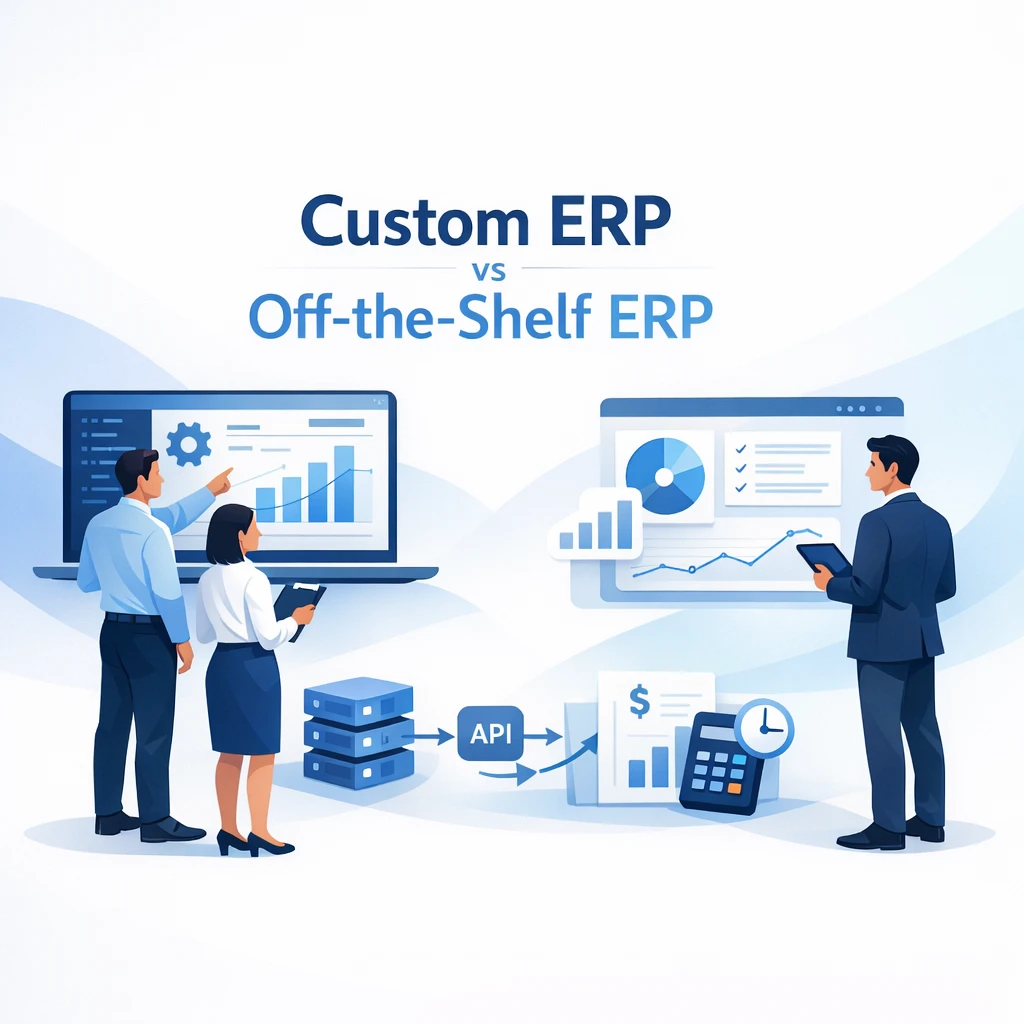
Choosing the right ERP strategy is a foundational decision for GCC enterprises aiming to scale, optimize operations, and stay compliant across diverse markets. The choice typically sits between developing a custom ERP tailored to unique processes or adopting a robust off-the-shelf solution that can be configured to meet many needs. This article offers a practical, tech-forward comparison focused on ROI, timelines, and total cost of ownership, with real-world guidance for SMBs, SMEs, startups, and growth-stage companies across the GCC, the United States, Canada, Europe, Australia, and beyond.
What is the Topic?
Custom ERP development refers to building a new enterprise resource planning system from scratch or with tightly scoped, highly specialized modules that align precisely with a company’s unique workflows. Off-the-shelf ERP, by contrast, is a commercially available product that provides a broad set of core modules (finance, procurement, inventory, sales, CRM, HR, manufacturing) configured to fit many scenarios but not always optimized for niche processes.
Both paths aim to streamline operations, improve data visibility, and drive strategic decisions. The question for GCC organizations often revolves around localization, regulatory compliance, long‑term cost of ownership, and speed to value in a market that demands rapid digital transformation.
Why it Matters in 2026
- Localization and compliance: Regional tax regimes, GCC VAT, Saudization targets, and data residency requirements influence ERP design and hosting decisions.
- Rapid digital transformation: Enterprises seek faster time to value without compromising governance, security, or scalability.
- Total cost of ownership (TCO): A hybrid approach—combining off-the-shelf capabilities with bespoke extensions—can balance upfront costs with long‑term maintenance and upgradeability.
- Talent and delivery models: Access to global talent pools and flexible outsourcing models enable higher-quality builds with predictable delivery timelines.
Current Industry Challenges
GCC markets share several common ERP pain points, with regional nuances that influence both build and buy decisions:
- Complex integrations: ERP must connect with logistics networks, customs, payment gateways, and regional banking systems while supporting multi-site operations.
- Data quality and migration: Legacy systems often hinder clean migrations, requiring robust data governance and reconciliation processes.
- Change management: User adoption and training are critical to realizing ROI, especially in diverse workforces with varied tech proficiency.
- Security and compliance: Data protection, privacy, and cross-border data flows require strong security postures and clear ownership of data and IP.
- Cost pressure: Across SMBs and SMEs, balancing capex vs opex, maintenance fees, and upgrade cycles is essential for sustainable growth.
How the Technology Works
ERP systems coordinate core business processes by combining modules such as finance, procurement, inventory, manufacturing, sales, CRM, HR, and analytics. In modern implementations, you typically see:
- Modular architecture: Each module (finance, supply chain, HR) can be deployed independently or in a bundled package.
- Unification layer: A shared data model ensures consistent master data across modules (customers, vendors, items, GL accounts).
- API-driven integrations: ERP connects with ecommerce platforms, WMS, CRM, payroll, bank feeds, and external analytics tools.
- Analytics and AI: Embedded dashboards, forecasting, and operational insights support proactive decision-making.
In a GCC context, the architecture must address regional data residency preferences, cloud-region availability, and performance needs for multi-site operations.
Architecture Overview
Below is a typical layered architecture for a modern ERP implementation, illustrating both custom and off-the-shelf pathways. The same core layers appear in most projects, with variations in customization depth and integration points.
In a custom ERP, you own the modules and data model end-to-end, enabling tighter alignment with business rules. In an off-the-shelf ERP, you may rely more on configuration, add-on modules, and third-party connectors to meet unique requirements.
Step-by-Step Workflow
- Discovery and requirements – Map end-to-end processes, collect KPIs, and identify must-have vs nice-to-have features. Document data migration needs and regulatory constraints.
- Vendor evaluation (for off-the-shelf) – Compare feature sets, roadmap, multi-tenant vs on-prem options, localization capabilities, and total cost of ownership.
- Architecture & design – Define target state, data model, integration points, security posture, and deployment plan. For custom ERP, this includes module boundaries and API contracts.
- Development / configuration – Build custom modules or configure the vendor solution, plus any required adapters, plugins, or middleware.
- Data migration – Cleanse, map, and migrate historical data with validation and reconciliation steps.
- Testing & QA – Functional, integration, performance, and security testing. Run user acceptance testing with real-world scenarios.
- Go-live & cutover – Execute the transition plan, monitor for issues, and switch to production with a rollback plan.
- Post-launch support – Training, hypercare, and ongoing optimization. Establish governance for future enhancements.
Business Use Cases
Consider how ERP choices translate into actual business value across common GCC sectors:
- Logistics and distribution (Dubai, UAE) – A hybrid ERP can optimize warehouse slots, automate customs pre-clearance data, and provide real-time shipment tracking across borders.
- Healthcare clinics (UAE) – ERP for patient flow, inventory, procurement, and regulatory reporting to improve asset utilization and compliance.
- Saudi retail and wholesale – Multi-site inventory management, dynamic pricing, and loyalty integration with e-commerce platforms.
- Global startups (Australia, UK, US) – Scalable ERP supports rapid expansion, cloud hosting, and modular governance without platform lock-in.
Industry Applications
While the core ERP blocks stay consistent, industry-specific extensions matter. Examples include:
- Manufacturing – Production planning, bill of materials, shop floor control, and material requirements planning.
- Retail and e-commerce – POS integration, omnichannel order orchestration, and returns management.
- Logistics – Freight audit, carrier integration, and last mile optimization.
- Financial services – Regulatory reporting, risk controls, and audit trails.
Benefits
- ROI clarity: Short-term wins from automation and better visibility; long-term gains through optimized supply chains, reduced manual effort, and improved decision latency.
- Scalability: A future-proof architecture that accommodates new sites, products, and regulatory changes.
- Security and governance: Consistent policies, auditable data, and centralized access control across the enterprise.
- Improved user experience: Modern interfaces and workflows reduce training time and boost user adoption.
Challenges
- Scope creep: Without strong governance, feature creep inflates timelines and budgets.
- Data migration risk: Dirty data and inconsistent master data slow go-live and degrade early insights.
- Vendor lock-in (for off-the-shelf) – Dependence on roadmap and licensing terms can constrain future changes.
- Change management: Employee training and process redesign are essential to achieve ROI.
Common Mistakes
- Underestimating data cleansing and migration effort
- Trying to replicate all legacy processes instead of reengineering for better outcomes
- Insufficient stakeholder involvement across sites and functions
- Under-scoping outcomes or misaligning KPIs with business goals
Best Practices
- Phased delivery: Break the program into MVP, mid-cycle enhancements, and a stable steady-state, with measurable milestones.
- Data governance: Establish data ownership, quality rules, and reconciliation procedures early.
- KPIs and success metrics: Define revenue, cost, and efficiency targets aligned with organizational strategy.
- Stakeholder alignment: Involve business leaders from each function to ensure buy-in and accountability.
Build vs Buy Comparison
| Criterion | Custom ERP (Build) | Off-the-Shelf ERP (Buy) |
|---|---|---|
| Customization depth | High, tailored to exact processes | Limited to configured options and extensibility |
| Time to value | Longer, depending on scope | Short to medium depending on deployment complexity |
| Initial cost | High capex for development, testing, data migration | Lower upfront, licensing fee and customization costs |
| Total cost of ownership | Higher early, potentially lower long-term if well maintained | Predictable annual costs, ongoing licenses and renewal fees |
| Risk | Higher technical risk if requirements evolve | Vendor risk, roadmap changes, and integration constraints |
| Control | Full control over architecture, data model, and security policies | Control limited by vendor capabilities and customization options |
Estimated Development Cost
Costs vary by scope, location, team structure, and domain. The ranges below reflect typical SMB/SME engagements with a 6–18 month horizon for ERP projects in the GCC and similar markets.
| ERP Component | Typical Range (USD) | Notes |
|---|---|---|
| Business Website | 5k–15k | Complementary to ERP in some deployments (landing pages, portals) |
| Customer Portal | 10k–40k | Self-service functions, integrations with ERP data |
| CRM | 15k–100k | Standalone or integrated with ERP |
| ERP Core (custom) | 40k–200k | Includes data model, modules, integrations, QA |
| AI Chatbot | 5k–25k | Automation, FAQ, and service desk |
| AI Automation | 15k–80k | Process automation, RPA-like workflows |
| SaaS MVP | 20k–80k | Initial cloud deployment with key modules |
| Enterprise Web App | 30k–200k | Complex, multi-site deployments |
Notes on pricing factors: scope clarity, data migration complexity, number of sites, regulatory reporting requirements, integration breadth, security and compliance needs, localization, and ongoing support. Triostack helps businesses plan budgets with phased milestones and transparent cost tracking.
Recommended Technology Stack
For a custom ERP build, a pragmatic stack supports modularity, performance, and maintainability. While your choices should reflect business goals, the following is a representative reference architecture:
- Frontend — React or Angular for web, Kotlin/Swift for mobile where native experiences are required
- Backend — Java Spring Boot or .NET Core microservices for robust, scalable services
- API — REST/GraphQL APIs with secure authentication (OAuth 2.0, OpenID Connect)
- Data layer — PostgreSQL or Microsoft SQL Server, with a data lake for analytics
- Identity & security — IAM, MFA, encryption at rest and in transit, audit trails
- Cloud & DevOps — Kubernetes, Docker, CI/CD pipelines (GitHub Actions, GitLab CI, Azure DevOps)
- AI & Analytics — Embedded BI, forecasting, anomaly detection, edge AI where applicable
For off-the-shelf ERP, prioritize compatibility with your current tech stack, extension capabilities, and partner ecosystem. Triostack emphasizes integrations, data modeling alignment, and security regardless of the path chosen.
Future Trends
- Low-code / no-code extensions: Shorter customization cycles with governance controls
- AI-driven operations: Predictive maintenance, demand forecasting, and intelligent automation
- Industry-specific accelerators: Prebuilt data models and workflows for GCC sectors
- Hybrid cloud strategies: Data residency with global accessibility
How Triostack Delivers Projects Globally
Triostack Technologies offers global software development capabilities with a strong emphasis on remote delivery, agile practices, and transparent governance. Our teams combine domain expertise with engineering excellence to deliver scalable digital products across industries and regions.
Key capabilities include:
- Custom Software, Web Development, Mobile Apps
- AI Development, Machine Learning, CRM, ERP
- SaaS, Cloud Migration, DevOps, UI/UX
- API Development, Dedicated Teams, QA, Maintenance
- Technical Consulting and Architecture Advisory
Triostack focuses on building long-term partnerships, emphasizing reliability, security, and measurable outcomes. We help clients design, build, deploy, and maintain scalable solutions with a global delivery model.
Remote Delivery: How Triostack Works from India
Outsourcing development to India offers multiple advantages when executed with disciplined project management, strong communication, and robust governance. The following approach is designed to maximize value for UAE and GCC clients while maintaining global standards:
- Agile and sprint planning: Collaborative planning with clear backlogs, acceptance criteria, and sprint goals.
- Weekly demos: Visible progress through demonstrations in Slack, Teams, Zoom, or Google Meet, with stakeholder sign-off.
- Tools and collaboration: Jira, ClickUp, GitHub, GitLab, Azure DevOps for issue tracking and source control.
- CI/CD and cloud staging: Automated builds, tests, and deployments with secure staging environments.
- QA and security: Comprehensive testing, vulnerability scanning, and secure coding practices.
- Documentation and IP ownership: Clear documentation, NDAs, and explicit IP ownership terms
- Timezone overlap and English communication: Overlapping hours with Dubai/Abu Dhabi, Jeddah, Doha, Muscat; strong written and verbal English capabilities
- Dedicated project managers: Single point of contact for governance, risk, and delivery risk mitigation
- Long-term support: Post-launch maintenance, feature enhancements, and managed services as needed
Why do UAE businesses outsource development to India? Cost efficiency, access to a large talent pool, faster hiring, flexible team scaling, high-quality engineering, and strong communication capabilities translate into faster delivery and better value without sacrificing governance.
Case Studies
Dubai-based logistics company
Challenge: Fragmented processes across warehouse operations, customs clearance data exchange, and limited analytics. Approach: A modular ERP with WMS integration, customs pre-clearance data automation, and real-time dashboards. Outcome: 28% reduction in order cycle time, improved inventory accuracy, and faster financial close.
UAE healthcare clinic
Challenge: Patient flow management, inventory control for medical supplies, and regulatory reporting. Approach: Custom ERP with patient scheduling, inventory modules, and reporting tailored to regulatory requirements. Outcome: Improved asset utilization, reduced stockouts, and compliant reporting.
Saudi retail business
Challenge: Multi-site inventory and pricing across regions with centralized finance. Approach: ERP with multi-site inventory, cross-border procurement, and unified financials. Outcome: Streamlined procurement, consistent pricing, and real-time visibility into margins.
UK SaaS company
Challenge: Rapid international expansion, need for scalable analytics, and tight security controls. Approach: Cloud-based ERP with modular architecture and embedded analytics. Outcome: Accelerated go-to-market and improved governance across geographies.
Pricing Factors and Typical Ranges
For SMBs and SMEs planning software projects in the 5k to 200k USD range, pricing is driven by scope, complexity, and the chosen delivery model. The following ranges provide a practical guide for budgeting the ERP journey:
- ERP Core (custom): 40k–200k
- CRM: 15k–100k
- AI and automation: 15k–80k
- SaaS MVP: 20k–80k
- Enterprise web app: 30k–200k
Other pricing drivers include data migration complexity, regulatory reporting requirements, localization needs, integration breadth, and ongoing support levels. A thoughtful plan from Triostack will help you forecast both upfront costs and long-term maintenance.
FAQ
- What is the typical timeline for a custom ERP project?
- Most custom ERP initiatives take 9–18 months to reach a stable go-live, depending on scope, data migration, and integration complexity. A phased approach with a clear MVP reduces risk and accelerates value realization.
- Is off-the-shelf ERP viable for GCC enterprises?
- Yes, when the product aligns with core processes and offers strong localization, multi-site support, and robust integration capabilities. However, customization and long-term upgrades should be evaluated for total cost and strategic fit.
- How does Triostack ensure data security and regulatory compliance?
- We follow industry best practices, implement role-based access controls, encryption, robust logging, and compliance mappings (GDPR, local regulations, and GCC data residency where applicable), plus NDA and IP protection agreements with clients.
- What is the role of change management in ERP projects?
- Change management drives user adoption, training, and governance. It often determines whether ROI targets are met. We emphasize stakeholder engagement, training plans, and ongoing support to maximize adoption.
Conclusion
For GCC enterprises evaluating custom ERP development versus off-the-shelf ERP, the decision hinges on alignment with core processes, regulatory considerations, and the organization’s stance on long-term capability building. Custom ERP offers deep alignment and control at the cost of longer delivery and higher upfront investment, while off-the-shelf ERP provides faster time to value with proven capabilities but may require compromises in customization and future flexibility. A pragmatic approach—often combining an off-the-shelf core with selective custom extensions and integrations—can deliver strong ROI, while preserving scalability for multinational operations.
Triostack stands ready to partner with you on this journey. Whether you are planning a new ERP from scratch or seeking to tailor an existing platform, our global delivery model emphasizes disciplined governance, security, and outcomes that matter to your business. If you are planning a similar software project, Triostack can help you design, build, deploy and maintain a scalable solution.
Internal Resources and Next Steps
Mermaid Diagram: Architecture Overview
Mermaid Diagram: Build vs Buy Decision
Mermaid Diagram: Deployment Pipeline
Triostack Team
Technology Evangelist & Writer
Triostack Team is an experienced writer and technologist, exploring the intersections of AI, cloud architecture, and modern application development. Passionate about turning complex technical concepts into accessible insights.