Custom ERP Development for Manufacturing in GCC: Cost, ROI, and Implementation Timeline
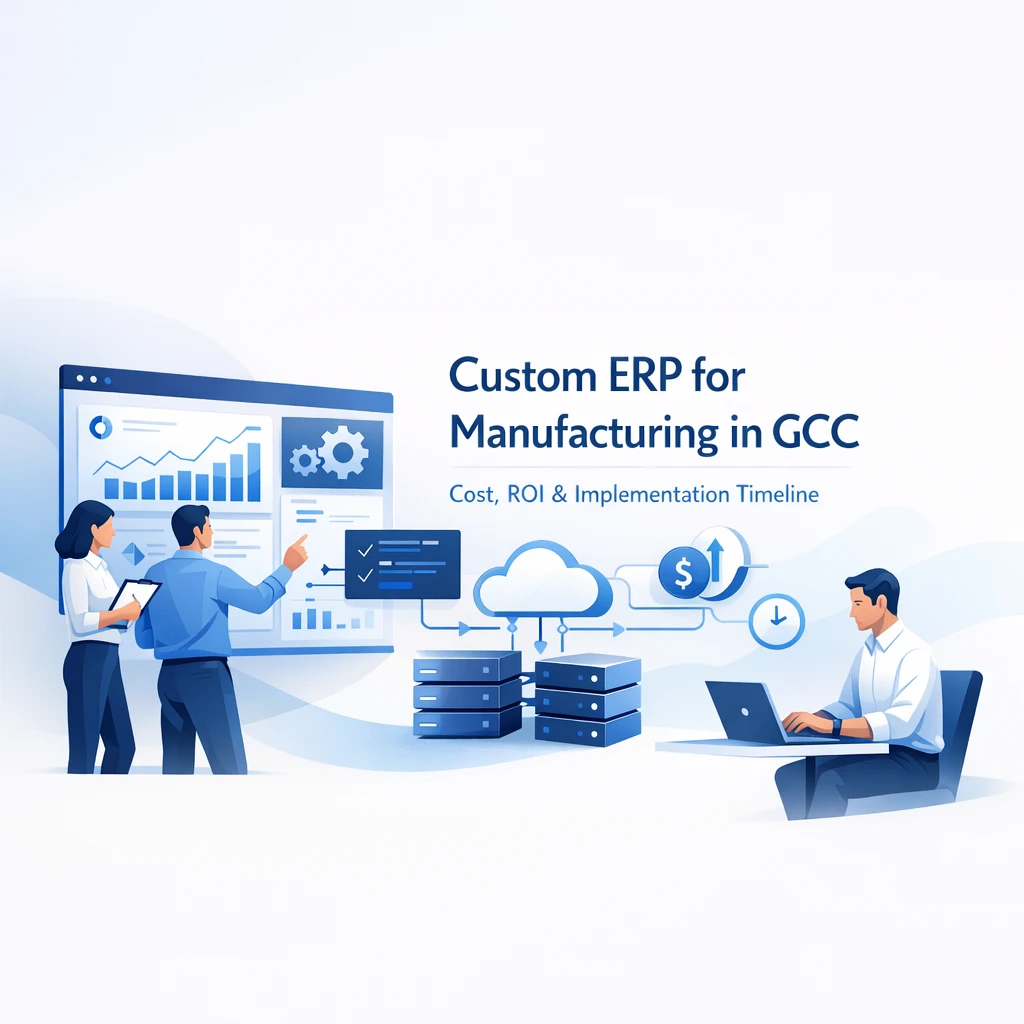
For GCC manufacturers aiming to scale ops, integrate supply chains, and improve responsiveness, a purpose-built ERP system can be a game changer. This guide breaks down what it takes to plan, price, and implement a custom ERP for manufacturing—covering cost ranges, ROI expectations, timelines, and practical steps you can apply today.
Introduction
Across Dubai, UAE, Saudi Arabia, Qatar, Oman, Kuwait, Bahrain, and beyond, manufacturers face growing demand, tighter schedules, and complex regulatory requirements. Off-the-shelf ERP solutions can help, but many SMBs and SMEs in the GCC market discover that generic software either overfits or under-delivers on their unique needs. A custom ERP tailored to manufacturing workflows—integrating engineering, planning, production, inventory, quality, maintenance, and analytics—offers the agility, scalability, and ROI that off-the-shelf options rarely achieve.
This article is written for business leaders planning software projects with budgets in the USD 5,000 to 200,000 range. It provides practical guidance, real-world considerations, and a thoughtful view of how a trusted partner like Triostack Technologies can help you design, build, deploy, and maintain a scalable ERP platform, whether you run a Dubai logistics hub, a GCC-based manufacturing plant, or a regional distribution network.
What is the Topic?
Custom ERP development for manufacturing means designing and delivering an enterprise resource planning system that is specifically crafted to support manufacturing workflows. It covers modules such as planning and scheduling, procurement, inventory and warehouse management, production execution, quality assurance, maintenance, financial integration, and reporting. Unlike generic ERP software, a custom solution is built to align with your processes, data models, KPIs, and regulatory requirements—so your technology becomes a business asset rather than a set of tools you must adapt to.
Why it Matters in 2026
Manufacturing in the GCC is undergoing rapid transformation driven by rising demand, digital acceleration, and a push toward regional manufacturing ecosystems. Key reasons to consider a custom ERP today include:
- Operational visibility: real-time production status, material availability, and order progress across multiple plants and hubs.
- Integrated quality and compliance: traceability, defect tracking, and regulatory reporting tailored to local standards (eg, GCC standards, ISO, and sector-specific guidelines).
- Demand-driven planning: advanced planning and scheduling that adapts to volatility in supply and demand.
- Cost discipline: tighter control of inventory, scrap, downtime, and maintenance costs.
- ROI acceleration: faster time-to-value through modular, phased implementations and a clear path to scaling across geographies.
For startups and established manufacturers alike, a well-governed, modular ERP can reduce manual work, improve data quality, and support data-driven decisions that drive cash flow and growth.
Current Industry Challenges
Manufacturers in the GCC region face common challenges that a tailored ERP can address:
- Fragmented systems: multiple point solutions for procurement, MES, inventory, and finance create data silos and reconciliation overhead.
- Complex supply chains: reliance on regional suppliers, fluctuating freight costs, and the need for just-in-time inventory.
- Regulatory compliance: adherence to GCC content, localization requirements, and industry standards.
- Downtime and maintenance: unplanned downtime hits throughput and margins; preventive maintenance requires reliable data capture.
- Change management: employees adapt to new processes; a lack of user adoption undermines ROI.
These challenges are solvable with a purpose-built ERP that aligns with your processes, data models, and regional realities—not just a generic software stack grafted onto your operations.
How the Technology Works
A custom manufacturing ERP typically combines core ERP capabilities with domain-specific components. The high-level layers include:
- Core ERP: finance, order management, and master data management.
- Manufacturing Execution: production planning, scheduling, shop floor control, and quality management.
- Supply Chain & Procurement: supplier management, purchase orders, inbound logistics, and warehouse operations.
- Inventory & Asset Management: stock levels, cycle counts, and maintenance scheduling.
- Analytics & BI: dashboards, reporting, and data-driven insights for operations and financial planning.
- Security & Compliance: access controls, auditing, and regulatory reporting.
The value comes from stitching these domains into a cohesive system that shares a single source of truth, supports automation, and enables seamless data flows across departments and locations.
Architecture Overview
Below is a typical architecture pattern for a custom ERP built for manufacturing in GCC markets. It emphasizes modularity, scalability, and secure integration with existing systems such as legacy ERP, CRM, and MES when needed.
- User Interface: responsive web frontend plus optional mobile apps for shop floor and field teams.
- Application Layer: domain services organized by bounded contexts (eg, production, inventory, procurement, finance).
- Data Layer: a unified data model with master data management, supporting analytics and reporting.
- Integration Layer: APIs and event-driven messaging to connect with suppliers, logistics partners, and equipment.
- Security & Compliance: identity management, role-based access, and audit trails.
- Infrastructure: cloud-hosted or hybrid deployment with CI/CD and automated testing.
Triostack Technologies adopts a pragmatic approach: start with core value streams, then progressively add domain modules as the business matures, reducing risk and time-to-value.
Architecture Diagram
Step-by-Step Workflow
- Discovery & Goals: map current processes, pain points, and KPI targets. Establish success criteria and a phased roadmap.
- Design & Data Modeling: create a canonical data model, define master data, and design domain boundaries.
- Development & Iteration: implement core modules, integrate with current systems, and run iterative sprints with stakeholder feedback.
- Testing & Quality Assurance: functional, integration, performance, and security testing with real data.
- Deployment & Change Management: staged rollout, user training, and documentation, followed by production cutover.
- Operations & Optimization: monitor KPIs, perform ongoing improvements, and scale modules as needed.
During each phase, maintain a transparent governance model and communication cadence to secure sponsorship and user adoption.
Business Use Cases
Below are representative use cases that resonate with manufacturing teams in the GCC region:
- Production Planning & Sequencing: optimize work orders, capacity, and material flow to maximize line throughput.
- Inventory Optimization: reduce excess stock while preventing stockouts through real-time consumption data.
- Quality & Compliance: enforce SOPs, record non-conformances, and generate regulatory reports automatically.
- Maintenance Management: proactive maintenance schedules based on equipment health data and usage.
- Cost-to-Serve Analytics: link manufacturing costs to orders, customers, and channels for profitability insights.
Industry Applications
While tailored to manufacturing, a custom ERP can support several industry verticals common in the GCC and global markets:
- Discrete manufacturing and contract manufacturing
- Chemical and specialty materials
- Food and beverage with traceability requirements
- Industrial equipment and machinery
- Logistics-focused manufacturing and assembly plants
Benefits
- End-to-end visibility: a single source of truth across procurement, production, inventory, and shipping.
- Faster time-to-value: modular, phased implementation reduces risk and accelerates ROI.
- Localization & compliance: built-in support for GCC localization, currency, tax, and regulatory reporting.
- Operational efficiency: automation of routine tasks, improved scheduling, and reduced waste.
- Strategic decision support: advanced analytics and scenario planning inform growth decisions.
Challenges
Even with a clear plan, several challenges commonly arise in ERP projects:
- Scope creep: expanding requirements can stretch timelines and budgets.
- Data migration: cleansing, mapping, and migrating legacy data require careful planning.
- Adoption resistance: user adoption depends on training, usability, and perceived value.
- Security & compliance: safeguarding sensitive data and meeting regional requirements.
Address these by defining a clear scope, staged delivery, strong data governance, and a robust change-management plan.
Common Mistakes
- Underestimating data governance needs during discovery.
- Over-customization that creates maintenance burden.
- Insufficient stakeholder alignment across production, finance, and supply chain teams.
- Ignoring cloud security and regulatory considerations in early design choices.
Best Practices
- Phased roadmap: deliver value in stages with measurable KPIs for each phase.
- Data-first design: define data ownership, data quality rules, and migration plan upfront.
- User-centered design: involve shop floor and management users in UI/UX decisions.
- Governance and security: implement RBAC, encryption, audit logs, and compliance reporting from day one.
- Continuous improvement: establish a backlog for optimization and leverage feedback loops.
Build vs Buy
Two common paths for manufacturing ERP projects: building a custom solution tailored to your processes or buying an off-the-shelf ERP and adapting your processes. The right choice depends on your goals, risk appetite, and budget.
| Aspect | Build (Custom ERP) | Buy (Off-the-shelf ERP) |
|---|---|---|
| Fit to processes | High; tailored to exact workflows | Medium; may require process changes |
| Time to value | Longer upfront, phased delivery | Quicker initial deployment |
| Cost uncertainty | Predictable but higher upfront capex | Lower upfront, ongoing licensing |
| Scalability | Designed for scalable growth | Depends on vendor roadmap |
| Control & IP | Full control of data and IP | Software IP belongs to vendor |
Estimated Development Cost
Understanding cost bands helps set expectations. The ranges below reflect typical SMB and SME ERP-related projects, including discovery, design, development, integration, and initial deployment. Actual prices vary by scope, region, data complexity, and vendor approach.
| Solution Type | Typical Range (USD) |
|---|---|
| Business Website | 5k – 15k |
| Customer Portal | 10k – 40k |
| CRM | 15k – 100k |
| ERP | 40k – 200k |
| AI Chatbot | 5k – 25k |
| AI Automation | 15k – 80k |
| SaaS MVP | 20k – 80k |
| Enterprise Web App | 30k – 200k |
Key cost drivers include scope breadth, data migration complexity, integration requirements, security and compliance needs, localization, and the level of automation and AI capabilities. A phased, milestone-driven approach reduces risk and helps you realize ROI sooner.
Recommended Technology Stack
While every project is unique, the following stack reflects common, production-grade choices for manufacturing ERP projects. Selection depends on your team skills, data strategy, and regulatory needs. Consider choosing a vendor who can tailor this stack to your environment and security posture.
| Layer | Recommended Options |
|---|---|
| Frontend | React or Angular; responsive design; offline support |
| Backend | Java Spring Boot or .NET Core; microservices or modular monolith |
| Database | PostgreSQL or MySQL for OLTP; Snowflake or Redshift for analytics |
| AI/ML | Python-based ML; MLflow for experiments; embeddings for chat and QA |
| Cloud & DevOps | AWS or Azure; Kubernetes; CI/CD; IaC (Terraform/ARM) | Monitoring |
| Security | OIDC with SSO, RBAC, encryption at rest in transit, DLP |
Future Trends
As manufacturing and digital transformation continue, ERP platforms will evolve with:
- AI-driven operations: predictive maintenance, demand forecasting, and quality analytics.
- IoT-enabled shop floors: real-time equipment data linked to production planning.
- Adaptive planning: flexible workflows that adjust to changing constraints and priorities.
- Edge computing: processing data near the source for lower latency in manufacturing environments.
- Data privacy & sovereignty: stronger localization and governance, particularly in GCC markets.
How Triostack Delivers Projects Globally
Triostack Technologies supports remote delivery from its India-based delivery centers, enabling scalable, high-quality software development for clients worldwide. Key aspects of our remote delivery model include:
- Agile discipline: iterative development with sprint planning, daily standups, and weekly demos.
- Communication cadence: regular updates via Slack, Teams, Zoom, or Google Meet with clear documentation in Jira or ClickUp.
- Version control & CI/CD: GitHub or GitLab for source control; automated CI/CD pipelines; blue/green deployments and cloud staging environments.
- Project governance: dedicated project managers; clear milestones; risk management and change control processes.
- Security & IP: NDA, strict access controls, secure data handling, and explicit IP ownership terms.
- Timezone overlap & English fluency: overlapping work hours with strong English communication for client teams in GCC, US, UK, Europe, and APAC.
- Team structure: product managers, tech leads, software engineers, QA, UI/UX, and DevOps specialists as needed.
- Long-term support: post-launch maintenance, optimization, and ongoing feature development.
- Why UAE clients outsource to India: cost efficiency, large talent pool, faster hiring, high quality engineering, and strong collaboration capabilities.
Case Studies (Anonymized)
Realistic, anonymized examples illustrate how manufacturing clients implemented custom ERP solutions. Each case highlights the industry, geography, challenges, and outcomes without disclosing sensitive details.
Dubai-based Logistics Company
Challenge: fragmented systems across warehousing, transportation, and billing led to delayed shipments and reconciliation pain.
Approach: phased ERP build focusing on warehouse management, transport planning, and integrated billing, with data migration from legacy systems and a unified analytics dashboard.
Outcome: 22% reduction in average order cycle time, real-time visibility across 3 facilities, and improved on-time delivery rates.
UAE Healthcare Clinic Network
Challenge: disparate patient management, inventory for medical supplies, and regulatory reporting inefficiencies.
Approach: custom ERP with patient scheduling, inventory control, and quality/compliance modules tailored to healthcare workflows.
Outcome: improved inventory turnover, faster regulatory reporting, and a cohesive view of patient services across clinics.
Saudi Retail Manufacturer
Challenge: demand volatility, supplier variability, and limited production visibility impacting margins.
Approach: integrated ERP with demand planning, supplier collaboration, and production scheduling for multiple product lines.
Outcome: 15% cost-to-serve improvement and more accurate production planning that reduced stockouts.
Australian Startup
Challenge: scaling operations quickly with limited resources, needing a lean ERP to support growth.
Approach: MVP ERP focusing on core production, inventory, and finance, followed by modular enhancements.
Outcome: faster market entry and a clear pathway for further automation and analytics.
UK-based SaaS Company
Challenge: manufacturing overlay requiring tight integration with a SaaS platform, multi-site operations, and regulatory compliance.
Approach: hybrid architecture with API-first services, robust data governance, and scalable production planning.
Outcome: scalable operations across geographies with improved customer delivery metrics.
Pricing Factors and Guidance
Pricing for ERP-related projects depends on several levers. Consider the following factors when budgeting for a GCC manufacturing ERP:
- Scope breadth: number of modules, workflows, and localization requirements.
- Data migration: data cleansing, mapping, and conversion complexity.
- Integrations: connections to suppliers, logistics partners, legacy systems, and IoT devices.
- Customization: level of domain-specific tailoring and rule engines.
- Security & compliance: RBAC, auditing, encryption, and regulatory reporting.
- Change management: user training, documentation, and adoption strategies.
- Cloud vs on-prem: deployment model, scalability, and maintenance costs.
For SMBs and SMEs in the GCC, a pragmatic plan often begins with a core ERP module set, followed by phased extensions. This approach accelerates ROI while keeping risk in check.
Delivery Timeline and Roadmap
While every project is unique, a typical phased timeline for a manufacturing ERP in the USD 5k–200k range looks like:
| Phase | Timeline (weeks) | Core Deliverables |
|---|---|---|
| Discovery & Design | 3–6 | Process mapping, data model, architecture plan, success metrics |
| Beta Modules & Integration | 6–12 | Core ERP + production planning + inventory + basic integrations |
| Pilot & Validation | 4–8 | User acceptance, data migration validation, QA pass |
| Production Rollout | 6–12 | Full deployment, training, go-live support |
In practice, variable factors such as regulatory readiness, supplier onboarding, and data quality can shift timelines. A trusted partner helps manage the plan with transparent milestones and regular demos to keep stakeholders aligned.
Workflow Diagram
Deployment Diagram
Thinking Ahead
Businesses planning similar solutions often benefit from experienced software development partners who understand both manufacturing processes and regional requirements. If you're evaluating a custom ERP project, Triostack can help you design, build, deploy and maintain a scalable solution that fits your goals and budget.
Consider engaging early with a partner who can offer strategic consulting, technical depth, and a plan that aligns with your growth trajectory.
Frequently Asked Questions
- What is the typical ROI window for a custom manufacturing ERP?
- ROI varies by scope and adoption, but many clients see payback within 12–24 months after go-live through reduced waste, better throughput, and improved inventory turns.
- How long does it take to implement a custom ERP?
- Phased programs often span 6–12 months for core modules, with ongoing enhancements in subsequent quarters. A smaller MVP may be delivered in 3–6 months.
- Can ERP scale across multiple GCC countries?
- Yes. A well-architected ERP supports localization, multi-site operations, and centralized governance, with regions like UAE, Saudi Arabia, and Qatar in scope.
- What about data security and IP ownership?
- Security is embedded by design, including RBAC, encryption, and secure APIs. IP ownership is typically defined in the contract, with NDA and clear termination clauses.
- What is the role of AI in a manufacturing ERP?
- AI can support demand forecasting, predictive maintenance, quality analytics, and process optimization, delivered in modular components to minimize risk.
Conclusion
A custom ERP for manufacturing in the GCC can unlock efficiency, improve visibility, and accelerate growth. By starting with a clear plan, choosing a pragmatic phased approach, and partnering with a provider that understands both manufacturing and regional realities, you set your organization up for sustained ROI and scalable success. Triostack Technologies is positioned to support this journey—from discovery through deployment and beyond—with a broad portfolio of services designed to address modern manufacturing challenges.
Triostack Team
Technology Evangelist & Writer
Triostack Team is an experienced writer and technologist, exploring the intersections of AI, cloud architecture, and modern application development. Passionate about turning complex technical concepts into accessible insights.