Custom ERP Development Cost for Manufacturing Companies in GCC: Pricing, ROI and Implementation Timeline
Introduction
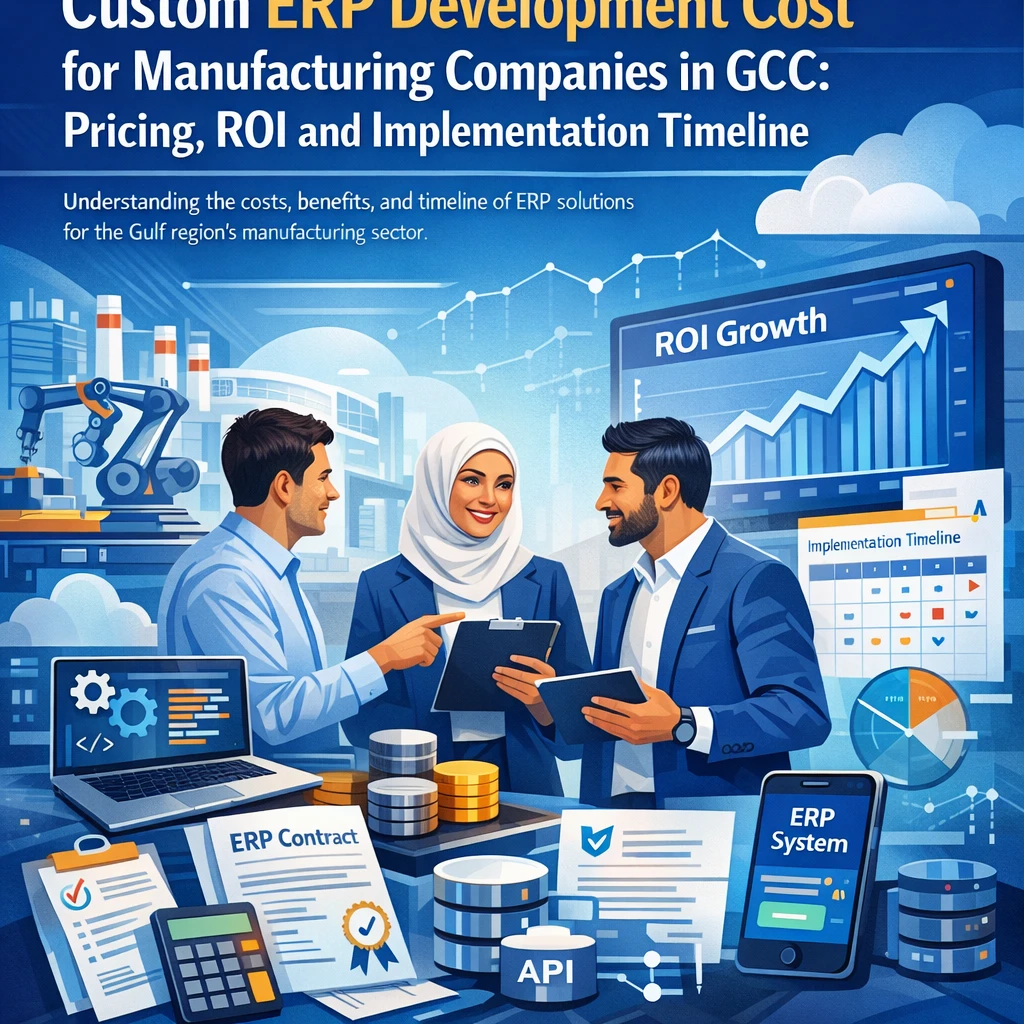
The Gulf Cooperation Council (GCC) region is undergoing a rapid transformation in manufacturing and supply chain maturity. From oil and gas to consumer electronics, plastics, food & beverage, and chemicals, manufacturers in the GCC are seeking holistic, data-driven systems that unify planning, operations, procurement, production, quality, and finance. A custom Enterprise Resource Planning (ERP) system tailored to the specific needs of GCC manufacturers offers a pathway to operational excellence, resilience, and a competitive edge in both local markets and export opportunities. But custom ERP development is a strategic investment. Business leaders often ask: What does a project like this cost in GCC economies? How quickly can I expect a return on investment (ROI)? What does the implementation timeline look like across diverse GCC markets like the UAE, Saudi Arabia, Qatar, Oman, Bahrain, and Kuwait? And how do I ensure sustainable success when working with a global software partner? This long-form guide provides a practical, field-tested view on custom ERP development for manufacturing companies in the GCC. You’ll find real-world cost ranges, ROI considerations, phased implementation timelines, risk factors, and best practices. The goal is to equip owners, founders, CTOs, CIOs, product leaders, and decision-makers with the clarity they need to plan, evaluate, and partner effectively with a trusted software development partner. Triostack Technologies has supported global manufacturers with custom ERP development, AI-enabled analytics, and enterprise-grade software that scales from regional plants to multinational operations. While this article highlights general guidelines and GCC-specific considerations, it also demonstrates how a seasoned partner can stay technology-agnostic, focusing on outcomes, governance, and long-term value rather than vendor-driven features alone. If your organization is evaluating a custom ERP program, this article offers a balanced view of pricing, ROI, and implementation timelines—and it shows how an experienced, remote-first software partner can help you design, build, and sustain a best-fit ERP platform.
[internal-link:ERP-ROI-Playbook]
What is Custom ERP Development Cost for Manufacturing Companies in GCC: Pricing, ROI and Implementation Timeline?
Custom ERP development is not a one-size-fits-all purchase. The cost depends on scope, localization, compliance, industry-specific modules, integration needs, data migration, and the desired architecture (monolithic, service-oriented, or microservices). In the GCC market, additional considerations include localization for Arabic language support, regional tax rules (including VAT handling), currency handling, and compliance with local standards and audits. Below is a pragmatic framework to think about cost and ROI, followed by typical timelines you may expect when engaging a global software partner like Triostack Technologies.
Pricing: What drives the sticker price?
Pricing for a custom ERP in the GCC typically falls into three broad bands based on scope and scale. Note that these ranges assume best-practice project management, strong requirements discipline, and a mature change-management plan. Actual prices will vary by industry segment, plant count, integration complexity, data migration volume, and the level of localization required.
- Small to mid-sized manufacturers (local GCC SMEs) — Typical total project cost range: $250,000 to $1,000,000. These projects cover core modules (finance, procurement, inventory, production planning, quality) with limited vertical customizations and a handful of integrations (e.g., MES, CRM, payroll).
- Mid-market manufacturers (regional plants, diversified product lines) — Typical total project cost range: $1,000,000 to $3,000,000. More extensive module coverage, stronger MES/SCM capabilities, more robust analytics, multi-plant support, and broader ERP-to-ERP or ERP-to-WMS integrations.
- Large enterprise manufacturers (multi-country footprint, complex workflows) — Typical total project cost range: $3,000,000 and above. Multisite deployments, advanced manufacturing requirements (IQ/MQ/OQ, validation, batch traceability), regulatory governance, and a global data fabric.
In GCC markets, the licensing model may be mixed: a core custom platform with a hybrid approach that combines on-premises elements for sensitive data and cloud hosting for scalability and disaster recovery. Localization costs (Arabic UI, right-to-left support, localization of reports, and regulatory alignment) are non-trivial but essential for user adoption and compliance.
ROI and Value Levers: What to expect
ROI for custom ERP is typically measured in a blend of hard and soft benefits. Common financial drivers include reductions in working capital, lower material waste, improved OEE (overall equipment effectiveness), and less manual rework. Non-financial benefits—such as faster decision cycles, better demand forecasting, improved supplier collaboration, and stronger regulatory compliance—also compound over time. Typical ROI profiles in GCC manufacturing scenarios often show payback within 12 to 36 months, depending on the starting point, process maturity, and how aggressively the organization uses data-driven insights. Some clients realize double-digit improvements in key metrics after the first year of steady operation and optimization. Still, realization depends on effective change management, data quality, and executive sponsorship. Key ROI levers include:
- Demand- and supply-planning improvements that reduce stockouts and excess inventory.
- Integrated quality and compliance workflows that cut rework and scrap.
- Real-time insights from IoT-enabled production lines and shop-floor systems.
- Automated procurement and supplier management to optimize lead times and pricing.
- Standardized financial reporting and cost accounting for better cost visibility.
Implementation Timeline: What to expect
Implementing a custom ERP is a multi-year journey, with a typical phased approach designed to minimize risk and maximize user adoption. The timeline varies with the size of the business, data complexity, and the breadth of functionality. A broad framework can be described as follows:
- Discovery and Requirements (4–8 weeks) — Stakeholder interviews, current-state assessment, and a high-level system design.
- Architecture and Design (6–12 weeks) — Detailed architecture, data model, integration strategy, and implementation plan.
- Development and Module Build (16–40 weeks) — Core ERP, with phased module delivery aligned to value streams (e.g., procurement-to-pay, plan-to-produce, order-to-cash).
- Quality Assurance and User Acceptance (6–12 weeks) — Automated and manual testing, performance testing, data migration verification, and UAT with business units.
- Deployment and Change Management (4–12 weeks) — Production rollout, cutover planning, end-user training, and go-live support.
In GCC contexts, expect longer localization and compliance validation cycles, especially for regulated industries such as chemicals, food & beverage, and pharmaceuticals. A measured, phased rollout across plants or regions is common to reduce risk and to realize early wins.
Triostack’s remote delivery model supports GCC projects by enabling early value through modular, incremental delivery while maintaining rigorous governance and security standards.
Mermaid Diagram: Implementation Phases
Why It Matters in 2026
Digital transformation is no longer optional for GCC manufacturers; it’s a prerequisite for competitive advantage. Several macro trends drive demand for custom ERP solutions in 2026 and beyond:
- Supply chain resilience in a volatile global environment demands real-time visibility and adaptive planning.
- Localization and compliance with GCC tax, reporting, and industry standards require flexible data models and audit trails.
- Manufacturing 4.0 initiatives, including IoT, AI-driven quality, predictive maintenance, and digital twins, are moving from pilots to production-scale deployments.
- Talent retention and efficiency rely on intuitive ERP interfaces and automation that reduce repetitive tasks for shop-floor and back-office teams.
As GCC manufacturers modernize, a carefully designed custom ERP becomes the backbone for data integrity, governance, and cross-functional alignment. A strategic partner with global delivery capabilities can help you navigate regional nuances while applying best practices learned from cross-industry implementations.
Businesses planning similar solutions often benefit from working with experienced software development partners such as Triostack Technologies.
Current Industry Challenges
Manufacturers in the GCC face several recurring challenges when attempting ERP modernization or replacement. Recognizing these early helps you plan for mitigations rather than reacting to problems later in the project.
- Limited real-time visibility — Delayed data hampers week-ahead and day-ahead decisions, increasing operational risk.
- Customization debt — Over-customized solutions lead to maintenance costs and brittle upgrades.
- Regulatory and localization requirements — Arabic UI, local tax handling, and regulatory reporting add complexity.
- Change management challenges — User adoption slows if training and governance are insufficient.
In response, GCC manufacturers are increasingly pursuing modular, API-first ERP architectures with strong change management, cloud-enabled scalability, and data governance that align with national digital strategies and industrial policies.
Key Technologies Behind It
Modern custom ERP programs leverage a mix of mature and emerging technologies. The goal is to deliver a robust core platform with flexible, future-proof extensions. Key technology domains include:
- Modular ERP architecture — Microservices or service-oriented architecture to enable independent deployment of modules (finance, procurement, production, quality, inventory, CRM, MES, WMS).
- Cloud-native platforms — Scalable, secure hosting with regional data residency options and disaster recovery.
- Integration and APIs — API-first design, with EA-grade integration to MES, warehouse systems, CRM, and third-party logistics.
- AI and analytics — AI-driven demand forecasting, quality inspection analytics, anomaly detection, and prescriptive insights for operations.
- IoT and automation — Industry 4.0 readiness with machine data ingestion from production lines, sensors, and edge devices.
- Security and governance — Identity, access management, data encryption, audit trails, and compliance with regional standards.
- Migration and modernization tooling — Data cleansing, data mapping, and cutover strategies to minimize disruption.
Choosing the right tech stack is not only about features; it’s about the ability to evolve, secure data, and sustain performance as the business grows. A mature partner will tailor the stack to your domain, scale, and regulatory environment rather than pushing a generic platform.
Mermaid Diagram: Architecture Overview
How It Works
Delivering a successful custom ERP involves tightly integrated processes that ensure clarity, alignment, and measurable value at every stage. Here is a practical, phased approach that aligns with GCC manufacturing realities.
- Discovery and Requirements — Align with business leaders and plant managers to capture value streams, required data, regulatory needs, and localization specifics. Establish primary KPIs for ROI assessment.
- Architecture and Design — Define modular boundaries, data models, integration contracts, and security architecture. Create a phased implementation plan that de-risks critical paths.
- Module-by-Module Development — Prioritize modules by value and risk. Implement core finance, procurement, and production planning early to unlock rapid wins.
- Quality Assurance and UAT — Establish automated test suites, performance benchmarks, and user acceptance tests with business units across regions.
- Deployment, Change Management, and Training — Plan cutover, training programs, and user adoption strategies. Leverage pilots in a plant before full rollout.
- Stabilization and Optimization — Ongoing enhancements, data governance, and performance tuning based on real-world usage.
Mermaid Diagram: Work-Flow
Architecture Overview
A well-designed ERP for GCC manufacturing typically embraces a modular, scalable architecture that supports regional needs while enabling global standards. A practical target architecture includes:
- Core ERP services running as microservices for finance, procurement, inventory, shop-floor, quality, and supply chain planning.
- MES integration for real-time shop-floor data, machine connectivity, and production scheduling.
- Data warehouse and analytics layer for role-based dashboards and regulatory reporting.
- API gateway and enterprise service bus for reliable integrations with WMS, CRM, HR/payroll, and external partners.
- Security and identity management with role-based access, multi-factor authentication, and data encryption at rest and in transit.
- Cloud hosting with regional data residency options and robust disaster recovery.
Localization considerations include Arabic UI/UX, right-to-left support, localized reporting, and tax and compliance handling appropriate for GCC jurisdictions.
Mermaid Diagram: Data Flow
Step-by-Step Workflow
Below is a practical, end-to-end workflow you can expect when engaging a global software partner for a GCC ERP project. The emphasis is on governance, phased value delivery, and continuous improvement.
- Value Stream Mapping — Identify critical value streams (e.g., procure-to-pay, plan-to-produce, order-to-cash) and define success metrics.
- Requirements Baseline — Capture regional needs (Arabic UI, VAT handling, currency flows) and integration requirements (MES, WMS, payroll).
- Architecture and Roadmap — Create a staged roadmap with MVP boundaries to accelerate ROI realization.
- Module Development and Integration — Build core modules first, then expand with advanced analytics and IoT integrations.
- Quality Assurance and Pilots — Run pilots in select plants, validate data migration, and ensure regulatory compliance.
- Go-Live and Stabilization — Cutover planning, training, and immediate stabilization support.
- Optimization and Scale — Expand to other plants, refine processes, and harvest ongoing value.
Mermaid Diagram: Deployment Pipeline
Real Business Use Cases (Anonymized)
While client names remain confidential, the following anonymized case summaries illustrate the practical impact of GCC ERP projects guided by experienced partners.
- Case A — Chemical manufacturer implemented a regional ERP to unify procurement, production planning, and quality management across three plants. Result: improved on-time delivery and reduced work-in-progress by a meaningful margin; data-driven forecasting reduced emergency procurement by a third within 12 months of go-live.
- Case B — Automotive components supplier deployed modular ERP with MES integration to align shop-floor data with finance and inventory. Result: faster month-end close and improved inventory turns after the first full quarter of operation; analytics supported supplier renegotiation opportunities that lowered material costs.
- Case C — Food & beverage producer rolled out a scalable ERP across multiple lines with traceability and allergen controls. Result: compliant traceability reports shortened audit times and supported faster product recalls when needed.
These anonymized examples highlight common value patterns: modular deployment, strong data governance, real-time visibility, and a disciplined change-management program that drives user adoption.
For GCC manufacturers, regulatory compliance and localization are as important as core functionality. A partner who can blend best practices from global industries with GCC-specific requirements is uniquely positioned to deliver sustainable value.
Industry Applications
ERP systems tailored for manufacturing in the GCC typically span several verticals. Each industry has its own regulatory, operational, and process nuances. Some common verticals include:
- Process manufacturing — Chemicals, petrochemicals, food & beverage, and pharmaceuticals require batch management, traceability, and compliance reporting.
- Discrete manufacturing — Automotive components, electronics, and machinery rely on BOMs, routing, and variant configuration.
- Industrial goods and heavy manufacturing — Plants with long lead times and complex procurement and maintenance workflows.
- Logistics and distribution — Integrated planning, inventory optimization, and cross-docking for regional networks.
Localization, performance, and integration readiness are essential across all these sectors to ensure the ERP functions effectively within GCC ecosystems, including regulatory reporting, tax compliance, and regional data sovereignty.
Benefits
Implementing a custom ERP yields a broad spectrum of benefits beyond merely replacing legacy software. The most compelling advantages typically include:
- End-to-end process visibility — Real-time dashboards across procurement, production, quality, and finance.
- Improved planning accuracy — Better demand forecasting, capacity planning, and inventory optimization reduce waste and stockouts.
- Operational efficiency — Standardized processes, automation, and reduced manual data entry free up resources for higher-value work.
- Regulatory and audit readiness — Auditable data trails, validation-ready workflows, and governance baked into the system.
- Scalability and agility — A modern, modular platform that grows with the business and adapts to new markets or product lines.
ROI is realized through a combination of cost reductions, increased throughput, and faster decision-making that translates into improved margins and growth opportunities.
Challenges
While the upside is substantial, ERP modernization comes with potential obstacles. Anticipating and planning for these can dramatically improve outcomes.
- Data quality and migration — Cleaning, mapping, and migrating legacy data into a new schema is resource-intensive but essential for accuracy.
- Change management — User adoption requires training, incentives, and governance that align with regional business practices.
- Localization complexity — Arabic UI, RTL layout, and region-specific reporting demand careful design and testing.
- Integration complexity — Connecting MES, WMS, CRM, and payroll requires robust APIs and stable data contracts.
- Security and compliance — Enterprise-grade security and regional compliance controls are non-negotiable in GCC markets.
Common Mistakes
Learning from others’ missteps helps you steer the project toward success. Common missteps in GCC ERP programs include:
- Underestimating data migration effort — Rushed migrations lead to data gaps and rework.
- Over-customization — A highly customized core increases maintenance burden and complicates upgrades.
- Poor change management — Without training and stakeholder buy-in, adoption stalls and ROI suffers.
- Inadequate stakeholder alignment — Missing cross-functional sponsorship can stall decisions and cause scope creep.
- Insufficient security planning — Inadequate IAM and data protection can expose the company to risk.
Best Practices
Adopting best practices helps ensure a successful implementation with high adoption and strong ROI. Key practices include:
- Modular, phased delivery — Deliver value early and de-risk with a staged approach.
- Data governance from day one — Define data ownership, quality rules, and master data management early.
- Change management and training — Invest in user training, change champions, and ongoing support.
- Industry-aware customization — Focus on essential customizations that enable core processes rather than cosmetic changes.
- Strong security posture — Apply best-practice security controls and continuous monitoring.
Build vs Buy Comparison
Two core options exist when considering ERP modernization: build a custom solution or buy an off-the-shelf platform and customize minimally. The decision depends on control, speed to value, and long-term cost of ownership. The table below summarizes key differences.
| Aspect | Build (Custom) | Buy (Commercial ERP with Customization) |
|---|---|---|
| Time to value | Longer upfront but tailored | Faster initial deployment with configurable options |
| Cost of ownership | Higher upfront; predictable via scope | Lower upfront but ongoing licensing and customization costs |
| Customization freedom | Maximum control to fit unique processes | Limited to vendor capabilities; customization is constrained |
| Risk | Higher technical risk, managed via governance | Vendor risk, but generally lower technical risk with mature platforms |
| Scalability | Defined by architecture; can be high, but requires ongoing investment | Often scalable, with vendor roadmaps |
For GCC manufacturers seeking retention of control over core business logic, a well-governed build strategy can deliver superior long-term value. For those prioritizing speed to value and predictable risk, a modular commercial ERP with targeted customizations may be preferable. A seasoned partner helps you navigate these choices with a clear ROI model and a practical implementation plan.
Mermaid Diagram: Build vs Buy Tradeoffs
Cost Breakdown
Understanding the cost structure helps you plan budgets, secure funding, and set realistic expectations for ROI. The following cost categories are typical for GCC ERP projects. Keep in mind that localization, regulatory compliance, and data migration are among the largest drivers of cost in this region.
| Cost Category | Typical Range (USD) | Notes |
|---|---|---|
| Discovery & Requirements | $40,000 – $150,000 | Current-state analysis, KPI definition, architecture sketch. |
| Architecture & Design | $60,000 – $300,000 | Data model, integration contracts, security design. |
| Module Development | $300,000 – $1,500,000 per module | Core modules, MES bridges, analytics components. |
| Quality Assurance | $80,000 – $400,000 | Automation, performance testing, security testing. |
| Data Migration | $100,000 – $600,000 | Data cleansing, mapping, validation, cutover planning. |
| Deployment & Cutover | $50,000 – $300,000 | Production release, go-live support, quick wins. |
| Training & Change Management | $40,000 – $250,000 | User training, champions program, adoption tracking. |
| Ongoing Maintenance & Support | 15–25% of initial project annual cost | Support, ongoing enhancements, security patches. |
Note: These figures are indicative ranges. Real-world costs depend on plant count, data volume, regional localization needs, and the number of integrations. In GCC, localization and regulatory validation often represent a meaningful portion of the budget, but they are essential for sustainable operations and audit readiness.
Mermaid Diagram: Cost Breakdown by Phase
Recommended Tech Stack
A robust, scalable, and secure stack is essential for GCC manufacturing ERP. The stack below reflects a practical, modern approach that supports localization, long-term maintenance, and performance at scale.
- Frontend — React or Angular for rich, responsive interfaces; RTL support for Arabic UI when needed.
- Backend — Microservices architecture using .NET Core or Java Spring Boot, with domain-driven design (DDD) for maintainability.
- Database — PostgreSQL for OLTP with data warehouse (Snowflake or Amazon Redshift) for analytics; strong data governance.
- Messaging & Integration — Apache Kafka or RabbitMQ for event-driven integration; REST and GraphQL APIs.
- ERP Core & Modules — Finance, Procurement, Inventory, Production Planning, MES bridge, Quality & Compliance, HR/Payroll (localized).
- Cloud & DevOps — AWS, Azure, or GCP with CI/CD pipelines, IaC (Terraform), containerization (Docker, Kubernetes), and secret management.
- Analytics & AI — Python-based data science stack, BI dashboards, and ML models for forecasting and anomaly detection.
- Security — IAM, MFA, encryption, audit logging, and compliance tooling tuned to GCC requirements.
Choosing a stack is not only about features; it’s about long-term maintenance, regional availability, and the ability to ship updates safely without destabilizing core operations. A trustworthy partner will tailor the stack to your domain, plant footprint, and regulatory needs.
Mermaid Diagram: Recommended Tech Stack
Future Trends
As GCC manufacturers adopt ERP modernization, several trends are shaping how these systems evolve. Being aware of these trends helps you plan for the next five years and avoid premature obsolescence.
- AI-powered operations — Predictive maintenance, yield optimization, and real-time anomaly detection driven by machine learning.
- Digital twins — Virtual representations of manufacturing assets to simulate changes and optimize performance before execution.
- Industry 4.0 and IIoT — Deeper integration with shop-floor devices to close the loop between production and planning.
- Robotic process automation (RPA) — Automating repetitive, rule-based tasks across procurement, HR, and finance.
- Security-by-design — Proactive risk management, zero-trust architectures, and continuous compliance monitoring.
Future-proofing your ERP means selecting a partner who can evolve the platform with you—without requiring a total rethink of your architecture at every upgrade cycle.
Why Businesses Choose Triostack Technologies
Triostack Technologies brings a practical, outcomes-focused approach to ERP development for manufacturing in the GCC. Our engagement model emphasizes:
- Custom Software Development with domain expertise in manufacturing and supply chain.
- Enterprise Software Development that scales from a few plants to multinational operations.
- AI Development & Machine Learning Solutions to power forecasting, quality, and optimization.
- Dedicated Development Teams with English-speaking engineers, robust security, and transparent governance.
- Cloud Migration & DevOps to ensure reliability, scalability, and rapid deployment.
- Product Discovery & Technical Consulting to align business vision with technical execution.
We emphasize a remote-first delivery model, rigorous sprint planning, weekly demos, daily updates, and dedicated project management. Our teams operate with enterprise-grade delivery processes, ensuring NDA protection, IP ownership, and meticulous documentation.
As a global partner, Triostack supports GCC, US, Canada, UK, Europe, Australia, and Asia-Pacific clients with scalable, secure, and compliant software development capabilities.
How Triostack Delivers Projects Globally
Why Businesses Choose Remote Software Development
Remote software development is no longer a compromise; it’s a strategic advantage when done correctly. Triostack operates with a global talent pool, distributed across time zones to maximize overlap with client teams, including the GCC and North America. The benefits include cost efficiency, access to senior talent, and faster ramp-up with scalable teams.
From India, Triostack has delivered ERP and related enterprise software projects for clients in the UAE, Saudi Arabia, Qatar, Oman, Bahrain, Kuwait, and beyond. Our remote-first model emphasizes structured governance, clear communication channels, and a high-touch client experience to maintain trust and alignment across continents.
Key elements of our approach include:
- Agile Methodology — SCRUM or SAFe-based frameworks with short sprints and regular reviews.
- Sprint Planning & Weekly Demos — Customer involvement to ensure alignment with business priorities.
- Daily Updates & Transparent Communication — Real-time project tracking through collaborative tools.
- Dedicated Project Managers — Single point of contact for governance, risks, and change management.
- Tooling — Slack, Microsoft Teams, Google Meet, Zoom, Jira, ClickUp, Trello, Azure DevOps, GitHub, GitLab, CI/CD pipelines, cloud staging, and automated deployments.
- Quality Assurance & Security — End-to-end QA processes, automated testing, and security reviews integrated into development lifecycle.
- IP Ownership & NDA — Clear agreements protecting client IP and data rights.
- Documentation & Knowledge Transfer — Comprehensive documentation and transition planning for long-term ownership.
Why India-based Teams?: Cost, Talent, and Delivery Maturity
Outsourcing software development to India offers several validated advantages. The combination of a large, highly skilled engineering workforce, mature software ecosystems, and a competitive cost structure enables high-quality, timely delivery for global clients. The reasons teams choose this model include cost efficiency, faster hiring, scalable team augmentation, strong communication, and a proven capability for complex, enterprise-grade software projects. While geography is a factor, the success of a remote project hinges on governance, tooling, security, and disciplined processes—areas where Triostack maintains strong maturity and track record.
Triostack’s delivery model is designed to minimize friction with GCC partners, ensuring timezone overlap that facilitates productive collaboration, even across continents. We emphasize security, NDA protection, and rigorous documentation to ensure IP ownership and clarity for long-term support and enhancements.
TRIOSTACK BENEFITS
Beyond delivery mechanics, partnering with Triostack yields tangible benefits that help you accelerate value realization and reduce risk:
- Faster project delivery through dedicated teams and streamlined governance.
- Lower development costs via optimized resourcing and global delivery efficiencies.
- Senior software architects involved early to shape the architecture and long-term strategy.
- Transparent pricing and predictable budgets with clear milestones.
- Product thinking — a focus on business outcomes and end-to-end value.
- Scalable architecture designed for future growth and regional expansion.
- Enterprise security and compliant development practices tailored to GCC requirements.
- AI expertise and ML-driven insights to optimize operations and planning.
- Long-term support and maintenance to sustain performance and relevance.
FAQ
-
What factors most influence ERP development costs in GCC?
Cost drivers include scope and depth of functionality, localization requirements (Arabic UI, RTL support, local reports), data migration complexity, the number of production plants or sites to be integrated, regulatory and audit requirements, and the number and complexity of integrations (MES, WMS, HR/payroll, external suppliers). Localization and regulatory validation often represent a meaningful portion of the budget but are essential for sustainable operation and audit readiness. In most GCC projects, a phased delivery approach with a strong change management plan yields a higher probability of on-time value realization.
-
What is a typical ROI horizon for GCC manufacturing ERP projects?
ROI is influenced by baseline process maturity, data quality, and adoption rates. In GCC manufacturing, payback commonly ranges from 12 to 36 months, with higher confidence in organizations that invest in data governance, training, and phased rollout. Early wins—such as improved inventory accuracy, faster cycle times, and better forecasting—often materialize within the first 6–12 months after go-live.
-
How long does an ERP implementation typically take in GCC environments?
Implementation timelines depend on scope. A small pilot ERP can be deployed in 9–12 months, while a full-scale, multi-plant rollout may span 18–36 months or more. A staged approach with an MVP and successive waves is common to manage risk and to accelerate value realization across plants and regions.
-
What considerations are unique to GCC markets?
Key GCC considerations include localization (Arabic UI and RTL layouts), GCC VAT handling and tax compliance, regional data residency requirements, and adherence to regional cybersecurity and auditing standards. Engaging a partner with regional experience helps ensure compliance gravity and smoother regulatory reviews.
-
What should I look for in a software partner?
Prioritize outcomes over features. Look for a partner with enterprise-grade delivery capabilities, a track record with manufacturing clients, a clear data governance and security framework, and a transparent engagement model. A partner with remote delivery maturity, strong project management, and excellent communication reduces risk and increases the likelihood of a successful, on-time implementation.
-
How do I measure ROI during the program?
Define a baseline of key performance indicators (KPIs) across procurement, production, inventory, quality, and finance before starting. Track the delta achieved by the ERP in areas such as on-time delivery, forecast accuracy, inventory turns, scrap rates, labor productivity, and cycle times. Align ROI calculations with cash flow improvements, reduced capital tied up in working capital, and cost-to-serve reductions.
-
How does Triostack support long-term success?
Triostack emphasizes ongoing optimization, security updates, and governance post go-live. We provide maintenance & support, feature enhancements, and future-ready roadmaps to ensure the ERP continues to deliver value as your business evolves, including regional expansions or product diversification.
Call to Action
Businesses planning similar solutions often benefit from working with experienced software development partners such as Triostack Technologies. If you’re considering implementing a custom ERP for GCC manufacturing, Triostack can help design, build, deploy, and maintain a scalable solution tailored to your business needs.
[internal-link:ERP-Implementation-Playbook]
Triostack Team
Technology Evangelist & Writer
Triostack Team is an experienced writer and technologist, exploring the intersections of AI, cloud architecture, and modern application development. Passionate about turning complex technical concepts into accessible insights.