CRM Development vs SaaS CRM in Real Estate: What Delivers Better ROI for Dubai Agencies?
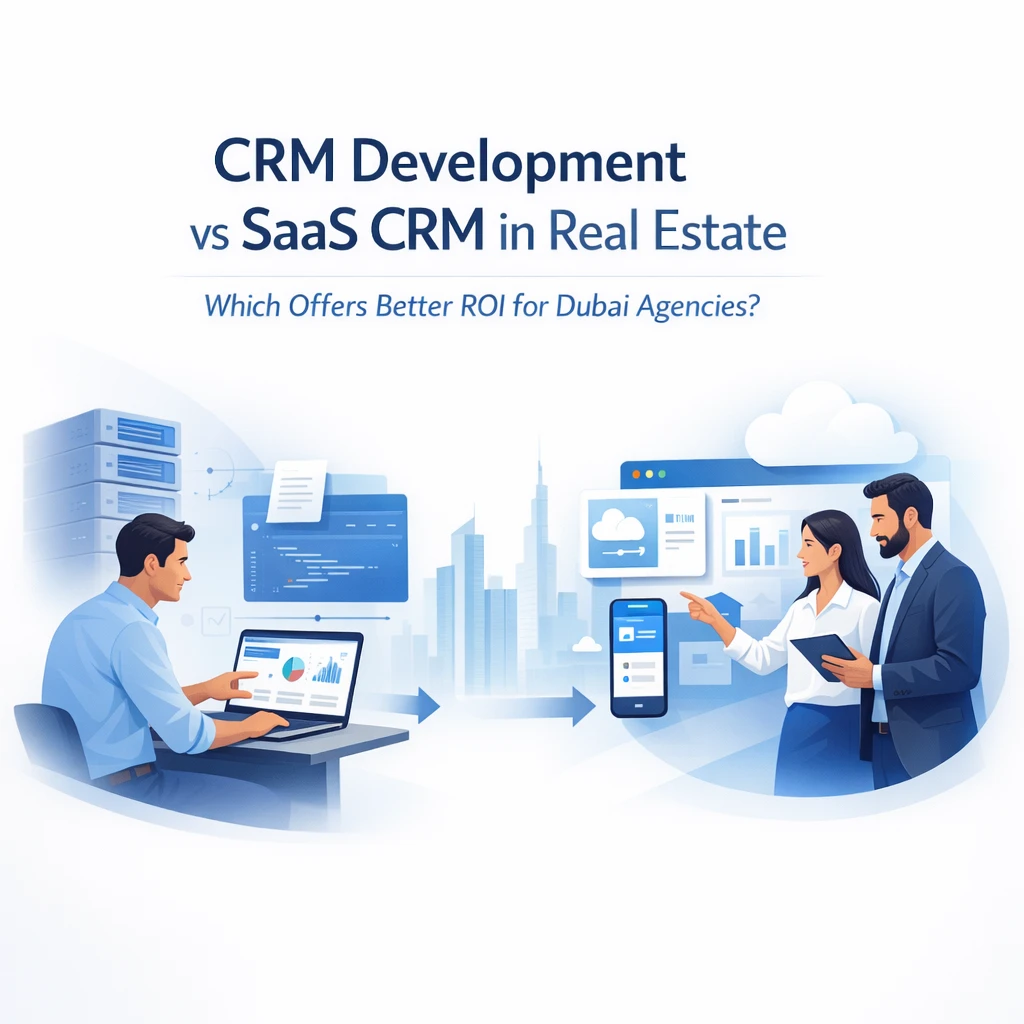
Real estate businesses operate on relationships, data, and speed. In fast-moving markets like Dubai, where property transactions, tenant management, and investment cycles hinge on timely information, the right Customer Relationship Management (CRM) strategy can either accelerate growth or become a bottleneck. The debate often comes down to two paths: building a custom CRM from scratch (CRM development) or adopting a Software-as-a-Service (SaaS) CRM. This guide examines how to compare these options in the context of real estate, with practical guidance, ROI considerations, and real-world implementation insights suitable for Dubai, GCC markets, and global expansion.
What is the Topic?
CRM development refers to designing, building, and deploying a bespoke CRM platform tailored to a real estate business’s unique processes—from lead capture and property listing management to client onboarding and post-sale service. SaaS CRM, by contrast, is a ready-made solution delivered over the internet, typically with configurable workflows, standard integrations, and ongoing vendor-managed updates. Both approaches aim to improve lead conversion, client retention, and operational efficiency; the key question is which path yields higher return on investment (ROI) under the realities of Dubai and regional markets.
For SMBs, SMEs, startup founders, CEOs, CTOs, and product managers planning software projects with budgets between USD 5,000 and 200,000, the choice often hinges on customization needs, regulatory requirements, speed to value, and total cost of ownership over time. This article provides a structured framework to evaluate those factors, with practical steps, architecture diagrams, and case-study-style insights—along the way, you’ll see how Triostack Technologies approaches these decisions for clients around the world, including Dubai and the broader GCC region.
Why It Matters in 2026
Real estate markets are increasingly data-driven. In Dubai, where international buyers, leasing demand, and property management evolve rapidly, a CRM must handle complex property workflows, regulatory compliance, multi-currency transactions, and cross-border partnerships. The “right” CRM isn’t just about storing contacts; it’s about orchestrating engagement across channels, automating repetitive tasks, and surfacing insights that guide pricing, marketing spend, and inventory decisions.
Two trends shape the 2026 decision:
- Intelligent automation and AI-driven insights that can be embedded into CRM workflows.
- Stricter data privacy and regional compliance (PDPL in the UAE, GDPR-inspired practices for international clients) that impact how data is stored, processed, and shared.
Choosing between CRM development and SaaS CRM is, at its core, a choice about where you want control, which risks you’re willing to manage, and how fast you need to scale. The optimal path often involves a hybrid approach: start with a scalable SaaS solution for rapid time-to-value, then extend it with custom modules or integrations that address unique processes as you mature—what many teams in Dubai and beyond refer to as a staged modernization strategy.
Current Industry Challenges
Real estate teams face a blend of operational, regulatory, and market risks. Common challenges include:
- Data fragmentation: Lead sources from portals, social media, property tours, and partner networks yield siloed data that complicates attribution and forecasting.
- Complex workflows: Lead qualification, property matching, client onboarding, and post-sale service require multi-step processes across teams (sales, marketing, property management, finance).
- Compliance and security: Data residency, cross-border data transfer, and PDPL considerations in the UAE demand explicit controls and audit trails.
- Customization vs maintenance: Custom modules mean ongoing maintenance, security updates, and potential vendor lock-in if not managed carefully.
- ROI pressure: Marketing spend, occupancy rates, and deal velocity are sensitive to CRM responsiveness and reliability.
A pragmatic approach is to map business outcomes to CRM capabilities: speed of lead-to-sale, accuracy of property recommendations, and the ability to deliver consistent client experiences across channels. The right CRM strategy helps real estate teams in Dubai and the GCC reduce cycle times, improve data quality, and increase client lifetime value.
How the Technology Works
Both CRM development and SaaS CRM rely on a core set of capabilities: contact management, property/product records, activity tracking, automation rules, reporting, and integrations. The differences lie in where these capabilities live and how much you tailor them to your processes.
Key components to consider include:
- Data model: Real estate CRM needs property records, transactional data, lease terms, client profiles, and agent associations, with robust search and filtering capabilities.
- Automation and workflows: Lead routing, property alerts, document generation, approvals, and notification systems.
- Integrations: MLS feeds, listing portals, payment gateways, ERP, marketing automation, and document management systems.
- Security and compliance: Role-based access, audit trails, data residency, encryption, and backup strategies.
- Analytics and AI: Forecasting demand, churn risk, and pricing optimization; lead scoring and next-best-action recommendations.
In practice, a custom CRM can be designed around your exact data model and process flows, while a SaaS CRM provides a proven backbone with configurable fields and automation. Triostack often helps clients decide where to draw the line between out-of-the-box capabilities and custom development, ensuring you get the right balance of speed, control, and ROI.
Architecture Overview
A robust CRM architecture for real estate typically consists of a frontend, a service layer, and a data layer, plus integrations for external systems. Below are three perspectives to help you visualize the structure.
Step-by-Step Workflow: From Lead to Loyal Client
Implementing a CRM involves aligning people, processes, and technology. A typical workflow in a Dubai-based real estate business might look like this:
- Lead capture from portals, website, and events is routed to a lead pool with initial scoring.
- Qualify leads using defined criteria and assign ownership to agents or teams.
- Match leads to properties using a recommendation engine and current listings.
- Schedule tours, capture feedback, and update deal stages in the CRM.
- Generate proposals and documents; trigger approvals and contracts.
- Onboard clients, link with payments and property management systems; handoff to post-sale service.
- Measure outcomes with dashboards and ongoing optimization.
In practice, you may implement an orchestrated hybrid approach: SaaS for core workflows and data, with custom modules that address your unique property management, broker agreements, or cross-border compliance requirements. This approach delivers faster time-to-value while preserving the flexibility needed for scale and regional variations.
Business Use Cases
These use cases illustrate how real estate teams typically use CRM capabilities to drive ROI in Dubai and beyond:
- Lead-to-deal acceleration: Automate outreach, lead qualification, and property matching to shorten the sales cycle.
- Cross-border sales and leasing: Manage multi-currency transactions, regulatory checks, and partner networks within a single CRM platform.
- Property management integration: Tie listings, tours, and tenant communications to leasing and payments for a unified customer journey.
- Analytics-driven pricing and marketing: Use data to optimize marketing spend, highlight high-conversion segments, and forecast occupancy or inventory movements.
Triostack collaborates with clients to map these use cases to tangible features—whether through custom modules, robust integrations, or carefully selected SaaS components—so you achieve measurable improvements in conversion rates, deal velocity, and customer satisfaction.
Industry Applications and Cross-Sector Relevance
While this article focuses on real estate in Dubai and the UAE, the core considerations apply across regions: GCC markets with similar regulatory concerns, as well as mature markets in the United States, Canada, the United Kingdom, Europe, and Australia. The difference lies in regulatory constraints, language and currency requirements, and the maturity of property ecosystems. SaaS CRMs often offer multi-region support out of the box, while custom CRM development can tailor to very specific workflows—especially for property management, developer partnerships, and international investor relations.
Benefits of Custom CRM Development vs SaaS CRM for Real Estate
Here’s a balanced view of what each path brings to real estate teams:
- Custom CRM development: Maximum alignment with unique processes, tailored data models, and controlled roadmap. Ideal for firms with complex property portfolios, bespoke commission structures, or strict compliance requirements.
- SaaS CRM: Rapid deployment, predictable costs, and proven scalability. Best for teams seeking speed-to-value, standard industry features, and frequent updates managed by a vendor.
- Most clients benefit from a hybrid approach: core CRM functionality via a SaaS platform, with custom extensions and integrations to address specialty workflows, analytics, or reporting needs.
Challenges to Anticipate
Whether you build or buy, some challenges are common:
- Data migration: moving from legacy systems without losing context or history.
- Change management: user adoption hinges on usability, training, and executive sponsorship.
- Vendor lock-in risk: SaaS solutions may constrain customization or data portability.
- Security and compliance: ensuring data privacy, residency, and access controls across regions.
- Maintenance and upgrades: ongoing support requirements for custom platforms vs vendor-managed updates.
Common Mistakes to Avoid
- Under-scoping integration requirements with portals, payment gateways, and ERP systems.
- Over-customizing SaaS platforms, leading to maintenance overhead and upgrade friction.
- Neglecting data governance and security from day one.
- Ignoring early user feedback in favor of a “perfect” design that delays adoption.
Best Practices for ROI-Focused CRM Projects
- Define a clear set of KPIs early (conversion rate, time-to-close, average deal size, onboarding time).
- Start with a scalable core and add extensions iteratively to minimize risk.
- Prioritize integrations that unlock the most data quality and automation benefits.
- Benchmark ROI across milestones and adjust the roadmap accordingly.
Build vs Buy: A Practical Comparison
Use the table below to compare the core considerations side by side. This helps you align expectations with budget and timeline.
| Aspect | Custom CRM Development | SaaS CRM |
|---|---|---|
| Customization | Full control over data model and workflows; tailored to unique processes. | Configurable features; limited by vendor roadmap. |
| Time to value | Longer initial build; risk of scope creep. | Typically faster to deploy; immediate ROI once configured. |
| Cost predictability | Higher upfront with ongoing maintenance costs. | Predictable monthly/annual pricing; maintenance handled by vendor. |
| Security & compliance | Custom controls; depends on in-house capability. | Vendor-provided security controls; data residency varies by plan. |
| Upgrade risk | Internal control over release cycles; risk of technical debt. | Vendor-managed upgrades; potential disruption if not planned carefully. |
Estimated Development Cost and Pricing Ranges
Pricing for CRM-related projects varies by scope, geography, and the level of customization. The ranges below reflect typical engagements for SMBs/SMEs within the USD 5k–200k project envelope. They are illustrative benchmarks to guide budgeting and vendor negotiations.
| Project Type | Typical Price Range (USD) | Notes |
|---|---|---|
| Business Website | 5,000–15,000 | Content, CMS, basic SEO, responsive design. |
| CRM | 15,000–100,000 | From standard CRM to fully customized workflow layers. |
| CRM + Integrations | 25,000–150,000 | Portal, payment gateway, ERP/finance, marketing tools. |
| ERP | 40,000–200,000 | End-to-end business process integration. |
| AI Chatbot | 5,000–25,000 | Conversational interfaces for customer support and lead qualification. |
| AI Automation | 15,000–80,000 | Workflow automation, predictive analytics, and decisioning. |
| SaaS MVP | 20,000–80,000 | Core CRM + essential integrations with rapid deployment. |
| Enterprise Web App | 30,000–200,000 | Complex, scalable platforms with multi-region support. |
Pricing is driven by scope clarity, data complexity, security requirements, and the level of integration with external systems. For many Dubai and GCC-based companies, a staged approach—start with a SaaS core and add bespoke modules—can optimize ROI while keeping budgets under control. Triostack works with clients to tailor a roadmap that aligns with risk tolerance and growth targets.
Recommended Technology Stack
The ideal stack depends on your goals, but a balanced approach for real estate CRM projects often includes:
- Frontend: React or Vue, with responsive design and accessibility focus.
- Backend: Node.js or Java Spring Boot for scalable microservices, or Python-based services for data science workloads.
- Database: SQL (PostgreSQL/MySQL) for structured data; NoSQL (MongoDB) for unstructured data and fast indexing.
- Integrations: RESTful APIs, GraphQL for flexible data querying, and secure OAuth2 / JWT auth.
- AI & Analytics: Python-based data science stack; ML platforms for lead scoring, forecasting, and automation.
- Cloud & DevOps: AWS, Azure, or GCP; CI/CD with GitHub/GitLab; containerization with Docker/Kubernetes.
Future Trends in Real Estate CRM
Expect the following to shape CRM decisions over the next 3–5 years:
- AI-driven engagement: Predictive lead scoring, adaptive content, and automated next-best-action recommendations.
- Data governance as a feature: Built-in data lineage, privacy controls, and compliance tracking across regions.
- Omnichannel experiences: Unified customer views across web, mobile, chat, email, and in-person interactions.
- Edge analytics and localization: Region-specific optimizations for the UAE, GCC, and beyond, with localized regulatory controls.
- Platform convergence: CRM combined with ERP, property management, and financial workflows in a unified surface.
Remote Delivery: How Triostack Delivers Projects Globally (From India)
Triostack routinely delivers complex software programs remotely from India. A well-structured remote delivery model ensures predictable timelines, high-quality results, and seamless collaboration for Dubai-based clients and global teams. Key elements include:
- Agile methodology: Scrum or Kanban with clearly defined sprints and backlog management.
- Sprint planning and demos: Regular planning sessions and weekly demos to keep stakeholders aligned.
- Communication platforms: Slack, Teams, Zoom, Google Meet for daily standups and ongoing collaboration.
- Task tracking and documentation: Jira, ClickUp, GitHub, GitLab, or Azure DevOps with transparent progress tracking.
- CI/CD and testing: Automated builds, tests, and deployment pipelines with cloud staging environments and QA gates.
- Security and IP ownership: NDAs, strict access controls, and clear IP ownership terms.
- Timezone and communication: Strategically overlapping time zones to ensure meaningful real-time collaboration with UAE teams.
- Dedicated project management: Assigning an experienced PM to guide the project, maintain documentation, and ensure governance.
- Long-term support: Post-launch maintenance, feature enhancements, and performance tuning.
Why UAE businesses choose to outsource development to India: cost efficiency, a large talent pool, faster hiring, flexible team scaling, high-quality engineering standards, and strong communication practices are the norm in established Triostack delivery models. This approach enables Dubai agencies to access top-tier engineering skills while maintaining control over timelines and outcomes.
How Triostack Delivers Projects Globally
Triostack combines global delivery capabilities with deep domain expertise in CRM, SaaS, and enterprise platforms. Our approach is designed to be modular, transparent, and outcome-focused:
- Dedicated teams: Cross-functional squads with domain experts, UI/UX designers, QA engineers, and DevOps specialists.
- Domain-aligned delivery: Real estate, property management, and investment workflows inform architecture decisions.
- Quality assurance: Test automation, performance testing, and security validation as part of the lifecycle.
- Knowledge transfer: Comprehensive documentation and onboarding to ensure a smooth handover to client teams.
- Strategic consulting: Ongoing tech strategy, platform modernization plans, and roadmap prioritization.
Why Businesses Choose Triostack
Triostack positions itself as a trusted global software development partner by combining domain experience, strong engineering practices, and a client-focused delivery model. We emphasize collaboration, architectural excellence, and measurable business outcomes. Our services cover the full spectrum from Custom Software and Web Development to Mobile Apps, AI Development, Machine Learning, CRM, ERP, SaaS, Cloud Migration, DevOps, UI/UX, API Development, Dedicated Teams, QA, Maintenance, and Technical Consulting.
Triostack’s approach to remote delivery is designed to be collaborative, transparent, and scalable—enabling Dubai and GCC clients to leverage global talent while maintaining local alignment and governance.
Case Studies
Below are anonymized, realistic implementation narratives illustrating how CRM decisions translate into tangible outcomes. Each case emphasizes a different aspect of the CRM journey—from Dubai logistics to a UK SaaS company—without naming real organizations.
Case Study 1 — Dubai-based Logistics Company (Anonymized)
Objective: Improve lead capture from multiple logistics partners and streamline freight quote generation.
Approach: Implement a hybrid CRM: a SaaS core for contact management and quoting workflows, with a small custom module to integrate carrier APIs and automate rate calculations. Added dashboards for real-time shipment visibility and revenue attribution.
Solution: Configured multi-party quotes, integrated with billing and customer portals, and delivered a secure data layer for cross-department analytics.
Outcome: Faster quote generation, improved visibility across the sales cycle, and more accurate revenue forecasting. The client achieved better alignment between sales and operations, reducing round-trips and rework.
Case Study 2 — UAE Healthcare Clinic (Anonymized)
Objective: Manage patient relationships, appointment scheduling, and insurance processing across multiple clinics.
Approach: A CRM with secure patient records, appointment workflows, and insurance integration. Included role-based access, audit trails, and data residency controls consistent with local regulations.
Solution: Built a privacy-conscious CRM with a patient portal and clinician dashboards. Implemented automated reminders and insurance claims tracking integrations.
Outcome: Improved patient engagement, faster insurance reconciliation, and a more consistent patient experience across clinics.
Case Study 3 — Saudi Retail Business (Anonymized)
Objective: Link loyalty programs, property displays in-store to online interactions, and B2B partner channels.
Approach: SaaS CRM core with custom extensions for loyalty engine and B2B partner onboarding. Implemented cross-channel analytics to measure campaign impact on foot traffic and online sales.
Outcome: Unified data across channels and partners, enabling targeted promotions and better inventory planning.
Case Study 4 — Australian Startup (Anonymized)
Objective: Prove a minimum viable product (MVP) for a real estate marketplace with strong agent collaboration features.
Approach: Rapid MVP using SaaS CRM with custom integration for marketplace-specific workflows and agent collaboration tools. Iterative releases driven by user feedback.
Outcome: Early market validation, faster time-to-value, and a scalable platform architecture designed for growth.
Frequently Asked Questions
What factors influence ROI when choosing between CRM development and SaaS?
Key factors include customization needs, speed to market, total cost of ownership, data governance requirements, and the ability to scale across regions. For Dubai agencies, regulatory alignment and data residency can tilt the decision toward a hybrid approach—using SaaS for core capabilities while building custom modules for region-specific workflows.
Is it possible to start with SaaS and move to a custom CRM later?
Yes. A staged approach is common: begin with a SaaS core to capture value quickly, then incrementally develop custom modules or integrations as your processes mature. This mitigates risk and preserves capital while enabling a path to full customization if needed.
What about security and data privacy in multi-region deployments?
Security and privacy are foundational. Plan for data residency, access controls, encryption, audits, and clear data ownership. In the UAE and GCC, PDPL and local regulations are critical considerations; your architecture should reflect these requirements from the outset.
How long does a typical CRM project take?
A phased approach often yields 3–6 months for a SaaS core with core integrations and initial automation. A full custom CRM with extensive integrations and data migrations can range from 6–18 months depending on scope and regulatory requirements. Triostack can tailor a plan aligned with your milestones and risk tolerance.
Conclusion
When planning a CRM for real estate in Dubai and across the GCC, the decision between CRM development and SaaS CRM hinges on your need for customization, control, compliance, and speed to value. For many organizations, the most ROI-friendly path is a pragmatic blend: deploy a robust SaaS core to capture immediate value, then extend with custom modules and integrations that reflect your unique processes, data models, and regulatory environment. This approach minimizes risk, accelerates time-to-value, and preserves future flexibility as your business grows.
Triostack stands ready to help with custom software, web development, mobile apps, AI development, CRM, SaaS, cloud migration, DevOps, UI/UX, API development, dedicated teams, QA, maintenance, and technical consulting. We embrace remote delivery, robust project governance, and industry-specific insights to help you achieve durable ROI. If you’re planning a similar software project, Triostack can help you design, build, deploy, and maintain a scalable solution that fits your budget and ambition.
Thinking About Your Next CRM Project?
Businesses planning similar solutions often benefit from experienced software development partners who understand both global delivery and local market needs. If you’re considering a CRM project in Dubai, the UAE, or beyond, start with a strategy session to map your ROI, risk, and roadmap.
Subtle call-to-action: If you're planning a similar software project, Triostack can help you design, build, deploy and maintain a scalable solution.
Explore the case studies or learn about our remote delivery model to see how this approach translates into tangible outcomes.
Triostack Team
Technology Evangelist & Writer
Triostack Team is an experienced writer and technologist, exploring the intersections of AI, cloud architecture, and modern application development. Passionate about turning complex technical concepts into accessible insights.