CRM Development vs Off-the-Shelf CRM in Dubai Real Estate: Which Option Drives More Sales?
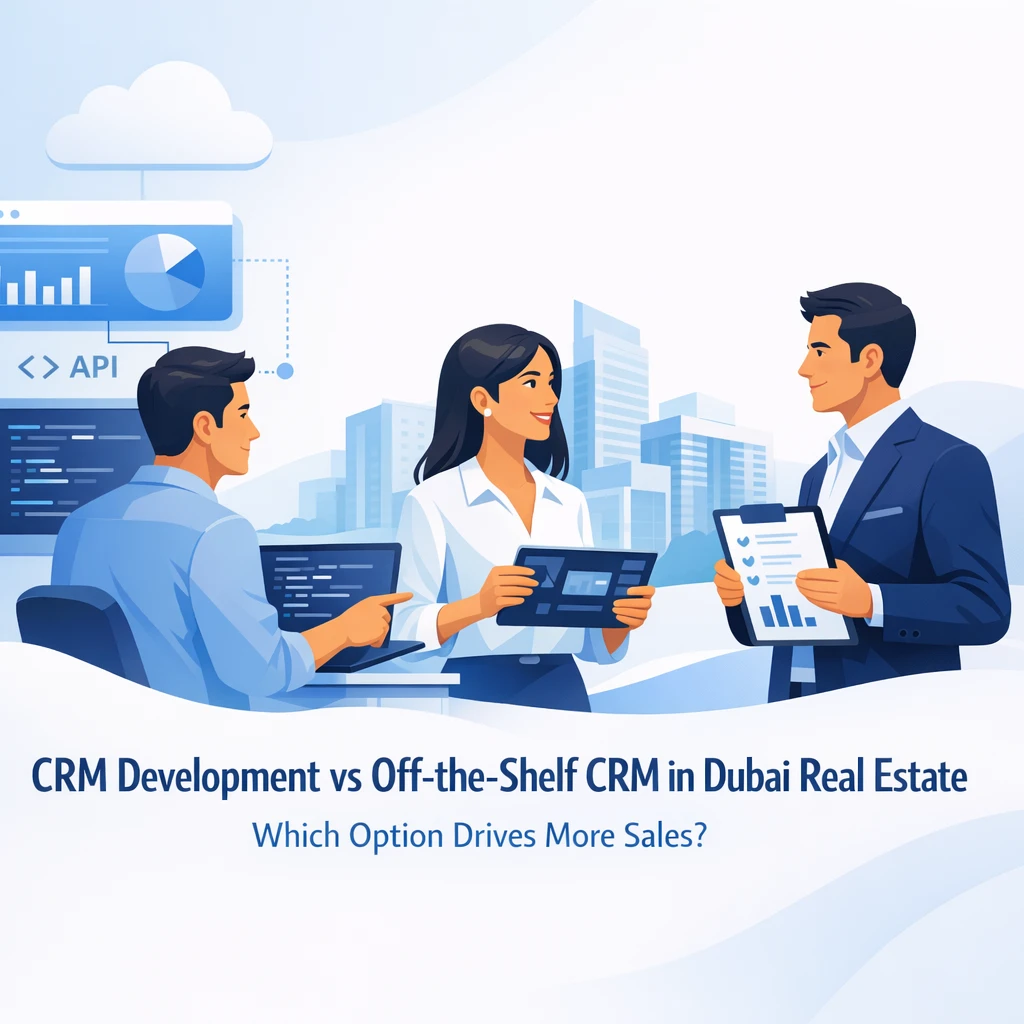
In fast-moving real estate markets like Dubai and the wider Gulf region, customer relationship management (CRM) is not just a backend tool—it is a strategic engine for growth. Real estate teams juggle complex schedules, multi-channel communications, regulatory requirements, and rapidly changing property inventories. The question many SMBs, SMEs, startups, and established brokers face is this: should you build a custom CRM tailored to your sales process, data model, and integrations, or should you buy an off-the-shelf CRM and adapt your workflows around it?
This article is designed to help decision-makers in the UAE, Saudi Arabia, Qatar, Oman, Kuwait, Bahrain, the United States, the UK, Europe, Australia, Singapore, and beyond make an informed choice. We’ll cover practical criteria, costs, and step-by-step guidance, with real-world examples and a focus on how Triostack Technologies approaches CRM projects as a global software partner.
What is the Topic?
The core choice is between two distinct strategies:
- CRM Development (Custom CRM): You design and build a CRM platform from scratch or with highly customized modules to fit your unique sales processes, data model, and integration requirements.
- Off-the-Shelf CRM (OTS): You purchase a pre-built CRM product and configure or customize it to fit your business, typically leveraging plugins or marketplaces for extensions.
Both approaches have merit. A custom CRM can deliver precise alignment with your unique workflows, data governance, and regional compliance needs. An off-the-shelf solution can accelerate time-to-value, lower upfront risk, and benefit from a broad ecosystem. The real question is: what combination of features, speed, total cost of ownership, and long-term scalability best supports your sales velocity in Dubai and the broader region?
Why It Matters in 2026
Markets in Dubai, the UAE, and GCC countries are increasingly data-driven. Real estate firms compete on how quickly they respond to inquiries, how accurately they forecast demand, and how efficiently they close deals. Two trends shape the decision:
- Integrated customer journeys: Prospects touch multiple channels — website inquiries, social media, events, referrals, and property showings. A CRM that unifies these signals into a coherent journey drives higher conversion.
- Compliance and data privacy: Real estate processes combine personal data, financial information, and sometimes health-related data for financing. A CRM must support regional privacy regulations and robust security practices.
In addition, regional growth markets emphasize scalability and vendor independence. If your business expands from a single office to multiple emirates or adds property segments (residential, commercial, logistics), your CRM should scale without reinventing the core processes. A well-chosen CRM strategy reduces manual handoffs, eliminates data silos, and unlocks AI-driven insights that can shorten the sales cycle.
Current Industry Challenges
Dubai real estate and its neighboring markets face several practical hurdles that influence CRM decisions:
- Fragmented data: Leads and inquiries come from websites, portals, brokers, social media, and walk-ins. Without a unified data model, duplicates proliferate and handoffs break down.
- Multi-channel engagement: Agents need to respond across calls, emails, WhatsApp, and in-person meetings. A CRM must capture all touchpoints and automate follow-ups while allowing human agents to tailor conversations.
- Complex sales cycles: Deals often involve multiple stakeholders, financing steps, and regulatory checks. The CRM should support pipeline stages, approvals, and task orchestration across teams.
- Regulatory and data security considerations: Protection of client data, contract details, and financial information is critical. Compliance with regional standards matters for retention, access control, and auditing.
- Adoption and change management: Teams accustomed to legacy systems or spreadsheets can resist new software. User experience, onboarding, and training are essential for success.
How the Technology Works
Understanding the technical levers helps in evaluating Build vs Buy options. Here is a concise model of how a CRM in a Dubai real estate context typically functions:
- Data model: Contacts, leads, properties, agents, appointments, viewings, offers, transactions, and commissions. Tax and regulatory fields may vary by jurisdiction.
- Integrations: ERP/finance for payments, property management systems for listings, marketing tools for campaigns, portal plugins for customer self-service, and identity providers for secure access.
- Automation: Lead routing, task creation, email and SMS campaigns, appointment reminders, and activity logging.
- Analytics: Dashboards for pipeline health, conversion rates, time-to-close, and agent performance. Predictive insights can guide lead prioritization.
- Security and compliance: Role-based access, data encryption at rest and in transit, audit trails, and privacy controls aligned with regional norms.
Architecture Overview
A typical custom CRM architecture for real estate in the Gulf region emphasizes modularity, security, and scalable integrations. The following high-level view explains how components fit together:
- Frontend clients: web and mobile apps used by agents, admins, and customers.
- API gateway: routes requests, enforces security policies, and handles rate limiting.
- CRM services: core domains such as Lead Management, Property Catalog, Contact & Communication, Scheduling, and Deals.
- Auxiliary services: Marketing Automation, Notifications, Reporting, and AI/ML components for insights and automation.
- Data layer: relational databases for structured data and data warehouses for analytics.
- Integrations: ERP/Finance, listing portals, payment gateways, identity providers, and document management systems.
- Security and governance: IAM, encryption, logging, and compliance controls.
Step-by-Step Workflow: Lead to Close
Let’s walk through a typical Dubai real estate lead journey, showing how a well-designed CRM supports each step:
- Lead Capture: Inquiries flow from the website, portals, broker networks, and social channels. The CRM deduplicates and enriches data, tagging source channels.
- Lead Qualification: Scoring rules assess fit and interest. High-potential leads are routed to the right agents automatically.
- Appointment Scheduling: Agents schedule property tours or virtual walkthroughs. Calendar integrations sync with team schedules.
- Property Matching: Each lead receives personalized property recommendations based on preferences and budget.
- Documentation & Approvals: Financing checks, KYC, and contract documents are tracked within the CRM, with tasks assigned to the appropriate team members.
- Offer & Negotiation: Deals progress with stage gates, approvals, and notifications to clients and agents.
- Closing & Aftercare: Final paperwork, handover, and service tasks post-sale to nurture referrals and repeat business.
Business Use Cases
CRM investments pay off when they map to concrete business outcomes. Here are practical use cases for Dubai and GCC real estate players:
- Lead-to-deal acceleration: Automate assignment and reminders to reduce time-to-first meeting and speed up the pipeline.
- Multi-channel marketing: Centralize campaigns across email, SMS, WhatsApp, and social ads with revenue attribution dashboards.
- Agent performance dashboards: Track activity, conversion rates, and revenue per agent to optimize team structure.
- Customer self-service: Client portals for document uploads, appointment booking, and status tracking to reduce back-and-forth calls.
- Finance and commission integration: Real-time commission calculations and payout workflows tied to closed deals.
Industry Applications
While this article focuses on Dubai real estate, the patterns apply across similar markets in the UAE and globally. The CRM needs often expand to:
- Property management and rental operations
- Brokerage networks and franchise models
- Developer sales with multiple project lines
- Asset management and investment advisory
Benefits of Custom CRM Over Off-the-Shelf in Real Estate
Custom CRM implementations are not a universal answer, but they offer meaningful advantages in this sector when aligned with business goals:
- Exact process alignment: Your sales stages, pricing models, and compliance checks map directly to the CRM, reducing manual work.
- Seamless integrations: Real-time connections to ERP, listing portals, and payment gateways eliminate data silos.
- Scalability and flexibility: As your portfolio grows or market needs shift, the system evolves without compensating compromises.
- Data governance: A single source of truth with role-based access and audit trails improves trust and regulatory compliance.
- Ownership and control: You own the data model, security posture, and roadmap priorities, reducing vendor dependency.
Challenges to Anticipate
Every approach has trade-offs. Anticipating challenges helps you design mitigations from day one:
- Migration risk: Moving data from legacy systems requires careful mapping and validation to avoid data loss.
- User adoption: UI/UX quality, onboarding, and change management determine whether a CRM is used effectively.
- Security posture: Regional data privacy norms demand stringent access controls and encryption.
- Total cost of ownership: Custom builds can incur higher initial costs but may yield lower long-term maintenance needs if well-architected.
Common Mistakes to Avoid
- Underestimating data migration effort and data cleansing needs
- Treating CRM as a one-time project rather than a product with a roadmap
- Over-customizing beyond essential processes, leading to brittleness
- Neglecting mobile usability and offline capabilities for on-site agents
- Ignoring change management and user training
Best Practices for CRM Projects in Dubai Real Estate
- MVP with modular growth: Start with core lead management and property matching, then layer advanced features.
- Data-first design: Define data models up front and enforce data quality rules across integrations.
- Security by design: Implement default-deny access, audit logs, and encryption from day one.
- Inclusive stakeholder engagement: Involve sales, marketing, operations, and IT early to validate requirements.
- Playable roadmaps: Prioritize features by impact and feasibility, with short, testable cycles.
Build vs Buy Comparison
Use this table as a practical lens to compare options. It highlights typical considerations for Dubai real estate teams evaluating CRM projects.
| Criterion | Build (Custom CRM) | Off-the-Shelf CRM |
|---|---|---|
| Customization depth | Maximal alignment with unique workflows | Limited to vendor roadmap |
| Integration scope | Tailored integrations with ERP, portals, payment providers | Depends on available connectors |
| Time to value | Longer upfront, but longer-term ROI if well scoped | Quicker to deploy initial use |
| Data ownership | Full ownership of data model and governance | Vendor-controlled data schema in most cases |
| Scalability | Designed for future growth and region-specific needs | Depends on vendor architecture |
| Cost (upfront) | Higher upfront development cost | Lower upfront, ongoing license fees |
| Vendor lock-in risk | Reduced risk if architecture is modular | Higher risk if customization is heavy |
| Security compliance | Custom controls tuned to regulations | Vendor baseline security, may require gaps |
Estimated Development Cost
Pricing for CRM projects varies by scope, region, and talent model. For SMBs and SMEs exploring Dubai-ready CRM initiatives, typical ranges (in USD) include:
| Service | Typical Range (USD) |
|---|---|
| Business Website | 5k–15k |
| Customer Portal | 10k–40k |
| CRM | 15k–100k |
| ERP | 40k–200k |
| AI Chatbot | 5k–25k |
| AI Automation | 15k–80k |
| SaaS MVP | 20k–80k |
| Enterprise Web App | 30k–200k |
What drives these ranges? Scope, data migration effort, regulatory requirements, integration depth, multi-region hosting, and the level of automation you want. A tightly scoped MVP with clear success metrics can de-risk the project and help you validate ROI early.
Recommended Technology Stack
Below is a pragmatic, modern stack often used for Dubai real estate CRM projects. It balances performance, developer productivity, security, and scalability:
- Backend: Node.js with NestJS or Python Django/FastAPI for service layers
- Database: PostgreSQL for transactional data; Redis for caching; optional NoSQL (MongoDB) for unstructured data
- APIs: RESTful and GraphQL for flexible integrations
- Cloud & DevOps: AWS or Azure; CI/CD with GitHub Actions or Azure DevOps; containerization via Docker/Kubernetes
- AI & Analytics: Python-based ML models, NLP for sentiment, and predictive analytics with dashboards
- Security & Compliance: IAM, SSO, MFA, encryption, and robust logging/auditing
- CRM-specific modules: Lead Management, Property Catalog, Scheduling, Deals, Marketing Automation, and Compliance
Future Trends in CRM for Real Estate
Investing in a CRM is not just about today’s needs. Look ahead to how technology can amplify sales in the next 24–36 months:
- AI-powered insights: Predictive scoring, next-best-action recommendations, and automated follow-ups improve win rates.
- Intelligent automation: AI-assisted document handling, contract analysis, and compliance checks reduce manual effort.
- Multi-region data fabrics: Seamless data access for teams across territories with compliant data residency controls.
- No-code/low-code extensions: Empower business users to tailor pipelines without heavy developer intervention.
How Triostack Delivers Projects Globally: Remote Delivery from India
Triostack works with clients around the world, including the UAE, GCC, Europe, North America, and Asia. When projects are delivered remotely from India, we bring a proven, scalable model that emphasizes communication, governance, and high-quality engineering. Core elements include:
- Agile framework: Scrum or Kanban-based delivery with clear sprint goals and backlog prioritization.
- Structured planning: Sprint planning sessions to align on scope, estimates, and acceptance criteria.
- Weekly demos: Transparent progress reviews with stakeholders using live showcases.
- Communication channels: Slack, Teams, Zoom, Google Meet for regular touchpoints.
- Project tooling: Jira or ClickUp for task tracking; GitHub or GitLab for code; Azure DevOps for CI/CD pipelines.
- CI/CD & staging: Automated build, test, and deployment with cloud staging environments for safe user testing.
- QA & security: Rigorous QA processes, security reviews, and threat modeling.
- Documentation & IP: Comprehensive product documentation, NDAs, and clear IP ownership terms.
- Timezone overlap: Deliberate overlap windows to enable real-time collaboration, typically 3–6 hours with UAE working hours.
- Dedicated PMs: Each client has a dedicated project manager to coordinate scope, risks, and communications.
- Long-term support: Post-launch maintenance, enhancements, and support agreements.
- Why UAE businesses outsource to India: Cost efficiency, access to a large talent pool, faster hiring, high-quality engineering, and strong communication standards that bridge time zones.
Remote delivery is not just about cost. It is about assembling a global team that can scale with your project, maintain strong governance, and maintain high-quality output while meeting regional requirements.
Case Studies (Illustrative, anonymized)
Below are anonymized, realistic implementation scenarios that demonstrate how a CRM project can transform operations in different markets. These are illustrative and do not reference specific clients or confidential data.
Case Study 1: Dubai logistics company
Challenge: A Dubai logistics firm needed a unified CRM to manage higher-volume lead flows from portal partners, with integrated shipment tracking and customer support workflows. The existing system relied on spreadsheets and disparate tools, causing delays in quote delivery and misaligned communications.
Solution: Triostack designed a custom CRM with lead management, automated routing to sales reps, a property/asset-backed pricing model for logistics services, and a lightweight customer portal for status updates. Integrations included ERP for billing, a ticketing system for support, and listing portals used by partners.
Outcome (illustrative):
- Lead-to-quote time reduced by a meaningful margin
- Single source of truth for customer data across departments
- Partner portal improved collaboration and transparency
Case Study 2: UAE healthcare clinic
Challenge: A regional clinic network needed patient scheduling, referral management, and post-visit follow-up automation while ensuring data privacy and consent management.
Solution: Custom CRM modules for patient profiles, appointment scheduling, referral workflows, and secure document exchange. The system integrated with the clinic’s existing EHR and billing workflows, with strong access controls.
Outcome (illustrative):
- Appointment no-show rate reduced through automated reminders
- Referral cycle accelerated via integrated task routing
- Improved patient communication and data governance
Case Study 3: Saudi retail business
Challenge: A retail real estate arm sought to coordinate multi-channel marketing for property launches and loyalty-based cross-sales across regions.
Solution: CRM with multi-channel campaign orchestration, property recommendations, and loyalty program integration. The system supported multi-region tax rules and currency handling.
Outcome (illustrative):
- Lead quality improved via consistent data capture
- Higher conversion rates from targeted campaigns
Case Study 4: Australian startup
Challenge: A scalable CRM platform was needed to support rapid international expansion with multi-tenant architecture and robust security controls.
Solution: A modular CRM platform with tenant isolation, centralized analytics, and a plugin ecosystem for rapid feature delivery.
Outcome (illustrative):
- Smoother onboarding of new markets
- Consistent cross-border data practices and governance
Pricing Models and Total Cost of Ownership
Real-world CRM projects often employ a mix of pricing approaches. Common models include fixed-price for well-scoped MVPs, time-and-materials for ongoing development, and hybrid approaches for phased rollouts with strong governance. For SMBs and startups, the sweet spot is often a staged build with clear milestones and a predictable monthly maintenance cost post-launch.
Frequently Asked Questions
- What should I consider when choosing Build vs Buy for a Dubai real estate CRM?
- Assess alignment with sales workflows, integration requirements, data governance, time-to-market, and total cost of ownership. Consider a phased MVP to reduce risk.
- How long does a typical custom CRM project take?
- A phased approach often spans 4–9 months for an MVP, depending on scope, integration complexity, and regulatory considerations. Longer-term enhancements follow in planned sprints.
- What is the role of remote delivery in this context?
- Remote delivery from regions like India can offer cost efficiency and access to a broad talent pool while maintaining strong governance, security, and collaboration practices through modern tooling and dedicated PMs.
- Can a real estate CRM support multi-region operations?
- Yes. A well-architected CRM can support multiple regions with localized data models, tax rules, languages, and regulatory controls while ensuring data residency where required.
Conclusion
Choosing between CRM development and an off-the-shelf solution is not simply a feature checklist. It’s a decision about how closely your CRM will mirror your sales process, how deeply it will integrate with your existing systems, and how scalable and governable your data will be as you grow in Dubai and across the region.
Triostack brings a pragmatic, outcomes-focused approach to CRM projects. We emphasize architecture that supports your current needs while providing a clear runway for future enhancements, whether you start with a minimal viable product or a feature-rich platform. Our teams work with clients across time zones, delivering secure, well-documented software with strong governance and shared ownership of IP.
If you’re planning a similar software project, Triostack can help you design, build, deploy and maintain a scalable solution that fits your business goals and budget.
What’s Next
Consider conducting a two-track assessment: (1) map your top 5 sales processes and data flows for a MVP outline, and (2) evaluate a small pilot with an off-the-shelf CRM integrated to your core systems. If you’d like independent guidance, Triostack offers Technical Consulting and Dedicated Teams to help you de-risk the decision and execute confidently.
Businesses planning similar solutions often benefit from experienced software development partners like Triostack Technologies.
Triostack Team
Technology Evangelist & Writer
Triostack Team is an experienced writer and technologist, exploring the intersections of AI, cloud architecture, and modern application development. Passionate about turning complex technical concepts into accessible insights.