CRM Development Cost in Qatar and Oman: Build vs Buy Analysis for Sales-Driven Businesses
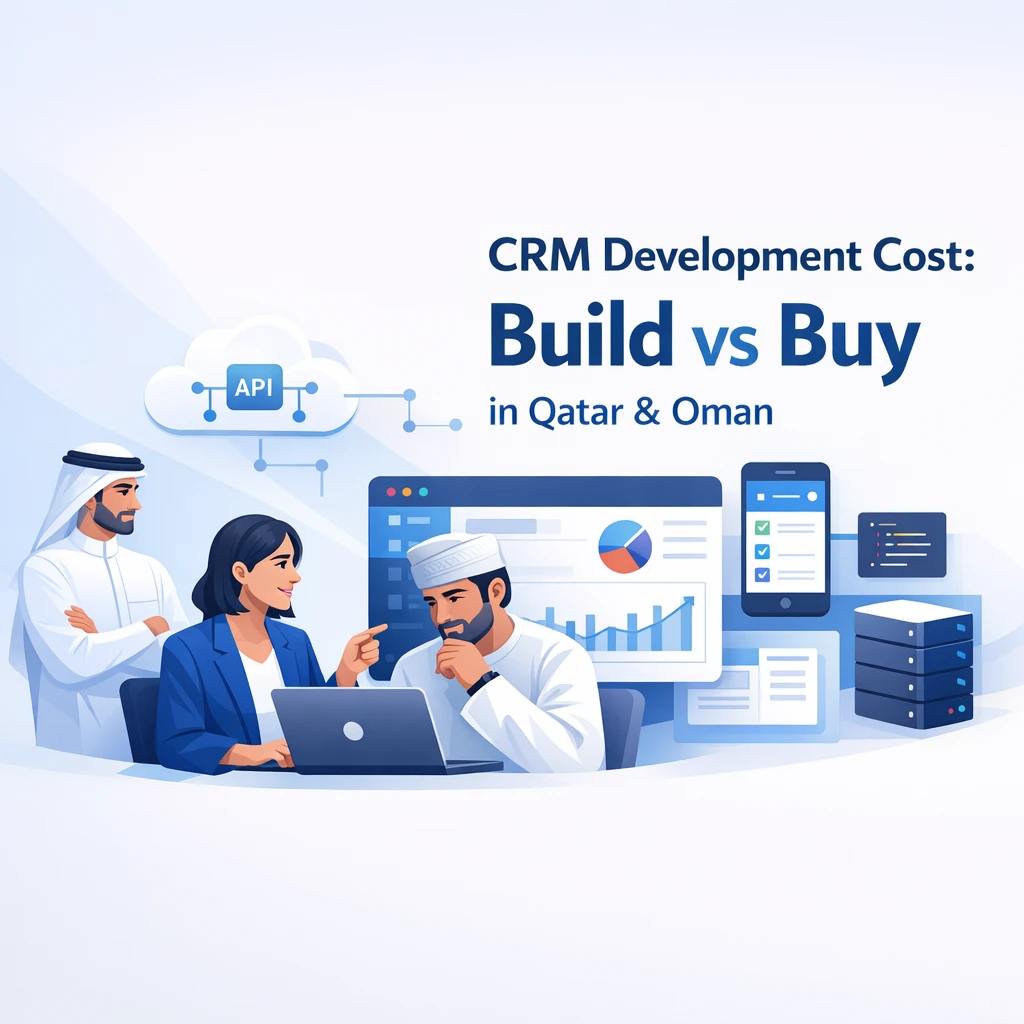
For SMBs, SMEs, startups, and regional enterprises in the Gulf and beyond, choosing between a custom CRM solution and an off-the-shelf system is more than a cost question. It is a strategic decision that shapes sales velocity, customer experience, data governance, and long-term scalability. This article offers a practical, data-informed guide to understand CRM development costs in Qatar and Oman, compare build vs buy options, and outline a path to a solution that aligns with growth, compliance, and regional realities. Along the way, you’ll see how Triostack Technologies approaches CRM projects as a global software partner that can deliver remotely with the same rigor as a local team.
What is the Topic?
CRM development cost refers to the total expenditure required to design, build, test, deploy, and maintain a customer relationship management system tailored to an organization’s sales, marketing, and service processes. Build represents custom development from scratch or major customization of a platform, while buy refers to implementing an existing CRM product with configuration and integrations. The build vs buy decision hinges on factors such as functional fit, time-to-value, total cost of ownership, data control, and long-term flexibility.
Why it Matters in 2026
- Sales velocity and personalization: Modern CRM must support omnichannel engagement, lead scoring, and real-time collaboration across teams.
- Regional regulatory alignment: Data localization and industry-specific compliance impact cost and architecture decisions in Qatar, Oman, and the broader UAE region.
- Remote delivery maturity: Global software partners enable cost-efficient access to top-tier engineering talent without sacrificing quality.
- Tech stack convergence: AI, automation, and cloud-native architecture reshape both build and buy options.
Current Industry Challenges
- Fragmented data across marketing, sales and service channels complicates customer insight.
- Legacy systems and point solutions slow decision-making and create data silos.
- Budget constraints in SMBs push stakeholders to seek faster, lower-risk deployments.
- Talent scarcity for specialized CRM competencies in regional markets.
- Security, privacy, and data residency requirements in the GCC ecosystem.
How the Technology Works
A modern CRM is more than a contact database. It orchestrates data from marketing campaigns, sales activities, customer support interactions, and back-office systems. Key capabilities include lead management, opportunity tracking, contact and account data management, workflow automation, analytics, and integrations via APIs. When combined with AI-driven insights and automated processes, a CRM becomes a decision support engine for revenue teams.
Architecture Overview
Below is a high-level view of how a CRM can be structured, whether built in-house or integrated from a vendor. The diagram highlights the core layers: front-end, application layer, data layer, and integrations.
Architecture Overview — Build vs Buy Considerations
Step-by-Step Workflow
- Discovery and scope definition around sales processes, data models, and regulatory constraints.
- Decision framework: Build vs Buy, including risk assessment, TCO, and time-to-value analysis.
- Architecture design and technology selection aligned with regional compliance requirements.
- Implementation plan with milestones, security reviews, and QA gates.
- Data migration strategy and integrations with ERP, marketing automation, and customer service tools.
- Quality assurance, user acceptance testing, and change management activities.
- Go-live, cutover planning, and post-go-live support.
Business Use Cases
CRM projects span many use cases. Some are particularly relevant to sales-driven businesses in our regions:
- Lead-to-Opportunity automation with regional currency and tax rules.
- Account-based sales for high-value B2B customers with multiple stakeholders.
- Service case escalation linked to account data for a unified customer view.
- Field sales enablement with mobile access for on-site activities in logistics, healthcare, and retail.
Industry Applications
Industries common to Qatar, Oman, Saudi Arabia, UAE, and beyond benefit from CRM solutions tailored to their specifics:
- Logistics and distribution
- Healthcare clinics and networks
- Retail and e-commerce
- Manufacturing and field services
- Financial services and insurance
Benefits
- Improved lead qualification and faster response times
- Centralized customer data with consistent experiences
- Data-driven decision making with real-time analytics
- Automated workflows reducing repetitive tasks
- Scalability to support growth across regions
Challenges
- Balancing rapid delivery with robust security and compliance
- Ensuring data migrates cleanly from legacy systems
- Managing change and user adoption across departments
- Finding long-term support for bespoke features
Common Mistakes
- Underestimating data migration complexity
- Over-customization leading to maintenance burden
- Lock-in with a single vendor without exit options
- Neglecting user training and change management
Best Practices
- Define a clear MVP with measurable success criteria
- Design for data governance and residency requirements
- Prioritize integrations with core systems (ERP, invoicing, marketing)
- Plan iterative releases with frequent stakeholder demos
Build vs Buy Comparison
Use this pragmatic framework to compare options. The table below highlights key factors that drive the decision for sales-driven organizations in the Gulf and beyond.
| Aspect | Build | Buy |
|---|---|---|
| Time to value | Longer, depends on scope | Shorter, ready-to-configure |
| Cost certainty | Variable, potential scope creep | More predictable, licensing costs |
| Customization | Unlimited (within tech constraints) | Limited to vendor capabilities |
| Data control | High, full ownership | Moderate, depends on vendor |
| Scalability | Designed for growth; higher risk if not planned | Vendor benchmarks for scale |
| Risk | Technical debt, maintenance burden | Vendor risk, ongoing licensing |
In many cases, a hybrid approach—core CRM from a platform with custom modules for unique processes—offers a balanced path. Triostack often helps clients design a hybrid CRM strategy that preserves data integrity while delivering bespoke workflows.
Estimated Development Cost
Development costs vary by region, scope, and vendor model. The ranges below reflect typical orders of magnitude for SMBs and SMEs seeking a robust CRM that supports sales-driven growth in Qatar, Oman, and neighboring markets. All figures are indicative and depend on requirements, team composition, and delivery model.
| Solution | Typical Range (USD) | Notes |
|---|---|---|
| Business Website | 5k–15k | Core presence and marketing automation extension |
| Customer Portal | 10k–40k | Authentication, self-service, data sync |
| CRM | 15k–100k | Lead, account, opportunity, analytics, integrations |
| ERP | 40k–200k | Finance, procurement, inventory, manufacturing |
| AI Chatbot | 5k–25k | Customer support and routing |
| AI Automation | 15k–80k | Lead scoring, intent signals, workflow automation |
| SaaS MVP | 20k–80k | Minimum viable product for market testing |
| Enterprise Web App | 30k–200k | Large-scale CRM with complex workflows |
Pricing factors influencing these ranges include: scope complexity, number of integrations, data migration effort, security and compliance requirements, performance and scalability targets, and the extent of custom UI/UX work. In many regional deployments, data residency rules, multilingual support, and currency configuration also shape the final cost and timeline.
Recommended Technology Stack
Choosing a stack that aligns with regional talent pools and security requirements is key. A pragmatic approach combines robust backend services, scalable databases, and a flexible frontend. A typical modern stack might include:
- Frontend: React or Angular for web, React Native or Flutter for mobile
- Backend: Node.js with Express or .NET Core, or Java Spring Boot
- Database: PostgreSQL or MySQL; optional NoSQL for specific use cases
- Integrations: RESTful APIs, GraphQL, and enterprise connectors
- AI/ML: Python-based microservices for scoring, forecasting, and automation
- Cloud: AWS, Azure, or Google Cloud with regional data residency considerations
- Security & Compliance: OAuth 2.0, SAML, encryption at rest and in transit, role-based access
Future Trends
- AI-powered sales assistants and predictive analytics to improve win rates
- Low-code/no-code extensions enabling faster customization
- Deeper workflow automation with intelligent routing and decisioning
- ComposableCRM architectures enabling modular expansions
- Enhanced data governance and privacy controls aligned with GCC regulations
How Triostack Delivers Projects Globally
Triostack Technologies is a global software development partner with a track record of delivering CRM, ERP, and AI-enabled solutions for diverse industries. We combine deep domain knowledge with practical, hands-on execution to help clients in Qatar, Oman, UAE, Saudi Arabia, and across North America, Europe, and the Asia-Pacific region achieve measurable outcomes. Our services include:
- Custom Software
- Web Development
- Mobile Apps
- AI Development and Machine Learning
- CRM, ERP, SaaS
- Cloud Migration
- DevOps, UI/UX
- API Development
- Dedicated Teams
- QA and Maintenance
- Technical Consulting
REMOTE DELIVERY: How Triostack Delivers Projects from India
Triostack leverages a structured remote delivery model designed to minimize risk while maximizing velocity and quality. Key components of our approach include:
- Agile: Flexible frameworks (Scrum or Kanban) with clear sprint goals
- Sprint Planning: Collaborative planning with customer product owners
- Weekly Demos: Transparent progress with stakeholder feedback
- Collaboration Tools: Slack, Teams, Zoom, Google Meet
- Issue Tracking & Project Management: Jira, ClickUp
- Code & Collaboration: GitHub, GitLab, Azure DevOps
- CI/CD & Cloud Staging: Automated builds, testing, and staging environments
- QA and Security: Rigorous QA, security reviews, and compliance testing
- Documentation & IP: Comprehensive docs, NDA, IP ownership agreements
- Timezone Overlap & Communication: Overlap windows with client teams for real-time collaboration
- Dedicated Project Managers: Single point of contact across the engagement
- Long-term Support: Post-launch maintenance and product evolution
Why UAE-based businesses outsource development to India? The rationale often includes cost efficiency, access to a large talent pool, faster hiring, scalable teams, high engineering quality, and strong communication practices tuned to global clients. Triostack structures engagements to preserve transparency, protect IP, and ensure seamless collaboration across time zones.
Case Studies
Case Study 1: Dubai-based logistics company
Challenge: A regional logistics provider needed a CRM to optimize route planning, driver assignments, and customer communications across multiple emirates. The legacy system led to delays in quote generation and inconsistencies in status updates.
Solution: Triostack designed a custom CRM with integrated route optimization, real-time telemetry from drivers, and automated customer notifications. The system connected to the ERP for invoicing and inventory status.
Outcome: Improved delivery visibility and faster quote turnaround, with a unified view of customers across touchpoints. Operational efficiency increased without sacrificing compliance.
Case Study 2: UAE healthcare clinic
Challenge: A network of clinics required a patient relationship platform to manage appointments, medical records, referrals, and patient portals in multiple languages while meeting data residency requirements.
Solution: A secure CRM platform with patient scheduling, consent management, and integration to an electronic health record (EHR) system. Localization and access control were built in from the start.
Outcome: Streamlined patient engagement, improved appointment adherence, and compliant data handling across the network.
Case Study 3: Saudi retail business
Challenge: A growing retailer needed a CRM to support omnichannel sales and loyalty programs across multiple storefronts and digital channels.
Solution: Triostack delivered a CRM with loyalty, segmentation, and real-time inventory visibility, integrated with the in-store POS and e-commerce platform.
Outcome: Cohesive customer journeys and improved cross-sell opportunities, with scalable architecture to accommodate expansion plans.
Case Study 4: Australian startup
Challenge: A fast-growing startup required a flexible CRM to support rapid iteration, experiment-driven marketing, and data-driven sales plays.
Solution: A modular CRM with a lean core and pluggable automation modules, enabling quick pivots as product-market fit evolved.
Outcome: Faster time-to-market for new sales campaigns and a foundation for analytics-driven growth.
Case Study 5: UK SaaS company
Challenge: A software-as-a-service company needed a multi-tenant CRM to manage enterprise customers, renewal cycles, and security controls for global operations.
Solution: A multi-tenant architecture with tenant isolation, robust RBAC, and automated compliance reporting.
Outcome: Scalable sales operations with consistent governance across tenants, reducing admin overhead.
Development Timeline and Team Structure
Below is a typical timeline for a mid-sized CRM project and how teams are structured. Timelines vary by scope and regulatory requirements.
| Phase | Typical Duration | Key Deliverables |
|---|---|---|
| Discovery & Planning | 2–4 weeks | Requirements doc, MVP scope, high-level architecture |
| Architecture & Design | 3–6 weeks | Data model, API contracts, UI/UX sketches |
| Development & Integrations | 8–20 weeks | Core features, integrations, automation rules |
| QA & UAT | 3–6 weeks | Test cases, security and performance verification |
| Go-Live & Support | 2+ weeks | Deployment, training, post-launch monitoring |
Future Trends for CRM in the Gulf and Global Markets
- Low-code customization for faster tailoring to regional processes
- AI-driven next-best-action recommendations for sales teams
- Federated data architectures enabling cross-border analytics
- Zero-trust security models and data residency-first deployments
Why Businesses Choose Triostack
Triostack blends software craftsmanship with domain insight. Our teams work as an extension of your business, translating sales processes into robust, scalable software. We specialize in custom software, web and mobile development, AI, CRM, ERP, SaaS, cloud migration, DevOps, UI/UX, API development, dedicated teams, QA, maintenance, and technical consulting. Whether you’re in Dubai, Doha, Muscat, Riyadh, or beyond, Triostack emphasizes practical outcomes, transparent collaboration, and long-term partnerships.
Conclusion
DFocusing on CRM development costs in Qatar and Oman requires balancing function, time-to-value, and risk. Build offers unmatched customization but demands strong governance and ongoing investment. Buy provides speed and vendor-aligned support but may restrict unique workflows. A thoughtful, phased approach—often combining core capabilities from a reliable platform with targeted custom modules—can deliver the best of both worlds. With Triostack as a trusted global partner, businesses can design and deploy CRM solutions that scale with growth while maintaining compliance, security, and excellent user experience.
Frequently Asked Questions
- What factors most influence CRM development cost in Qatar and Oman? Scope complexity, number of integrations, data migration effort, security requirements, compliance, localization, and ongoing support.
- Is it better to build or buy for a regional business? For many SMBs, a hybrid approach often yields the best balance of speed and customization. It depends on process fit, budget, and long-term strategy.
- How long does a typical CRM project take? Simple CRM projects can take 3–6 months; larger, multi-region deployments can extend to 9–12 months or more depending on integrations and compliance work.
- Can Triostack deliver remotely and still meet GCC data residency requirements? Yes. We design architectures that respect data residency, with regional data stores, compliant data flows, and partner governance aligned to local regulations.
Internal links: Case Studies, Remote Delivery, FAQ
Triostack Team
Technology Evangelist & Writer
Triostack Team is an experienced writer and technologist, exploring the intersections of AI, cloud architecture, and modern application development. Passionate about turning complex technical concepts into accessible insights.