CRM Development Cost in Abu Dhabi: Custom vs SaaS Comparison for Growing Sales Teams
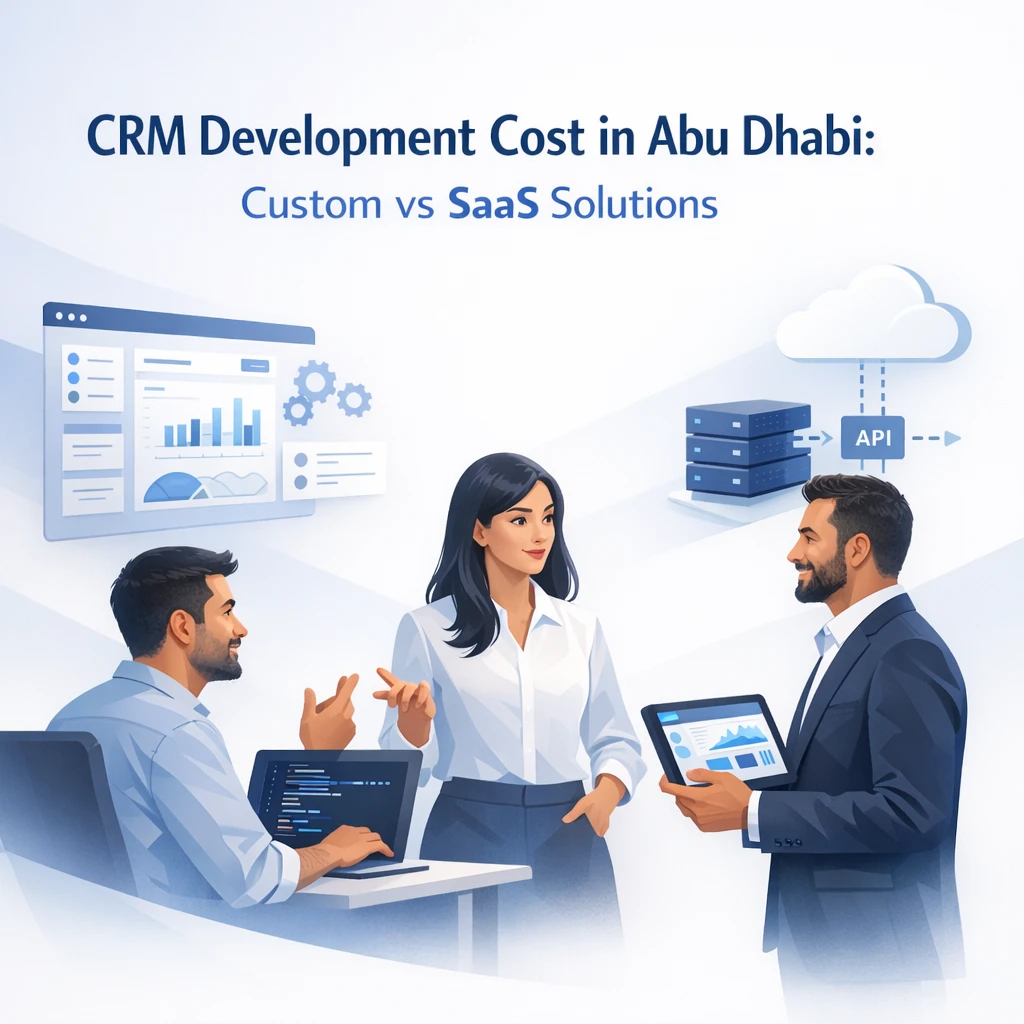
As sales teams in Abu Dhabi and the wider UAE scale, organizations face a pivotal decision: build a custom CRM tailored to unique workflows or adopt a ready-made SaaS CRM that accelerates time to value. This guide breaks down cost considerations, architecture choices, real-world scenarios, and practical guidance to help SMBs, SMEs, startups, and established firms make an informed choice.
Introduction
Customer relationship management (CRM) is more than a database of contacts. For growing sales teams, a CRM is the nerve center of the revenue engine—capturing leads, qualifying opportunities, automating follow-ups, and orchestrating the customer journey across marketing, sales, and service. In Abu Dhabi, Dubai, and across the Gulf region, organizations face a mix of regulatory expectations, data sovereignty concerns, and a strong emphasis on fast time-to-value.
This article explores CRM development cost in Abu Dhabi, comparing custom CRM development with SaaS CRM solutions. We translate technical considerations into business outcomes and provide practical guidance, real-world examples, and a clear framework to help you decide what to build, what to buy, and how to deploy it efficiently—with Triostack Technologies positioned as a trusted global partner to enable your journey.
What is the Topic?
The topic centers on two primary approaches to CRM for growing teams:
- Custom CRM Development — Building a CRM from scratch (or heavily tailoring a commercial base) to meet highly specific processes, data models, and integrations with existing systems (ERP, OMS, BI, etc.).
- SaaS CRM — Adopting a cloud-based, subscription-based CRM platform (like Salesforce, HubSpot, or a regional SaaS) with configurable workflows and available add-ons.
Each approach has distinct cost implications, timelines, and risk profiles. The choice depends on your target users, data complexity, regulatory requirements, integration needs, and the pace at which you must reach value.
Why It Matters in 2026
By 2026, the CRM landscape is defined by data-driven decision-making, AI-assisted workflows, and increasingly modular architectures. For Abu Dhabi-based companies and regional operations, several dynamics drive the cost and feasibility of CRM projects:
- Regulatory and data sovereignty considerations require careful handling of data localization, access controls, and audit trails.
- Scalability and integration with ERP, e-commerce, logistics, and marketing automation are common requirements for growth-oriented teams.
- Talent and offshore delivery options enable access to a large pool of engineers while balancing cost and time-to-value.
- Security and compliance expectations (data protection, role-based access, encryption) influence architecture and ongoing maintenance costs.
Understanding the cost dynamics today helps organizations plan for the future—whether they are a Dubai logistics company expanding its client-facing workflows, a UAE healthcare clinic coordinating patient relationships, or a Saudi retailer seeking unified customer insight across channels.
Current Industry Challenges
Teams evaluating CRM investments in the Gulf and globally face several recurring challenges:
- Data silos across sales, marketing, service, and operations hinder a unified customer view.
- Inconsistent data quality and de-duplication complexities complicate reporting and forecasting.
- Complex integrations with ERP, supply chain, logistics, and financial systems can inflate costs and timelines.
- User adoption concerns—complex tools reduce engagement unless the UX is intuitive and tailored to real workflows.
- Security and compliance considerations require robust identity, access management, and data governance.
Choosing between custom and SaaS CRM is often a question of trade-offs between speed, control, and total cost of ownership (TCO) over time.
How the Technology Works
A CRM system is a layered application that typically includes:
- Data model for accounts, contacts, leads, opportunities, activities, and cases.
- Workflow and automation to guide users through sales processes, nurture campaigns, and service escalations.
- Integrations with ERP, e-commerce, help desk, marketing automation, and analytics platforms.
- AI and analytics features such as lead scoring, forecasting, and next-best-action recommendations.
When selecting between custom and SaaS, the critical questions are: how much control do you need over data and processes, how quickly do you need to start, and how complex are your integration and customization requirements?
Architecture Overview
Whether you build or buy, a robust CRM architecture typically includes:
- Frontend (web and mobile) for data entry, dashboards, and user interactions.
- Backend services that implement business logic, workflow, and integration adapters.
- Data storage for customers, activities, and transactional history.
- APIs for integrations with ERP, CMS, e-commerce, and BI systems.
- Security and governance to enforce access controls, encryption, and compliance.
- Deployment options spanning cloud-native deployments or hybrid configurations for data sovereignty.
Below is a simplified depiction of a modern CRM architecture and how Triostack typically maps out a project to align with business goals.
Step-by-Step Workflow
A pragmatic workflow for a CRM project typically looks like this:
- Discovery & scope with your Triostack team to capture the core processes, data model, and integrations.
- Architecture design including data governance, security, and deployment strategy.
- MVP development focusing on core entities (Accounts, Contacts, Leads, Opportunities) and essential automations.
- Integrations with ERP, e-commerce, or marketing tools as required.
- QA & security validation to meet regulatory and internal standards.
- Deployment to production with thorough training and change management.
- Iteration & scale through continuous improvement, additional modules, and AI features.
Business Use Cases
Consider typical scenarios where a CRM adds tangible value for growing teams:
- Dubai-based logistics company uses CRM to track key accounts, tender opportunities, and service-level performance with seamless integration to the warehouse management system (WMS).
- UAE healthcare clinic centralizes patient communications, appointment scheduling, referrals, and post-visit follow-ups with HIPAA-/local-compliance-conscious workflows (where applicable).
- Saudi retail business unifies customer data across in-store and online channels, powering loyalty programs and personalized promotions.
- Australian startup launches a SaaS CRM MVP to validate market fit quickly while planning for a scalable custom layer later.
- UK SaaS company consolidates multi-region customer data, supports partner ecosystems, and scales support workflows with automation.
Industry Applications
While the core CRM capabilities are universal, industry-specific configurations can significantly affect cost and roadmaps:
- Logistics & 3PL—integration with freight management, rate shopping, shipments, and SLA tracking.
- Healthcare—secure patient data handling, appointment workflows, consent management, and referral networks.
- Retail & E-commerce—customer segmentation, cross-channel marketing, loyalty programs, and post-sale service.
- Manufacturing & Field Services—asset trails, service tickets, and predictive maintenance support.
Benefits
Key benefits to expect from a well-implemented CRM, whether custom-built or SaaS-based, include:
- Unified customer view leading to better forecasting and targeting.
- Improved sales velocity through automated workflows and reminders.
- Enhanced collaboration between sales, marketing, and service teams.
- Better data quality, governance, and compliance evidence.
- Faster onboarding and higher user adoption when the UI mirrors real workflows.
Challenges
Every CRM project carries risks. Anticipating them helps keep costs in check:
- Scope creep and feature bloat in custom builds.
- Underestimating integration effort with ERP or logistics platforms.
- Choosing a SaaS solution that later needs heavy customization or data migration.
- Over-reliance on a single vendor for security or data governance.
Common Mistakes
- Starting with a flashy toolkit and not aligning features to actual sales processes.
- Underinvesting in data migration and data quality cleanup.
- Failing to plan for change management and user training.
- Ignoring security and privacy implications during design.
Best Practices
- Define a clear data model and one source of truth for customer data.
- Start with an MVP that targets the most critical journeys (e.g., lead-to-cash or case-to-resolution).
- Prioritize integrations that unlock the most business value first.
- Adopt a modular, API-first architecture to enable future extensions.
- Invest in user onboarding, training, and governance from day one.
Build vs Buy: A Quick Comparison
Below is a concise comparison to help decide whether to build a custom CRM (or heavily tailor an ecosystem) or adopt a SaaS solution and extend it over time.
| Aspect | Custom Build | SaaS |
|---|---|---|
| Time to value | Longer – 4–12+ months depending on scope | Shorter – weeks to a few months |
| Total cost of ownership (TCO) | High upfront; ongoing maintenance | Predictable monthly/annual subscription |
| Customization | Very high; tailored to unique processes | Limited to configuration and add-ons |
| Security & compliance | In-house control; requires dedicated governance | Vendor-driven with shared responsibility |
| Scalability | Depends on architecture; potentially limitless with refactors | Fast scaling via SaaS infrastructure |
| Maintenance burden | Internal team required | Vendor-managed updates (with upgrade cycles) |
Estimated Development Cost
The cost of CRM projects varies by scope, region, and team model. For SMBs in Abu Dhabi and the broader GCC, the following ranges provide a pragmatic reference. Note that these figures assume a reasonable level of integration and a target delivery window of 4–12 months for MVPs or growth-focused deployments.
| CRM Type | Scope / Features | Typical Range (USD) |
|---|---|---|
| Custom CRM (MVP) | Core data model, lead-to-cash, basic automation | 50,000 – 150,000 |
| Custom CRM (Growth) | Advanced automation, integrations with ERP, BI, marketing | 150,000 – 350,000 |
| SaaS CRM + Customization | Subscription + tailored workflows, limited development | 15,000 – 100,000 (initial setup) + ongoing per-user |
| AI-enabled CRM features | Lead scoring, forecasting, automation | 10,000 – 60,000 (add-ons) + SaaS costs |
Pricing factors that commonly influence these ranges include:
- Number of users and roles
- Data migration and cleansing requirements
- Number and complexity of integrations (ERP, e-commerce, WMS, etc.)
- Regulatory and security requirements (data residency, encryption, auditing)
- Customization depth of workflows, dashboards, and AI features
- Hosting model (cloud provider, data center localization)
Additionally, SaaS pricing often includes per-user per-month fees and tiered plans. In contrast, a custom CRM’s cost is front-loaded (development) with ongoing maintenance and potential platform upgrades as part of the ownership model.
Recommended Technology Stack
Below is a practical, modern stack that Triostack commonly uses for CRM projects across regions including the UAE, Europe, North America, and Asia-Pacific. The stack emphasizes modularity, security, and scalability, enabling both custom and hybrid approaches.
| Layer | Options | Rationale |
|---|---|---|
| Frontend | React or Vue.js; React Native for mobile | Rapid development, rich UX, strong ecosystem |
| Backend | Node.js, Python (FastAPI), or .NET | Scalable APIs, robust libraries, enterprise-ready |
| Database | PostgreSQL, MySQL; Redis for caching | Reliable, open, and scalable data stores |
| Cloud & DevOps | AWS / Azure / GCP; Kubernetes; CI/CD | Resilient deployments and fast iterations |
| AI & Analytics | Python ML stack; OpenAI / custom ML models | Decision support, automation, and personalization |
| Security & Compliance | OIDC/SAML, IAM, encryption, DLP | Protection of PII and regulatory alignment |
Future Trends
CRM platforms continue to evolve. Key trends shaping cost and implementation paths in 2026 and beyond include:
- AI-driven automation for lead scoring, next-best-action, and conversational interfaces.
- Low-code/no-code configurations to accelerate customization without heavy engineering.
- Deeper integrations with ERP, supply chain, and field-service platforms for end-to-end visibility.
- Data governance by design with built-in data quality checks and compliance tooling.
- Remote delivery maturity enabling global teams to collaborate efficiently across time zones.
How Triostack Delivers Projects Globally (Remote Delivery)
Triostack Technologies enables seamless, remote CRM projects from India to clients across the UAE, GCC, Europe, North America, and beyond. Our approach emphasizes discipline, transparency, and collaboration:
- Agile and sprint planning with fixed increments, typically 2-week sprints to deliver measurable value.
- Weekly demos to surface progress, gather feedback, and adjust scope.
- Communication channels via Slack, Teams, or Zoom; daily stand-ups for critical teams.
- Collaboration platforms using Jira, ClickUp, GitHub, GitLab, and Azure DevOps for issue tracking and code management.
- CI/CD and cloud staging to ensure secure, repeatable deployments and high-quality code.
- QA and documentation with clear test plans, release notes, and user guides.
- Security and NDA/IP ownership assurances, with dedicated project managers and defined time zone overlap for UAE clients.
- Long-term support and managed services to ensure continuity as teams scale and requirements evolve.
Why UAE businesses choose to outsource development to India often comes down to a combination of cost efficiency, a deep talent pool, faster hiring, high engineering quality, and robust communication. Triostack aligns these advantages with strict security, regulatory awareness, and strong English communication to deliver reliable results for regional clients.
Case Studies (Realistic, Anonymized)
Below are anonymized, realistic examples illustrating how organizations use CRM projects to address concrete business needs. Names and precise figures are withheld to protect client privacy, but these describe plausible outcomes based on typical engagements.
Case Study 1 — Dubai-based Logistics Company (Anonymized)
Challenge: Fragmented customer data across sales, operations, and contracts, with limited visibility into freight tender status and SLA compliance. No single source of truth for customer interactions.
What we did: Delivered a custom CRM layer integrated with the company’s WMS and ERP to centralize client records, opportunities, and service tickets. Implemented automated task routing for tender deadlines and SLA alerts, plus dashboards for pipeline health and delivery performance.
Outcome (qualitative): Improved lead-to-order cycle times, better visibility into customer commitments, and a more consistent onboarding experience for major accounts.
Case Study 2 — UAE Healthcare Clinic (Anonymized)
Challenge: Siloed patient communications across scheduling, referrals, and follow-ups, with strict data privacy requirements and consent handling.
What we did: Implemented a CRM with patient-facing scheduling, referral routing, and secure messaging, plus role-based access controls and audit trails. Integrated with the clinic’s existing EHR system for seamless data exchange where permissible.
Outcome (qualitative): Higher patient satisfaction scores, reduced no-show rates, and improved clinician scheduling efficiency.
Case Study 3 — Saudi Retail Business (Anonymized)
Challenge: Cross-channel customer data fragmentation across stores, e-commerce, and loyalty programs; limited ability to personalize promotions.
What we did: Built a customer data hub with unified profiles, loyalty integration, and real-time segmentation for targeted campaigns. Deployed dashboards for merchandising and customer lifetime value (CLV) analysis.
Outcome (qualitative): Increased repeat purchase rate and more effective cross-sell campaigns across geographies.
Case Study 4 — Australian Startup (Anonymized)
Challenge: Quick-market entry with a lean team; needed an MVP CRM to validate product-market fit and support early customers.
What we did: Delivered a SaaS-based CRM MVP with essential lead, opportunity, and customer management, plus a lightweight automation flow to onboard users rapidly. Prepared a plan for scalable customization as user feedback mounts.
Outcome (qualitative): Faster go-to-market, validated pricing and onboarding flows, and a clear roadmap for growth-oriented customization.
How Triostack Delivers Projects Globally
Triostack Technologies combines deep software engineering expertise with a global delivery model. Our experience spans custom software, CRM, ERP, SaaS development, cloud migration, DevOps, UI/UX, API development, QA, and ongoing maintenance. Whether you’re a startup in Europe, a manufacturing firm in North America, or a logistics company in the UAE, we tailor engagements to your goals, budget, and timelines.
Key capabilities include:
- Custom Software Development
- Web & Mobile App Development
- AI Development and Machine Learning
- CRM, ERP, and SaaS Solutions
- Cloud Migration and DevOps
- UI/UX Design, API Development, and QA
- Dedicated Teams and Technical Consulting
Why Businesses Choose Triostack
Triostack is a trusted global software development partner for organizations planning software projects with budgets ranging from USD 5,000 to USD 200,000 and beyond. Our approach is collaborative, transparent, and outcomes-focused—delivering solutions that scale with your business needs while maintaining a strong emphasis on security, governance, and quality.
If you’re planning a CRM project—custom or SaaS—Triostack can help you design, build, deploy, and maintain a scalable solution with a clear path to growth. Consider this a conversation starter rather than a commitment.
Subtle call-to-action: Businesses planning similar solutions often benefit from experienced software development partners like Triostack Technologies. For a no-obligation consult, contact us to explore your options and a phased plan tailored to your context.
Frequently Asked Questions
What is the typical cost range for a CRM project in Abu Dhabi?
Costs vary based on scope, data complexity, integrations, and whether you choose a custom build or a SaaS approach. As a practical guide for SMBs, MVP-style custom CRM projects often start around USD 50,000–150,000, with more comprehensive, enterprise-grade deployments rising to USD 150,000–350,000 or more. SaaS-focused deployments typically involve lower upfront costs (customization and setup) plus ongoing per-user or per-month subscription fees.
How long does it take to deploy a CRM?
For an MVP in a typical regional context, plan 3–6 months for a custom build, depending on integration scope and regulatory considerations. SaaS deployments generally conclude faster, often within weeks to a few months, depending on configuration depth and data migration needs.
What should I consider when choosing between custom vs SaaS?
Key considerations include: alignment with unique business processes, data governance and security requirements, the speed to value, total cost of ownership, and the need for future scalability and integrations. A hybrid approach—SaaS for core CRM with a custom extension layer for specialized workflows—can offer a balanced path for many organizations.
Triostack Team
Technology Evangelist & Writer
Triostack Team is an experienced writer and technologist, exploring the intersections of AI, cloud architecture, and modern application development. Passionate about turning complex technical concepts into accessible insights.