Cloud Migration Strategy: A Comprehensive Guide for Enterprises in 2026
For most enterprises, the question is no longer whether to move to the cloud, but how to do it without disrupting the business along the way. A rushed migration creates downtime, cost overruns, and security gaps; a well-planned one becomes the foundation for faster releases, better scalability, and lower long-term infrastructure costs.
Why Enterprises Are Accelerating Cloud Migration in 2026
Rising on-premises maintenance costs, growing demand for AI-powered features that need elastic compute, and pressure to support distributed teams are pushing more enterprises to finish migrations they may have paused years ago. Cloud providers have also matured their compliance and data residency options, removing one of the biggest historical blockers for regulated industries.
Choosing a Cloud Migration Strategy
Rehosting (Lift-and-Shift)
Moving applications to the cloud with minimal changes is the fastest path to migration, ideal when the priority is exiting a data center quickly rather than optimizing architecture immediately.
Replatforming
This involves making targeted improvements — such as moving to managed databases or containerizing services — without a full rebuild, balancing speed with meaningful efficiency gains.
Refactoring / Re-architecting
Rebuilding applications to be cloud-native unlocks the biggest long-term benefits in scalability and cost efficiency, but requires the largest upfront investment in time and engineering effort.
Hybrid & Multi-Cloud
Many enterprises keep certain workloads on-premises or split across multiple cloud providers for compliance, latency, or vendor risk reasons, rather than committing everything to a single cloud.
A Step-by-Step Cloud Migration Roadmap
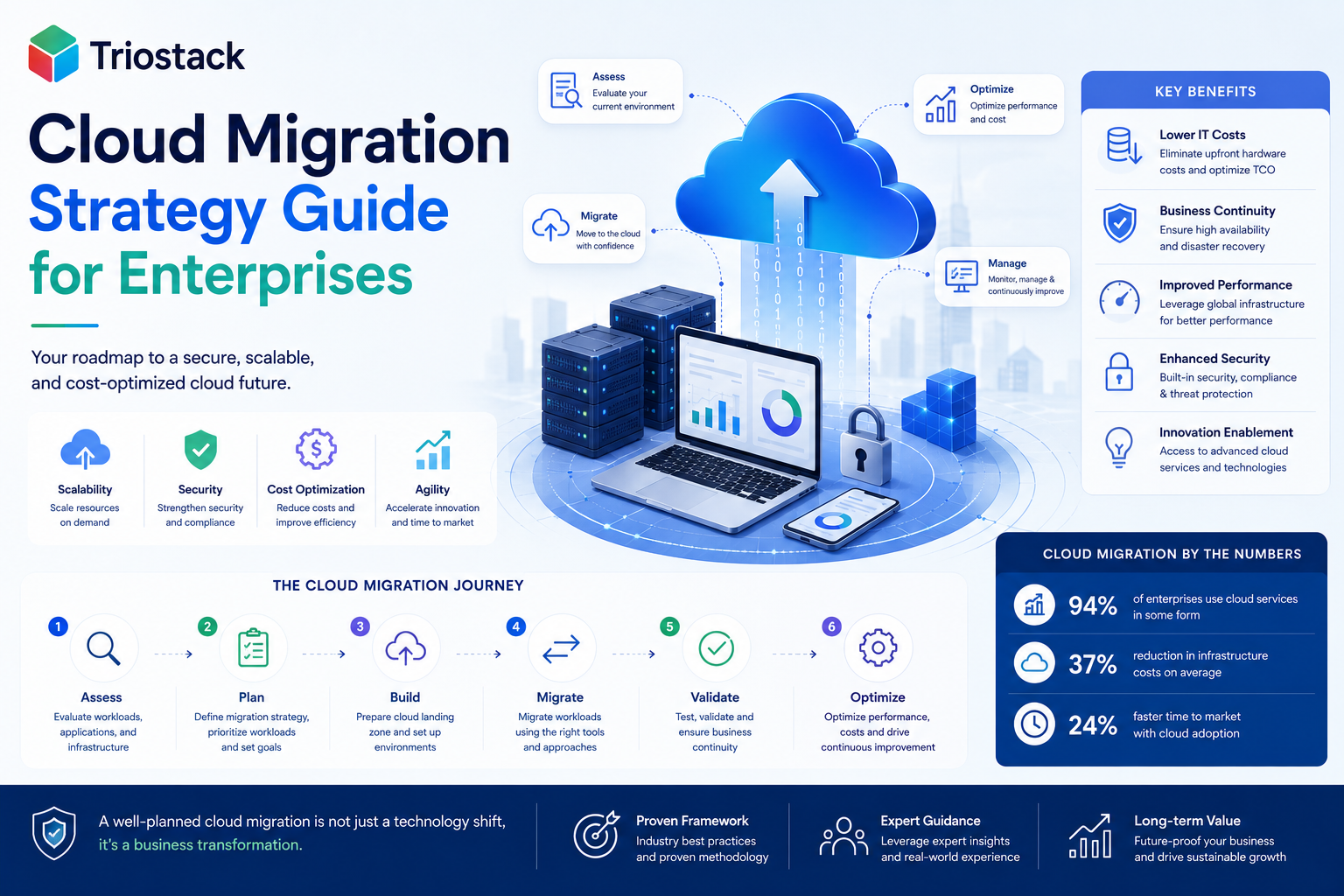
A disciplined migration moves through five recurring phases: assessing the current application and data landscape, planning the sequencing and target architecture, executing the migration in controlled waves, validating performance and security post-migration, and continuously optimizing cost and performance afterward. Treating this as a one-time project rather than a cycle is a common source of post-migration cost overruns.
Common Cloud Migration Risks and How to Avoid Them
- Underestimating data transfer time and cost for large, tightly coupled datasets.
- Migrating applications without first mapping their dependencies, causing unexpected outages.
- Skipping a proper cost model, leading to surprise cloud bills after go-live.
- Treating security and compliance as a post-migration checklist item instead of a design input.
Conclusion
Cloud migration succeeds when it's treated as a structured, ongoing process rather than a single cutover event. Enterprises that assess honestly, sequence deliberately, and keep optimizing after go-live get the cost and agility benefits the cloud promises — without the outages and budget surprises that derail rushed migrations.
Frequently Asked Questions
Which cloud migration strategy is cheapest?
Rehosting (lift-and-shift) is typically the fastest and cheapest to execute upfront, though it may not deliver the largest long-term cost savings compared to refactoring.
How long does an enterprise cloud migration take?
It varies significantly with application complexity and count, but most enterprises plan phased migrations across several months rather than a single cutover weekend.
Is multi-cloud always better than a single provider?
Not necessarily — multi-cloud adds redundancy and negotiating leverage but also adds operational complexity, so it should be a deliberate choice tied to specific compliance or resilience needs.

Triostack Editorial Team
Technology Evangelist & Writer
Triostack Editorial Team is an experienced writer and technologist, exploring the intersections of AI, cloud architecture, and modern application development. Passionate about turning complex technical concepts into accessible insights.