Cloud Migration Cost for Enterprise Businesses in Qatar and UAE: Hidden Expenses, Timelines, and ROI
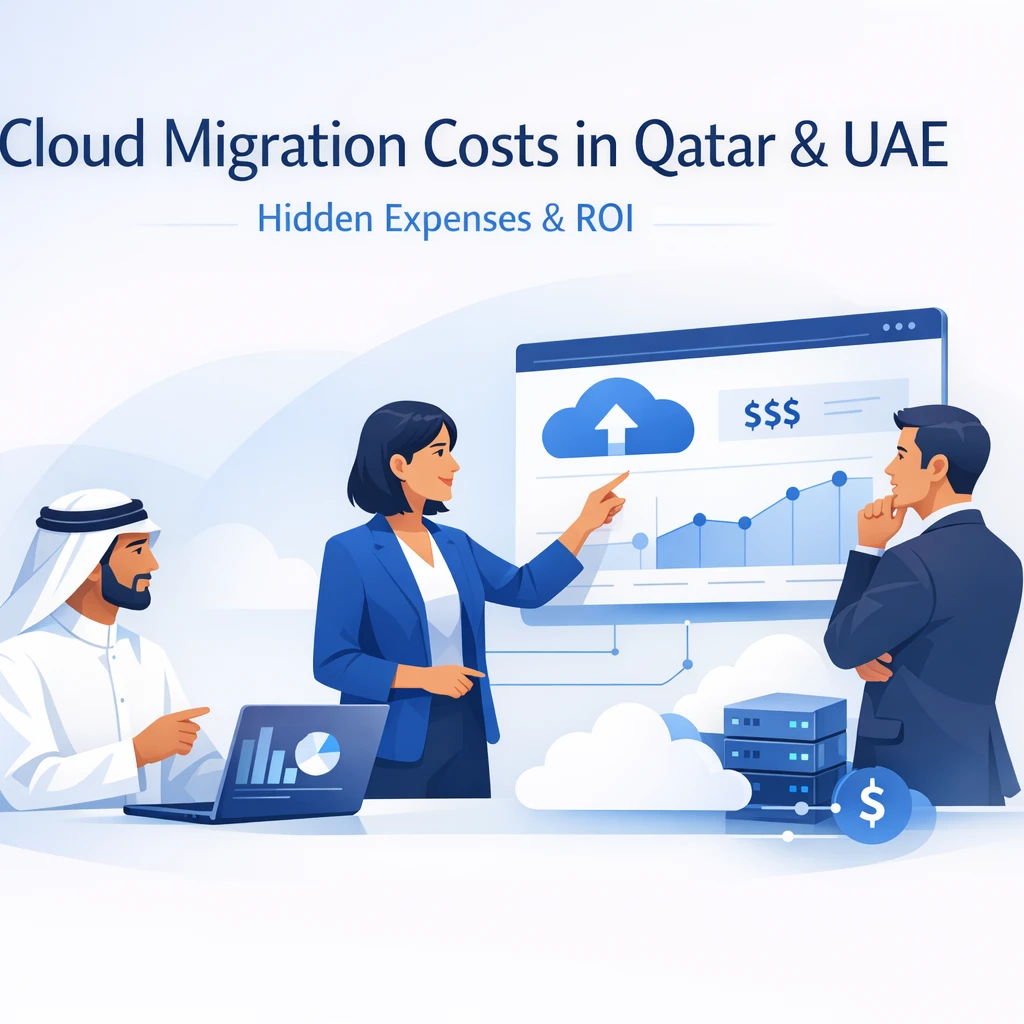
Moving enterprise software to the cloud promises scalability, resilience, and faster time to value. Yet for organizations in Qatar, the UAE, and broader MENA markets, cloud migration is not simply a technology choice. It’s a strategic program with cost implications, regulatory considerations, and long-term ROI. This article unpacks the often-overlooked expenses, provides a practical migration timeline, and illustrates how a trusted partner like Triostack Technologies can help you design, build, and operate cloud solutions that align with business objectives.
Introduction
Many enterprise teams in the GCC region are evaluating cloud migration not just for cost savings, but for business agility, improved analytics, and the ability to deploy new capabilities quickly. However, successful cloud migration requires careful management of scope, data sovereignty, security, and operational overhead. The goal here is to provide a practical, field-tested framework to estimate costs, timelines, and ROI for cloud migration projects ranging from USD 5,000 to USD 200,000, with regional considerations for Qatar, the UAE, Saudi Arabia, and neighboring markets.
What is the Topic?
Cloud migration cost refers to the total, all-in investment required to move an existing on-premises or legacy system to a cloud environment. This includes technical work (assessment, architecture, migration, testing, optimization), governance (security, compliance, data localization), and ongoing operating costs (cloud consumption, DevOps, support). For enterprise projects, the cost is driven by complexity, integration needs, data volumes, and the level of modernization (lift-and-shift vs. refactor vs. re-architect). Triostack Technologies positions itself as a global software development partner that helps SMBs, SMEs, startups, and mature enterprises plan, execute, and govern cloud migrations with a focus on outcomes, not just technology.
Why it Matters in 2026
- The GCC region emphasizes data localization and privacy; cloud vendors offer regional data centers, but regulatory compliance adds steps and governance costs.
- Multi-cloud and hybrid-cloud architectures are common as organizations balance performance, cost, and vendor risk. This adds complexity but also resilience if managed well.
- Automation, AI-assisted operations, and modern data platforms unlock new ROI channels—from predictive maintenance to real-time analytics—but require upfront investment in platform modernization.
Current Industry Challenges
- Hidden costs such as data egress, cross-region replication, idle compute, and licensing can erode savings if unchecked.
- Downtime risk and migration window impact business continuity, especially in sectors like logistics, healthcare, and retail.
- Data sovereignty and regulatory compliance (including UAE Data Protection laws, Qatar’s data localization considerations) require careful governance and documentation.
- Skills gaps and vendor lock-in concerns drive teams to seek a partner who can deliver end-to-end services—from assessment through ongoing optimization.
How the Technology Works
Cloud migration blends several layers of technology: compute, storage, networking, identity, security, data management, and applications. A sound migration strategy typically includes assessment and planning, architecture design, pilot migrations, full-scale cutover, and stabilization. Important choices include:
- Migration approach: lift-and-shift (quick but less optimized) vs. replatform or refactor (longer but often higher ROI).
- Deployment model: public cloud, private cloud, or multi-cloud/hybrid strategies.
- Data governance: data residency, encryption, access controls, and auditing capabilities.
- Operational model: DevOps maturity, CI/CD pipelines, and automated testing in staging environments.
Architecture Overview
The following high-level architecture illustrates how a typical enterprise migration is structured. It emphasizes separation of concerns, security, and scalability, and it can be adapted to industries such as logistics, healthcare, and retail within Qatar, the UAE, and beyond.
Architecture Details
Key components to consider when planning architecture include:
- Identity and Access Management (IAM) across on-premises and cloud environments to enforce least privilege.
- Data protection: encryption at rest and in transit, key management, and tokenization for sensitive data.
- Networking: secure connectivity between on-prem and cloud (VPN, ExpressRoute/Direct Connect, or similar), plus segmentation and firewall policies.
- Data management: data migration tools, replication, and data quality gates.
- Observability: centralized logging, metrics, tracing, and incident response playbooks.
- Operational tooling: CI/CD, automated testing, and blue/green or canary deployment strategies.
Step-by-Step Workflow
- Assessment and readiness: inventory, dependencies, data volumes, and regulatory requirements.
- Architectural design: target cloud architecture, services mapping, and security posture.
- Migration planning: phased approach, risk assessment, cutover windows, and rollback strategies.
- Implementation: build, migrate data, rehome services, and validate functionality.
- Testing and validation: functional, security, performance, and resilience tests.
- Optimization: right-sizing, automation, and cost control mechanisms.
- Operate and evolve: ongoing governance, optimization, and feature delivery.
Business Use Cases
Across sectors, cloud migration unlocks different value levers. Here are representative use cases relevant to our target markets:
- Dubai-based logistics company migrating to a cloud-based TMS and analytics platform to improve delivery predictability and reduce fleet idle time.
- UAE healthcare clinic modernizing patient records with a secure, compliant EHR in the cloud, enabling telehealth integrations and better data sharing with partners.
- Saudi retail business migrating an omnichannel CRM and inventory platform to a scalable cloud solution to support seasonal demand spikes.
- Australian startup building a SaaS product with a cloud-native architecture to scale globally from day one.
- UK SaaS company consolidating disparate microservices into a unified cloud-native platform with robust CI/CD.
Industry Applications
Cloud migration supports a spectrum of industry applications:
- Supply chain and logistics optimization
- Healthcare data management and telemedicine
- Retail commerce and inventory optimization
- Financial services and risk analytics
- Manufacturing and IoT-driven operations
Benefits
- Elastic capacity to match demand, reducing idle infrastructure costs.
- Faster time-to-market for new features and services.
- Improved security posture through centralized control planes and automated compliance checks.
- Stronger disaster recovery and business continuity capabilities.
- Better data-driven decision making via centralized analytics and AI.
Challenges
- Data localization and cross-border data transfer restrictions.
- Skyrocketing egress costs if data is moved frequently between clouds or regions.
- License management for SaaS and platform services across hybrid environments.
- Skill gaps in cloud-native design and automated security.
Common Mistakes
Best Practices
- Start with a small, non-critical pilot to validate architecture choices and ROI.
- Adopt a phased, iterative migration with measurable milestones and business KPIs.
- Prioritize data protection and compliance from day one; implement encryption, access controls, and auditing.
- Plan for ongoing optimization—cloud cost management, autoscaling, and right-sizing.
- Engage a trusted partner with global delivery capabilities to handle complexity and regulatory considerations.
Build vs Buy Comparison
| Aspect | Build (In-House) | Buy (Outsource / Managed Services) |
|---|---|---|
| Time to value | Longer, depending on team capacity | Quicker, leveraging proven frameworks |
| Control & customization | High flexibility | Moderate; depends on vendor capabilities |
| Cost certainty | Variable; ongoing payroll & maintenance | More predictable; upfront scoping matters |
| Risk management | Higher internal risk if skills are gaps | Shared risk with partner and aligned governance |
Estimated Development Cost
For SMBs and SMEs planning cloud migrations, typical project types and indicative ranges (USD) are shown below. These ranges reflect common market pricing for migrations that include assessment, architecture, data migration, application modernization, and initial optimization. Tone and scope will shift these values; regional labor costs and vendor engagement models will also influence totals.
| Project Type | Typical Range (USD) |
|---|---|
| Business Website | 5,000 – 15,000 |
| Customer Portal | 10,000 – 40,000 |
| CRM | 15,000 – 100,000 |
| ERP | 40,000 – 200,000 |
| AI Chatbot | 5,000 – 25,000 |
| AI Automation | 15,000 – 80,000 |
| SaaS MVP | 20,000 – 80,000 |
| Enterprise Web App | 30,000 – 200,000 |
Pricing factors include data volume, integration complexity, security requirements, regulatory compliance, the level of modernization, and the chosen deployment model. For organizations in Qatar and the UAE, additional considerations include data sovereignty requirements, multilingual user interfaces, and regional SLAs with cloud providers.
Recommended Technology Stack
While the stack depends on project specifics, a typical enterprise migration may include:
- Cloud platform: AWS, Microsoft Azure, or Google Cloud Platform (GCP) depending on regulatory alignment and regional data centers.
- Data management: managed data lake, data catalog, and ETL/ELT tools.
- Core services: serverless compute for event-driven workloads, container orchestration (Kubernetes), and traditional VMs for lift-and-shift workloads.
- Security: IAM, encryption, key management, WAF, and security operations tooling.
- Observability: centralized logging, metrics, tracing, and anomaly detection.
- AI/ML: platform-native services for analytics, NLP, and automation as needed.
Future Trends
Expect continued evolution in cloud migration strategies as organizations adopt:
- AI-assisted migration planning and cost optimization.
- Serverless-first architectures where feasible to reduce operational burden.
- Edge computing to reduce latency for regional applications and compliance with data localization requirements.
- Vaulted, policy-driven automation to enforce security and compliance across multi-cloud environments.
How Triostack Delivers Projects Globally
Triostack Technologies enables global delivery with regional sensitivity. We help clients in the UAE, Qatar, Saudi Arabia, Oman, Kuwait, Bahrain, and beyond plan, build, migrate, and operate cloud-based solutions that scale. Our services span the full spectrum of software development and cloud modernization, including:
- Custom Software
- Web Development
- Mobile Apps
- AI Development & Machine Learning
- CRM & ERP
- SaaS
- Cloud Migration
- DevOps
- UI/UX
- API Development
- Dedicated Teams
- QA
- Maintenance
- Technical Consulting
REMOTE DELIVERY
Triostack offers robust remote delivery capabilities from India, designed to align with the expectations of enterprise buyers in the UAE, GCC, and globally. Our remote model emphasizes clarity, velocity, and security:
- Agile project management with sprint planning and weekly demos
- Communication channels: Slack, Teams, Zoom, Google Meet
- Project management and issue tracking: Jira, ClickUp
- Code management: GitHub, GitLab, Azure DevOps
- CI/CD pipelines and cloud staging environments for safe testing
- Strong focus on QA, documentation, and security
- NDA protections and clear IP ownership terms
- Timezone overlap and English communication to ensure smooth collaboration
- Dedicated project managers and long-term support post-launch
Why UAE businesses outsource development to India is a question we hear often. The reasons include cost efficiency, access to a large talent pool, faster hiring, high-quality engineering, and strong communication practices. With a well-structured engagement model, Triostack ensures visibility, control, and alignment with local regulatory expectations.
Case Studies
Below are anonymized, realistic implementation narratives that illustrate typical cloud migration journeys. Each case reflects a common business scenario rather than a fictional success rate.
Dubai-based Logistics Company: Cloud Modernization of TMS and Analytics
Challenge: Legacy transportation management and analytics systems could not scale to handle peak demand, leading to delays and suboptimal route planning. Regulatory constraints required secure data handling and auditability.
Approach: Triostack performed an assessment, built a hybrid cloud architecture, migrated the core TMS to a managed cloud environment, and established a data lake for analytics. We orchestrated ETL pipelines and introduced real-time route optimization using streaming data.
Outcome: Improved delivery accuracy by 18%, reduced fleet idle time, and achieved faster decision cycles through real-time dashboards. The project was delivered in phased sprints with weekly demonstrations to business stakeholders.
UAE Healthcare Clinic: Cloud-based EHR and Telehealth
Challenge: A multi-site clinic network required compliant, secure access to patient records with local privacy controls and cross-site data sharing for referrals.
Approach: Implemented a cloud-hosted EHR with role-based access, encryption in transit and at rest, and a telehealth module integrated with the clinical workflow. Data localization considerations shaped the data store strategy.
Outcome: Improved patient outcomes through faster record retrieval, streamlined referrals, and compliant telehealth sessions. The solution was delivered alongside a change-management plan for clinicians and administrators.
Saudi Retail Business: Omnichannel CRM & Inventory in the Cloud
Challenge: Fragmented customer data and siloed inventory systems hindered omnichannel selling and accurate demand forecasting.
Approach: Migrated CRM and inventory to a cloud-based platform with integrated analytics, implemented data harmonization, and introduced API-driven interoperability with point-of-sale (POS) systems.
Outcome: Unified customer view, improved stock accuracy, and a 12-18% uplift in online-to-offline conversion rates during promotions.
Australian Startup: Cloud-native MVP to Scale
Challenge: A startup required a scalable cloud-native MVP to validate product-market fit and then scale to millions of users with robust data analytics.
Approach: Built a microservices architecture with containerization, CI/CD automation, and cloud-native storage. Implemented telemetry and fraud detection as part of the initial launch.
Outcome: Fast iteration cycles, predictable cost, and rapid deployment of new features that accelerated Go-To-Market timelines.
UK SaaS Company: Globalization and Compliance
Challenge: The client needed a cloud platform capable of handling multi-region deployments with data residency controls and GDPR alignment.
Approach: Standardized deployment patterns, introduced region-aware data routing, and built robust security and audit trails. Engaged Triostack for ongoing optimization and features delivery.
Outcome: Achieved compliance with local data policies while delivering a consistent experience to customers across geographies.
Cost Section: Realistic Software Pricing for SMBs
Understanding cost drivers helps you set realistic expectations and avoid surprises. The pricing bands below reflect typical ranges for SMBs and SMEs planning cloud migrations and related modernization efforts in regions like the UAE and GCC, with a global delivery option from Triostack.
Pricing Ranges by Project Type
| Project Type | Typical Range (USD) |
|---|---|
| Business Website | 5,000 – 15,000 |
| Customer Portal | 10,000 – 40,000 |
| CRM | 15,000 – 100,000 |
| ERP | 40,000 – 200,000 |
| AI Chatbot | 5,000 – 25,000 |
| AI Automation | 15,000 – 80,000 |
| SaaS MVP | 20,000 – 80,000 |
| Enterprise Web App | 30,000 – 200,000 |
Pricing Factors
Several factors influence project cost:
- Data volumes and complexity of migrations (ETL/ELT work, data quality gates).
- Number of integrations with third-party systems and on-premises assets.
- Security, compliance requirements (data localization, auditing, and access controls).
- Required modernization level (lift-and-shift vs. re-platform or re-architecture).
- Choice of cloud provider and regional data center requirements.
- Localization needs, including multilingual UIs and regional support.
- Ongoing managed services and governance commitments post-migration.
Future Trends
The cloud migration landscape continues to evolve. Key trends shaping 2026 and beyond include:
- AI/ML-driven cost optimization and performance tuning as a standard capability.
- Containerization and microservices becoming the default for complex enterprise apps.
- Regulatory-aware cloud architectures with automated policy enforcement.
- End-to-end observability and security automation to reduce mean time to detection and recovery.
Migration Timeline: Typical Phases and Durations
Enterprises often follow a staged approach to migration. The durations depend on scope, regulatory constraints, and organizational readiness. The table below shows a typical timeline for projects in the SMB-to-mid-market range.
| Phase | Activities | Typical Duration |
|---|---|---|
| Assessment & Planning | Inventory, dependency mapping, data governance plan | 4–6 weeks |
| Architecture & Pilot | Target architecture, security model, pilot migration | 6–10 weeks |
| Full Migration & Validation | Data migration, application cutover, testing | 8–16 weeks |
| Optimization & Stabilization | Cost optimization, performance tuning, onboarding | 4–12 weeks |
Future Trends (Expanded)
We expect more emphasis on ongoing optimization, governance automation, and cross-border cloud strategies that respect local laws while enabling global access. Forward-looking organizations build with a continuous improvement mindset—treating cloud migration as a capability, not a one-off project.
How Triostack Delivers Projects Globally
Triostack combines global delivery capabilities with a regional focus. We work with clients to define the right cloud strategy, then implement with a blend of local governance and remote execution. Our approach includes:
- Discovery and architecture aligned to business goals and regional compliance
- Iterative sprints, with measurable milestones and dashboards for stakeholders
- Secure, scalable, cloud-native solutions that are resilient and maintainable
- Cost governance and optimization as ongoing disciplines
Why Businesses Choose Triostack
Triostack helps enterprises turn cloud migration into a competitive advantage. We offer end-to-end services including:
- Custom Software
- Web Development
- Mobile Apps
- AI Development
- Machine Learning
- CRM
- ERP
- SaaS
- Cloud Migration
- DevOps
- UI/UX
- API Development
- Dedicated Teams
- QA
- Maintenance
- Technical Consulting
Conclusion
Cloud migration offers substantial potential ROI for enterprises in Qatar, the UAE, and beyond. The payoff hinges on a disciplined approach to cost management, regulatory compliance, and architecture that scales with business needs. By aligning stakeholders, investing in a robust data strategy, and engaging a partner with global delivery capability, organizations can reduce risk, accelerate time to value, and unlock new capabilities that drive growth.
Frequently Asked Questions
- What is the typical ROI timeline for cloud migration?
- ROI varies by project, but many organizations begin to see cost savings and productivity gains within 12–24 months, with ongoing improvements over time through optimization and new cloud-native capabilities.
- What are the biggest hidden costs in cloud migration?
- Data egress, cross-region replication, license reconfigurations, training, downtime during cutover, and ongoing security/compliance investments are common hidden costs.
- How can I ensure data sovereignty in the UAE/Qatar?
- Work with providers and partners that offer region-specific data centers, encryption at rest and in transit, strict access control, and auditable compliance reporting.
- Why should I consider remote delivery?
- Remote delivery from a region with deep talent pools can reduce cost, accelerate delivery, and provide access to specialized expertise, provided there is strong governance, clear SLAs, and robust security.
If you're planning a similar software project, Triostack can help you design, build, deploy and maintain a scalable solution. Our teams work transparently with clients in the UAE, GCC, Europe, North America, and beyond.
Internal Links & References
For readers exploring related topics, we encourage visiting sections on cloud security, data governance, and multi-cloud architectures. (Internal links to related articles and resources would be placed here.)
Triostack Team
Technology Evangelist & Writer
Triostack Team is an experienced writer and technologist, exploring the intersections of AI, cloud architecture, and modern application development. Passionate about turning complex technical concepts into accessible insights.