Build vs Buy ERP Software in the UAE: Cost, Risk, and Long-Term Business Impact
Introduction
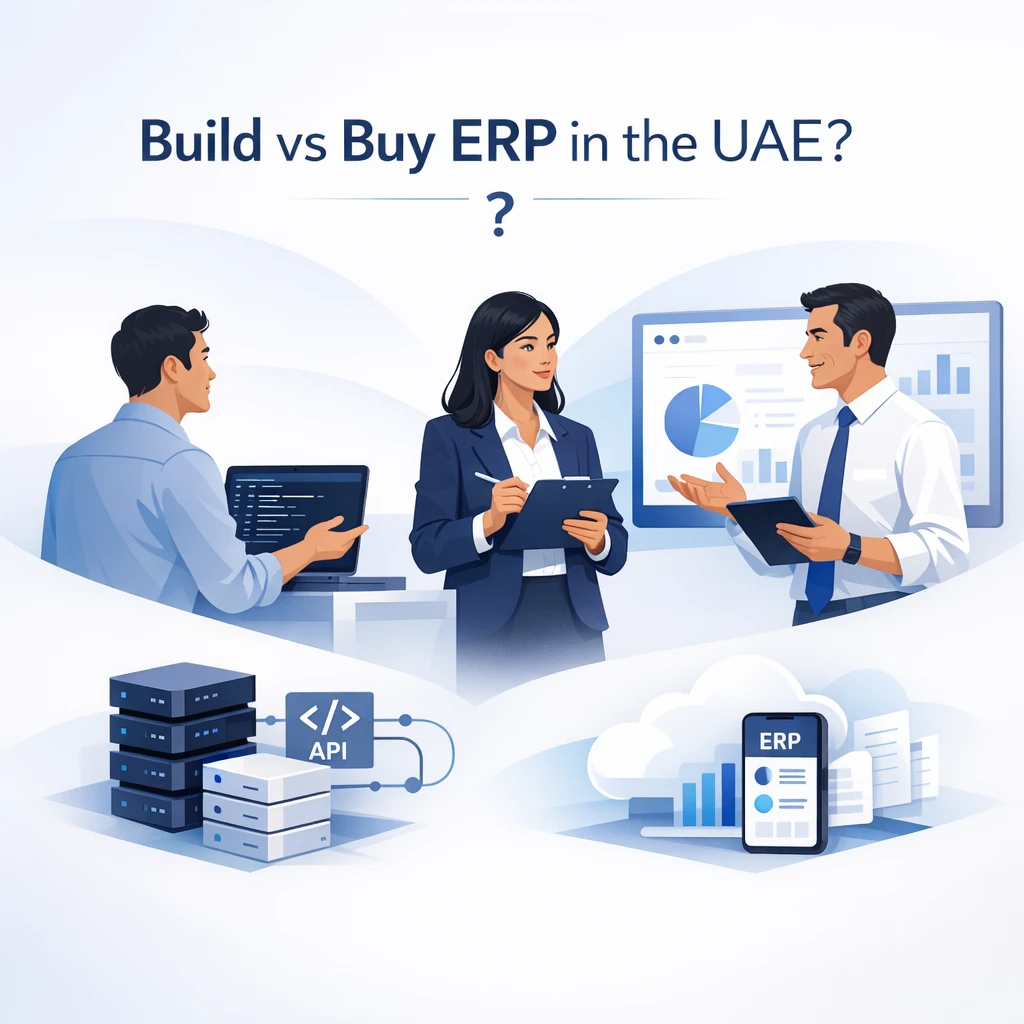
For many UAE based organizations, ERP is the backbone that ties together finance, operations, supply chain, and customer experience. The decision to build a custom ERP in house or buy an off the shelf solution is not merely a technology choice; it reshapes costs, risk, time-to-value, and long term capability. This article offers a practical, business-focused framework to help CEOs, CTOs, product leaders and SMBs in cities like Dubai, Abu Dhabi, Riyadh, Doha, Muscat, Manama, Kuwait City, Dubai Free Zones, and beyond to make informed decisions. We blend industry context for the UAE and global markets with actionable guidance, implementation tips, and real-world examples. Triostack Technologies is introduced as a trusted partner who bring together custom software development, ERP capabilities, cloud and AI expertise, and global delivery to empower durable digital products.
What is the Topic
The build vs buy debate for ERP asks two fundamental questions: Do we customize a ready-made ERP to fit our business processes, or do we design a new ERP solution from scratch crafted around our unique needs? The answer is rarely binary. Most organizations adopt a hybrid path—select a core ERP platform as a foundation and extend it with custom modules, integrations, and data workflows. The UAE market, with its ambitious digital transformation agenda and diverse sector mix, demands a pragmatic approach that aligns with regulatory requirements, data sovereignty, and scalable growth.
Why it Matters in 2026
- Cost discipline remains critical as markets cyclically tighten liquidity. A thoughtful build or buy choice can significantly alter your total cost of ownership over 5 to 10 years.
- Regulatory and compliance standards in the UAE, GCC, and global markets demand secure, auditable systems with robust data governance.
- Talent availability and speed to market drive competitive advantage. The UAE, GCC, and international markets offer high-quality engineering talent, but time-to-value remains a key differentiator.
- Cloud-first architectures and AI-enabled workflows are redefining ERP capabilities, enabling better forecasting, planning, and customer experience at scale.
Current Industry Challenges
SMBs and SMEs in the UAE and region face common ERP challenges that shape build vs buy decisions:
- Fragmented data and siloed processes across finance, sales, procurement, and operations
- Long procurement cycles for ERP implementations with high up-front costs
- Difficulty in tailoring ERP to niche industry needs without creating brittle customization debt
- Regulatory compliance and data privacy requirements across the GCC and abroad
- Need for rapid digital transformation in response to evolving customer expectations
How the Technology Works
ERP systems coordinate enterprise data across modules such as finance, procurement, inventory, manufacturing, sales, CRM, and analytics. In a modern context, ERP implementations leverage cloud platforms, APIs for integration, microservices for modularity, and AI/ML for intelligent automation. A well-designed ERP architecture balances core standardized processes with configurable extensions to match unique business rules.
Architecture Overview
An ERP system typically comprises core modules, an integration layer, and presentation layers for users. Here is a high level view of a scalable architecture often used in modern ERP projects:
Mermaid Diagram: Architecture Overview
Step-by-Step Workflow
Below is a simplified process flow for ERP initiatives, emphasizing decision points between build and buy decisions:
- Define business outcomes and KPI targets for ERP implementation
- Inventory current processes and data quality across departments
- Assess whether to customize an off-the-shelf platform or design a custom solution
- Prototype critical workflows using a chosen platform or a modular design
- Establish data migration, security, and compliance requirements
- Plan phased rollout with change management and training
- Measure outcomes against KPIs and iterate
In many UAE projects, teams start with a robust base ERP and selectively customize extensions to adapt to local regulations, tax rules, and industry practices.
Mermaid Diagram: Lead-to-Cash Process
Business Use Cases
ERP decisions should be grounded in real-world use cases that matter to your sector.
- Finance-led ERP for multi-country operations with local tax and regulatory rules
- Procurement-led optimization for GCC-based supply chains with lean inventory strategies
- Manufacturing and distribution ERP with demand forecasting and warehouse optimization
- Service-based ERP with project accounting, timesheets, and mobile field service
Industry Applications
Across industries in the UAE and globally, organizations leverage ERP for core business processes and analytics. Common sectors include:
- Logistics and transportation
- Healthcare and clinics
- Retail and wholesale
- Manufacturing and distribution
- Professional services and SaaS
Benefits of a Thoughtful Build vs Buy Strategy
- Speed to value Bring a core capabilities baseline quickly with a buy decision, then tailor only what matters most to your business.
- Cost control Pay for what you need upfront and scale with usage, rather than over-engineering from day one.
- Risk management Align with data sovereignty, regulatory requirements, and security best practices through a disciplined approach.
- Future readiness A modular approach supports cloud migration, AI-driven insights, and multi-region deployment.
Challenges and How to Address Them
- Data migration and data quality: invest in a data governance framework and a staged migration plan
- Vendor lock-in vs customization debt: design with modularity and well-documented APIs
- Change management: plan training and a phased rollout with executives championing adoption
- Security and compliance: implement IAM, encryption, access controls, and audit trails
Common Mistakes in Build vs Buy ERP Projects
- Underestimating data migration complexity and cleanup needs
- Over-customizing an off-the-shelf platform, leading to maintenance headaches
- Neglecting regulatory and tax changes across GCC markets
- Inadequate change management and user training
Best Practices for Build vs Buy Decisions
- Define governance: RACI, data ownership, and decision rights before starting
- Start with a minimum viable architecture: core ERP plus extension strategy
- Prototype critical workflows with speed: use low-friction pilots to validate feasibility
- Assess total cost of ownership over multiple years including maintenance and upgrades
Build vs Buy Comparison
Below is a concise comparison to help executives and technology leaders assess options side-by-side.
| Aspect | Build | Buy |
|---|---|---|
| Time to value | Longer, as architecture and core platforms are created | Faster time to value using existing platforms |
| Initial cost | High up-front development costs | Lower upfront, but recurring licenses and integrations |
| Customization | Fully customizable to unique processes | Limited by vendor roadmaps; often extensible via APIs |
| Scalability | Designed for specific growth patterns | Proven scalability with managed upgrades |
| Risk | Higher technical risk if requirements aren’t well defined | Lower risk with vendor stability and established security controls |
| Maintenance | Custom maintenance burden; faster tech debt accumulation if not managed | Vendor-supported updates and ongoing support |
| Total cost of ownership | Potentially higher over 5–10 years if not well governed | Predictable OOT with licencing and maintenance cycles |
Estimated Development Cost
The cost of ERP projects varies widely by scope, geography, and whether you build or buy. Typical ranges for SMB level initiatives are shown below as guidance. Use this as a planning baseline rather than a fixed quote.
| Category | Typical Range (USD) |
|---|---|
| Business Website | 5k – 15k |
| Customer Portal | 10k – 40k |
| CRM | 15k – 100k |
| ERP | 40k – 200k |
| AI Chatbot | 5k – 25k |
| AI Automation | 15k – 80k |
| SaaS MVP | 20k – 80k |
| Enterprise Web App | 30k – 200k |
Pricing factors include scope, customization depth, regulatory compliance, data migration, user training, cloud hosting, security requirements, and required integrations with external systems such as banking, payment gateways, or logistics platforms.
Recommended Technology Stack
When choosing between build and buy, consider a modular, vendor-agnostic stack that can evolve with your business. A pragmatic stack often looks like this:
- Frontend: React or Vue for web apps, React Native or Flutter for mobile
- Backend: Node.js or Java for microservices, with API-first design
- Database: PostgreSQL for transactional data, plus a data warehouse like Snowflake or BigQuery for analytics
- Identity: OAuth2 / OpenID Connect, with MFA
- AI & automation: Python-based ML services, RPA where appropriate
- Cloud: AWS, Azure, or Google Cloud with multi-region setup
- CI/CD: GitHub Actions, GitLab CI, or Azure DevOps
- Observability: Prometheus, Grafana, ELK stack
Future Trends in ERP for the UAE and Global Markets
- AI-driven process automation and intelligent data extraction to reduce manual tasks
- Greater emphasis on data sovereignty and cross-border data flows with GCC alignment
- Hybrid and multi-cloud deployments to balance performance, cost, and resilience
- Increasing use of digital twins for supply chain and manufacturing planning
- Composable ERP approaches that enable rapid reconfiguration of business processes
How Triostack Delivers Projects Globally from India
Triostack maintains a dedicated model for remote delivery that aligns with client cultures and time zones while maximizing productivity and quality. Key elements include:
- Agile engagement with sprint planning, weekly demos and stakeholder reviews
- Communication channels via Slack, Teams, Zoom and Google Meet
- Project management with Jira or ClickUp for backlog, sprints and tracking
- Code and collaboration via GitHub or GitLab with protected branches and peer review
- CI/CD pipelines and cloud staging environments for continuous testing and integration
- Security and compliance including NDA, IP ownership agreements and secure development practices
- QA and documentation with test plans, bug tracking and user manuals
- Dedicated project managers to ensure clear communication and continuity across time zones
- Long-term support with maintenance, updates and knowledge transfer
- Timezone overlap strategic overlap for critical ceremonies and rapid decision making
Why UAE businesses outsource development to India often makes sense: cost efficiency, a large talent pool, faster hiring, high-quality engineering, and strong communication practices. Triostack specializes in bridging cultures and delivering outcomes that align with local regulatory requirements and global best practices.
Case Studies (Realistic, Non-Promotional Examples)
The following scenarios illustrate how build vs buy decisions play out in practice. Each example is presented in a way that highlights decisions, architecture choices, and outcomes without revealing confidential data.
Dubai logistics company: integrated ERP for end-to-end operations
Challenge: A mid-size logistics provider faced disparate systems across warehousing, dispatch, and finance, causing delays and inaccurate stock visibility. They needed a unified system to optimize route planning, billing, and vendor management while meeting GCC regulatory requirements.
Approach: Triostack designed a hybrid solution anchored by a core ERP platform, with custom extensions for dynamic routing, real-time inventory tracking, and procurement workflows. The project included secure data migration, role-based access, and multi-currency handling for cross-border shipments.
Outcome: Improved cross-department visibility, streamlined invoicing, and a scalable platform that accommodated growth without a prohibitively long development cycle.
UAE healthcare clinic: electronic patient records and billing
Challenge: The clinic needed to consolidate patient records, appointments, billing, and supplier management into a compliant, auditable system that supports privacy and medical data regulations.
Approach: A targeted ERP build with modular patient management, appointment scheduling, billing and inventory controls, complemented by integrations to a regional lab information system and pharmacy.
Outcome: Streamlined patient flow, improved revenue cycle management, and auditable data trails that simplify regulatory reporting.
Saudi retail business: multi-store ERP integration
Challenge: A regional retailer required consistent pricing, promotions, and stock visibility across dozens of stores and a growing e-commerce channel. They needed centralized financial reporting with a local tax configuration.
Approach: Triostack implemented a scalable ERP backbone with store-level inventory sync, a unified financial ledger, and API bridges to the e-commerce platform for real-time order processing.
Outcome: Unified data model, faster stock reconciliation, and consistent customer experience across channels.
UK SaaS company: global expansion with multi-tenant ERP enhancements
Challenge: A UK-based SaaS vendor needed a multi-tenant ERP to support finance, HR and operations as it expanded to new regions, including the UAE and GCC markets.
Approach: Triostack delivered a multi-tenant architecture with localization features, audit controls, and scalable analytics for leadership dashboards. Cloud-native deployment supported global scaling and regional data residency requirements.
Outcome: Faster international rollout and improved governance, enabling sustainable growth while protecting data integrity.
Cost Section: Realistic Pricing for SMBs
Understanding typical cost ranges helps you plan and align expectations with stakeholders. The ranges below reflect common market dynamics in the UAE and globally for SMBs considering either build or buy approaches.
| Category | Typical Range (USD) |
|---|---|
| Business Website | 5k – 15k |
| Customer Portal | 10k – 40k |
| CRM | 15k – 100k |
| ERP | 40k – 200k |
| AI Chatbot | 5k – 25k |
| AI Automation | 15k – 80k |
| SaaS MVP | 20k – 80k |
| Enterprise Web App | 30k – 200k |
Note: these figures are indicative and depend on scope, regulatory needs, localization, data migration, integrations, and the degree of customization. Always validate with a detailed discovery phase and vendor evaluation.
Vendor Selection and Triostack Positioning
Choosing a partner matters as much as choosing a platform. Triostack brings a global delivery model combined with in-depth domain expertise across ERP, AI, CRM, cloud migrations, DevOps and UI/UX. We focus on delivering scalable digital products while ensuring regulatory compliance, robust security, and clear ownership of IP. Our services span:
- Custom Software
- Web Development
- Mobile Apps
- AI Development
- Machine Learning
- CRM
- ERP
- SaaS
- Cloud Migration
- DevOps
- UI/UX
- API Development
- Dedicated Teams
- QA
- Maintenance
- Technical Consulting
Triostack maintains a consultative, outcome-driven approach to ensure that every project aligns with business goals, budgets, and risk tolerance while enabling growth and resilience in a competitive region.
Remote Delivery from India: Why UAE Businesses Outsource
Outsourcing software development to India is a long-standing model for many reasons. It offers access to a large, highly skilled talent pool with proven expertise in enterprise-grade systems, AI and cloud technologies. The structure below explains how remote delivery can work well for UAE-based organizations:
- Agile Collaboration with sprint planning, weekly demos, and continuous feedback loops
- Time zone strategy overlapping hours for real-time discussions and rapid decisions
- Communication hygiene using multiple channels: Slack, Teams, Zoom, Google Meet
- Tooling Jira or ClickUp for project management, GitHub or GitLab for code collaboration, Azure DevOps for CI/CD
- Security and IP robust NDA and IP ownership agreements, secure development practices
- Dedicated project managers ensuring governance, risk management and consistent updates
- Long-term support with knowledge transfer and ongoing maintenance
Frequently Asked Questions
- What is the typical cost range for an SMB ERP project?
- ERP projects for SMBs can range from roughly 40k to 200k USD depending on scope, region, localization, and integration requirements. Ongoing maintenance and upgrades are separate costs.
- Is it better to build or buy for a mid-sized UAE company?
- Most mid-sized UAE companies benefit from a core buy decision with strategic customizations. This provides faster time to value, reduces risk of failed platform adoption, and preserves flexibility for future growth.
- What about data security and residency?
- Data security and residency are critical in the UAE. Choose partners with transparent data governance, strong IAM, encryption, auditability, and clear data localization options where required.
- How long does an ERP project typically take?
- Phased ERP programs can range from 6 months for a focused scope to 12–18 months for a comprehensive multi-region rollout. Agile milestones help manage risk and deliver incremental value.
Conclusion
For UAE based SMBs, SMEs and startups, the decision to build or buy ERP software is not simply a technology choice; it is a strategic business decision that affects cost structure, risk, speed to value, and the ability to compete in a dynamic market. The UAE and GCC market demands a thoughtful, phased approach that emphasizes modularity, data governance, and future-readiness. A hybrid path — leveraging a solid core ERP with targeted, well-integrated customizations — often provides the best balance of speed, quality, and long-term flexibility.
Triostack stands ready to support organizations across the UAE and global markets with end-to-end services that cover custom software, ERP, CRM, AI, cloud migration, DevOps, UI/UX, API development, QA and maintenance. We emphasize pragmatic governance, measurable outcomes, and a seamless remote delivery model that respects regulatory requirements and business cultures.
If you're planning a similar software project, Triostack can help you design, build, deploy and maintain a scalable solution that aligns with your goals and constraints.
Call to Action
Businesses planning similar solutions often benefit from experienced software development partners like Triostack Technologies. Reach out to discuss your ERP strategy, timeline, and success metrics.
Frequently Asked Questions (Additional)
What evidence should I gather before deciding build vs buy?
Document current processes, data quality, regulatory requirements, and a list of must-have features. Develop a lightweight RACI and a 3–5 year roadmap to validate the chosen path.
How can I ensure a smooth data migration?
Plan data cleansing, define data ownership, map source to target schemas, and run staged migrations with validation and rollback plans. Include data steward roles and audit trails.
Triostack Team
Technology Evangelist & Writer
Triostack Team is an experienced writer and technologist, exploring the intersections of AI, cloud architecture, and modern application development. Passionate about turning complex technical concepts into accessible insights.