Build vs Buy ERP Software in Dubai: Total Cost of Ownership, Risks, and Long-Term Business Value
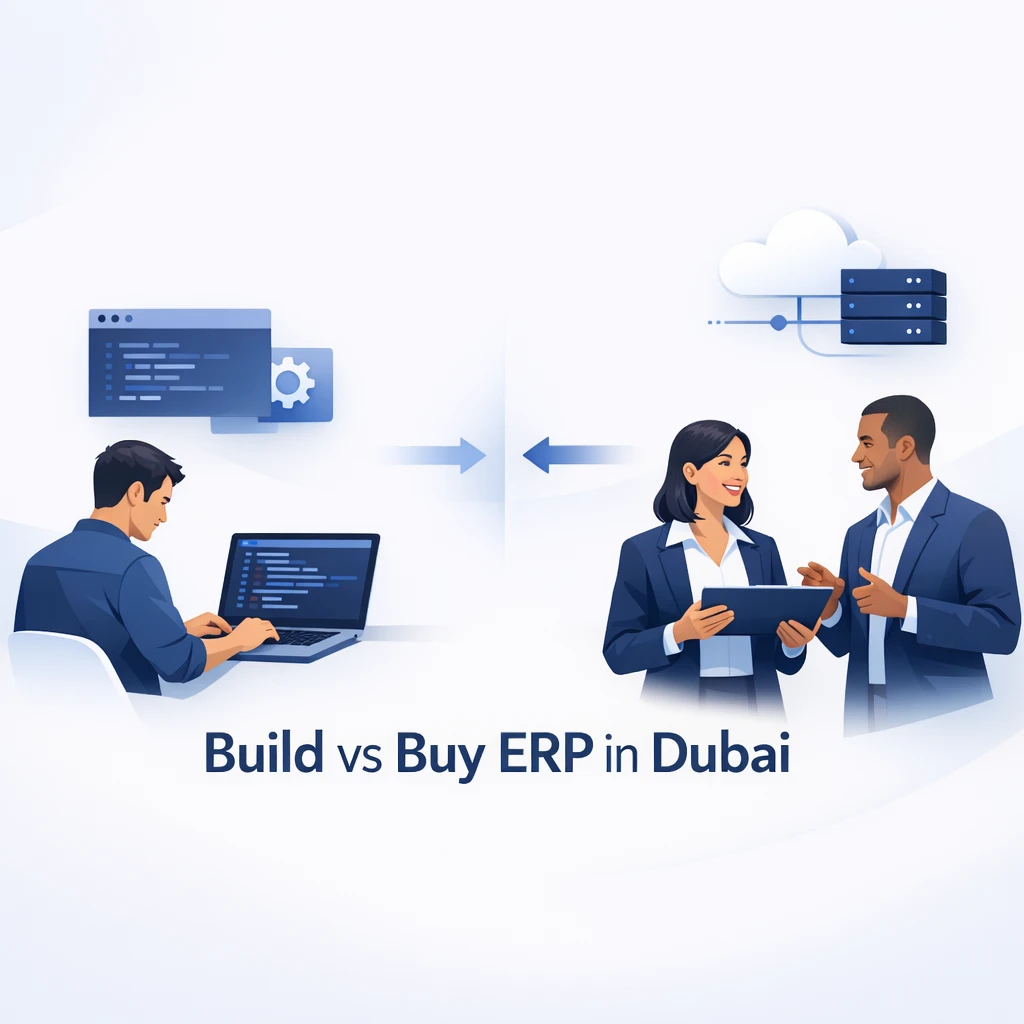
A practical, business-first guide for SMBs, SMEs, and startups planning an ERP project across the Gulf region and beyond.
Introduction
For ambitious organizations in Dubai, the UAE, and across the broader Gulf region, Enterprise Resource Planning (ERP) is not just a system—it’s a strategic platform. It coordinates fragmented business processes, harmonizes data across departments, and provides the visibility needed to make informed decisions. When faced with a new ERP initiative, leadership teams typically weigh two paths: build a custom solution tailored to unique processes, or buy an off-the-shelf ERP and customize it to fit.
This article is written for small and medium businesses (SMBs and SMEs), startup founders, CEOs, CTOs, product managers, and digital transformation leaders who are considering ERP investments in the USD 5,000–USD 200,000 range. We’ll explore total cost of ownership (TCO), risk profiles, and the long-term business value of each option. Along the way, you’ll see practical guidance, real-world examples, and how a capable partner like Triostack Technologies can help you execute successfully—without turning your project into an unnecessary advertisement.
The goal is clarity: you’ll come away with a framework to evaluate ROI over the product lifecycle, understand trade-offs, and ultimately choose the path that best aligns with your strategy, people, and data governance requirements.
What is the Topic?
Build vs Buy ERP is about choosing between constructing a custom software stack that mirrors your unique business processes (the build path) and selecting a robust, scalable, commercially supported ERP solution that can be extended with integrations and custom modules (the buy path).
- Build means bespoke development from scratch or heavily customized systems crafted to your exact workflows.
- Buy means acquiring a commercial ERP (often cloud-based) and tailoring it through configuration, integration, and optional extensions.
In both cases, you’ll face decisions about data migration, security and compliance (particularly important in the UAE and Saudi Arabia), user experience, integration with legacy systems, and ongoing maintenance. The right choice depends on your maturity, process complexity, regulatory requirements, and the scale you expect to achieve in the next 3–5 years.
Why it Matters in 2026
The ERP landscape has evolved dramatically. Cloud-native ERP platforms, modular architectures, AI-assisted analytics, and API-first integrations have lowered barriers to entry while enabling deeper customization through configuration rather than code. In 2026, organizations expect:
- Rapid deployment with predictable costs and clear roadmaps.
- Strong data governance, privacy, and regulatory compliance support (GDPR-like controls, local data residency options, UAE VAT compliance, KSA NAC, etc.).
- Unified experiences across web, mobile, and partner ecosystems.
- Scalable architectures that support growth from regional to global operations.
For GCC-based businesses and international operators (e.g., US, UK, Europe, Australia, Singapore), the decision to build or buy is increasingly about time-to-value, total cost of ownership, and the ability to adapt quickly to changing business conditions—without compromising security or compliance.
Note: This article prioritizes practical guidance and industry insights rather than promotional language. The goal is to empower informed decision-making with actionable steps and real-world considerations.
Current Industry Challenges
ERP projects face familiar hurdles, but regional specifics matter. Here are the most impactful challenges you’ll encounter:
UAE VAT, local data privacy expectations, and cross-border data transfer considerations for multinational teams. - Legacy integration: Connecting with on-premise or legacy systems—finance, payroll, or supply chain systems that still run critical operations.
- Data quality and migration: Migrating clean, normalized data from scattered sources is costly and error-prone.
- Change management: Adoption, training, and governance require dedicated effort to avoid user resistance.
- Security and resiliency: Robust identity management, encryption, and disaster recovery are non-negotiable for financial and healthcare data.
- Supply chain volatility: ERP must handle demand variability, vendor risk, and logistics complexity—especially important for Dubai logistics and regional retailers.
How the Technology Works
ERP systems harmonize core business functions—finance, procurement, manufacturing, inventory, order management, CRM, HR, and analytics—into a single source of truth. A modern ERP typically features:
- Modular architecture: Core ERP with optional modules (CRM, HR, manufacturing, supply chain, etc.).
- Cloud-first delivery: Software-as-a-Service (SaaS) or managed cloud hosting for scalability and predictable costs.
- APIs and integrations: Pre-built connectors to CRM, ecommerce platforms, WMS, and other business systems.
- Analytics and AI: Embedded dashboards, AI-assisted forecasting, anomaly detection, and process automation.
- Security and governance: Role-based access, encryption, auditing, and compliance features.
The choice between build and buy hinges on whether you value tailored workflows that align perfectly with nuanced business processes, or speed, risk mitigation, and ecosystem support offered by mature ERP platforms.
Architecture Overview
A high-level view helps communicate complexity to stakeholders and to teams evaluating resources, timelines, and costs.
In Dubai and the broader GCC, emphasize data residency and security controls in your architecture diagram to reassure stakeholders and regulators.
Step-by-Step Workflow
A disciplined workflow reduces risk and accelerates time-to-value. Here’s a pragmatic framework you can adapt:
- Discovery and scoping: Align business goals with measurable success criteria and define MVP scope.
- Design and architecture: Map processes, data models, and integration touchpoints. Decide data migration strategy (big-bang vs. phased).
- Configuration vs. customization: Prefer configuration to code to reduce maintenance overhead.
- Development and integration: Build extensions, connectors, and automation using APIs and middleware where possible.
- Quality assurance: Establish test plans, performance benchmarks, and security assessments.
- Deployment and cutover: Plan for parallel runs, user training, and runbooks for support teams.
- Adoption and optimization: Monitor usage, refine processes, and implement continuous improvement loops.
Business Use Cases
ERP projects vary by industry and region. Here are representative use cases that reflect Dubai, UAE, and GCC market needs:
- Dubai logistics company: A 3PL provider consolidates fleet management, warehousing, and invoicing in a single system, improving shipment tracking and accuracy.
- UAE healthcare clinic: A multi-site clinic standardizes patient intake, appointment scheduling, billing, and inventory of medical supplies with regulatory-compliant data handling.
- Saudi retail business: A regional retailer unifies point-of-sale, merchandising, supplier relations, and financial reporting across stores and e-commerce channels.
- Australian startup: A fast-growing SaaS company scales its finance and user management with a modular ERP that supports rapid international expansion.
- UK SaaS company: A software provider leverages a configurable ERP to manage quotes, subscriptions, revenue recognition, and customer success across markets.
Industry Applications
While the Gulf region drives a lot of ERP interest in manufacturing, logistics, and retail, modern ERP platforms are adaptable across sectors. Common modules that offer immediate value include:
- Finance and accounting with local tax compliance features.
- Procurement and supplier governance to optimize costs and risk.
- Inventory and warehouse management for rateable stock and batch controls.
- Sales, CRM, and customer service alignment with back-office operations.
- Human resources and payroll with regional benefits considerations.
Benefits of Build vs Buy in Practice
No single path fits every organization. Here are practical outcomes you might expect from each approach, based on industry experience and project histories:
- Build: Maximum customization, process ownership, and potential competitive differentiation. Good for highly distinctive workflows or regulated operations where off-the-shelf solutions cannot capture all nuances.
- Buy: Faster time-to-value, lower risk of schedule overruns, access to ongoing upgrades, and a broad ecosystem of integrations and support partners.
In many cases, a hybrid approach—buying a core ERP and building targeted extensions or connectors—provides a balanced combination of speed, control, and value. Triostack has guided many clients through such hybrid strategies, leveraging our deep expertise in custom software, web and mobile development, AI, and cloud platforms.
Best Practices
- Define a clear MVP: Focus on critical processes first (finance, procurement, inventory) and plan staged rollouts for remainder modules.
- Prioritize data governance: Establish data ownership, quality metrics, and a single source of truth from day one.
- Adopt cloud-native constructs: Use managed services, auto-scaling, and robust backup strategies to reduce operational overhead.
- Security by design: Implement zero-trust principles and continuous monitoring, especially for financial and healthcare data.
- Plan for change management: Invest in training, onboarding, and executive sponsorship to maximize user adoption.
Build vs Buy Comparison
This section contrasts the two primary paths in a practical, decision-focused way. Each row represents a core consideration with implications for Dubai, UAE, and international markets.
| Aspect | Build ERP | Buy ERP |
|---|---|---|
| Customization & fit | Highest: can mirror exact processes, but requires substantial design and ongoing maintenance. | Moderate to high: configuration and extensions; some process gaps may remain. |
| Time to value | Longer: design, develop, test, and migrate—often 9–24+ months depending on scope. | Shorter: core system deployment within months; phased rollouts possible. |
| Cost profile | Capex heavy early; ongoing maintenance, DevOps, security, and feature drift costs. | Opex-friendly; predictable subscription fees; lower upfront risk. |
| Risk & governance | Higher risk due to custom code, integration risk, and long-term support needs. | Lower risk with vendor accountability, SLAs, upgrades, and support ecosystems. |
| Regulatory alignment | Requires bespoke controls and documentation; effort scales with scope. | Leverages vendor-compliant frameworks and regional certifications; may require thin customization. |
| Long-term scalability | Depends on architecture decisions; can be tailored for growth but maintenance burden rises. | Typically stronger out-of-the-box scaling with updates and ecosystem integrations. |
Tip: In many markets, a blended approach—buy the core ERP and customize with integrations or extensions—delivers a practical balance of risk and value. Triostack often helps clients design and implement such hybrid solutions.
Estimated Development Cost
For SMBs planning ERP-related initiatives within the USD 5,000–USD 200,000 range, here are typical development cost bands by deliverable. These ranges reflect a blend of in-house development, partner-driven integration, and optional cloud services. Real-world pricing varies by region, team location, requirements, and governance needs.
| Deliverable | Typical Range (USD) |
|---|---|
| Business Website | 5,000–15,000 |
| Customer Portal | 10,000–40,000 |
| CRM | 15,000–100,000 |
| ERP | 40,000–200,000 |
| AI Chatbot | 5,000–25,000 |
| AI Automation | 15,000–80,000 |
| SaaS MVP | 20,000–80,000 |
| Enterprise Web App | 30,000–200,000 |
Pricing is influenced by: scope and complexity, data migration requirements, regulatory constraints, security and audit needs, and the level of integration with third-party systems. For regional considerations, it’s common to see higher upfront planning costs in markets with stricter data residency rules or multi-country rollout plans.
In practice, you’ll often start with a mid-sized MVP that covers core ERP modules, then incrementally add functionality as you prove value and stabilize operations. This staged approach reduces risk and helps teams learn quickly.
If you’re planning a project in Dubai or across the GCC, early alignment on data ownership, compliance, and partner ecosystem is crucial to avoid costly rework later.
Recommended Technology Stack
A robust ERP implementation benefits from a modern, scalable, and secure tech stack. While the exact stack depends on whether you’re building in-house or configuring a commercial ERP, the following categories are a practical baseline for SMB projects in 2026:
- Frontend: React or Angular for dynamic dashboards and responsive UIs; accessible UX patterns for diverse user groups.
- Backend: Node.js, Java Spring Boot, or .NET Core depending on team proficiency and ecosystem.
- Database: PostgreSQL or MySQL for open-source flexibility; SQL Server or Oracle for enterprise-grade features.
- Cloud & DevOps: AWS, Azure, or Google Cloud with CI/CD pipelines (GitHub Actions, GitLab CI, or Azure DevOps).
- AI & Automation: Python-based ML tooling, RPA connectors, and workflow automation frameworks.
- Security & Compliance: IAM, encryption at rest/in transit, SBOM, regular vulnerability scanning, and privacy controls aligned to local regulations.
Triostack brings a practical, modular approach: start with a core ERP core, add integrations with CRM and finance, and evolve with AI-driven analytics and automated workflows as needed. Our teams specialize in Custom Software, Web Development, Mobile Apps, AI Development, CRM, ERP, SaaS, Cloud Migration, DevOps, UI/UX, API Development, Dedicated Teams, QA, and Maintenance—delivered through globally distributed teams with rigorous quality standards.
Future Trends in ERP for 2026 and Beyond
ERP continues to evolve, and smart buyers plan for the future by choosing systems that can adapt. Notable trends include:
- Modular, API-first architectures: Build your ERP through interoperable modules and third-party connectors.
- AI-driven decision support: Forecasting, risk analysis, and anomaly detection integrated into daily workflows.
- Low-code/no-code extensions: Business teams can tailor automations without heavy IT backlog.
- Hybrid cloud and edge capabilities: Data processing near the source for compliance and speed.
- Security-by-design: Proactive threat modeling, continuous monitoring, and policy-driven access controls.
For Gulf-region organizations, regional data residency guarantees and regulatory alignment will remain top-of-mind. The right ERP path accepts these realities and reduces risk through governance, auditability, and scalable architecture.
How Triostack Delivers Projects Globally (Remote Delivery)
Triostack has a well-established model for delivering software projects remotely, with teams primarily operating from India and collaborating with clients around the world, including the UAE, GCC, Europe, North America, and Australia. The goal is to combine agility with cost discipline and high-quality engineering.
Key elements of our remote delivery model
- Agile approach: We use iterative sprints, with clear objectives and measurable demos.
- Sprint planning and demos: Weekly or bi-weekly demos via Slack, Teams, Zoom, or Google Meet to maintain transparency.
- Communication platforms: Slack for day-to-day updates; Teams and Zoom for meetings; Jira or ClickUp for project tracking; GitHub or GitLab for code management.
- CI/CD and cloud staging: CI/CD pipelines with automated builds, tests, and cloud-based staging environments for risk-free testing.
- Documentation and security: Comprehensive docs, NDA, IP ownership clarity, and robust security practices.
- Dedicated project management: A single point of contact (PM) who manages scope, risk, and governance across time zones.
- Timezone overlap: Structured overlap with client teams to maximize collaboration during business hours in the UAE and other regions.
- Long-term support: Post-live maintenance, updates, and capability enhancements as part of a sustainable partnership.
Why UAE businesses outsource development to India
- Cost efficiency without compromising quality due to a large, skilled engineering talent pool.
- Faster hiring and scalable teams to adapt to project needs.
- Strong communication channels and established processes with multinational clients.
Triostack follows strict data protection and contractual controls, including NDAs and IP ownership terms, to ensure client autonomy and compliance. Our remote delivery model is designed to enable smooth collaboration with distributed teams while maintaining high standards of security and governance.
Case Studies (Hypothetical Examples)
The following case studies illustrate typical engagements and outcomes. They are presented as representative scenarios to highlight learnings, not as real client statistics. Names and specific numbers are omitted to avoid public disclosure of confidential information.
Case Study 1: Dubai Logistics Company (Hypothetical)
Challenge: A Dubai-based third-party logistics (3PL) provider needed a unified platform to manage inventory across multiple warehouses, real-time shipment tracking, and chargeback accounting. Legacy systems caused data silos, manual reconciliations, and delayed reporting.
Approach: We designed a modular ERP with core financials, procurement, inventory, and order management. Integration with the client’s WMS and transport management system (TMS) was achieved via APIs and a middleware layer. A phased cutover preserved business continuity.
Outcome: The client gained consolidated visibility, reduced manual reconciliations, and improved order accuracy. The solution was deployed in a staged manner to minimize disruption while enabling a faster overall go-to-value for critical processes.
Case Study 2: UAE Healthcare Clinic (Hypothetical)
Challenge: A multi-site clinic group needed patient management, appointment scheduling, billing, and supply chain controls aligned with local privacy requirements.
Approach: We implemented a configurable ERP with patient intake workflows, appointment calendars, and inventory management. Data residency and access controls were tailored to regulatory expectations, with audit trails for critical transactions.
Outcome: Operational consistency improved, revenue cycle processes became more predictable, and inventory shortages were addressed through better demand planning.
Case Study 3: Saudi Retail Business (Hypothetical)
Challenge: A regional retailer required cross-channel merchandising, centralized procurement, and unified financial reporting across stores and online channels.
Approach: Core ERP components were deployed with storefront integrations and a centralized data model. The project followed a staged rollout across regions with training and governance checks.
Outcome: The client achieved more consistent pricing, better stock availability, and a single source of truth for analytics—supporting smarter merchandising decisions.
Case Study 4: Australian Startup (Hypothetical)
Challenge: The startup needed scalable finance, customer management, and onboarding automation to support rapid international growth.
Approach: An MVP ERP core was implemented with subscription billing, user management, and a lightweight CRM. The system was designed for future AI enhancements and localization for new markets.
Outcome: The company could scale operations, maintain compliance in new markets, and iterate quickly on product and process improvements.
Frequently Asked Questions
- What is TCO and why is it important for ERP projects?
- Total Cost of Ownership (TCO) includes all direct and indirect costs over the ERP lifecycle: initial development or deployment costs, licenses or subscriptions, maintenance, upgrades, integrations, and ongoing operational expenses. A TCO analysis helps balance short-term budgets with long-term value and risk.
- Is cloud ERP better for SMBs in the GCC?
- Cloud ERP often provides faster time-to-value, lower upfront risk, automatic updates, and global accessibility. However, data residency, latency, and regulatory considerations must be evaluated. Hybrid models can also work well when needed.
- How long does it take to implement ERP for SMBs?
- Typical timelines vary by scope. A core ERP deployment with essential modules can take 3–6 months for a buy approach, while a bespoke build may require 9–24 months depending on customization, integrations, and data migration complexity.
- What should I look for in a software partner like Triostack?
- Look for proven delivery capabilities, domain expertise in your industry, a transparent process, strong data security practices, and a track record of successful remote collaboration with multinational clients.
Businesses planning similar solutions often benefit from experienced software development partners who can design, build, deploy, and maintain scalable ERP platforms. If you’re evaluating options, Triostack can help you explore a balanced approach that aligns with your goals and constraints.
If you’re planning a similar software project, Triostack can help you design, build, deploy and maintain a scalable solution.
Conclusion
Building an ERP from scratch or choosing a ready-made ERP with tailored configurations are legitimate strategies. The decision hinges on your business processes, regulatory environment, risk tolerance, and the speed at which you need to realize value. For many SMBs and regional organizations, a pragmatic blend—buying a core ERP and extending it with targeted customizations and integrations—offers a compelling mix of speed, control, and long-term value.
Triostack approaches ERP projects with a holistic mindset: align technology choices with business outcomes, apply rigorous governance, and deliver iteratively to ensure consistent value delivery. Our global delivery model, combined with deep expertise in Custom Software, Web & Mobile Development, AI, CRM, ERP, and Cloud, helps clients realize scalable digital product outcomes while managing risk and cost.
Triostack Team
Technology Evangelist & Writer
Triostack Team is an experienced writer and technologist, exploring the intersections of AI, cloud architecture, and modern application development. Passionate about turning complex technical concepts into accessible insights.