Build vs Buy ERP for UAE Manufacturers: Cost Comparison, Risks, and Long-Term ROI
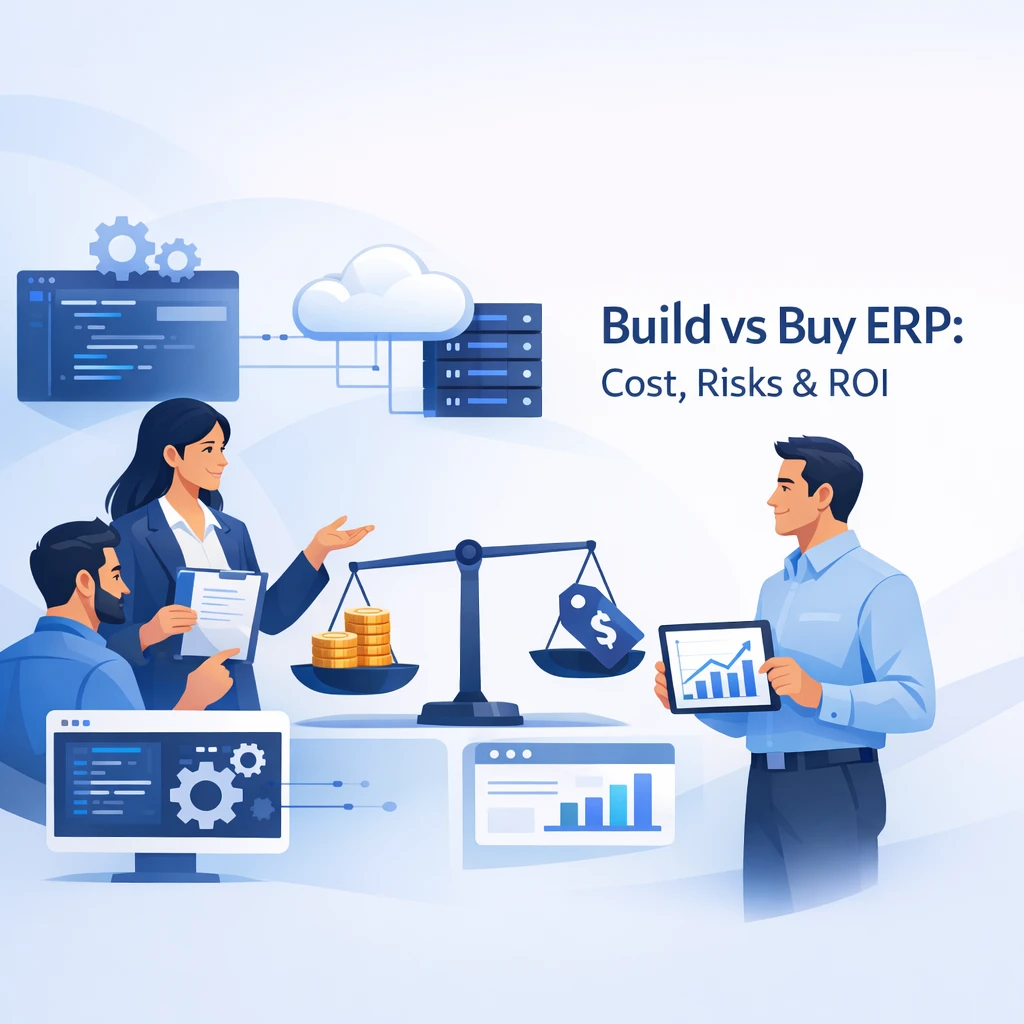
For manufacturing leaders in the UAE and across the GCC, an enterprise resource planning (ERP) solution is often the backbone of operational excellence. Whether you operate a Dubai-based distribution network, a Saudi processing plant, or a manufacturing SME in Qatar, the decision to build an ERP from scratch or buy a commercial solution has profound implications for cost, risk, and long-term ROI. This guide aims to educate SMBs, SMEs, startup founders, CEOs, CTOs, product managers and transformation leaders on how to approach Build vs Buy decisions, what the numbers look like, and how a trusted global software partner like Triostack Technologies can help you design, implement and scale a solution that aligns with regional regulations, talent markets, and business goals.
What is the Topic?
Build vs Buy ERP is a decision framework that weighs the merits of developing a tailored, in-house ERP system against purchasing an off-the-shelf ERP platform and configuring it to fit the business. In practice, most manufacturing organizations adopt a blended approach: buy a core ERP for standard processes (finance, procurement, inventory, sales, HR) and build composites or integrations for industry-specific needs (MES interfaces, batch traceability, regulatory reporting, custom dashboards). The UAE market, with its diverse mix of heavy industry, logistics, process manufacturing and consumer goods, often benefits from modular, hybrid ERP strategies that allow rapid deployment with room for future customization.
Triostack Technologies positions itself as a global software partner that helps you pick the right path—balancing cost, speed, risk, and long-term adaptability—while keeping data governance, security, and regional compliance front-and-center.
Why it Matters in 2026
- Rising expectations for real-time visibility across the supply chain, quality, and manufacturing execution systems.
- Regulatory alignment across the UAE, Saudi Arabia, Qatar, Oman, Kuwait and Bahrain requiring robust audit trails and data security.
- Global talent shortages in traditional ERP development; the economics of outsourcing and nearshore/offshore models influence build options.
- Digital transformation efforts accelerating cloud adoption, AI-assisted insights, and modular architecture that reduces time-to-value.
Current Industry Challenges
Manufacturers in the region face a mix of pressures: fluctuating commodity costs, evolving trade regimes, and the need to digitalize legacy processes without disrupting day-to-day operations. Common ERP-related challenges include:
- Data silos across procurement, manufacturing, logistics and sales leading to misaligned planning.
- Legacy systems that lack modern APIs for integration with new IoT devices, AI analytics, or CRM platforms.
- Customization sprawl in legacy ERP implementations that becomes expensive to maintain and difficult to upgrade.
- Security, privacy and regulatory compliance risks in the cloud and in hybrid environments.
- Shortage of regional ERP talent to speed up implementation and maintain complex customizations.
How the Technology Works
At a high level, ERP consolidates core business processes into a centralized data model with modular components. In manufacturing contexts, the most valuable modules include:
- Finance and Accounting: GL, AP, AR, cost accounting, financial consolidation.
- Procurement and Inventory: supplier management, purchasing, stock control, batch/lot tracking.
- Production Planning and MES: capacity planning, routing, shop floor data collection, quality checks.
- Sales and CRM: order orchestration, pricing, quote-to-cash, customer service.
- Supply Chain and Logistics: warehousing, transport management, cross-docking, route optimization.
- Reporting and Analytics: dashboards, regulatory reporting, KPI tracking.
In 2026, a practical ERP strategy often favors a hybrid approach: a robust, scalable core ERP (commercial or custom) paired with lightweight, purpose-built integrations or microservices that handle niche needs (e.g., specialized MES integration, custom compliance workflows, or AI-enabled predictive maintenance).
Architecture Overview
A practical ERP architecture for UAE manufacturers typically emphasizes modularity, security and cloud readiness. A common pattern is:
- A cloud-hosted core ERP with multi-tenant or single-tenant deployment, depending on data sovereignty.
- API-first design enabling integration with MES, CRM, IoT devices, WMS, and third‑party logistic providers.
- Data lake or data warehouse for advanced analytics, with governed data models (master data, product definitions, bill of materials).
- Automation and AI components for forecasting, demand planning, and anomaly detection.
- Security and compliance layers including identity & access management, encryption at rest/in transit, and audit trails.
Step-by-Step Workflow
- Discovery and Scope: identify core processes, data sources, regulatory requirements and success metrics.
- Vendor/Make-or-Buy Evaluation: compare core ERP platforms, assess total cost of ownership, and decide on build vs buy components.
- Solution Design: define data models, integrations, reporting, and security architecture; plan for phased deployment.
- Development or Configuration: implement core modules, tailor workflows, and develop required custom connectors.
- Testing and Validation: functional tests, data migration tests, security and disaster recovery tests.
- Deployment and Rollout: staged go-live, cutover planning, and user enablement.
- Operate and Improve: monitor performance, refine dashboards, and plan for future enhancements.
Business Use Cases
The Build vs Buy decision often hinges on domain-specific needs. Examples for UAE manufacturers include:
- Discrete manufacturing with multi-site production lines requiring real-time MES integration and batch traceability.
- Process manufacturing needing strict compliance reporting and quality management tied to production data.
- Hybrid operations that combine fabrication, assembly, and distribution across free zones and UAE port corridors.
- Export-focused SMEs needing multi-currency, multi-language financials and tax compliance (VAT, Excise, etc.).
Industry Applications
Across the GCC and beyond, manufacturers explore ERP strategies in several sectors:
- Logistics and warehousing services that require integrated TMS, WMS and ERP data flows.
- Food and beverage processing where batch traceability and quality control drive compliance.
- Pharma and healthcare supply chains with serialization and regulatory reporting needs.
- Cosmetics and consumer goods with fast-moving SKUs and complex promotions.
Benefits
- Improved data accuracy and faster decision making through a single source of truth.
- Better planning: integrated procurement, inventory, and production planning reduces stockouts and waste.
- Faster time-to-market for new products through streamlined product lifecycle management and CI/CD for software changes.
- Regulatory readiness and enhanced security posture with centralized governance and audit trails.
- Scalable architecture that accommodates growth, new markets, and changing business models.
Challenges
- Change management: aligning user adoption with new processes and dashboards.
- Data migration: consolidating legacy data while preserving integrity and lineage.
- Customization creep: avoiding over-engineering and keeping upgrade paths clear.
- Vendor lock-in and multi-cloud governance in complex regional operations.
Common Mistakes
- Underestimating data quality and migration effort during go-live.
- Over-customization in a Buy solution, making future upgrades expensive and risky.
- Rushing to select a technology stack without a clear data model or integration plan.
- Neglecting change management and user training in the rollout plan.
Best Practices
- Adopt a modular, hybrid architecture that allows core functions to be bought while niche needs are built or integrated.
- Define a clear data model and governance with master data management from day one.
- Plan a phased rollout with early-win pilots to demonstrate value and boost user adoption.
- Invest in robust data migration, security, and compliance reviews appropriate to the UAE and GCC regimes.
- Engage a global software partner with experience in remote delivery and local support.
Build vs Buy Comparison
Below is a concise view of how Build and Buy strategies compare on key dimensions. Consider this as a decision framework rather than a scorecard to be applied mechanically.
| Aspect | Build | Buy |
|---|---|---|
| Time to value | Longer, depending on scope and talent access | Typically faster to core functionality |
| Cost certainty | Variable; HR, dev, and data migration cost uncertainties | More predictable up-front costs but ongoing licensing and maintenance |
| Customization | High flexibility, but costly to maintain | Pre-built workflows with configurability; customization feasible but can add cost |
| Risk | Higher technical risk if talent is scarce | Vendor risk (lock-in, roadmap), but established standards and support |
| Scalability | Unbounded by architecture choices; requires strong governance | Proven scalability with subscription economics |
| Regulatory alignment | Depends on internal controls and auditability | Often strong via vendor compliance features; needs customization for local regs |
Estimated Development Cost
Costs for software projects scale with scope, data complexity, and regulatory requirements. The ranges below reflect typical SMB/SME ERP projects including design, development, integration, and initial deployment. All figures are in USD and assume typical regional considerations such as UAE data sovereignty and GCC compliance where relevant.
| Component | Typical SMB Range |
|---|---|
| Business Website | 5k–15k |
| Customer Portal | 10k–40k |
| CRM | 15k–100k |
| ERP | 40k–200k |
| AI Chatbot | 5k–25k |
| AI Automation | 15k–80k |
| SaaS MVP | 20k–80k |
| Enterprise Web App | 30k–200k |
Pricing factors include scope, data complexity, customization depth, regulatory reporting, integration payload, data migration effort, and the need for ongoing support and upgrades. For UAE manufacturers, consider data localization requirements, cybersecurity standards, and timezone coordination with global teams.
Recommended Technology Stack
Triostack advocates modular, scalable, and secure stacks. A typical mixed stack for a Build or Buy plus customization approach includes:
- Frontend: React or Vue for responsive dashboards and user-friendly workflows
- Backend: Node.js with NestJS, Java Spring Boot, or .NET depending on team strengths
- Database: PostgreSQL or SQL Server with a data warehouse option for analytics
- APIs: RESTful and GraphQL for flexible integrations
- Cloud: AWS, Azure, or Google Cloud with a preference for cloud-native services
- AI/ML: PyTorch or TensorFlow for forecasting and quality analytics
- CI/CD: GitHub Actions, GitLab CI or Azure DevOps
- Security: IAM, MFA, encryption in transit and at rest, role-based access, and audit logging
In practice, Triostack tailors the stack to your team’s skill set, regulatory demands, and the need to scale across multiple GCC markets and beyond.
Future Trends
- AI-driven insight for demand forecasting, maintenance, and quality management integrated with ERP data
- Composable ERP architectures enabling rapid reconfiguration as product lines evolve
- Edge-enabled manufacturing with real-time MES data feeding ERP analytics
- Automation of governance, risk and compliance using intelligent monitoring
- Enhanced security with zero-trust models and advanced encryption
How Triostack Delivers Projects Globally
Triostack supports clients around the world with a focus on pragmatic delivery, quality, and long-term success. Our approach combines industry-specific domain knowledge with a modern software engineering discipline. Key capabilities include:
- Custom Software development across web, mobile and cloud platforms
- Web Development and UI/UX design focused on enterprise usability
- AI Development and Machine Learning for predictive insights
- CRM, ERP, SaaS development, and cloud migration
- DevOps, API Development, and dedicated teams for scalable projects
- QA, maintenance, and technical consulting to sustain momentum
REMOTE DELIVERY
Triostack operates with a robust remote delivery model from India, designed to align with UAE and GCC business hours and regulatory expectations. The approach emphasizes transparency, collaboration, and governance.
Agile and Sprint Cadence
- Agile frameworks with 2–4 week sprints and well-defined sprint plans
- Weekly demos to stakeholders in the client team with clear acceptance criteria
- Backlog grooming and sprint planning sessions to maintain alignment
Communication Channels
- Slack for daily communications
- Teams, Zoom, or Google Meet for video meetings
- Jira or ClickUp for project management and issue tracking
- GitHub or GitLab for version control and code reviews
- Azure DevOps for CI/CD workflows and cloud deployments
Delivery Artifacts
- Architecture diagrams, API specifications, data models
- Documentation and runbooks, user manuals
- QA plans, testing results, and security assessments
Quality and Security
- QA pipelines with automated tests and code reviews
- Security reviews, threat modeling, and data protection measures
- NDAs, IP ownership clauses, and governance documentation
Timezone Overlap and Communication
We emphasize overlapping hours with client teams to ensure timely feedback and decision-making while providing flexible collaboration windows outside peak times.
Long-term Support
Post-implementation support includes an ongoing maintenance plan, feature roadmaps, and dedicated project managers to ensure continuity and stability.
Why UAE Businesses Outsource to India
- Cost efficiency without compromising quality
- Access to a large, diverse talent pool with deep software engineering expertise
- Faster hiring and scalable team growth
- High-quality engineering practices and robust communication standards
Illustrative Architectures and Workflows
Below are three mermaid diagrams illustrating typical architecture, workflow and deployment patterns for Build and Buy ERP projects. These diagrams are meant to convey concepts rather than render a specific product configuration.
Case Studies (Anonymized)
These anonymized examples illustrate typical outcomes and decision-making patterns in real-world projects. They are representative and not tied to a specific named client.
Dubai-based Logistics Company
Challenge: Siloed warehousing, fragmented procurement, and manual exception handling across multiple sites. The leadership sought a scalable ERP that could unify stock visibility, automate order processing, and enable smarter route planning for shipments to port hubs.
Approach: A hybrid strategy combining a proven core ERP with selected custom connectors to the company’s WMS and a mobile MES interface for shop floor data capture. Triostack managed data migration, integration, and user enablement with a phased rollout.
Outcome: Improved data visibility, streamlined order-to-cash cycles, and better inventory accuracy across locations. The modular approach allowed incremental investment without disrupting ongoing operations.
UAE Healthcare Clinic
Challenge: Need for patient management, inventory control for medical supplies, and regulatory reporting while maintaining patient privacy and data sovereignty.
Approach: Selection of a core ERP with strong compliance features, augmented by a clinical data integration layer for anonymized analytics and supply chain controls tailored to medical inventory.
Outcome: Strong auditability, streamlined procurement, and better alignment between clinical operations and back-office processes, with a roadmap for telehealth integration.
UK SaaS Company Integrating with Local Partners
Challenge: A UK-based SaaS vendor expanding to GCC markets requiring multi-currency finance, localized tax rules, and partner support workflows embedded in ERP.
Approach: Buy-focused core ERP with rapid localization, plus a set of partner relationship management workflows built on top of the ERP. Triostack handled multi-region data models, APIs, and onboarding for regional distributors.
Outcome: Faster market entry and a flexible framework for ongoing regional customization, minimizing disruption to core product development.
Pricing Factors and Market Realities
For SMBs evaluating ERP options, costs go beyond initial software purchase or development. Consider ongoing operational costs, support, infrastructure, data migration effort, regulatory reporting, and training. The following factors commonly influence total cost of ownership (TCO) for ERP initiatives in the UAE and beyond:
- Scope: number of modules, number of sites, and the depth of customization
- Integrations: how many external systems need to connect and the complexity of data mapping
- Data migration: legacy data cleansing, mapping, and validation activities
- Regulatory compliance: VAT, import/export compliance, and sector-specific reporting
- Security and governance: identity management, encryption, access controls, and auditing
- Cloud vs on-prem: hosting model, DR/Business Continuity requirements
- Change management: training, user adoption, and operational readiness
Businesses planning similar solutions often benefit from an experienced software development partner like Triostack Technologies.
Conclusion
Choosing between building and buying an ERP for UAE manufacturers is not simply a cost question. It is a strategic decision about speed-to-value, risk, governance, and the ability to adapt to an evolving market. A thoughtful approach—one that blends a solid core ERP with targeted customizations and robust integrations—can deliver durable ROI, improved customer service, and stronger competitive positioning in Dubai, the GCC, and global markets. Triostack Technologies stands ready to help you assess options, design a pragmatic architecture, and deliver a solution that aligns with your business goals and regional realities.
Frequently Asked Questions
Q: How long does it typically take to implement an ERP for a mid-market manufacturing business?
A: Timelines vary by scope, but phased ERP programs often span 6–12 months for core deployment, with additional time for deeper integrations and analytics layers. A staged approach helps mitigate risk and accelerate value realization.
Q: Is cloud ERP safer than on‑premise in the GCC context?
A: Cloud ERP offers scalable security controls, built-in redundancy, and automatic updates. For GCC entities with data sovereignty concerns, regional data centers and multi‑region deployments can address compliance while preserving the benefits of cloud delivery.
Q: What is the role of AI in ERP for manufacturers?
A: AI can enhance demand forecasting, quality analytics, predictive maintenance, and automated exception handling, turning ERP data into actionable insights without requiring a separate analytics platform.
Internal Link References
Triostack Team
Technology Evangelist & Writer
Triostack Team is an experienced writer and technologist, exploring the intersections of AI, cloud architecture, and modern application development. Passionate about turning complex technical concepts into accessible insights.