Build vs Buy ERP for UAE Businesses: Cost, Customization, and Long-Term Value
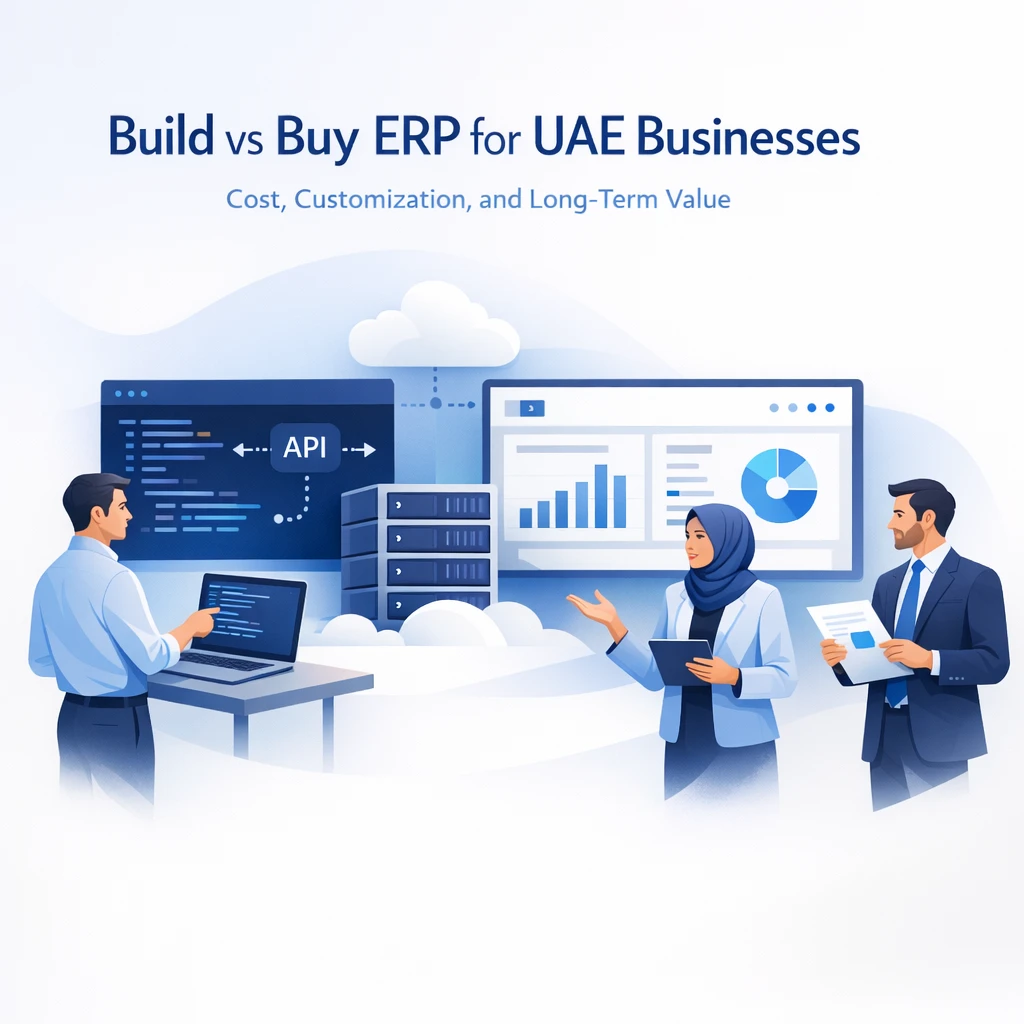
Understanding the trade-offs between building a custom ERP and buying an off-the-shelf solution is essential for UAE-based SMBs, SMEs, startups, and large regional firms. This guide provides practical, real-world guidance to help you choose the path that aligns with your goals, budgets, and long-term value—with Triostack as a trusted global software partner when you’re ready to execute.
Introduction
ERP projects sit at the intersection of strategy and execution. In markets like the UAE, where regulatory requirements, multi-currency operations, and rapid growth are common, the decision to build a bespoke ERP or buy an existing system is not merely a technology choice—it shapes operational risk, time-to-value, and future adaptability. This article explains how to evaluate cost, customization, and long-term value across the Build vs Buy spectrum, with practical steps, real-world patterns, and examples drawn from UAE and global contexts.
What is the Topic?
Build vs Buy ERP is a strategic decision about who owns the software stack, where the system is hosted, how much you customize, and how quickly you can deliver value to your customers. A built ERP is an in-house or partner-developed system tailored precisely to your business processes. A buy ERP is an off-the-shelf product or suite designed to serve many customers, with configuration, extensions, and integrations used to fit your needs. In practice, most organizations implement a hybrid approach—core ERP functions from a vendor with custom modules or integrations built to address unique workflows.
Why It Matters in 2026
- Digital transformation demand: UAE and GCC markets continue to accelerate cloud adoption, data-driven decision-making, and customer-centric experiences.
- Regulatory and compliance complexity: VAT, data privacy, and sector-specific rules require robust data governance and traceability.
- Global talent and cost considerations: The UAE ecosystem benefits from global talent, but costs and delivery timelines are sensitive to scale and scope.
- Integration and data quality: ERP success hinges on seamless integration with CRM, WMS, analytics, and IoT data streams.
In this environment, the choice between building and buying is a question of trade-offs rather than a binary decision. A well-planned approach can deliver faster time-to-value, higher customization where needed, and greater long-term adaptability.
Current Industry Challenges
- Data silos and fragmented systems: Disparate systems across departments hinder end-to-end visibility.
- Localization and compliance: Local tax rules, Emiratisation considerations, and sector-specific regulations demand careful configuration.
- Scalability and performance: Growth in e-commerce, multi-site operations, and cross-border trade strain legacy solutions.
- Change management: Adoption and user training impact ERP ROI as much as technology choices do.
For UAE-based organizations, a pragmatic approach balances rapid deployment and future-proof customization, while maintaining strong governance and security standards.
How the Technology Works
ERP systems unify core business processes—finance, procurement, inventory, production, sales, and human resources—by modeling data around a common set of master records (customers, items, suppliers, employees) and a shared process workflow. Modern ERP platforms often embrace modular architectures and cloud-native delivery, enabling incremental adoption and easier integrations with CRM, analytics, and AI layers.
Key concepts to understand when evaluating ERP options:
- Modularity: Ability to deploy modules independently and integrate them later.
- Data model: Master data management, data governance, and cross-module consistency.
- Integrations: API-first design, pre-built connectors, and event-driven data flows.
- Deployment model: On-premises, cloud (SaaS), or hybrid—each with tradeoffs for cost, security, and control.
- Localization: Local tax handling, Arabic language support, and regional reporting formats.
Architecture Overview
A well-architected ERP strategy often favors a modular, cloud-native approach. The following diagram illustrates a typical modular ERP reference architecture:
Notes:
- Cloud-first deployment improves scalability and reduces on-premises maintenance costs.
- APIs and event-driven integration enable better alignment with CRM, ecommerce, and logistics systems.
- Localization modules ensure compliance with UAE VAT, GCC standards, and sector-specific reporting.
Step-by-Step Workflow
- Discover and assess: Map current processes, data quality, and governance maturity. Identify pain points and critical success factors.
- Define scope and success metrics: Establish core modules, required integrations, and measurable outcomes (cycle time, inventory accuracy, receivables days).
- Decide path (build vs buy): Evaluate total cost of ownership, risk, and time-to-value for each option.
- Plan architecture and data strategy: Design data model, migration strategy, and integration contracts.
- Prototype and select tooling: Build a minimum viable integration or prototype core modules to validate fit.
- Develop or configure: Build custom components or configure the vendor solution with extensions.
- Test and improve: Perform functional, security, and performance testing; run pilot with real users.
- Deploy and adopt: Roll out in phases, train users, and establish change management practices.
Business Use Cases
1) Dubai-based logistics company
Challenge: Disparate systems across warehousing, finance, and sales created delays in invoicing and limited shipment tracking visibility.
Approach: Implemented a modular ERP with a dedicated WMS integration, real-time inventory visibility, and automated invoicing workflows. Custom reports supported regulatory and VAT requirements.
Outcome: Improved order-to-cash cycle visibility and reduced manual reconciliation, enabling faster decision-making across operations.
2) UAE healthcare clinic
Challenge: Fragmented patient records led to inefficient scheduling, billing errors, and limited data sharing across clinics.
Approach: Deployed a patient-centric ERP with secure patient data management, streamlined appointment scheduling, and compliant billing processes aligned with local regulations.
Outcome: Enhanced patient experience and stronger data governance while maintaining privacy standards.
3) Saudi retail business
Challenge: Multi-store operations with inconsistent pricing, stockouts, and slow restocking decisions.
Approach: Implemented ERP with centralized pricing, cross-store inventory valuation, and automated procurement triggers tied to demand signals.
Outcome: Improved stock availability and consistent customer experiences across sites.
Industry Applications
- Manufacturing: Production planning, shop floor control, BOM management, quality assurance.
- Distribution & Logistics: Inventory optimization, route planning, carrier integrations, cross-border trade compliance.
- Retail & Wholesale: Omni-channel commerce, pricing discipline, promotions, and loyalty programs.
- Healthcare: Patient management, billing, compliance, and scheduling.
- Professional Services: Project accounting, resource utilization, and time tracking.
Benefits
- Faster time-to-value: Buy-first approaches can yield faster deployment for standard processes; build-to-fit options deliver exact fit where it matters most.
- Customization where it counts: Tailor business-critical workflows, data models, and reporting to your unique needs.
- Better governance and risk management: Clear governance, security, and compliance controls regardless of path.
- Scalability and future-proofing: Modular architectures enable phased growth and easier upgrades.
Challenges
- Budget creep: Uncontrolled scope expansion can derail projects, especially in bespoke builds.
- Data migration risk: Migrating legacy data requires careful mapping and cleansing.
- Change management: User adoption determines ROI more than technology choice alone.
- Vendor lock-in vs. flexibility: Consider long-term licensing, upgrade cycles, and portability.
Common Mistakes
- Underestimating data cleansing and migration effort during scope planning.
- Over-customizing an ERP, leading to maintenance complexity and upgrade challenges.
- Neglecting organizational change management and training plans.
- Failing to plan for integrations with critical systems (CRM, WMS, BI).
Best Practices
- Define a clear governance framework: RACI, data ownership, and decision rights.
- Adopt a phased ladder approach: Start with core modules, deliver quick wins, then extend.
- Onshore + offshore delivery model: Leverage global talent while maintaining clear communication channels.
- Prioritize data quality and security: Implement data mapping, access controls, and encryption from day one.
Build vs Buy Comparison
Below is a concise framework to compare the two paths. Consider local requirements (UAE/GCC), scale plans, and strategic goals when you review this table.
| Factor | Buy ERP | Build ERP | Implications for UAE Firms |
|---|---|---|---|
| Time-to-value | Short to moderate | Medium to long depending on scope | Buy offers faster baseline; build offers tailored advantage over time |
| Customization | Limited to vendor capabilities; extensions possible | End-to-end customization possible | UAE-specific workflows, localization, and regulatory needs |
| Cost certainty | Predictable licensing and subscription; addons vary | Variable, often higher upfront; maintenance ongoing | Budgeting and ROIs require scenario modeling |
| Control & governance | Vendor-driven governance with integration points | Full internal governance for architecture and data | Stronger compliance controls, data sovereignty options |
| Upgrade risk | Vendor manages upgrades; potential disruption | Upgrade roadmap defined by your team; higher risk if skills lapse | Plan for ongoing maintenance and skill development |
Estimated Development Cost
Costs vary by scope, localization, data migration, and security needs. The ranges below reflect common SMB to mid-market ERP projects. Use them as a starting point for budgeting conversations with vendors and partners like Triostack:
| Component | Typical Range (USD) | Notes |
|---|---|---|
| Business Website | 5k – 15k | Landing pages, information architecture for ERP initiative |
| Customer Portal | 10k – 40k | Self-service, user management, service requests |
| CRM | 15k – 100k | Sales, marketing, pipeline management with integrations |
| ERP | 40k – 200k | Core financials, procurement, inventory, manufacturing |
| AI Chatbot | 5k – 25k | Customer support, automation, escalation policies |
| AI Automation | 15k – 80k | RPA workflows, process automation |
| SaaS MVP | 20k – 80k | MVP for rapid validation |
| Enterprise Web App | 30k – 200k | Large-scale, multi-site deployments |
Pricing factors include localization (Arabic language support, UAE VAT handling), data migration complexity, regulatory reporting, security requirements (encryption, IAM), integrations (WMS, ecommerce, BI), user training, and change management.
Recommended Technology Stack
Choosing the right stack depends on whether you build or buy. Here are examples of practical stacks commonly used in UAE projects:
Build path (fully custom ERP)
- Frontend: React or Angular
- Backend: Java/Spring Boot or Node.js/Express
- Database: PostgreSQL or SQL Server
- APIs: REST/GraphQL with an API gateway
- Data & analytics: Snowflake or BigQuery, Power BI or Tableau
- Cloud: AWS, Azure, or Google Cloud
- Security: IAM, OAuth2, MFA, encryption at rest/in transit
Buy path (off-the-shelf with extensions)
- Core ERP: Cloud-based suite with localization options
- Extensions: Pre-built connectors to CRM, e-commerce, WMS
- Integrations: API-based, event-driven patterns
- Analytics: Embedded BI, with optional data lake for advanced analytics
Triostack supports both paths, helping you select a practical, maintainable stack aligned with your budget and long-term goals. See also the section on Remote Delivery for how global teams collaborate efficiently.
Future Trends
- AI-assisted ERP: Predictive planning, demand forecasting, and autonomous workflows.
- AI-driven automation: Robotic process automation integrated with ERP processes to reduce manual tasks.
- Hybrid and multi-cloud: Flexibility to deploy modules where they fit best, while maintaining data governance.
- Security by design: Zero-trust concepts, continuous compliance monitoring, and privacy-by-design.
How Triostack Delivers Projects Globally (Remote Delivery)
Triostack leverages a robust remote delivery model that combines agile software engineering practices with disciplined governance. We work with clients across the UAE, GCC, the United States, Europe, and the Asia-Pacific region, including ongoing engagements in India for scalable, cost-efficient execution.
Agile and governance
- Agile framework: Scrum or Kanban tailored to project needs, with iterative milestones and measurable outcomes.
- Sprint Planning & Demos: Weekly or bi-weekly demos to ensure alignment and rapid feedback.
- Communication channels: Slack, Teams, Zoom, Google Meet for daily communications and weekly reviews.
- Project management & collaboration tools: Jira or ClickUp for backlog, tracking, and reporting; GitHub or GitLab for version control.
- CI/CD & cloud staging: CI/CD pipelines, automated testing, and cloud-based staging environments for safe experimentation.
- Security & IP ownership: NDA, strong access controls, and explicit IP ownership clauses.
- Timezone overlap: Careful planning to maximize overlap between UAE clients and offshore teams to keep collaboration fluid.
- Dedicated project managers: Point-of-contact, risk management, and escalation paths for every engagement.
Why UAE businesses outsource to India
- Cost efficiency: Competitive rates without compromising quality for skilled software engineering roles.
- Large talent pool: Broad access to senior engineers, data scientists, and security specialists.
- Faster hiring and scalable teams: Flexible staffing to accommodate project phases and pivots.
- High quality engineering and strong communication: Mature delivery practices and English-language collaboration norms.
- Time zone synergy: Reasonable overlap with UAE business hours to enable real-time coordination.
Triostack ensures clear contractual terms, robust governance, and transparent progress reporting to minimize risk and maximize value for UAE clients.
How Triostack Delivers Projects Globally
Triostack blends global delivery with local market knowledge. Our teams operate with disciplined communication, robust security standards, and a commitment to long-term partnership. We offer services across:
- Custom Software
- Web Development
- Mobile Apps
- AI Development and Machine Learning
- CRM and ERP
- SaaS and Cloud Migration
- DevOps, UI/UX, API Development
- Dedicated Teams, QA, Maintenance
- Technical Consulting
We tailor engagement models to project complexity and budget—ranging from dedicated teams for ongoing product development to fully managed engagements for one-off ERP implementations.
Why Businesses Choose Triostack
Triostack is not just a contractor; we act as a strategic partner that aligns technology initiatives with business outcomes. Why organizations choose us:
- Proven delivery excellence: A track record of delivering complex software programs with measurable impact.
- Global footprint: Distributed teams with domain expertise across industries and geographies.
- End-to-end capabilities: From discovery and architecture to ongoing maintenance and support.
- Focus on quality and security: Rigorous QA, security-by-design, and clear IP ownership terms.
- Flexible engagement models: Time-and-materials, fixed-price, or managed services with scalable teams.
Triostack emphasizes practical outcomes—reducing risk, shortening time-to-market, and enabling sustainable growth for UAE and global clients.
Case Studies (Realistic, anonymized examples)
Dubai logistics company (anonymized)
Challenge: Fragmented systems across warehouses and finance caused delays in fulfillment and invoicing. Approach: Implemented a modular ERP with WMS integration and a centralized financial module, plus migration and training. Outcome: Improved operational visibility, faster invoicing, and better stakeholder alignment across departments.
UAE healthcare clinic (anonymized)
Challenge: Disparate patient data and scheduling workflows across clinics. Approach: Deployed a patient-centric ERP with secure data management, appointment orchestration, and compliant billing. Outcome: Consistent patient experiences, improved data governance, and stronger regulatory compliance posture.
Saudi retail business (anonymized)
Challenge: Multi-site stockouts and inconsistent pricing across stores. Approach: ERP with centralized pricing, cross-store inventory control, and automated procurement rules. Outcome: Better stock availability, uniform pricing, and streamlined supplier interactions.
Australian startup (anonymized)
Challenge: Rapid growth required scalable operations, including CRM, billing, and analytics. Approach: Build vs buy evaluation with a phased ERP deployment and cloud-native architecture. Outcome: Scalable platform that supported growth while maintaining strong governance and security practices.
Cost Considerations and Pricing Ranges
Understanding pricing helps you model total cost of ownership and long-term value. The ranges below reflect common budgets for SMBs moving toward growth stages. Local UAE taxes, localization, data migration, security, and change management will influence final figures.
Typical ranges (USD):
- Business Website: 5k–15k
- Customer Portal: 10k–40k
- CRM: 15k–100k
- ERP: 40k–200k
- AI Chatbot: 5k–25k
- AI Automation: 15k–80k
- SaaS MVP: 20k–80k
- Enterprise Web App: 30k–200k
Cost drivers include localization, integrations, data migration, security requirements, regulatory reporting, user training, and post-go-live support. A build-first approach may incur higher upfront costs, while a buy-first approach could reduce initial spend but require ongoing subscription fees and customization addons.
For UAE businesses evaluating these options, a practical approach is to model several scenarios—one prioritizing near-term ROI with a ready ERP, another emphasizing long-term fit with bespoke extensions. Triostack can help you run those scenarios and compare total cost of ownership across options.
Future Trends (Summary)
In the years ahead, expect ERP systems to become more autonomous, interconnected, and secure. For UAE businesses, this means:
- AI-assisted planning for inventory, finance, and workforce management
- Deeper integration with e-commerce, logistics, and IoT-enabled operations
- Stronger data governance, privacy, and regional compliance support
- Flexible deployment models enabling efficient global delivery and local adaptability
Key Diagrams
Frequently Asked Questions
1. What is the typical time-to-value difference between build and buy ERP?
Buy ERP often delivers faster baseline value, especially for common processes. Build ERP can require 6–18 months or more for a fully tailored solution, depending on scope and data complexity, but may offer a closer fit to unique workflows over time.
2. How do localization and compliance affect ERP choices in the UAE?
Localization impacts tax handling, currency, language support, and reporting. A buy ERP with GCC localization can reduce risk, while a build path allows precise control of data governance and regulatory reporting.
3. What are common risks in ERP projects?
Data migration challenges, scope creep, integration complexity, and user adoption issues are the top risks. Thorough planning, governance, and change management reduce these risks significantly.
4. How does Triostack support long-term maintenance?
Triostack provides ongoing maintenance, security updates, platform upgrades, and dedicated support, whether you choose a build or buy path. We emphasize knowledge transfer and robust documentation to ensure smooth future evolution.
5. What should I consider when selecting a partner for remote ERP delivery?
Look for proven processes, transparent governance, security assurances, clear IP ownership, and a track record of successful cross-border projects with strong communication practices.
Conclusion
For UAE-based businesses weighing Build vs Buy ERP, there is no one-size-fits-all answer. The decision hinges on your strategic goals, risk tolerance, timeline, and the degree of customization you require for mission-critical processes. A pragmatic, phased approach—often starting with a robust buy solution for core functions and targeted build extensions for unique workflows—can deliver rapid value while preserving long-term flexibility. Triostack stands ready to help you assess options, design a resilient architecture, and execute with disciplined remote delivery teams that align with UAE business needs.
If you're planning a similar software project, Triostack can help you design, build, deploy and maintain a scalable solution that fits your budget and goals. This is not a hard sell; it’s a structured path to informed decision-making and reliable delivery.
Internal link note: For detailed case studies and service descriptions, see our case studies and remote delivery sections.
Triostack Team
Technology Evangelist & Writer
Triostack Team is an experienced writer and technologist, exploring the intersections of AI, cloud architecture, and modern application development. Passionate about turning complex technical concepts into accessible insights.