Build vs Buy ERP for GCC Enterprises: Cost, ROI, and Implementation Risks Decision Makers Must Know
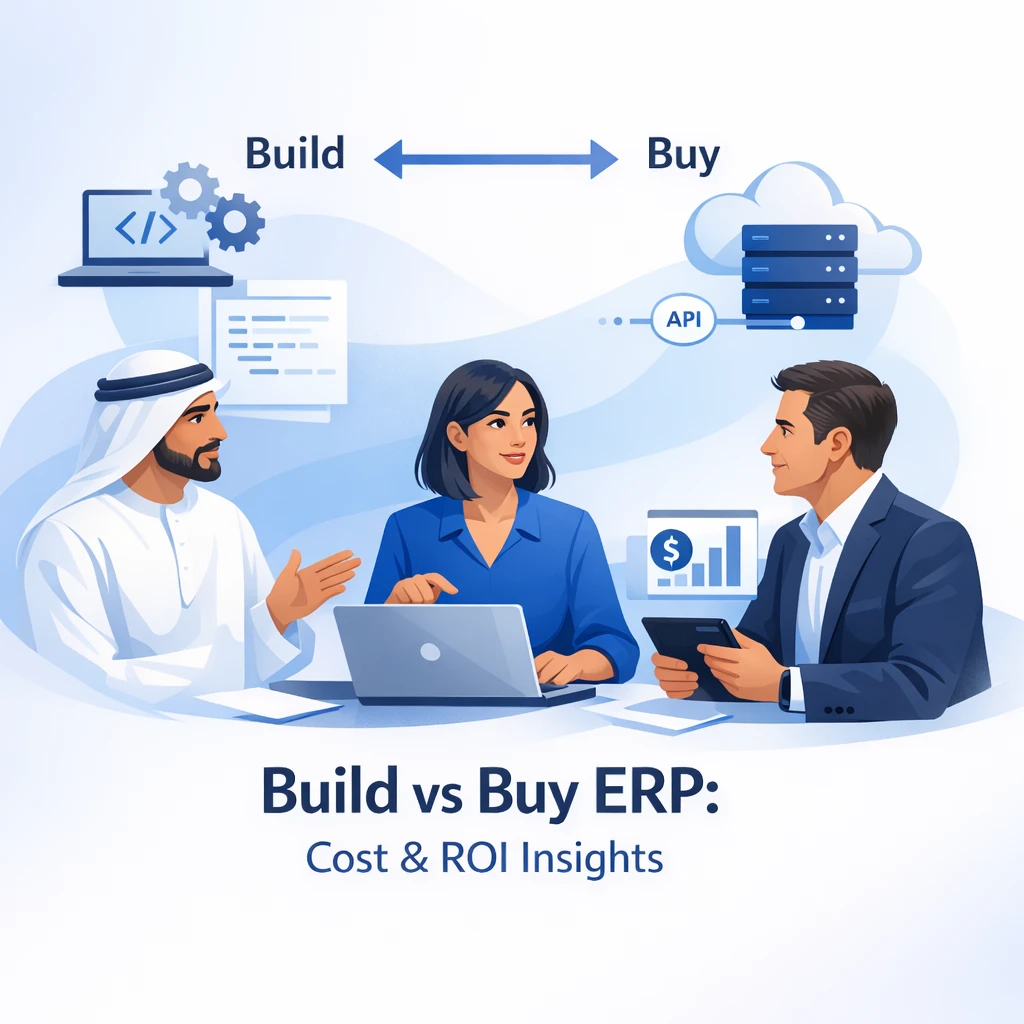
For growing businesses in the GCC and beyond, choosing between a build-and-custom ERP and a ready-made ERP package is a defining strategic decision. This guide cuts through the hype, offering practical criteria, real-world scenarios, and a clear pathway to a scalable, future-ready solution. Along the way, you’ll see how Triostack Technologies approaches such projects as a global software development partner—focusing on outcomes, governance, and sustainable value.
Introduction
ERP decisions in 2026 are less about technology for technology’s sake and more about business outcomes: faster time-to-value, stronger data governance, seamless integrations, and the ability to adapt as regulatory and market conditions shift. In the GCC—where industries from logistics to healthcare are modernizing rapidly—organizations face pressure to choose between custom-built ERP platforms and off-the-shelf systems that can be configured quickly. This article unpacks the cost, ROI, and risk profiles of build vs buy, with practical guidance, examples, and a framework you can apply to your own software project, whether you are a startup founder, a CEO, a treasury controller, or a product manager.
What is the Topic?
The debate between building a bespoke ERP versus buying an enterprise solution is fundamentally about alignment with business process, control over data, and long-term cost of ownership. A build approach creates a tailor-made platform from the ground up—optimizing for your unique workflows but requiring ongoing development, maintenance, and governance. A buy approach leverages a commercial ERP with core modules and best-practice processes, offering faster deployment and predictable licensing but introducing vendor dependency and potential customization limits.
In practice, most GCC enterprises adopt a hybrid stance: a core ERP core with critical custom extensions or integrations that address unique regional requirements (local tax rules, regulatory reporting, multilingual needs, and sector-specific workflows). This hybrid approach is where the decision between build and buy becomes nuanced and highly strategic.
Why It Matters in 2026
Several forces shape ERP decisions today:
- Regulatory localization: GCC markets impose specific compliance needs around data sovereignty, tax reporting, and healthcare privacy. Any ERP choice must support localization, audit trails, and security controls that satisfy local regulators.
- Digital transformation velocity: Companies expect modular, scalable systems that can grow with business needs, integrate with cloud services, and leverage AI-driven insights.
- Total cost of ownership (TCO) clarity: Many SMBs and SMEs seek cost models that align with growth, avoiding surprise upgrade costs or maintenance liabilities.
- Remote capabilities and global talent: Accessible, high-quality engineering teams from nearshore and offshore locations enable faster delivery without compromising governance.
In this context, a well-scoped build or hybrid approach can be a strategic differentiator, enabling better data quality, tighter control over processes, and a better user experience for front-line teams. The right choice respects your business model, risk tolerance, and growth trajectory rather than chasing a single industry trend.
Current Industry Challenges
GCC enterprises face common ERP challenges that influence build-vs-buy decisions:
ERP must connect with CRM, e-commerce, logistics, HR, and financial systems, often via a mix of on-prem and cloud environments. - Data migration risk: Migrating legacy data without loss or corruption is a major project risk and a source of post-go-live issues.
- Change management: User adoption and business process reengineering require careful governance, training, and ongoing support.
- Security and privacy: Compliance with regional data protection standards and industry-specific regulations is non-negotiable.
- Total cost of ownership: Licensing, maintenance, upgrades, and customization costs accumulate over time, influencing ROI calculations.
How the Technology Works
ERP platforms coordinate data, processes, and roles across an organization. At a high level:
- Modular architecture: Core financials, procurement, inventory, manufacturing, order management, CRM, HR, and analytics modules can be combined and extended as needed.
- API-driven integrations: REST/GraphQL APIs connect ERP with external systems, data lakes, and BI tools.
- Workflow and business rules: Customizable workflows enforce governance, approvals, and business-specific rules.
- Data model and analytics: A unified data model supports cross-functional reporting, AI-driven insights, and predictive analytics.
Whether you build or buy, the goal is a scalable, secure platform that offers clean data, strong traceability, and a user experience that supports daily operations.
Architecture Overview
The architecture of a modern ERP—whether built in-house or configured from a vendor stack—typically follows a layered approach that emphasizes modularity, security, and extensibility.
Key architectural decisions include choosing a modular microservices approach, selecting a scalable database strategy, and establishing a robust API governance model to ensure secure integrations with external systems such as CRM, e-commerce, and HR platforms.
Step-by-Step Workflow
A practical pathway to decide Build vs Buy and execute the chosen path typically follows these stages:
- Requirements & discovery: Map business processes, regulatory needs, data requirements, and success metrics. Include localization considerations for the GCC.
- Vendor evaluation or architecture design: Decide whether to select an ERP package, build modules, or adopt a hybrid approach with custom extensions.
- Roadmap and MVP: Define a phased rollout in manageable modules (e.g., finance first, then inventory, then sales & CRM).
- Development/configuration & data strategy: Establish data migration plans, governance, and security controls. Plan for parallel environments (development, staging, production).
- Quality assurance & training: Implement test plans and user training; plan change management activities.
- Deployment & support: Go-live with a staged rollout, monitoring, and a plan for post-launch enhancements.
Business Use Cases
Below are representative scenarios where GCC enterprises typically invest in ERP decisions:
- Dubai-based logistics company: An ERP to unify warehouse management, freight billing, and fleet scheduling, enabling better capacity planning and real-time visibility.
- UAE healthcare clinic: An ERP that coordinates patient records, inventory for medical supplies, and compliant billing and reporting.
- Saudi retail business: A retail ERP with POS integration, omnichannel inventory, and supplier collaboration.
- Australian startup (global operations): A modular ERP to manage product operations, subscriptions, and regional compliance across markets.
- UK SaaS company: An ERP to standardize finance, customer success metrics, and resource planning across a growing customer base.
Industry Applications
ERP decisions often hinge on how well solutions align with industry requirements:
| Industry | Key ERP Focus | Localization Needs | Typical ROI Levers |
|---|---|---|---|
| Logistics & Transportation | WMS, route optimization, freight accounting | Tax rules, customs, multilingual labels | Inventory accuracy, on-time delivery |
| Healthcare | Patient billing, inventory, procurement | HIPAA-like privacy controls, data retention | Regulatory compliance, claim processing speed |
| Retail & Wholesale | POS, omnichannel fulfillment, supplier collaboration | Localization, tax reporting, currency handling | Stock availability, gross margin optimization |
Benefits
Key advantages that influence ROI and long-term sustainability:
- Faster time-to-value: Off-the-shelf ERP configurations can be deployed quickly, while a hybrid approach accelerates critical business areas with tailored extensions.
- Improved data quality and governance: A unified data model reduces silos and improves cross-functional reporting.
- Scalability and adaptability: Modular architectures support growth, regulatory changes, and new markets.
- Better user adoption: User-centered design and targeted change management improve engagement and productivity.
Challenges
Awareness of risk is critical to avoid over-promising and under-delivering. Common challenges include:
- Underestimating data migration effort and data quality remediation needs.
- Vendor lock-in or limited customization in off-the-shelf ERP solutions.
- Ongoing maintenance costs and upgrade cycles for custom components.
- Change fatigue and insufficient user training during go-live.
Common Mistakes
- Skipping a formal governance structure and a clear decision rubric.
- Over-customization that creates fragile architecture and high maintenance costs.
- Underestimating the complexity of data migration and master data management.
- Neglecting change management and training in the planning phase.
Best Practices
- Define a decision framework: Create a comparison matrix covering cost, ROI, risk, and strategic fit.
- Pilot with a minimal viable product: Start with critical modules and test data migration early.
- Plan for data governance: Establish data ownership, quality rules, and a migration strategy before coding begins.
- Invest in change management: Include training, adoption metrics, and executive sponsorship.
- Choose a flexible partner: Look for a partner with experience in your sector, regulatory context, and a demonstrated track record of remote delivery.
Build vs Buy Comparison
The decision matrix below summarizes how build and buy approaches typically compare across key dimensions for GCC enterprises.
| Factor | Build (Custom ERP) | Buy (Vendor ERP / Hybrid) |
|---|---|---|
| Customization | Unlimited customization to fit exact processes | Limited by vendor capabilities; customizations possible but may require workarounds |
| Time to Value | Longer due to development and data migration | Faster for core modules; phased rollouts possible |
| Total Cost of Ownership (TCO) | Higher upfront and ongoing development costs | Predictable licensing; potential ongoing customization costs |
| Implementation Risk | Higher risk due to scope, data migration, and talent needs | Vendor risk includes licensing changes and upgrade cycles |
| Compliance & Localization | Can tailor to local requirements precisely | Depends on vendor capabilities; localization often supported but may require extensions |
| Upgrades & Maintenance | In-house ownership; continuous maintenance required | Vendor-managed; upgrade cycles are defined by license terms |
| Scalability | Scales with your roadmap but requires architecture discipline | Built for scale; can be faster to achieve widespread adoption |
| Vendor Dependency | Low if you own the stack; high if key components are external | High reliance on vendor roadmap and support |
Estimated Development Cost
For SMBs planning a custom ERP, cost ranges vary by scope, localization, and team model. The figures below provide a practical reference for budgeting purposes and reflect ranges commonly observed in cross-border engagements that include GCC localization needs and remote delivery capabilities.
| ERP Component | Estimated Cost (USD) | Notes |
|---|---|---|
| Governance & Discovery | 5k – 15k | Requirements, architecture vision, risk assessment |
| Core ERP Modules (Finance, Inventory, HR) | 20k – 120k | Depends on complexity and localization |
| Integrations & Data Migration | 15k – 60k | Includes data cleansing and mapping |
| Custom Extensions & Workflows | 15k – 70k | ROI-critical automations and sector-specific rules |
| QA, Security & Compliance | 5k – 25k | Security hardening, audit trails, access controls |
| Change Management & Training | 5k – 20k | User adoption and readiness activities |
| Project Management & Contingencies | 5k – 15k | PMO, risk reserves, governance |
Note: These ranges are indicative and assume a scoped, phased delivery for a mid-sized organization in a regulated market. Actual costs depend on scope, localization, architecture choices, and team composition. A hybrid approach often reduces upfront risk while preserving customization where it matters most.
Recommended Technology Stack
While the exact stack depends on your domain, here is a practical, modern set of technologies that align with maintainability, performance, and security for a GCC ERP program that might be built or extended with Triostack’s support:
- Frontend: React or Vue.js with TypeScript for modular, reusable UI components and strong accessibility support.
- Backend: Node.js or .NET 7+ for robust APIs; microservices pattern to enable independent development and deployment.
- Database: PostgreSQL for relational data; Redis for caching; data warehouse partner for analytics.
- API & Integration: REST and GraphQL APIs; event-driven messaging with Kafka or equivalent.
- Cloud & DevOps: Cloud-native architecture on AWS, Azure, or GCP; CI/CD pipelines with GitHub Actions or Azure DevOps; automated testing and security scanning.
- AI & Automation: Embedded AI for forecasting, anomaly detection, and process automation; RPA for repetitive tasks where appropriate.
- Security & Compliance: IAM, SSO, encryption at rest and in transit, audit logging, and regulatory controls tailored for the GCC markets.
Triostack can tailor the stack to your domain, ensuring alignment with your governance, data strategy, and regional compliance requirements. The goal is a balanced stack that supports rapid delivery, reliable operation, and clear ownership of each component.
Future Trends
ERP is moving beyond traditional ERP boundaries toward more intelligent, connected platforms. Expect:
- AI-assisted workflows: Predictive planning, demand forecasting, and autonomous exception handling.
- Low-code/no-code extensions: Empowering business users to adjust workflows without heavy development sprints.
- Industry-specific templates: Sector-ready modules that reduce configuration time and improve accuracy.
- Enhanced security and privacy by design: Stronger controls for data lineage, access governance, and compliance.
- SaaS-first mindset with on-prem options: Hybrid deployments that balance latency, data control, and regulatory needs.
How Triostack Delivers Projects Globally
Triostack Technologies operates as a global software development partner with a focus on pragmatic delivery, governance, and measurable outcomes. We work with clients across the GCC, Europe, North America, and Oceania, offering services across the full lifecycle:
- Custom Software, Web Development, and Mobile Apps
- AI Development, ML, and CRM integrations
- ERP, SaaS, and Cloud Migration
- DevOps, UI/UX, and API Development
- Dedicated Teams, QA, and Maintenance
- Technical Consulting and Architecture Review
Remote Delivery: How Triostack Delivers Projects from India
Many GCC businesses partner with Triostack for remote engineering excellence. Our approach combines agile discipline with a strong governance model to ensure outcomes, not just code. Key aspects include:
- Agile methodologies: Scrum or Kanban, with clear sprint goals and product increments.
- Sprint planning and demos: Weekly planning; regular demos to ensure alignment with business priorities.
- Communication tools: Slack, Teams, Zoom, Google Meet, with structured meeting cadences.
- Project management & tracking: Jira, ClickUp, GitHub, GitLab, or Azure DevOps for issue tracking and version control.
- CI/CD and testing: Automated pipelines, cloud-staging environments, and rigorous QA processes.
- Documentation & security: Comprehensive documentation, security reviews, and strict NDA/IP ownership controls.
- Time zone overlap & English communication: Overlapping hours to optimize collaboration, with fluent English communication at all levels.
- Dedicated project managers: Single-point accountability for scope, schedule, risk, and client satisfaction.
- Long-term support: Ongoing maintenance, upgrades, and feature enhancements as your business grows.
Why UAE businesses outsource development to India? The reasons commonly cited include cost efficiency, access to a large talent pool, faster hiring, flexible team scaling, high-quality engineering, and strong communication practices. Triostack structures remote delivery to preserve governance and security while enabling rapid delivery timelines.
Case Studies (Realistic Scenarios)
Below are anonymized, plausible case studies illustrating how organizations typically approach ERP decisions and implementations with Triostack as a partner:
- Dubai-based logistics company: Implemented a modular ERP to unify warehouse management, freight billing, and fleet scheduling. Result: improved operational visibility, tighter inventory control, and streamlined billing processes.
- UAE healthcare clinic: Deployed an ERP to coordinate patient records, procurement, and compliant billing. Result: faster revenue cycle, better inventory management, and a clear audit trail.
- Saudi retail business: Implemented ERP with POS integration and omnichannel inventory management, plus supplier collaboration workflows. Result: consistent stock levels and improved supplier performance.
- Australian startup (fintech): Built a modular ERP to manage product operations, subscriptions, and compliance across markets. Result: scalable operations and accelerated go-to-market.
- UK SaaS company: Consolidated finances, customer success metrics, and resource planning into a unified platform, aligning with growth objectives. Result: improved forecasting and profitability visibility.
In each case, Triostack contributed through architecture guidance, remote delivery discipline, and a focus on measurable outcomes—without standing in the way of business teams and day-to-day operations.
Cost Section: ERP Pricing for SMBs
Realistic software pricing for SMBs typically follows buckets tied to capability and scope. The ranges below reflect commonly observed patterns in the market, including localization and cloud migration considerations.
| Software Type | Typical Range (USD) | Notes |
|---|---|---|
| Business Website | 5k – 15k | Branding, content, basic CMS integration |
| Customer Portal | 10k – 40k | Self-service, authentication, data sync |
| CRM | 15k – 100k | Lead-to-customer lifecycle, automation |
| ERP | 40k – 200k | Modular, localization, integrations |
| AI Chatbot | 5k – 25k | Natural language processing, integration, training data |
| AI Automation | 15k – 80k | Workflow automation, RPA integration |
| SaaS MVP | 20k – 80k | Minimum viable product with core value |
| Enterprise Web App | 30k – 200k | Large-scale, multi-tenant, secure |
Pricing factors to consider include: scope and complexity, localization requirements, data migration effort, security and compliance overhead, cloud vs on-premise architecture, integrations, and the chosen delivery model (staff augmentation, managed services, or turnkey project).
Next Steps
Businesses planning a similar solution often benefit from experienced software development partners that can design, build, deploy, and maintain scalable solutions. If you're evaluating Build vs Buy for ERP in the GCC or globally, consider engaging with a partner that can provide architecture guidance, a phased delivery plan, and transparent governance. Triostack can help you align technical strategy with business outcomes, without overwhelming you with marketing jargon.
If you're planning a similar software project, Triostack can help you design, build, deploy and maintain a scalable solution.
Frequently Asked Questions
- What is the difference between build and buy ERP?
- Building an ERP means creating a custom solution tailored to your exact processes, while buying an ERP involves configuring and integrating a vendor-supported platform. A hybrid approach blends both strategies for critical differentiators.
- How long does an ERP build typically take?
- Timeline depends on scope, localization, and team size. A phased, MVP-based approach can deliver initial value in 6–12 months, with ongoing enhancements thereafter.
- What factors influence ERP ROI?
- Process standardization, data quality, user adoption, and the ability to scale without proportionally increasing cost are key drivers of ROI.
- Can Triostack deliver remote ERP projects?
- Yes. Triostack provides remote delivery with Agile practices, robust governance, and dedicated project managers, enabling global collaboration with strong time-zone overlap and secure IP ownership.
- Which markets benefit most from GCC localization in ERP?
- Finance, procurement, and regulatory reporting modules require localization for tax compliance, audit requirements, language support, and currency handling.
Internal Links & References
Internal references are placeholders for future content. Consider linking to: Dubai logistics case study, UAE healthcare case study, ERP services overview, Cloud migration services.
Deployment & Architecture Diagrams
The diagrams below illustrate typical architecture, workflow, and deployment patterns used in modern ERP programs, including remote delivery scenarios.
Triostack Team
Technology Evangelist & Writer
Triostack Team is an experienced writer and technologist, exploring the intersections of AI, cloud architecture, and modern application development. Passionate about turning complex technical concepts into accessible insights.