Build vs Buy AI Chatbots for Enterprise Customer Support: Cost, Risk, and ROI Analysis
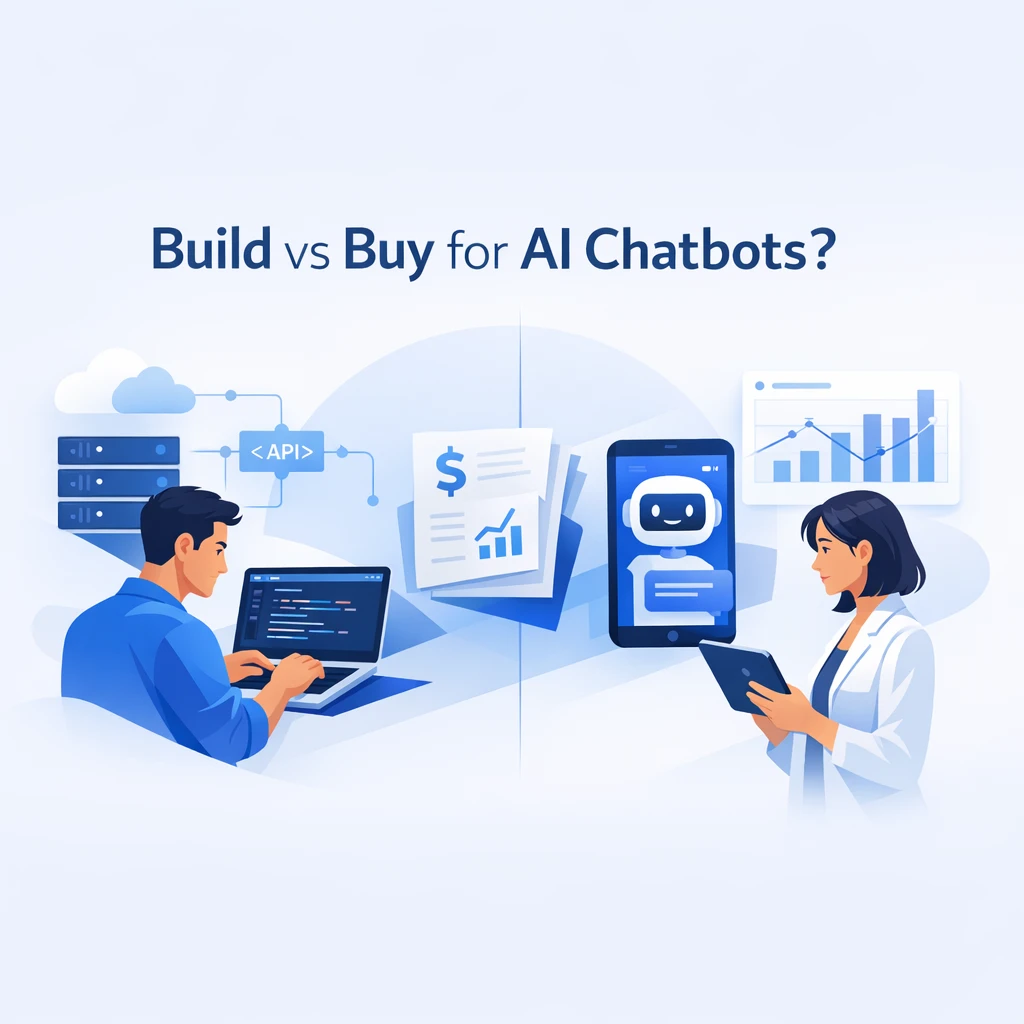
For modern enterprises, AI chatbots are no longer a niche capability—they are a strategic asset for driving customer satisfaction, streamlining support operations, and enabling scalable growth. The question is not simply how smart your chatbot should be, but whether to build a tailor-made solution in-house or buy a ready-made platform from a trusted partner. This article provides a practical, data-driven framework to evaluate cost, risk, and ROI for enterprise chatbots in 2026, with real-world considerations for SMBs, SMEs, startups, and large organizations across the UAE, GCC, North America, Europe, and APAC. It also shows how Triostack Technologies can help you design, build, deploy, and maintain a scalable solution—without sounding like a vendor pitch.
What is the Topic?
An AI chatbot for enterprise customer support is more than conversational UI. It’s a service that understands customer intent, retrieves and composes contextually relevant responses, and integrates with backend systems (CRM, ERP, order management, knowledge bases) to resolve requests with velocity and accuracy. Modern solutions often combine natural language understanding (NLU) with retrieval-augmented generation (RAG), domain-specific knowledge, and robust governance controls for privacy, security, and compliance. The core decision is whether to build a custom chatbot tailored to your data and workflows or buy a platform that accelerates delivery while requiring less upfront development.
Why it Matters in 2026
Customer expectations and cost pressures are driving a tighter boundary between excellent service and failed interactions. Key reasons to evaluate build vs buy now include:
- Speed to value: a purchased platform can reduce time-to-first-value, while a custom build can deliver a uniquely tailored experience.
- Total cost of ownership (TCO): initial outlay versus ongoing maintenance, data ingestion, and model updates.
- Compliance and governance: data residency, privacy (GDPR, CCPA-like regimes), and auditability are essential for regulated industries.
- Scale and resilience: multi-language support, omnichannel presence, and integration with mission-critical systems.
- ROI and CX metrics: faster resolution, higher first-contact resolution (FCR), increased CSAT, and decreased call center load.
For enterprises in Dubai, UAE, Saudi Arabia, Qatar, Oman, Kuwait, Bahrain, and beyond, the choice also hinges on regulatory constraints, data localization requirements, and the availability of remote delivery partners who can align with local business hours and cultural nuances.
Current Industry Challenges
As you consider build vs buy, several real-world challenges shape the decision:
- Data silos and integration: Customer data resides in multiple systems (CRM, ERP, ticketing platforms). A chatbot must harmonize this data to deliver coherent responses.
- Model drift and governance: Language models can drift over time. Enterprises need continuous monitoring, guardrails, and approvals for content and actions.
- Security and privacy: Token handling, identity assurance, access control, and secure data handling are non-negotiable.
- Localization and multilingual support: Regional languages and dialects require robust NLU and tone adaptation.
- Maintenance burden: Ongoing model updates, data quality efforts, and integration maintenance can be substantial.
- Vendor lock-in versus control: Buy solutions may limit customization; build options trade flexibility for speed and control.
In high-regulation markets like the UAE and Saudi Arabia, edge cases around data residency, auditing, and cross-border data flows push organizations toward governance-focused implementations—whether you build or buy.
How the Technology Works
At a high level, an enterprise chatbot comprises four layers:
- Natural Language Understanding (NLU) and intent recognition to identify what the user wants.
- Dialogue management to decide how to respond, gather missing data, and route requests to human agents when needed.
- Knowledge and data integration to fetch information from CRM, ERP, ticketing, knowledge bases, and product data sources.
- Response generation that can be template-based, retrieval-based, or generative, with appropriate guardrails and fallback mechanisms.
Modern systems often combine a foundational LLM (large language model) with domain-specific retrieval, structured prompts, and strict governance to ensure safe, accurate, and compliant behavior. Implementations typically support:
- Multichannel presence (web chat, mobile apps, messaging apps, voice assistants)
- Context retention across sessions
- Escalation to human agents with seamless handoffs
- Analytics dashboards and feedback loops for continuous improvement
Architecture Overview
The following diagram shows a practical, scalable architecture for an enterprise chat solution. It emphasizes modularity, data governance, and robust integration points.
Key components: - Frontend/UI layer and omnichannel adapters - Orchestrator and policy engine for routing and escalation - NLU and domain-specific knowledge processing - Data integration and access layer (CRM, ERP, ticketing, product data) - Knowledge bases, documents, and data lake for context - Observation, monitoring, and governance controls
Mermaid Diagram: Architecture Details
Step-by-Step Workflow
Implementing an enterprise chatbot typically follows a structured workflow. Here is a pragmatic, production-ready sequence:
- Discovery and requirements: define use cases, KPIs (FCR, CSAT, handle time), data sources, multilingual needs, and governance constraints.
- Data strategy: inventory data sources, establish data pipelines, and determine data residency requirements; define data quality targets.
- Prototype and MVP: build a minimal viable chatbot focusing on 2–3 core use cases; integrate with one system (e.g., CRM) and one knowledge source.
- Design and integration: create intents, entities, prompts, business rules, escalation paths, and secure integration with backend systems.
- Security and compliance: implement authentication, authorization, data masking, access controls, logging, and encryption in transit and at rest.
- Testing and QA: end-to-end test plans, noise tests, load tests, and privacy checks; include real-world operators to validate tone and escalation rules.
- Deployment and CI/CD: set up cloud infrastructure, containerization, CI/CD pipelines, staging environments, and automated testing.
- Monitoring and governance: establish dashboards for model performance, data drift, response quality, and security events; run periodic audits.
- Iteration and scale: expand use cases, languages, and channels; refine prompts and retrieval strategies; scale teams as needed.
Business Use Cases
Operational efficiency and elevated customer experiences come from applying chatbots across the customer journey. Consider these representative use cases:
- Order tracking and fulfillment: customers can check order status, shipment ETA, and delivery changes without human intervention.
- Appointment scheduling: clinics, diagnostics labs, and field services can book, reschedule, or cancel appointments with calendar integration.
- Billing and account inquiries: status of invoices, payments, and plan details with secure identity checks.
- Troubleshooting and self-service: guided steps for common issues, with escalation to human agents for unresolved problems.
- HR and IT helpdesk: password resets, hardware requests, and policy clarifications via common enterprise channels.
Industry Applications
Different industries benefit from tailored chatbot capabilities. A few examples:
- Logistics and e-commerce: order updates, returns processing, and delivery notifications at scale.
- Healthcare: patient triage, appointment management, and post-visit follow-ups with privacy compliance.
- Retail and hospitality: loyalty programs, product recommendations, and consistent guest support across channels.
- Financial services: balance inquiries, transaction alerts, and policy guidance with strict security controls.
Benefits
- Cost efficiency: reduce repetitive support volume and handle peak loads without proportional headcount increases.
- Availability: 24/7 support across time zones, including the Middle East, North America, Europe, and APAC.
- Consistency: standardized responses and knowledge access minimize human variability.
- Data-driven insights: analytics reveal trends, gaps, and product issues for faster product and process improvements.
- Improved CSAT and FCR: rapid resolutions and guided self-service improve customer satisfaction and first-contact resolution rates.
Challenges
Despite the upside, challenges exist and must be mitigated:
- Data quality and coverage: poor or incomplete data leads to incorrect conclusions or failed resolutions.
- Model bias and safety: governance controls are essential to prevent harmful or biased responses.
- Complex integrations: connecting to disparate systems can be technically demanding and time-consuming.
- Change management: adoption requires stakeholder alignment, process redesign, and change governance.
Common Mistakes
Avoid the most frequent missteps when deciding to build or buy:
- Scoping too narrowly: starting with a single chat line rather than an end-to-end service capable of escalation.
- Underestimating data prep: data labeling, cleansing, and normalization block progress if neglected.
- Overpromising capabilities: avoid setting expectations for perfect, context-aware reasoning on day one.
- Neglecting governance: insufficient attention to privacy, access, retention, and compliance risks.
Best Practices
Adopt these best practices to maximize ROI and minimize risk:
- MVP with scope control: start with a focused set of use cases and a measurable KPI plan.
- Modular architecture: separate UI, dialog logic, data access, and integrations for maintainability and scalability.
- Strong data governance: define data ownership, retention rules, and access controls; implement data masking in sensitive flows.
- Security by design: secure credentials, role-based access, and regular security testing.
- Continuous improvement: implement feedback loops, A/B testing, and incremental releases.
Build vs Buy: A Side-by-Side View
Decision factors include time to value, customization, risk, and long-term cost. The table below highlights core differences you should weigh before starting a project.
| Dimension | Build | Buy | Key Considerations |
|---|---|---|---|
| Time to value | Longer (requirements, data prep, integration) | Faster (out-of-the-box capabilities) | Balance speed with long-term control |
| Customization | High, tailored to your data and processes | Limited to vendor capabilities | Assess critical vs nice-to-have features |
| Control & IP | Full control of data, prompts, and deployment | Vendor controls data handling and roadmap | IP ownership considerations |
| Security & Compliance | Customizable governance, but responsibility on you | Vendor-managed controls may differ | Ensure regulatory alignment |
| Cost trajectory | Upfront capex, ongoing maintenance | Opex with predictable licensing | Long-term TCO requires careful modeling |
| Maintenance | Internal team ownership | Vendor updates and SLAs | Plan for integration upkeep and model drift |
Estimated Development Cost
Market conditions vary, but the following ranges reflect typical SMB/SME project footprints. These ranges assume a tailored approach with secure data practices and standard integrations (CRM, knowledge base, ticketing). All figures are USD and exclude taxes unless noted.
| Project Type | Typical Range | Notes |
|---|---|---|
| Business Website | USD 5k – 15k | Content, CMS integration, basic security |
| Customer Portal | USD 10k – 40k | Authentication, user workflows, data sync |
| CRM | USD 15k – 100k | Automation, integrations, custom UI |
| ERP | USD 40k – 200k | Core processes, multi-module integration |
| AI Chatbot | USD 5k – 25k | Core bot, integration with 1–2 systems |
| AI Automation | USD 15k – 80k | RPA-like automation with conversational UI |
| SaaS MVP | USD 20k – 80k | Minimum viable product for a software-as-a-service idea |
| Enterprise Web App | USD 30k – 200k | Complex workflows, strict governance |
Pricing factors to consider beyond base development include data preparation, security and compliance, multi-language support, hosting, ongoing maintenance, and SLAs. When you partner with Triostack Technologies, we tailor the cost model to your project scope, timeline, and desired governance posture.
Recommended Technology Stack
Whether you choose to build or buy, a thoughtful tech stack is essential. Below are practical recommendations across common layers. Note that Triostack emphasizes open ecosystems, security, and scalability, not vendor lock-in.
Build Path
- Frontend: React or Vue.js for web; React Native or Flutter for mobile.
- Backend: Python (FastAPI) or Node.js (Express/NestJS) for APIs; microservices pattern recommended.
- AI & NLP: OpenAI API, Azure OpenAI, or Cohere with domain adapters; LangChain or custom orchestration for retrieval and context handling.
- Data & Storage: PostgreSQL for structured data; MongoDB or vector stores for embeddings; Redis for caching.
- Search & Retrieval: Elasticsearch or OpenSearch; vector databases for semantic search (Pinecone, Weaviate).
- Integrations: REST/GraphQL APIs to CRM (Salesforce, HubSpot), ERP (Oracle, SAP), ticketing (ServiceNow), and knowledge bases.
- Security & Compliance: OAuth2, SSO (SAML/OIDC), encryption in transit/at rest, auditing, and data masking.
- DevOps & Deployment: Docker/Kubernetes, GitHub/GitLab, CI/CD (Azure DevOps, GitHub Actions), cloud providers (AWS, Azure, GCP).
Buy Path (Vendorization for acceleration)
- Platform: Enterprise-grade chatbot platforms with tested connectors and governance controls.
- Headless approach: Pair a robust AI service with your own UI and orchestration layer.
- Integrations: Pre-built connectors for CRM/ERP quickly extend capabilities.
Triostack specializes in custom software delivery, Web Development, AI Development, and API Development, with a bias toward APIs and data integration that unlock seamless CRM/ERP workflows. We also support Cloud Migration, DevOps, UI/UX refinement, QA, and dedicated teams for long-term engagements.
Future Trends
What should you watch for in the next 18–36 months when planning a build or buy decision?
- Multilingual and multilingual UIs with real-time translation and cultural nuance adaptation.
- Hybrid human-in-the-loop models that blend automation with human validation for high-stakes tasks.
- Model governance and audit trails to support compliance, usage analytics, and safety.
- Edge and on-device inference for privacy-sensitive scenarios and reduced latency.
- Deeper workflow automation across ERP, CRM, field services, and inventory with end-to-end intents.
Triostack stays ahead by combining enterprise-grade security, process awareness, and scalable AI techniques to ensure that your chatbot grows with your organization’s needs.
How Triostack Delivers Projects Globally
Triostack Technologies specializes in remote delivery from India, enabling access to a large, highly skilled engineering talent pool while preserving the quality and security expected by global enterprises. Our approach emphasizes agility, transparency, and outcomes over hours logged. Core elements of our delivery model include:
- Agile and sprint planning: bi-weekly or weekly sprints with clear backlog items and sprint goals.
- Weekly demos: live demonstrations to stakeholders via Slack, Teams, Zoom, or Google Meet.
- Collaboration tools: Jira, ClickUp, GitHub, GitLab, Azure DevOps for issue tracking, version control, and CI/CD.
- Delivery cadence: cloud staging environments, automated testing, and continuous deployment pipelines.
- QA and security: QA testing, security reviews, and compliance checks as standard practice.
- Documentation and IP ownership: thorough documentation, NDA, and explicit IP rights allocation.
- Timezone overlap and communication: practical overlaps for real-time collaboration; English proficiency and structured reporting ensure clarity.
- Dedicated PMs and long-term support: ongoing governance, roadmaps, and support post-launch.
Why UAE businesses outsource development to India? Reasons include cost efficiency, access to a large talent pool, faster hiring, flexible team scaling, high-quality software engineering, and strong communication practices that enable successful offshore collaborations.
Remote Delivery: Case Considerations and Best Practices
To operationalize remote delivery effectively, consider these practical guidelines:
- Define clear sprint goals and acceptance criteria aligned with business outcomes.
- Establish secure communication channels (Slack, Teams, Zoom) and a regular cadence for updates.
- Use CI/CD pipelines with cloud staging to catch issues early.
- Enforce strict NDA, IP ownership, and data protection agreements.
- Schedule overlapping work hours to maximize real-time collaboration across time zones.
- Involve local stakeholders in critical milestones to maintain alignment with regional requirements.
Case Studies
Below are representative, non-identifying examples that reflect practical outcomes from Triostack engagements. Each case illustrates how a partner approached the Build vs Buy decision and the resulting impact.
Case Study 1: Dubai logistics company
Challenge: A prominent Dubai-based logistics firm faced rising support volumes across delivery channels and needed faster order-status updates for B2B customers. The team sought a scalable solution with strong data privacy and multi-channel capabilities.
Approach: Triostack designed a bespoke chatbot architecture integrated with the company’s OMS, CRM, and a central knowledge base. The solution supported Arabic and English, with escalation to human agents for exceptions. We implemented a modular pipeline with strict data governance and logs for auditability.
Outcome: 35% reduction in live-agent handle time during peak periods; CSAT improved by 12 points within six months; the bot achieved 1.4x FCR improvement across key use cases, with scalable support for seasonal spikes.
Case Study 2: UAE healthcare clinic
Challenge: An UAE-based healthcare clinic needed to manage patient scheduling, triage, and post-visit follow-ups while complying with patient privacy regulations and local licensing requirements.
Approach: A privacy-conscious chatbot was built to handle appointment requests, triage questions, and reminders, integrating with the clinic’s EHR system and patient portal. Language support included Arabic and English with safe-handling of PHI (protected health information).
Outcome: 40% reduction in scheduling friction; improved patient engagement with automated follow-ups; high adoption rate among patients and staff, with secure data handling and auditable traces.
Case Study 3: Saudi retail business
Challenge: A regional retailer sought to streamline customer support across online channels, returns, and product inquiries, while maintaining brand voice and multilingual support.
Approach: Triostack delivered a headless chatbot with robust product knowledge integration and return workflow automation. The bot user interface aligned with the retailer’s brand guidelines and supported both Arabic and English interactions.
Outcome: 20–25% decrease in case volume for routine inquiries; faster response times; navigational consistency across web, mobile, and social channels.
Case Study 4: Australian startup
Challenge: An Australian software startup needed a chatbot to handle onboarding, feature discovery, and trial-to-paid conversion for a SaaS product.
Approach: A modular chatbot built with context retention, multilingual prompts, and a guided onboarding flow integrated with the signup and billing systems of the SaaS product.
Outcome: 15% uplift in trial-to-paid conversion; improved onboarding completion rates; faster iteration cycles due to a flexible, API-driven design.
These case studies illustrate how the Build vs Buy decision can vary by segment and how Triostack tailors the approach to meet regional and regulatory realities while maintaining a focus on measurable business outcomes.
Business Model and CTA
For organizations planning similar solutions, partnering with an experienced software development partner can help you design, build, deploy, and maintain a scalable solution with robust governance. Triostack emphasizes collaboration, transparent governance, and long-term support to ensure you achieve your CX objectives across regions.
If you're planning a similar software project, Triostack can help you design, build, deploy and maintain a scalable solution.
Frequently Asked Questions
- What is the typical ROI for an enterprise chatbot? ROI varies by industry and use case, but common metrics include reductions in average handling time, higher CSAT, improved FCR, and lower human support costs. A well-governed deployment often yields payback within 12–18 months after initial enhancements.
- How long does it take to deploy a chatbot project? A typical 3–6 month window covers MVP, integrations, and initial governance, with ongoing iterations to expand use cases and language support.
- Can a chatbot operate across multiple channels? Yes. A modern solution should support web chat, mobile apps, SMS, and popular messaging platforms, with a unified conversation state across channels.
- How does Triostack handle data security? We implement encryption, access controls, identity management, regular security testing, and governance documentation, with clear IP ownership terms and NDAs.
- Is it better to build or buy for a regulated industry? It depends. A build approach gives maximum control over governance, while a buy approach accelerates delivery under a trusted governance framework. The best path often involves a hybrid approach—buy core capabilities and customize critical workflows and data handling.
Conclusion
The decision to build or buy an AI chatbot for enterprise customer support is not just about technology. It’s a strategic evaluation of data readiness, governance, time-to-value, cost of ownership, and the ability to scale across languages, channels, and regions. In 2026, the most successful implementations blend a solid governance framework with the speed and flexibility of modern AI platforms. Whether you’re in Dubai, UAE, Saudi Arabia, Qatar, Oman, Kuwait, Bahrain, or beyond, you’ll find that a thoughtful, phased approach—driven by clear use cases and measurable outcomes—delivers the best ROI. Triostack thrives in this space by offering end-to-end services: Custom Software, Web Development, Mobile Apps, AI Development, ML, CRM, ERP, SaaS, Cloud Migration, DevOps, UI/UX, API Development, Dedicated Teams, QA, Maintenance, and Technical Consulting. Our emphasis is on practical, business-focused delivery, not marketing fluff.
Internal Resources and Next Steps
If you’re exploring a project of this kind, consider starting with an enterprise chatbot workshop to identify use cases, data sources, and governance requirements. For more information about how Triostack can support remote delivery with strong governance and quality assurance, contact our team to discuss a tailored plan that aligns with your regional requirements and timelines.
FAQ: Summary Checklist
- What is the right balance between build and buy for a new chatbot?
- Which integrations are essential for enterprise chatbots?
- How should governance, security, and compliance be implemented?
- What is a practical phased roadmap for a chatbot project?
Triostack Team
Technology Evangelist & Writer
Triostack Team is an experienced writer and technologist, exploring the intersections of AI, cloud architecture, and modern application development. Passionate about turning complex technical concepts into accessible insights.