AI Chatbot vs AI Agent for Enterprises: Cost, Use Cases, and Implementation Strategy in the UAE
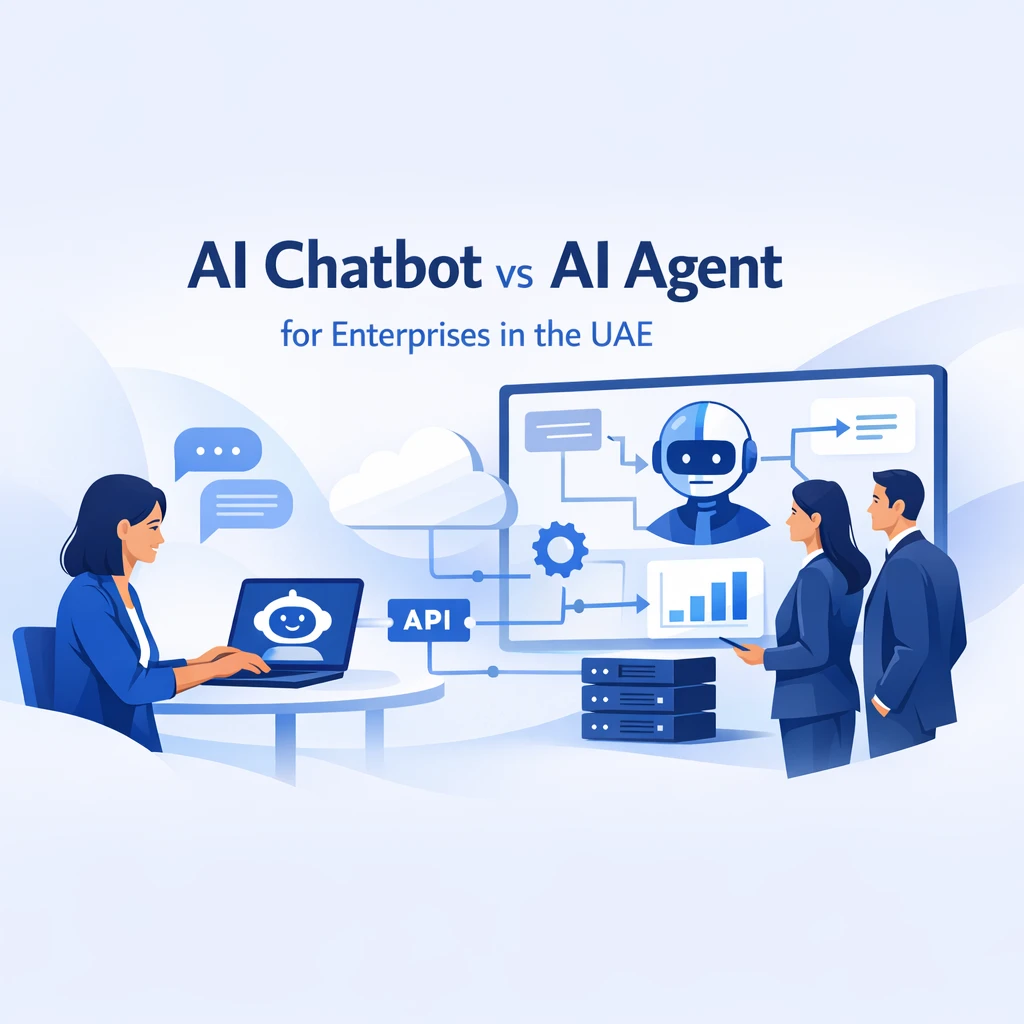
For many organizations in the UAE and beyond, AI-powered conversational technologies promise faster customer responses, smarter workflows, and data-driven decision making. But when you start evaluating options, a pivotal question emerges: should you build an AI chatbot or an AI agent that orchestrates tasks across systems? The answer depends on your goals, data complexity, integration needs, and budget. This article takes an educational, practitioner-focused view, with practical guidance, real-world examples, and a path for implementation that resonates with SMBs, SMEs, startup founders, CEOs, CTOs, and digital transformation leaders across Dubai, the UAE, and globally.
What is the Topic?
An AI chatbot is primarily a conversational interface designed to understand and respond to user queries in natural language. An AI agent, by contrast, is a broader construct: it automates tasks by orchestrating multiple services, APIs, databases, and business logic. In enterprise contexts, chatbots handle dialogues with customers or employees, while AI agents coordinate actions across CRM, ERP, ticketing, inventory, and analytics to complete end-to-end workflows.
Why it Matters in 2026
The UAE continues to accelerate digital transformation as it diversifies away from dependence on single industries. Enterprises face rising customer expectations, regulatory scrutiny, and the need to scale operations without dramatically increasing headcount. AI chatbots can reduce first-line support loads and boost engagement, but AI agents unlock end-to-end automation and cross-system orchestration, delivering measurable productivity gains.
From a cost perspective, early pilots are often cheaper for chatbots. However, as you add complexity—multi-language support, data governance, security, and integrations—the total cost of ownership for a standalone chatbot can surpass a well-designed AI agent that streamlines end-to-end processes.
Current Industry Challenges
- Data fragmentation across CRM, ERP, helpdesk, and legacy systems
- Data privacy, security, and regulatory compliance (especially in healthcare, finance, and logistics)
- Multi-language support and local context (Arabic, English, Hindi, Urdu, and more)
- Change management and user adoption in large organizations
- Maintaining accuracy and avoiding hallucinations in production deployments
- Scalability: handling peak demand without compromising latency
How the Technology Works
A chatbot typically relies on a language model to interpret user input, a dialogue manager to maintain context, and a set of rule-based or ML-powered responses. A AI agent expands this architecture with orchestration logic: it calls external services, performs actions, monitors outcomes, and can trigger workflows across multiple systems. In practice, many deployments blend both: a chatbot front-end paired with an agent-driven backend that executes business processes.
Architecture Overview
Below is a high-level view of how AI chatbots and AI agents fit into typical enterprise landscapes. The two diagrams illustrate both the conversations and the orchestration that powers end-to-end workflows.
Step-by-Step Workflow
- Discovery and requirements: define goals, success criteria, and integration points (CRM, ERP, helpdesk).
- Data strategy: inventory data sources, identify privacy requirements, and plan data governance.
- Platform selection: decide between a chatbot-led approach or an AI agent-led orchestrator, or a hybrid pattern.
- Architecture design: choose NLU models, orchestration logic, and integration patterns (APIs, webhooks, event streams).
- Implementation: build the frontend, backend services, and integration adapters; implement security controls and audit trails.
- Testing: perform unit, integration, and user-acceptance testing; simulate load and end-to-end scenarios.
- Deployment: stage in a cloud environment with proper sandboxing and progressive rollout
- Monitoring and governance: set KPIs, establish incident response, and maintain an iteration loop for improvement.
Business Use Cases
Consider these common enterprise scenarios where AI chatbots or AI agents add measurable value:
- Customer support automation: handling common inquiries, triaging to human agents, and maintaining SLA commitments.
- Order status and logistics updates: providing real-time shipment tracking, ETA estimates, and problem escalation.
- HR and IT helpdesk automation: new-employee onboarding, policy lookup, password resets, and ticket routing.
- Sales and customer success: capturing leads, scheduling meetings, and pulling account data for reps.
- Operations and field service: coordinating tasks across teams, approvals, and inventory replenishment.
Industry Applications
Across sectors prevalent in the Gulf and global markets, AI-driven automation can be tailored to governance, risk, and compliance requirements while improving customer experience:
- Logistics and supply chain: proactive shipment notifications, demand forecasting, and exception management in Dubai and beyond.
- Healthcare and clinics: patient scheduling, intake triage, and secure information exchange compliant with local regulations.
- Retail and e-commerce: order tracking, personalized recommendations, and loyalty program management.
- Finance and banking: Know Your Customer (KYC) workflows, fraud alerts, and tens of thousands of routine inquiries handled automatically.
- Public sector and utilities: citizen services portals, permit applications, and service requests routed to the right department.
Benefits
- Faster response times and improved customer satisfaction.
- Lower operational costs through automation of repetitive tasks.
- Improved data capture, analytics, and decision support.
- Consistent user experiences across channels and languages.
- Auditability and governance through traceable workflows and logs.
Challenges
- Data quality and privacy concerns, especially in regulated industries.
- Managing multi-language capabilities and local context in the UAE and GCC markets.
- Ensuring reliability and handling edge cases that require human intervention.
- Maintaining interoperability with legacy systems and third-party APIs.
Common Mistakes
- Underestimating data preparation and integration complexity.
- Choosing a shiny chatbot without a plan for end-to-end automation.
- Over-promising NLP capabilities without a governance framework.
- Neglecting security, access control, and IP protection in outsourced models.
Best Practices
- Start with a measurable objective (reduction in call volume, faster onboarding, etc.).
- Define data governance, privacy, and retention policies up front.
- Architect for multi-language, localization, and regulatory compliance.
- Use a modular architecture: AI, orchestration, and integration layers decoupled for scalability.
- Adopt an iterative delivery model with frequent demos and feedback loops.
Build vs Buy Comparison
In many enterprise projects, the decision between building a bespoke solution or buying a platform matters more than whether you choose a chatbot or an agent. The table below highlights typical considerations.
| Aspect | AI Chatbot | AI Agent |
|---|---|---|
| Primary value | Conversation-centric; handles inquiries and basic tasks | End-to-end automation; orchestrates actions across systems |
| Implementation effort | Moderate; needs intents, responses, multilingual support | Higher; requires integration adapters and workflow logic |
| Data governance needs | Important for accuracy of responses | Critical; cross-system data flows and auditability |
| Total cost of ownership | Lower upfront, potential cost of scale | Higher upfront but often lower long-term maintenance if well-architected |
| Time to value | Shorter cycles for MVPs | Longer cycles but with broader automation impact |
For many UAE-based teams, a practical path is to start with a robust chatbot to validate conversational flows and gradually layer in AI agent capabilities as data sources, APIs, and governance mature. Triostack helps you design the optimal mix, balancing speed and automation depth.
Estimated Development Cost
Costs vary by scope, region, data quality, integrations, and governance requirements. The ranges below are representative for SMBs and mid-market projects in 2026. They reflect typical outcomes when engaging a capable global software partner like Triostack.
| Project Type | Typical Range (USD) | Notes |
|---|---|---|
| Business Website | 5k – 15k | Responsive design, content management, basic analytics |
| Customer Portal | 10k – 40k | Authentication, dashboards, integrations with core systems |
| CRM | 15k – 100k | Contact management, sales pipelines, automation rules |
| ERP | 40k – 200k | Financials, procurement, inventory, multi-department workflows |
| AI Chatbot | 5k – 25k | NLU, intents, dialogues, multilingual support |
| AI Automation | 15k – 80k | Orchestration, API adapters, workflow logic |
| SaaS MVP | 20k – 80k | Core product with initial cloud services |
| Enterprise Web App | 30k – 200k | Large-scale, multi-tenant, integrations, security |
Pricing factors: scope size, data readiness, integrations complexity, governance and security requirements, localization (language and regional regulations), cloud hosting vs on-prem, and post-launch support. Triostack works with you to map a cost-to-value plan, ensuring you get measurable outcomes at each milestone.
Recommended Technology Stack
Choosing the right tools is critical to achieving the desired balance of speed, reliability, and scalability. A practical stack for most enterprise projects includes:
- Frontend: React or Vue.js with responsive design and accessibility considerations
- Backend: Node.js or Python Django/Flask for robust API services
- AI & NLP: OpenAI API, Llama-based models, or vendor-specific NLP services with fine-tuning capabilities
- Orchestration: Custom workflow engine or low-code/automation platform for process orchestration
- Data & search: Vector databases (Pinecone, Qdrant) and a scalable data lake
- Integrations: RESTful APIs, GraphQL, message queues (RabbitMQ, Kafka)
- Security & compliance: OAuth 2.0 / OpenID Connect, audit logs, encryption in transit and at rest
- DevOps: CI/CD pipelines (GitHub Actions, GitLab CI), IaC, containerization (Docker, Kubernetes)
Future Trends
- Multi-modal AI: combining text, speech, and vision for richer enterprise interactions
- Edge and on-device inference for sensitive data
- Stronger governance: policy-based automation and impact assessment frameworks
- Industry-specific AI: healthcare, logistics, and finance uses with compliant data handling
- Hybrid human-in-the-loop systems to balance automation with expert oversight
How Triostack Delivers Projects Globally
Triostack brings a global delivery model that emphasizes quality, speed, and clear communication. Our approach combines modern engineering practices with practical governance and risk management. We work with clients across the UAE, GCC, and international markets, delivering projects from our distributed centers.
REMOTE DELIVERY
Triostack specializes in remote delivery from India, combining time-zone overlap with cost efficiency and access to a large talent pool. Our remote model includes:
- Agile project management with defined sprints and milestones
- Weekly demos and continuous feedback loops
- Communication via Slack, Teams, Zoom, and Google Meet
- Task tracking with Jira or ClickUp; code management on GitHub or GitLab
- CI/CD pipelines and automated testing; cloud staging environments
- Comprehensive QA and security reviews; documentation and NDAs
- IP ownership and long-term maintenance contracts
- Timezone overlap and strong English communication for seamless collaboration
- Dedicated project managers and long-term support
Why UAE businesses outsource development to India?
- Cost efficiency and predictable budgeting for SMBs and mid-market firms
- Access to a large, highly skilled engineering talent pool
- Faster time-to-market through scalable teams and flexible hiring
- Proven quality in complex software engineering, AI, and cloud-native solutions
- Strong communication, cultural alignment, and robust project governance
Case Studies
Below are anonymized, realistic scenarios that illustrate how AI chatbots and AI agents have been deployed in practice. We focus on outcomes and approach rather than naming specific companies.
Case Study 1: Dubai-based logistics company
Challenge: A regional logistics provider faced high support volumes due to shipment status inquiries, while field agents were overloaded with routine requests.
Approach: Implemented an AI agent for order tracking, inventory checks, and ETA updates, connected to the ERP and WMS. A conversational chatbot handled customer questions and escalated complex cases to human agents when needed. Localization and 24/7 availability were prioritized.
Outcome: Reduced first-response time by 40%, improved on-time delivery visibility, and trimmed helpdesk workload by nearly one-third within the first six months.
Case Study 2: UAE healthcare clinic
Challenge: Streamline patient intake, appointment scheduling, and information requests while ensuring PHI privacy and compliance with local regulations.
Approach: Deployed an AI chatbot for patient self-check-in and triage, integrated with the clinic's scheduling and EHR systems. An AI agent managed appointment calendars, reminders, and document routing to departments.
Outcome: Increased appointment completion rate, improved patient experience, and reduced administrative burden on front-desk staff.
Case Study 3: Saudi retail business
Challenge: Scale customer support during peak shopping periods and coordinate returns and order eligibility checks across stores and online channels.
Approach: Built a multi-channel AI chatbot with a rule-based escalation path, plus an AI agent that orchestrated order checks, return approvals, and inventory lookups in real time.
Outcome: Higher customer satisfaction scores, faster issue resolution, and better stock visibility for store managers.
Case Study 4: Australian startup (global reach)
Challenge: Rapidly launch a SaaS MVP with robust security and multi-tenant support for customers in North America, Europe, and Asia.
Approach: Leveraged Triostack's global delivery model to accelerate development, focusing on core product features, secure authentication, and scalable cloud infrastructure. Implemented AI features for customer onboarding and automated support.
Outcome: Shortened time-to-market, early adopter feedback informed product roadmap, and scalable architecture prepared the company for rapid growth.
Future Trends for Enterprises
As organizations mature, you can expect a gradual shift from chatbot-centric experiences to orchestration-first architectures where AI agents handle multi-system workflows with human-in-the-loop oversight when needed. The UAE market, with its emphasis on digital infrastructure, smart cities, and regulatory compliance, is particularly well-suited for this evolution.
Triostack operates as a global software development partner offering a wide range of services to help you design, build, deploy, and maintain scalable digital products. Our capabilities include:
- Custom Software and Web Development
- Mobile Apps
- AI Development and Machine Learning
- CRM and ERP Integrations
- SaaS, Cloud Migration, and DevOps
- UI/UX, API Development
- Dedicated Teams, QA, Maintenance
- Technical Consulting and Security
Build vs Buy>
In practice, many enterprises combine both approaches. You may begin with a proven, off-the-shelf AI assistant for core customer support and gradually build custom AI agents to automate internal workflows. Triostack supports phased, value-driven implementations with risk-managed rollouts.
Future Planning and Roadmapping
Plan in three horizons:
- Near-term (0–6 months): MVP chatbots with limited governance and basic integrations.
- Mid-term (6–18 months): AI agents coordinating across 2–4 critical systems, multi-language support, robust analytics.
- Long-term (18+ months): End-to-end automation, policy-driven orchestration, and extensive governance with security-by-design.
1. What is the key difference between an AI chatbot and an AI agent?
An AI chatbot focuses on conversation and handling user inquiries. An AI agent orchestrates actions across systems, executes workflows, and automates end-to-end processes, often combining multiple services and data sources.
2. Which is better for my UAE business—a chatbot or an AI agent?
It depends on your goals. If you want to improve customer support with fast responses, start with a chatbot. If your objective is end-to-end automation of business processes across CRM, ERP, and IT systems, invest in AI agents and the necessary integrations.
3. How long does it take to implement?
Varies by scope. A chatbot MVP might take 6–12 weeks; a fully integrated AI agent solution could take 4–9 months depending on integrations and governance requirements.
4. How is data security handled in a remote delivery model?
We enforce strict NDAs, data handling policies, encryption, access controls, and compliance checks. IP ownership is clearly defined in the contract, and security reviews are conducted at each milestone.
5. What about ongoing maintenance?
Triostack offers long-term support with monitoring, performance tuning, security patches, and periodic retraining or model updates as needed.
1. What is the key difference between an AI chatbot and an AI agent?
An AI chatbot focuses on conversation and handling user inquiries. An AI agent orchestrates actions across systems, executes workflows, and automates end-to-end processes, often combining multiple services and data sources.
2. Which is better for my UAE business—a chatbot or an AI agent?
It depends on your goals. If you want to improve customer support with fast responses, start with a chatbot. If your objective is end-to-end automation of business processes across CRM, ERP, and IT systems, invest in AI agents and the necessary integrations.
3. How long does it take to implement?
Varies by scope. A chatbot MVP might take 6–12 weeks; a fully integrated AI agent solution could take 4–9 months depending on integrations and governance requirements.
4. How is data security handled in a remote delivery model?
We enforce strict NDAs, data handling policies, encryption, access controls, and compliance checks. IP ownership is clearly defined in the contract, and security reviews are conducted at each milestone.
5. What about ongoing maintenance?
Triostack offers long-term support with monitoring, performance tuning, security patches, and periodic retraining or model updates as needed.
We tailor engagement models to client needs, balancing proximity, cost, and expertise. For many UAE-based projects, our model emphasizes:
- Clear collaboration rituals and governance structures
- Localized product ownership and rapid feedback loops
- Transparent milestone-based billing and risk management
Both AI chatbots and AI agents offer compelling value propositions for enterprises in the UAE and beyond. The most effective approach depends on your objectives, data maturity, and integration landscape. Start with a clear problem statement, design for governance and security, and scale through iterative delivery. Triostack is a partner that can help you navigate from discovery to deployment and long-term success, blending technical excellence with pragmatic program management.
Explore related topics and placeholders for future internal content: Build vs Buy, Case Studies, Remote Delivery, Future Trends
Triostack Team
Technology Evangelist & Writer
Triostack Team is an experienced writer and technologist, exploring the intersections of AI, cloud architecture, and modern application development. Passionate about turning complex technical concepts into accessible insights.