AI Chatbot vs AI Agent for Customer Service in Dubai: Cost, Use Cases and Business ROI
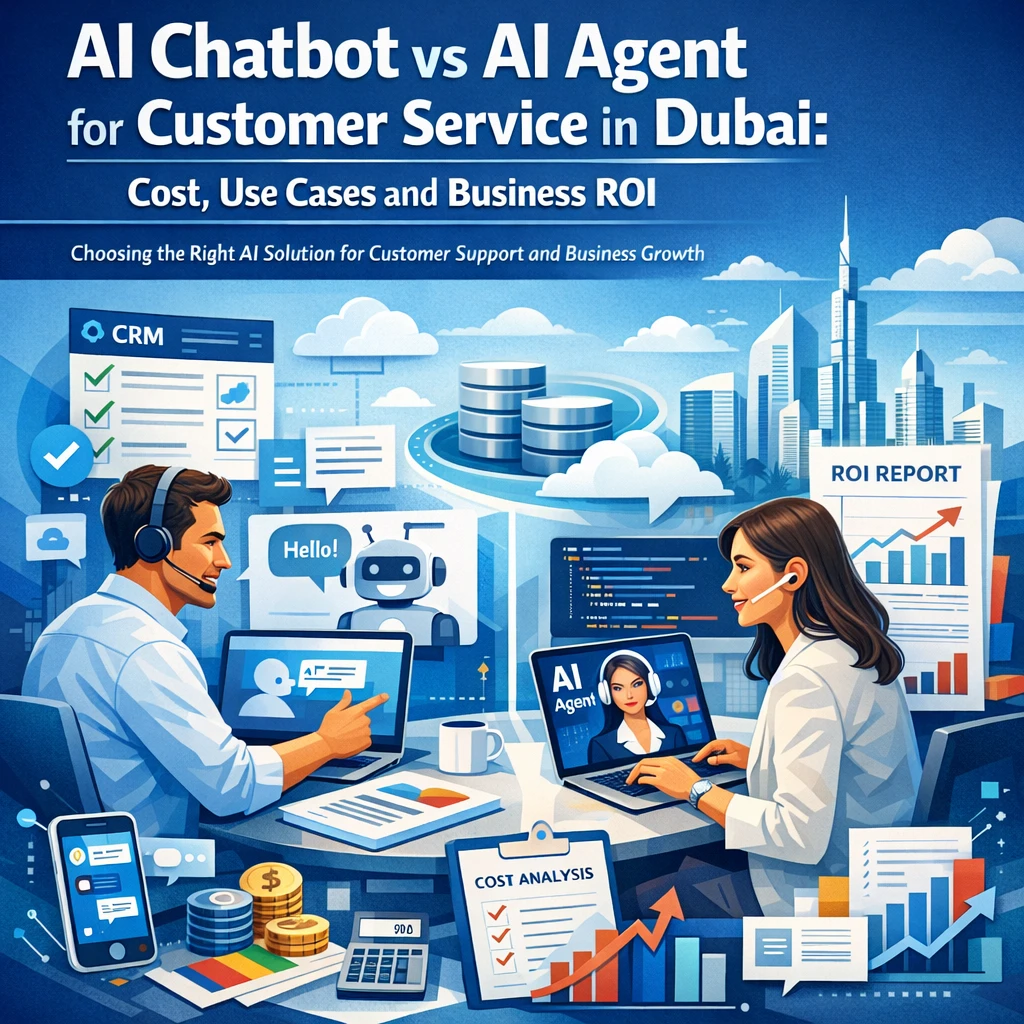
As businesses in Dubai and the wider Gulf region accelerate digital transformation, the choice between AI chatbots and AI agents for customer service becomes more nuanced. This guide unpackses practical differences, real-world use cases, cost implications, and ROI considerations to help SMBs, SMEs, startup founders, and enterprise teams make informed decisions.
Introduction
Customer service is increasingly a product of automation that blends conversational agents with intelligent workflow orchestration. In 2026, markets across the UAE, Saudi Arabia, Qatar, Oman, Kuwait, Bahrain, and beyond are adopting AI-powered assistants that can handle routine inquiries, triage issues, and even drive proactive engagement. Yet the way you deploy these capabilities matters as much as the technology itself. This article explores the differences between AI chatbots and AI agents, compares costs and ROI, and provides a practical framework for planning, building, and scaling a customer service AI program with Triostack Technologies as a trusted partner.
What is the Topic?
While terms like AI chatbot and AI agent are sometimes used interchangeably, there is a meaningful distinction in scope and capability. An AI chatbot typically focuses on natural language interaction through chat interfaces and is designed to answer questions, guide users, or route requests. An AI agent extends that concept by integrating with business systems, automating tasks, and making autonomous decisions within predefined policy and workflow boundaries. In practice, an AI agent can:
- Access CRM/ERP data to personalize responses and perform actions (e.g., create an order, update a ticket).
- Orchestrate multi-step processes across systems (e.g., inventory check, shipping label creation, notification).
- Proactively trigger actions based on events (e.g., out-of-stock alert, abnormal service latency).
- Offer decision support to human agents by surfacing relevant data and recommended actions.
For customer service in Dubai and the GCC, the distinction translates into speed, autonomy, and integration depth. The right mix often depends on your current systems, data quality, and desired level of automation.
Why it Matters in 2026
Several macro trends push businesses toward AI-enabled customer service:
- Cost efficiency and scalability: AI agents can handle routine inquiries at scale, reducing human workload without sacrificing quality.
- 24/7 availability: In markets with diverse time zones and high service expectations, round-the-clock support can be a differentiator.
- Localized experiences: Language, cultural context, and regulatory considerations play a bigger role than ever in the Gulf region and in global expansions.
- Data-driven improvement: AI systems learn from interactions, enabling continuous improvement in response quality and resolution rates.
For SMBs and startups, choosing between a chatbot and an agent is not binary. A staged approach—starting with a chatbot for low-complexity tasks and gradually layering AI agent capabilities for deeper automation—often yields the best ROI.
Current Industry Challenges
Businesses in Dubai and the GCC face several challenges when adopting AI for customer service:
- Data silos across CRM, ERP, and bespoke systems hinder context and continuity in conversations.
- Maintaining regulatory compliance and data privacy across cross-border operations.
- Ensuring multilingual and culturally aware interactions for a diverse customer base.
- Balancing rapid deployment with robust governance, security, and IP ownership concerns.
- Managing expectations: not every process is suitable for full automation, and human-in-the-loop remains critical for complex cases.
This is where partnering with an experienced software development partner matters. Triostack Technologies brings global delivery capabilities and local market insights to help you navigate these challenges effectively.
How the Technology Works
At a high level, AI chatbots and AI agents rely on three layers: natural language understanding (NLU), decision logic/orchestration, and integrations with data sources or actions. An AI chatbot may excel at understanding intent and providing generic answers, while an AI agent extends capabilities by implementing business rules and performing actions in your systems.
Key components typically include:
- NLU models for intent recognition and entity extraction.
- Dialogue management to maintain context and steer conversations.
- Workflows or orchestration engines to manage multi-step processes.
- APIs to CRM, ERP, order management, HR systems, analytics, and messaging channels.
- Data security, privacy controls, and audit logging to meet regulatory requirements.
When you scale, you’ll often combine AI chatbots for conversational access with AI agents for automation and decision making. This hybrid approach yields fast wins and a clear path to deeper automation as your data quality and process maturity improve.
Architecture Overview
The following diagram illustrates a practical architecture for a Dubai-based customer service solution that blends chatbot capabilities with agent-driven automation and enterprise integrations.
Notes:
- The front-end can be a web chat, WhatsApp, Teams, or a mobile app. The channel adapters normalize messages for the NLU engine.
- The AI Action Service embodies the AI agent capabilities, performing tasks in your systems and enforcing business rules.
- Security and compliance are woven through the stack to protect customer data and ensure traceability.
In Triostack’s experience, a phased architecture helps: start with a robust chatbot layer, then progressively add agent-based automations and system integrations as data and governance mature.
Step-by-Step Workflow
The following flow shows how a typical customer inquiry travels from initial contact to resolution, including automated actions by an AI agent when appropriate.
Key decisions during the workflow include whether a query can be resolved by a chatbot, whether it requires a human agent, or whether it should trigger an automated action via the AI agent.
Business Use Cases
Below are representative scenarios in the Gulf region and beyond where AI chatbots and AI agents deliver measurable value.
Dubai Logistics Company – Order Tracking and SLA Automation
Challenge: Customers frequently asked for shipment status and ETA updates across multiple carriers. Agents were overwhelmed during peak hours.
Solution: An AI chatbot provides real-time tracking across carriers, while the AI agent autonomously creates tracking tickets, updates status in the CRM, and notifies customers of SLA breaches via SMS or chat.
Impact: Faster responses, improved visibility, and reduced ticket volume for human agents.
UAE Healthcare Clinic – Appointment Scheduling andTriage
Challenge: Scheduling and patient triage consumed significant staff time, especially for after-hours inquiries.
Solution: A bilingual AI agent handles appointment bookings, basic triage, and reminders, while securely integrating with the clinic’s EHR system.
Impact: Higher patient satisfaction, fewer no-shows, and more efficient use of clinical staff time.
Saudi Retail Business – Omnichannel Support
Challenge: Customer queries spread across social, chat, and email channels with inconsistent agent handoffs.
Solution: A unified AI agent orchestrates conversations across channels, applies business rules for promotions, and updates orders in the OMS/CRM in real time.
Impact: Consistent omnichannel experiences and improved conversion rates.
Australian Startup – Global Customer Support Platform
Challenge: Scaling to a global customer base with multilingual support and varied product lines.
Solution: A modular AI platform that evolves from chatbot-driven self-service to agent-driven automation with regional customization and governance controls.
Impact: Faster time-to-market for new product lines and improved support coverage across time zones.
Industry Applications
While the GCC market has unique requirements, the underlying patterns apply across industries:
- Retail and e‑commerce: product discovery, order status, returns processing, loyalty integration.
- Logistics and transportation: proactive shipment alerts, routing optimizations, and SLA tracking.
- Healthcare: appointment management, triage guidance, patient education while protecting PHI.
- Banking and fintech: customer inquiries, KYC guidance, and secure action workflows with approvals.
Benefits
- Improved first-contact resolution and faster response times.
- Consistent customer experiences across channels and languages.
- Scalability without linearly increasing headcount.
- Data-driven insights to refine products, services, and support contacts.
- Clear separation of concerns: automation handles routine tasks, humans focus on complex cases.
Challenges
- Data quality and integration complexity can limit automation gains.
- Maintaining tone, compliance, and regional language nuance.
- Balancing automation with the need for human empathy and oversight.
- Security, IP ownership, and data residency requirements in cross-border deployments.
Common Mistakes
- Underestimating data preparation and governance needs before deployment.
- Over-automating high-touch processes that still require nuanced human intervention.
- Poor channel design—treating all channels the same instead of tailoring experiences.
- Ignoring multilingual and cultural considerations in the Gulf region.
Best Practices
- Start with a clear problem statement and measurable success metrics (e.g., deflection rate, CSAT, time to resolution).
- Adopt a phased approach: chatbot for low-complexity tasks, AI agent for automations, then expand to proactive actions.
- Invest in data governance, privacy controls, and security by design.
- Implement human-in-the-loop safeguards for sensitive transactions and high-stakes decisions.
- Plan for multilingual capabilities and cultural context from day one.
Build vs Buy
Many organizations debate building in-house versus buying a managed service. The right choice depends on your goals, risk tolerance, and resource availability. The table below summarizes typical considerations.
| Aspect | Build In-House | Buy / Outsource |
|---|---|---|
| Control & Customization | Highest control; bespoke workflows | Faster time-to-market; some customization possible |
| Time to Value | Longer development cycle | Faster deployment with proven patterns |
| Cost | Higher upfront and ongoing maintenance | Capex vs opex trade-offs; predictable monthly costs |
| Quality & Talent | Depends on internal capabilities | Access to global talent pools and best practices |
| Governance & Compliance | Frames around internal processes | Vendor governance can simplify compliance with standards |
In many scenarios, a hybrid approach—core automation built by Triostack with custom glue for your systems—delivers the best balance of control, speed, and risk management.
Estimated Development Cost
Costs vary by scope, data readiness, and integration complexity. The ranges below reflect typical SMB and startup scenarios in the Gulf region and beyond. All figures are USD and assume a professional services engagement with a structured project plan.
| Solution Type | Typical Range (USD) |
|---|---|
| AI Chatbot | 5,000 – 25,000 |
| AI Automation | 15,000 – 80,000 |
| Customer Portal | 10,000 – 40,000 |
| CRM | 15,000 – 100,000 |
| ERP | 40,000 – 200,000 |
| SaaS MVP | 20,000 – 80,000 |
| Enterprise Web App | 30,000 – 200,000 |
Pricing factors include data readiness, number of integrations, channel breadth, language support, security requirements, and ongoing maintenance needs. Triostack works with you to define a phased roadmap that aligns with your budget and business goals.
Recommended Technology Stack
The right stack accelerates delivery while ensuring security, scalability, and maintainability. A typical selection might include:
- NLU & Conversational AI: OpenAI, Rasa, or custom NLP pipelines depending on data and language needs
- Orchestration & Workflow: Node.js services, Python microservices, or serverless functions
- Data & Integrations: REST/GraphQL APIs, middleware for CRM/ERP (Salesforce, SAP, Oracle)
- Frontend: React or Vue for web; native/mobile apps for iOS/Android
- Cloud & DevOps: AWS, Azure, or Google Cloud; CI/CD pipelines; IaC
- Security: OAuth2.0 / OpenID Connect, encryption at rest and in transit, audit logs
- CI/CD & QA: GitHub/GitLab, Jira/ClickUp, automated testing, staging environments
Triostack’s approach emphasizes modularity, clear API contracts, and robust governance to support long-term growth without lock-in.
Future Trends
- Conversational agents with stronger multimodal capabilities (text, voice, images) and improved real-time translation.
- Deeper integration with back-end systems enabling end-to-end automation of business processes.
- Policy-driven automation to ensure compliance with data privacy, local regulations, and industry standards.
- Edge AI and on-prem options for data-sensitive use cases alongside cloud deployments.
How Triostack Delivers Projects Globally (Remote Delivery)
Triostack supports remote delivery from India and other locations while maintaining a client-centric, time-zone-aware engagement. Our model emphasizes collaboration, transparency, and governance to ensure successful outcomes for Dubai-based and global clients alike.
- Agile methodology: Sprints typically span 1–2 weeks with backlog grooming and sprint planning in local times where possible.
- Weekly demos: Regular stakeholder reviews keep the project aligned with business goals.
- Collaboration tools: Slack, Teams, Zoom, Google Meet for daily communication; Jira or ClickUp for project management; GitHub/GitLab for code; Azure DevOps for CI/CD.
- Cloud staging and production: Separate environments for development, QA, staging, and production to minimize risk.
- QA & security: Dedicated QA cycles, security reviews, and documentation for NDA/IP ownership in place.
- Documentation: Clear technical and user documentation to expedite onboarding and future maintenance.
- IP ownership & NDA: Clear agreements protecting client IP and ensuring confidentiality.
- Timezone overlap: Structured overlap windows to enable real-time collaboration between UAE-based teams and Triostack delivery squads in India and beyond.
- Dedicated project managers: Single point of contact managing priorities, risks, and changes.
- Long-term support: Post-go-live maintenance and enhancement options to maintain momentum.
Why UAE businesses outsource development to India and other global centers? The reasons include cost efficiency, access to a large talent pool, faster hiring, flexible scaling, high-quality engineering, and strong communication practices when aligned with robust project governance.
Case Studies (Realistic Scenarios)
Dubai-based Logistics Firm
Challenge: High inquiry volume about shipment status across multiple carriers and a rising need for proactive ETA alerts.
Solution: Implemented an AI chatbot for frontline inquiries and an AI agent integrated with the logistics platform to pull data from carrier trackers and automatically update shipment statuses in the CRM and helpdesk system.
Outcome: Improved response times, reduced ticket backlogs, and better customer visibility into transit events without adding headcount.
UAE Healthcare Clinic
Challenge: Appointment scheduling and basic triage consumed substantial administrative capacity, with strict privacy requirements.
Solution: Deployed a bilingual AI agent that schedules appointments, sends reminders, and performs initial triage while logging data in the EHR with appropriate access controls.
Outcome: Higher appointment adherence and freed staff to focus on clinical tasks, while maintaining PHI security standards.
Saudi Retailer
Challenge: Multichannel customer service with inconsistent handoffs and delayed responses during peak seasons.
Solution: A unified AI agent orchestrates conversations across chat, email, and social channels, applying promotions and updating orders in the OMS in real time.
Outcome: Consistent customer experience and faster order resolution across channels.
UK SaaS Company (Global Deployment)
Challenge: Global customer base required multilingual support and scalable automation as product complexity grew.
Solution: Scalable AI agent framework with modular microservices, enabling region-specific configurations and governance across customers.
Outcome: Accelerated international expansion with uniform support quality and reduced manual escalation rates.
Build vs Buy: Practical Pricing and ROI Signals
ROI is not just about the initial price tag; it is about the cost of delay, the speed of delivery, and the value of automation. The following table captures typical cost and ROI levers you should consider when evaluating a project with Triostack.
| ROI Driver | Buy/Outsource Advantage | In-House Build Considerations |
|---|---|---|
| Time to Value | Faster to initial results with off-the-shelf patterns | Longer ramp-up, but full control over architecture |
| Maintenance Burden | Vendor-managed updates and SLA-backed support | Ongoing maintenance talent and governance required |
| Customization | Core workflows can be tailored with configuration | Highest customization potential but at higher cost |
| Risk & Compliance | Vendor governance simplifies governance and audit trails | Requires internal processes and security expertise |
Future Trends and What to Watch
Look for vendors and teams to emphasize:
- Better multilingual and multicultural capabilities for Gulf markets
- Stronger security models including zero-trust architectures
- Deeper integration with HR, finance, and supply chain systems for end-to-end automation
- Smarter human-in-the-loop workflows with confidence scoring and escalation rules
How Triostack Delivers Projects Globally
Triostack brings a balanced mix of product engineering excellence, global delivery, and industry-focused knowledge. Our services span:
- Custom Software
- Web Development
- Mobile Apps
- AI Development
- Machine Learning
- CRM & ERP
- SaaS
- Cloud Migration
- DevOps
- UI/UX
- API Development
- Dedicated Teams
- QA
- Maintenance
- Technical Consulting
We operate with a client-centric mindset, combining offshore centers with local market insights to deliver scalable digital products. Our approach is collaborative, transparent, and outcome-driven.
Why Businesses Choose Triostack
Triostack has supported clients in multiple regions with complex integrations, regulatory considerations, and cross-border workloads. Our strengths include:
- Experience building AI-driven customer service platforms at scale
- Strong emphasis on architecture, security, and governance
- Proven remote delivery model with continuous customer involvement
- Global delivery footprint with flexible engagement models
- Focus on measurable business outcomes and ROI
Internal Resources & Next Steps
If you’re planning a similar software project, explore our case studies for concrete patterns and outcomes. You can also review our guide on remote delivery to understand how Triostack collaborates across time zones.
Frequently Asked Questions
- What is the difference between an AI chatbot and an AI agent?
- An AI chatbot focuses on natural language interactions and basic workflow routing, while an AI agent extends capabilities by automating tasks and making decisions within integrated systems.
- How do I determine if I should build or buy?
- Consider factors like time to value, customization needs, data readiness, compliance requirements, and budget. A staged approach or hybrid model is often most effective.
- What regions does Triostack support for remote delivery?
- We support global delivery with a strong footprint in India and other centers, enabling scalable, cost-efficient development for clients in Dubai, UAE, KSA, GCC, Europe, North America, and more.
- What are typical costs for an AI chatbot project?
- For SMBs, AI chatbots commonly range from 5k to 25k USD, depending on language support, integrations, and complexity. Larger AI automation projects and CRM/ERP integrations vary widely (see pricing ranges in this article).
Conclusion
Choosing between an AI chatbot and an AI agent is less about a single technology decision and more about aligning capabilities with business goals, data readiness, and governance. In 2026, most successful customer service transformations leverage a staged, hybrid approach: start with a capable chatbot, unlock automation through an AI agent, and scale with strategic integrations and governance. Triostack Technologies helps you map, build, deploy, and optimize these capabilities globally while adapting to regional requirements in Dubai, UAE, and beyond.
Triostack Team
Technology Evangelist & Writer
Triostack Team is an experienced writer and technologist, exploring the intersections of AI, cloud architecture, and modern application development. Passionate about turning complex technical concepts into accessible insights.